2010 FORD F150 maintenance schedule
[x] Cancel search: maintenance schedulePage 1 of 57

Introduction2
F-150 SVT Raptor specific features 4
Engine/Transmission 6
Driving 10
Off-road mode 10
Hill descent mode 11
Upfitter controls 13
Driving your F-150 SVT Raptor off-road 14
Roadside Emergencies
20
Wrecker towing 20
Cleaning
21
Washing your vehicle 21
Maintenance
22
Tire Information 26
Warranty coverage 29
Scheduled Maintenance Guide 30
All rights reserved. Reproduction by any means, electronic or mechanical
including photocopying, recording or by any information storage and retrieval
system or translation in whole or part is not permitted without written
authorization from Ford Motor Company. Ford may change the contents without
notice and without incurring obligation.
Copyright © 2009 Ford Motor Company
Table of Contents
1
2010 F-150(f12)
Supplement, 1st Printing
USA (fus)
Page 22 of 57

MOTORCRAFT PART NUMBERS
Component 5.4L Triton V8 engine 6.2L V8 engine
Air filter element FA-1883 FA-1883
Battery BTX-59 or BTX-65-650
1BTX-59 or
BTX-65-6501
Oil filter FL-820S FL-820S
Spark plugs22
1
Heavy-duty battery, if equipped
2For spark plug replacement, see your authorized dealer. Refer to
scheduled maintenance informationfor the appropriate intervals for
changing the spark plugs.
Replace the spark plugs with ones that meet Ford material and
design specifications for your vehicle, such as Motorcraft or
equivalent replacement parts. The customer warranty may be
void for any damage to the engine if such spark plugs are not
used.
Maintenance
22
2010 F-150(f12)
Supplement, 1st Printing
USA(fus)
Page 24 of 57
Your vehicle’s rear axle is filled with a synthetic rear axle lubricant and is
considered lubricated for life. These lubricants do not need to be
checked or changed unless a leak is suspected, service is required or the
axle assembly has been submerged in water. The axle lubricant should
be changed any time the rear axle has been submerged in water.
3Ensure the correct automatic transmission fluid is used. Transmission
fluid requirements are indicated on the dipstick or on the dipstick
handle. Check the container to verify the fluid being added is of the
correct type. Refer to yourscheduled maintenance informationto
determine the correct service interval.
4Approximate dry fill capacity including transmission fluid cooling
system, actual refill capacities will vary based on vehicle application and
transmission fluid cooling system (i.e. coolers size, cooling lines, auxiliary
cooler capacities). The amount of transmission fluid and fluid level
should be set by the indication on the dipstick’s normal operating range.
5Use of synthetic or synthetic blend motor oil is not mandatory. Engine
oil need only meet the requirements of Ford specification WSS-
M2C930-A and the API Certification mark.
OCTANE RECOMMENDATIONS
Your vehicle is designed to use
“Regular” unleaded gasoline with a
pump (R+M)/2 octane rating of 87.
In high altitude areas, we do not
recommend the use of any “Regular”
fuel with an octane rating below 87.
Do not be concerned if your engine sometimes knocks lightly. However, if
it knocks heavily under most driving conditions while you are using fuel
with the recommended octane rating, see your authorized dealer to
prevent any engine damage.
FFV ENGINE (5.4L ENGINE ONLY)
If your vehicle is flex fuel capable, it is designed to use Fuel Ethanol
(Ed75–Ed85), “Regular” unleaded gasoline or any mixture of the two
fuels.
Use of other fuels such as Fuel Methanol may cause powertrain
damage, a loss of vehicle performance, and your warranty may be
invalidated.
87(R+M)/2 METHOD
Maintenance
24
2010 F-150(f12)
Supplement, 1st Printing
USA(fus)
Page 27 of 57
•Extra caution should be taken when operating the vehicle near its
maximum load, including assuring proper tire pressure and reducing
speeds.
•In the event that you encounter an abnormally harsh impact, inspect
your tires for damage.
•Inspect your tires for damage on a regular basis. If a tire is damaged,
replace it immediately.
•Proper suspension alignment is critical for maximum performance and
optimal tire wear. If you notice uneven tire wear, have your alignment
checked.
•Your SVT vehicle follows a more stringent tire rotation schedule as
compared to the base F-150. Refer toSpecial operating conditions
(off-road operation)in theScheduled maintenance guidefor more
information.
•When replacing tires, the only way to assure original performance is to
use the original equipment tire. If a different tire is used, it should be
the same size, speed rating and load rating.
WHEELS
Your SVT vehicle is equipped with unique wheels matched to the tires.
To avoid damage to your wheels:
•Maintain proper tire pressure (see “Tires” previously listed).
•Due to extreme tire/wheel width, this vehicle cannot be taken through
an automatic car wash that uses mechanical tracks, as wheel damage
may result.
•When installing wheels, always torque lug nuts to specification with a
torque wrench.
•Inspect your wheels for damage on a regular basis. If a wheel is
damaged, replace it immediately.
•In the event that you encounter an abnormally harsh impact, inspect
the outer diameter of your wheels, both inside and out, for damage.
Tire Information
27
2010 F-150(f12)
Supplement, 1st Printing
USA(fus)
Page 29 of 57
WARRANTY COVERAGE
The F-150 Raptor carries the same New Vehicle Limited Warranty as
other Ford F-150 models. This information is covered in its entirety in
the Ford Motor Company Warranty Guide.
Warranty service for the F-150 Raptor or any SVT vehicle can be
obtained at any Ford dealer nationwide.
SVT does not recommend modifying or racing SVT vehicles, as they are
designed and built to be driven as delivered from the factory. The Ford
Motor Company Warranty Guide discusses vehicle usage and the
installation of aftermarket parts and their effect on warranty coverage.
Ford SVT has engineered your F-150 Raptor for off-road use beyond
what is normal for a F-150. However, it can incur damage if driven
beyond its capabilities. Skid plates, shock guards and running boards
were designed to help limit damage to vital components and exterior
finishes, but cannot prevent all damage if driven in extreme off-road
conditions. Damage to skid plates, shock guards, running boards and
exterior finishes as well as bent, cracked or broken body, frame and
chassis components may not be covered by warranty.
Please see the Warranty Guide for complete information.
Perform Multi-Point Inspection and the inspections outlined in the
150,000 mile (240,000 km) Normal Maintenance Schedule found in the
scheduled maintenance information. Refer to the Vehicle Service Manual
for removal and installation procedures. Replace with Genuine Ford and
Motorcraft service parts as needed.
These modifications may not necessarily protect your engine from
damage in competition conditions. Subjecting your vehicle to competition
conditions even with these proposed modifications may render repairs
non-reimbursable under the New Vehicle Limited Warranty.
Warranty coverage
29
2010 F-150(f12)
Supplement, 1st Printing
USA(fus)
Page 30 of 57
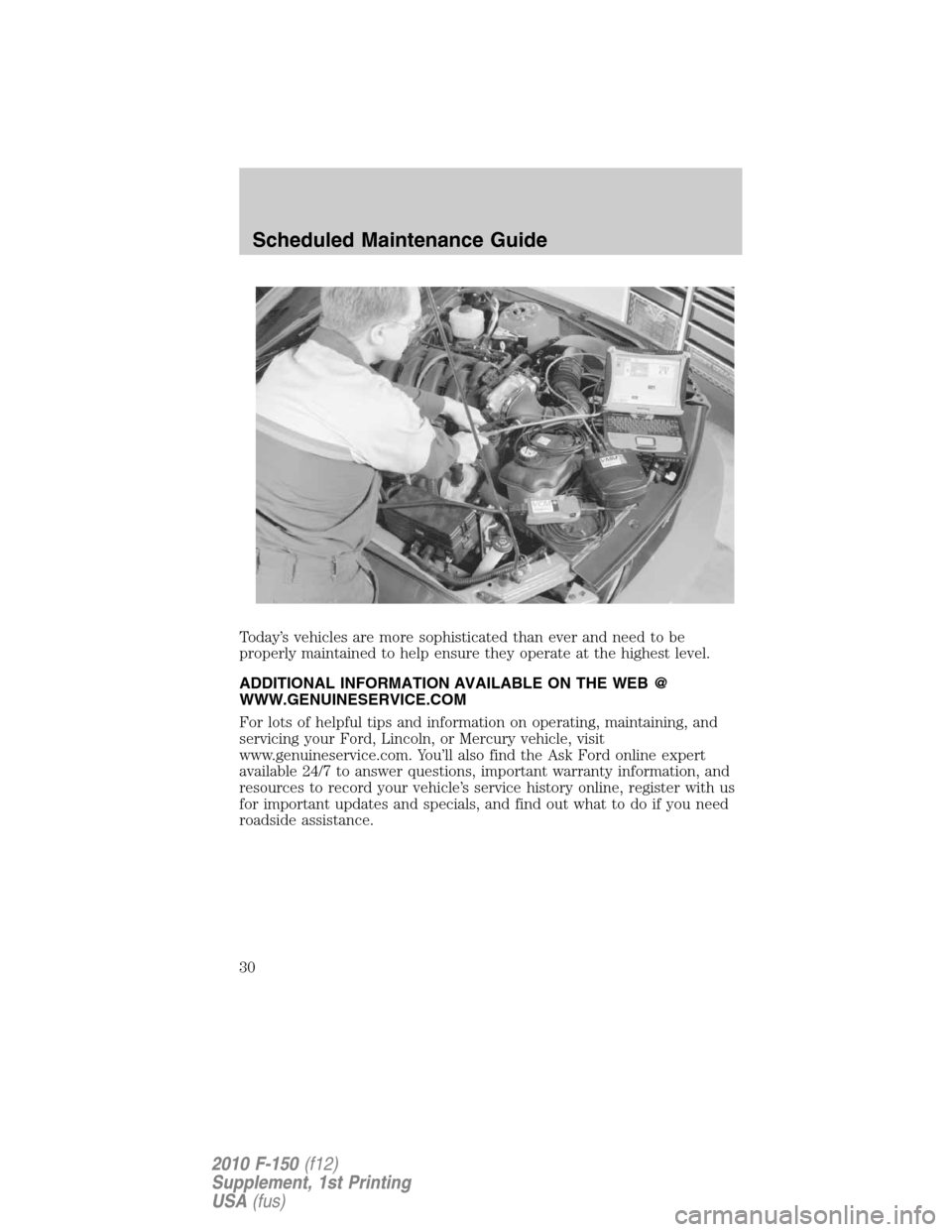
Today’s vehicles are more sophisticated than ever and need to be
properly maintained to help ensure they operate at the highest level.
ADDITIONAL INFORMATION AVAILABLE ON THE WEB @
WWW.GENUINESERVICE.COM
For lots of helpful tips and information on operating, maintaining, and
servicing your Ford, Lincoln, or Mercury vehicle, visit
www.genuineservice.com. You’ll also find the Ask Ford online expert
available 24/7 to answer questions, important warranty information, and
resources to record your vehicle’s service history online, register with us
for important updates and specials, and find out what to do if you need
roadside assistance.
Scheduled Maintenance Guide
30
2010 F-150(f12)
Supplement, 1st Printing
USA(fus)
Page 31 of 57
GET THE MOST FROM YOUR VEHICLE WITH ROUTINE
MAINTENANCE
Routine maintenance is the best way to help ensure you get the
performance, dependability, long life and resale value you expect from
your vehicle. This is exactly why we’ve put together the Scheduled
Maintenance Guide. It outlines the services required to properly maintain
your vehicle and when they should be performed. The focus is on
maintaining your vehicle while it’s running great, which goes a long way
toward preventing major repairs and expenses later.
Here are a few suggestions to help you get started on the road to routine
maintenance:
•Familiarize yourself with your vehicle by going through yourOwner’s
Guide
•Take a few minutes to review this handy Scheduled Maintenance
Guide
•Make it a habit to use this guide to record scheduled maintenance
•Consider your Ford and Lincoln Mercury Dealership for all your
vehicle’s needs
PROTECT YOUR WARRANTY!
Routine maintenance is not only the best way to help keep your vehicle
running great, it’s also the best way to protect your warranty. While
maintenance and repair services may be performed by you or by any
automotive service provider you choose, it is your responsibility to see
that all scheduled maintenance is performed and that the materials used
meet Ford Engineering specifications. Failure to perform scheduled
maintenance specified in this guide will invalidate warranty coverage on
parts affected by the lack of maintenance. We can’t stress enough how
important it is to keep records of all maintenance. This guide will help
you do just that. Ford Motor Company will not deny a warranty claim
simply because there is no documentation.However, damage or
failures due to neglect or a lack of proper maintenance are not
covered under warranty.
Scheduled Maintenance Guide
31
2010 F-150(f12)
Supplement, 1st Printing
USA(fus)
Page 32 of 57
KEEPING MAINTENANCE RECORDS IS EASY WITH THE
SCHEDULED MAINTENANCE GUIDE
It’s important to document the maintenance of your vehicle. Every time
you bring your vehicle in for scheduled maintenance, be sure to present
this guide and certify the work. Also record the date of service, mileage
at the time of service, and attach your receipt. This will make record
keeping easy and, should your vehicle ever require warranty coverage,
you will have all the documentation to show you’ve properly maintained
it.
MAINTENANCE INTERVAL
Ford Motor Company establishes recommended maintenance intervals
based upon engineering testing to determine the most appropriate
mileage to perform the various maintenance services. This protects your
vehicle at the lowest overall cost to you. Ford Motor Company
recommends that you not deviate from the maintenance schedules
presented in this Scheduled Maintenance Guide.
DETERMINE WHICH MAINTENANCE SCHEDULE TO FOLLOW
It’s important to follow the maintenance schedule that most closely
mirrors your driving habits and the conditions under which you drive.
For this reason, the Scheduled Maintenance Guide is divided into two
basic maintenance schedules: theNormal Schedule(further segmented
intoTrucks, Fullsize Vans & SUVsandCars & CUVs) andSpecial
Operating Conditions
Determining which maintenance schedule is right for you is easy. For the
most part, do you drive your Ford, Lincoln or Mercury vehicle under
typical, everyday conditions? If so, follow theNormal Schedule Trucks,
Fullsize Vans & SUVs,orNormal Schedule Cars & CUVs.
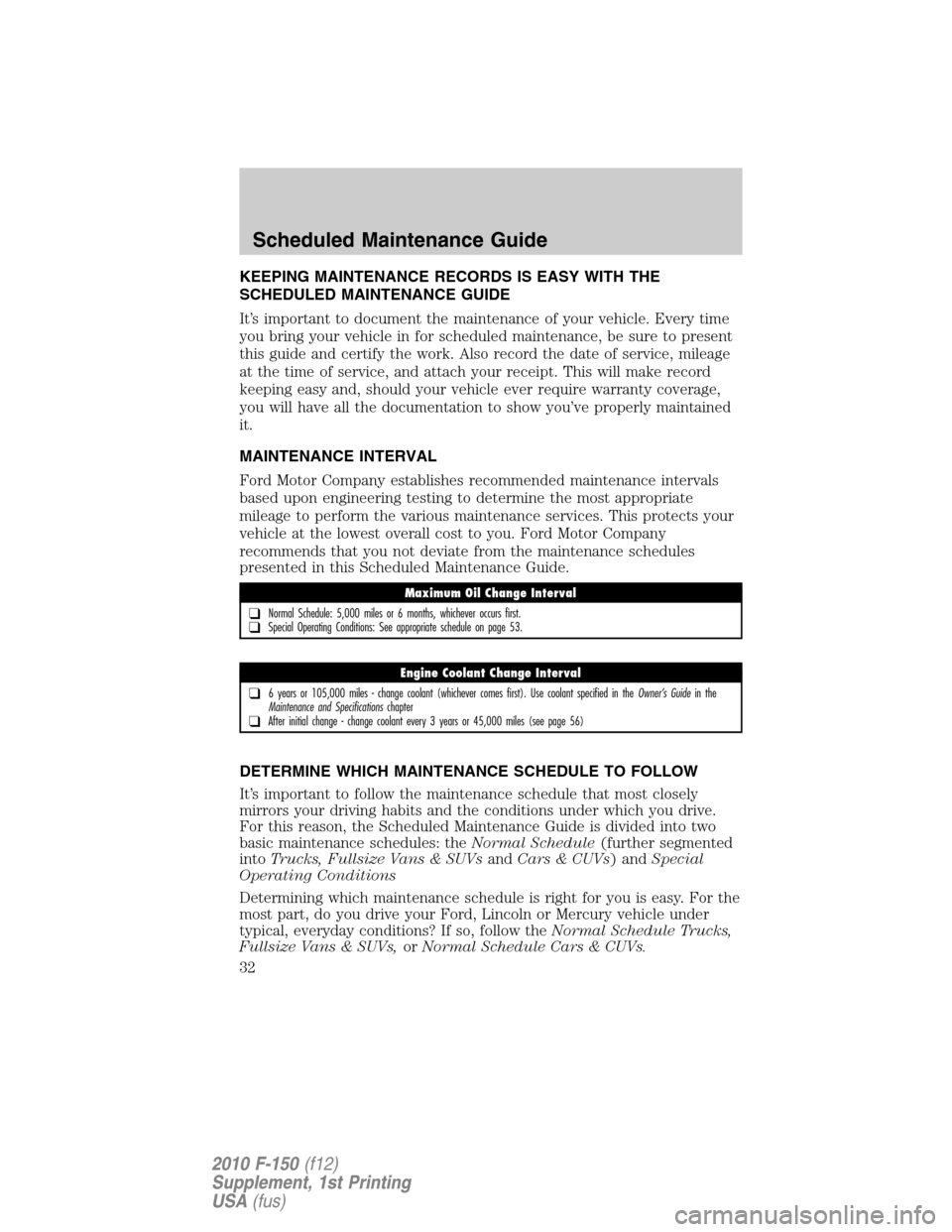
Maximum Oil Change Interval
❑Normal Schedule: 5,000 miles or 6 months, whichever occurs first.❑Special Operating Conditions: See appropriate schedule on page 53.
Engine Coolant Change Interval
❑6 years or 105,000 miles - change coolant (whichever comes first). Use coolant specified in theOwner’s Guidein theMaintenance and Specificationschapter❑After initial change - change coolant every 3 years or 45,000 miles (see page 56)
Scheduled Maintenance Guide
32
2010 F-150(f12)
Supplement, 1st Printing
USA(fus)