2010 FORD F150 warning
[x] Cancel search: warningPage 166 of 419

•Push the indicated side of the
control for minimum heat.
•Push again to deactivate.
The heated seat module resets at every ignition run cycle. While the
ignition is in the on position, activating the high or low heated seat
switch enables heating mode. When activated, they will turn off
automatically when the engine is turned off.
The indicator light will illuminate when the heated seats have been
activated.
SAFETY RESTRAINTS
Personal Safety System™
The Personal Safety System™ provides an improved overall level of
frontal crash protection to front seat occupants and is designed to help
further reduce the risk of airbag-related injuries. The system is able to
analyze different occupant classifications and conditions and crash
severity before activating the appropriate safety devices to help better
protect a range of occupants in a variety of frontal crash situations.
Your vehicle’s Personal Safety System™ consists of:
•Driver and passenger dual-stage airbag supplemental restraints.
•Front outboard safety belts with pretensioners, energy management
retractors, and safety belt usage sensors.
•Driver’s seat position sensor.
•Front crash severity sensor.
•Front passenger sensing system
•Passenger Airbag Off indicator light.
•Restraints Control Module (RCM) with impact and safing sensors.
•Restraint system warning light and back-up tone.
•The electrical wiring for the airbags, crash sensor(s), safety belt
pretensioners, front safety belt usage sensors, driver seat position
sensor, and indicator lights.
Seating and Safety Restraints
166
2010 F-150(f12)
Owners Guide, 1st Printing
USA(fus)
Page 168 of 419

in rear-facing child seats, this occurs because they are initially sitting
very close to the airbag. For other occupants, this occurs when the
occupant is not properly restrained by safety belts or child safety seats
and they move forward during pre-crash braking. The most effective way
to reduce the risk of unnecessary injuries is to make sure all occupants
are properly restrained. Accident statistics suggest that children are
much safer when properly restrained in the rear seating positions than in
the front.
WARNING:Air bags can kill or injure a child in a child seat.
NEVERplace a rear-facing child seat in front of an active air
bag. If you must use a forward-facing child seat in the front seat, move
the seat all the way back.
WARNING:Always transport children 12 years old and under in
the back seat and always properly use appropriate child
restraints.
WARNING:When possible, all children 12 years old and under
should be properly restrained in a rear seating position.
The front passenger sensing system can automatically turn off the
passenger front airbag when a rear facing child seat, a forward-facing
child restraint, or a booster seat is detected. Even with this technology,
parents areSTRONGLYencouraged to always properly restrain children
in the rear seat. The sensor also turns off the passenger front airbag and
passenger seat-mounted side airbag when the passenger seat is empty.
When the front passenger seat is occupied and the sensing system has
turned off the passenger’s frontal airbag, the “pass airbag off” indicator
will light and stay lit to remind you that the front passenger frontal
airbag is off. SeeFront passenger sensing systemin theAirbag
supplemental restraint system (SRS)section of this chapter.
Front safety belt usage sensors
The front safety belt usage sensors detect whether or not the driver and
front outboard passenger safety belts are fastened. This information
allows your Personal Safety System™ to tailor the airbag deployment
and safety belt pretensioner activation depending upon safety belt usage.
Refer toSafety belt usage sensorslater in this chapter.
Seating and Safety Restraints
168
2010 F-150(f12)
Owners Guide, 1st Printing
USA(fus)
Page 169 of 419

Front outboard safety belt pretensioners
The safety belt pretensioners at the front outboard seating positions are
designed to tighten the safety belts firmly against the occupant’s body
during frontal collisions, and in side collisions and rollovers. This helps
increase the effectiveness of the safety belts. In frontal collisions, the
safety belt pretensioners can be activated alone or, if the collision is of
sufficient severity, together with the front airbags.
Front outboard safety belt energy management retractors
The front outboard safety belt energy management retractors allow
webbing to be pulled out of the retractor in a gradual and controlled
manner in response to the occupant’s forward momentum. This helps
reduce the risk of force-related injuries to the occupant’s chest by
limiting the load on the occupant. Refer toEnergy management
retractorssection in this chapter.
Determining if the Personal Safety System™ is operational
The Personal Safety System™ uses a warning light in the instrument
cluster or a back-up tone to indicate the condition of the system. Refer
to theWarning lights and chimessection in theInstrument Cluster
chapter. Routine maintenance of the Personal Safety System™ is not
required.
The Restraints Control Module (RCM) monitors its own internal circuits
and the circuits for the airbag supplemental restraints, crash sensor(s),
safety belt pretensioners, front safety belt buckle sensors, and the driver
seat position sensor. In addition, the RCM also monitors the restraints
warning light in the instrument cluster. A difficulty with the system is
indicated by one or more of the following.
•The warning light will either flash or stay lit.
•The warning light will not illuminate immediately after ignition is
turned on.
•A series of five beeps will be heard. The tone pattern will repeat
periodically until the problem and warning light are repaired.
If any of these things happen, even intermittently, have the Personal
Safety System™ serviced at an authorized dealer immediately. Unless
serviced, the system may not function properly in the event of a
collision.
Seating and Safety Restraints
169
2010 F-150(f12)
Owners Guide, 1st Printing
USA(fus)
Page 170 of 419
Safety restraints precautions
WARNING:Always drive and ride with your seatback upright
and the lap belt snug and low across the hips.
WARNING:To reduce the risk of injury, make sure children sit
in a rear seating position where they can be properly restrained.
WARNING:Never let a passenger hold a child on his or her lap
while the vehicle is moving. The passenger cannot protect the
child from injury in a collision.
WARNING:All occupants of the vehicle, including the driver,
should always properly wear their safety belts, even when an
airbag supplemental restraint system (SRS) is provided.
WARNING:It is extremely dangerous to ride in a cargo area,
inside or outside of a vehicle. In a collision, people riding in
these areas are more likely to be seriously injured or killed. Do not
allow people to ride in any area of your vehicle that is not equipped
with seats and safety belts. Be sure everyone in your vehicle is in a
seat and using a safety belt properly.
WARNING:In a rollover crash, an unbelted person is
significantly more likely to die than a person wearing a safety
belt.
WARNING:Each seating position in your vehicle has a specific
safety belt assembly which is made up of one buckle and one
tongue that are designed to be used as a pair. 1) Use the shoulder belt
on the outside shoulder only. Never wear the shoulder belt under the
arm. 2) Never swing the safety belt around your neck over the inside
shoulder. 3) Never use a single belt for more than one person.
WARNING:When possible, all children 12 years old and under
should be properly restrained in a rear seating position.
Seating and Safety Restraints
170
2010 F-150(f12)
Owners Guide, 1st Printing
USA(fus)
Page 171 of 419
WARNING:Safety belts and seats can become hot in a vehicle
that has been closed up in sunny weather; they could burn a
small child. Check seat covers and buckles before you place a child
anywhere near them.
WARNING:Front and rear seat occupants, including pregnant
women, should wear safety belts for optimum protection in an
accident.
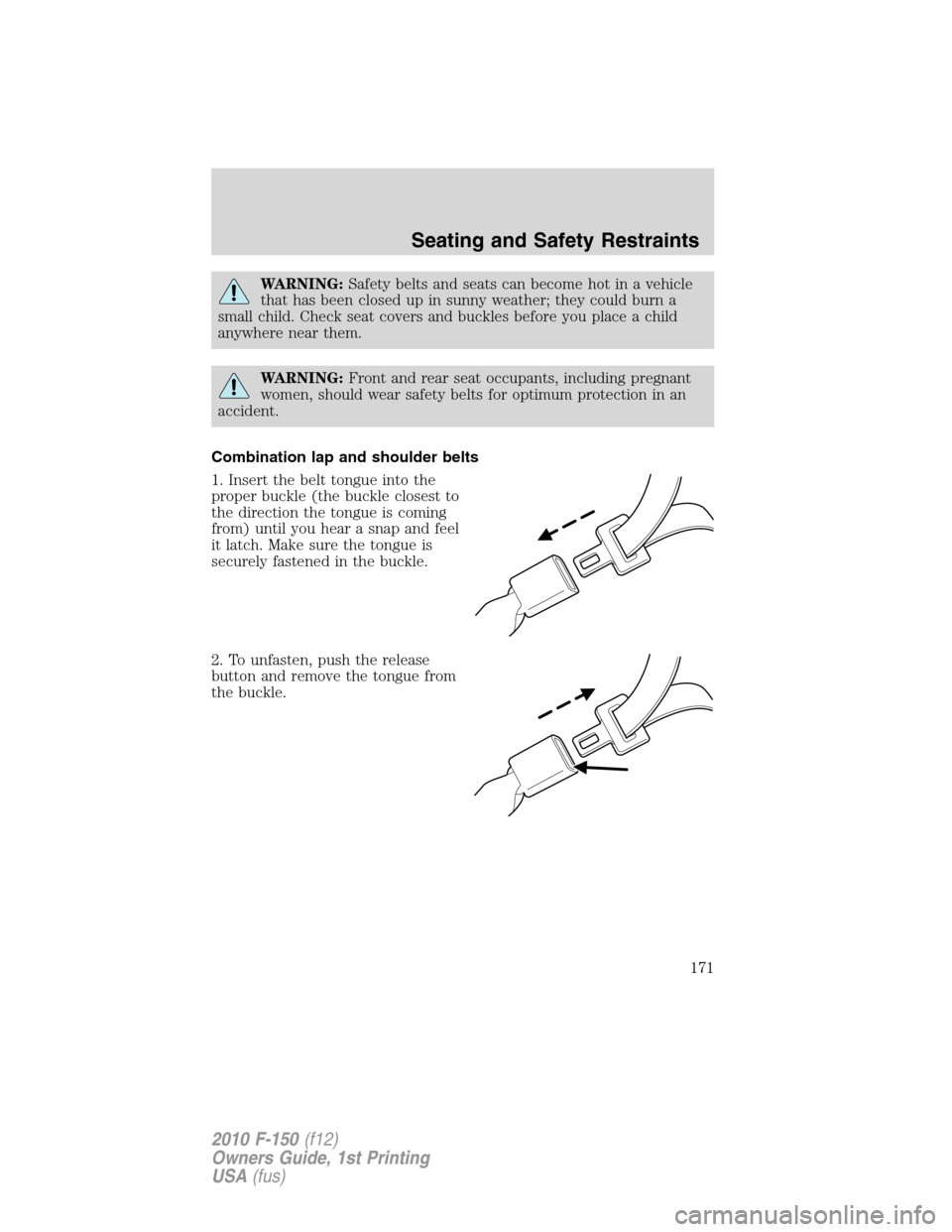
Combination lap and shoulder belts
1. Insert the belt tongue into the
proper buckle (the buckle closest to
the direction the tongue is coming
from) until you hear a snap and feel
it latch. Make sure the tongue is
securely fastened in the buckle.
2. To unfasten, push the release
button and remove the tongue from
the buckle.
Seating and Safety Restraints
171
2010 F-150(f12)
Owners Guide, 1st Printing
USA(fus)
Page 172 of 419
Regular Cab Center front safety belt
WARNING:Always use both lap and shoulder safety belt in the
Regular Cab center seating position.
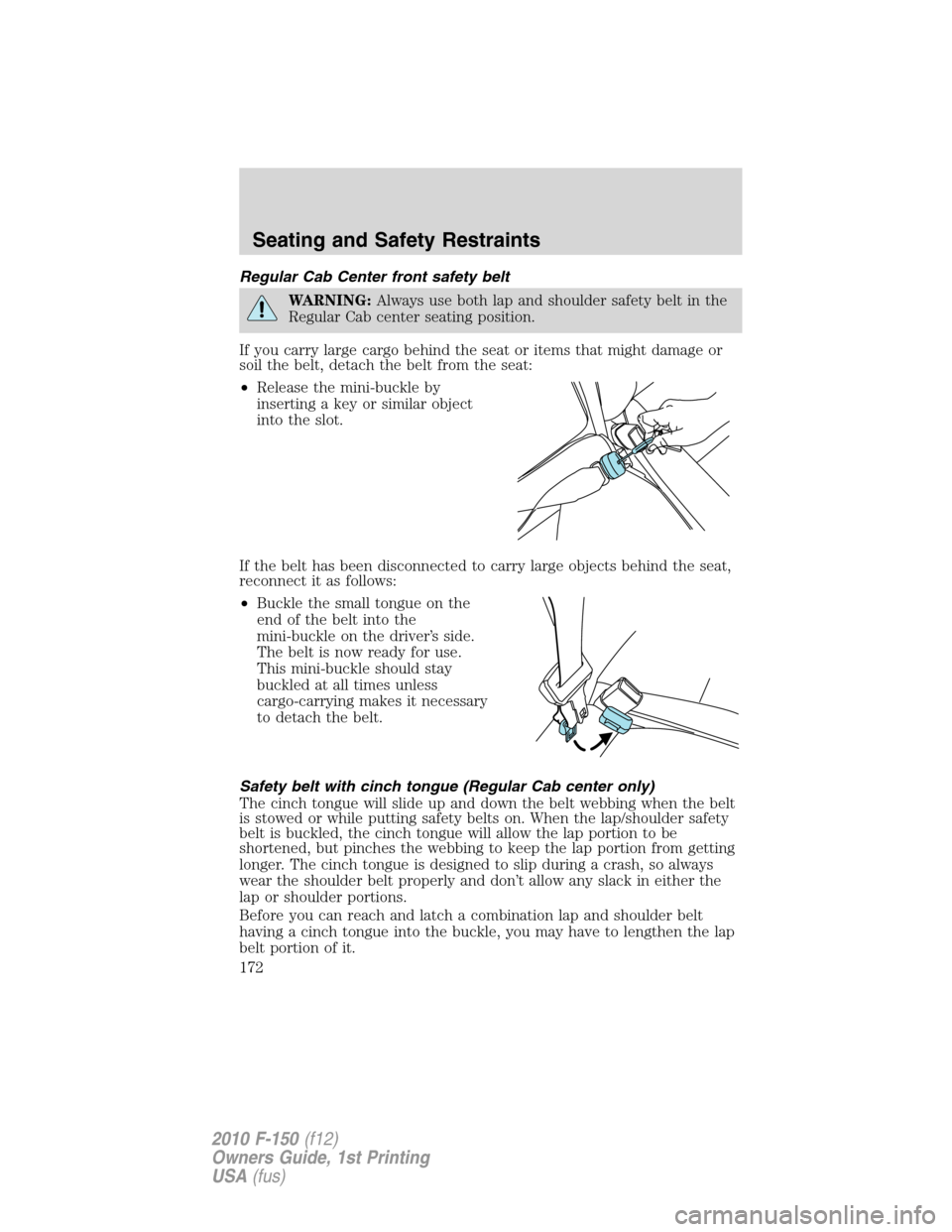
If you carry large cargo behind the seat or items that might damage or
soil the belt, detach the belt from the seat:
•Release the mini-buckle by
inserting a key or similar object
into the slot.
If the belt has been disconnected to carry large objects behind the seat,
reconnect it as follows:
•Buckle the small tongue on the
end of the belt into the
mini-buckle on the driver’s side.
The belt is now ready for use.
This mini-buckle should stay
buckled at all times unless
cargo-carrying makes it necessary
to detach the belt.
Safety belt with cinch tongue (Regular Cab center only)
The cinch tongue will slide up and down the belt webbing when the belt
is stowed or while putting safety belts on. When the lap/shoulder safety
belt is buckled, the cinch tongue will allow the lap portion to be
shortened, but pinches the webbing to keep the lap portion from getting
longer. The cinch tongue is designed to slip during a crash, so always
wear the shoulder belt properly and don’t allow any slack in either the
lap or shoulder portions.
Before you can reach and latch a combination lap and shoulder belt
having a cinch tongue into the buckle, you may have to lengthen the lap
belt portion of it.
Seating and Safety Restraints
172
2010 F-150(f12)
Owners Guide, 1st Printing
USA(fus)
Page 173 of 419
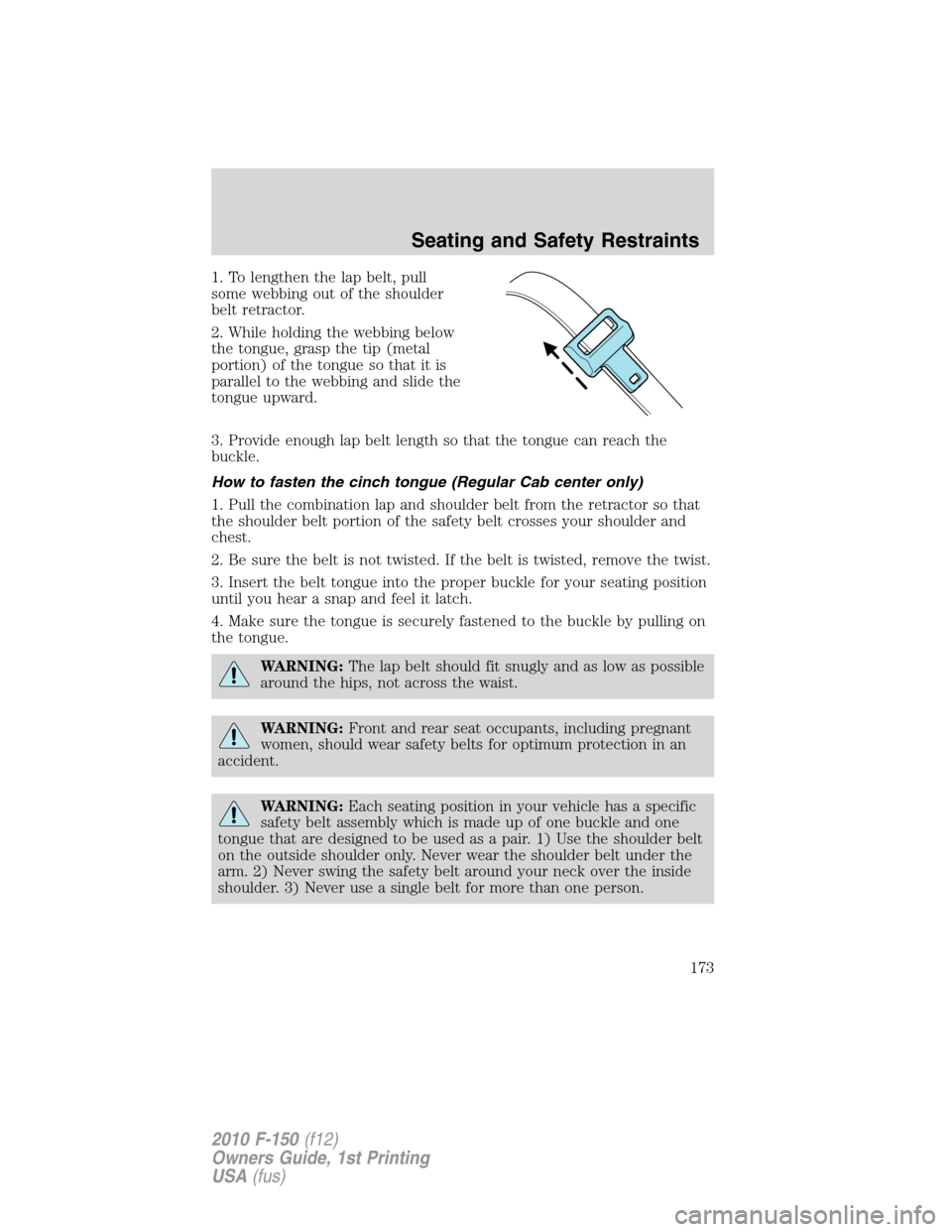
1. To lengthen the lap belt, pull
some webbing out of the shoulder
belt retractor.
2. While holding the webbing below
the tongue, grasp the tip (metal
portion) of the tongue so that it is
parallel to the webbing and slide the
tongue upward.
3. Provide enough lap belt length so that the tongue can reach the
buckle.
How to fasten the cinch tongue (Regular Cab center only)
1. Pull the combination lap and shoulder belt from the retractor so that
the shoulder belt portion of the safety belt crosses your shoulder and
chest.
2. Be sure the belt is not twisted. If the belt is twisted, remove the twist.
3. Insert the belt tongue into the proper buckle for your seating position
until you hear a snap and feel it latch.
4. Make sure the tongue is securely fastened to the buckle by pulling on
the tongue.
WARNING:The lap belt should fit snugly and as low as possible
around the hips, not across the waist.
WARNING:Front and rear seat occupants, including pregnant
women, should wear safety belts for optimum protection in an
accident.
WARNING:Each seating position in your vehicle has a specific
safety belt assembly which is made up of one buckle and one
tongue that are designed to be used as a pair. 1) Use the shoulder belt
on the outside shoulder only. Never wear the shoulder belt under the
arm. 2) Never swing the safety belt around your neck over the inside
shoulder. 3) Never use a single belt for more than one person.
Seating and Safety Restraints
173
2010 F-150(f12)
Owners Guide, 1st Printing
USA(fus)
Page 174 of 419
While you are fastened in the safety belt, the combination lap/shoulder
belt with a cinch tongue adjusts to your movement. However, if you
brake hard, turn hard, or if your vehicle receives an impact of 5 mph
(8 km/h) or more, the safety belt will become locked and help reduce
your forward movement.
Lap belts
Adjusting the lap belt
(Front center seat position SuperCab and SuperCrew only)
WARNING:The lap belt should fit snugly and as low as possible
around the hips, not across the waist.
The front center lap belt tongue is designed to fit only in the correct
buckle. The tongue will not securely latch if you attempt to use it in any
of the outboard seating position buckles. To ensure that you have used
the correct buckle you should hear a snap and feel it latch.
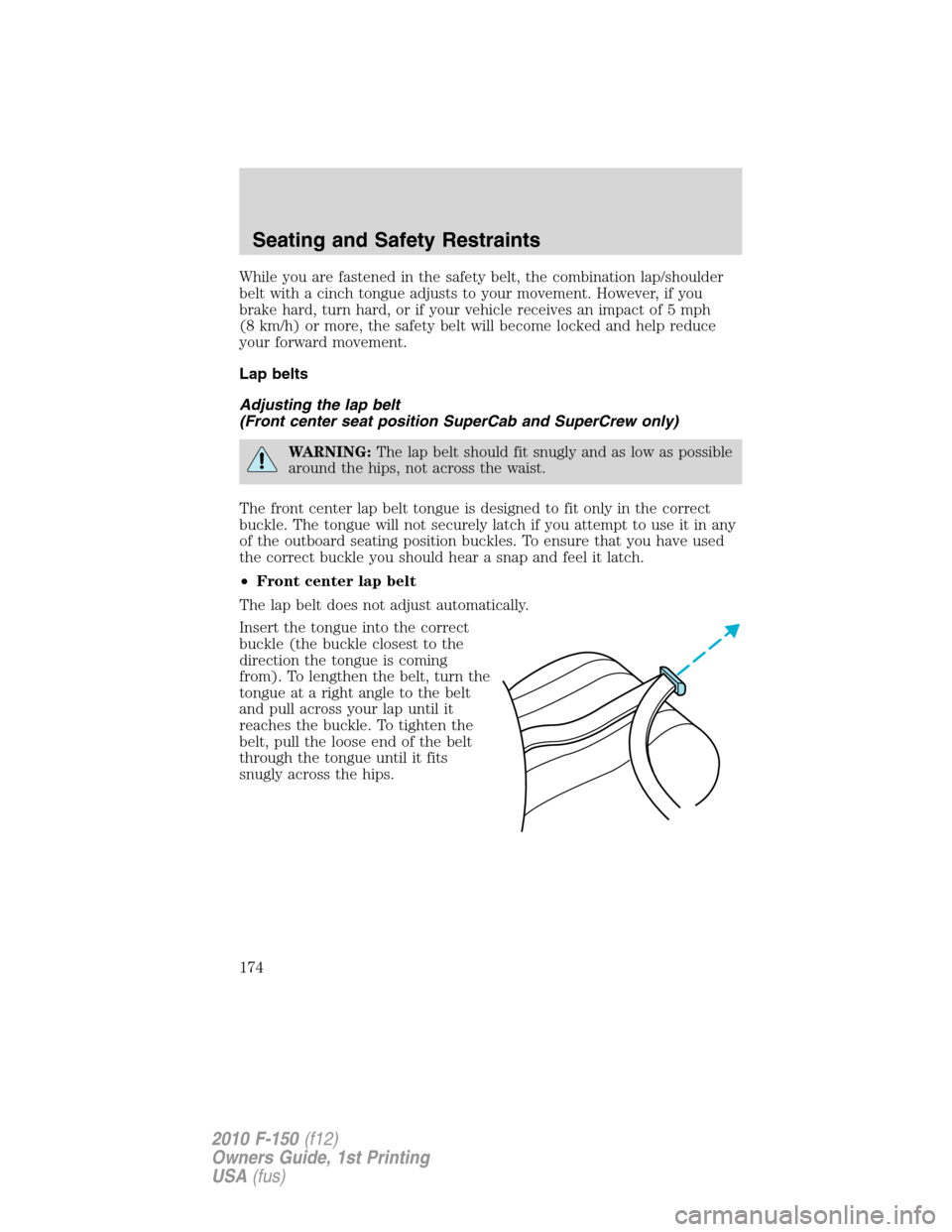
•Front center lap belt
The lap belt does not adjust automatically.
Insert the tongue into the correct
buckle (the buckle closest to the
direction the tongue is coming
from). To lengthen the belt, turn the
tongue at a right angle to the belt
and pull across your lap until it
reaches the buckle. To tighten the
belt, pull the loose end of the belt
through the tongue until it fits
snugly across the hips.
Seating and Safety Restraints
174
2010 F-150(f12)
Owners Guide, 1st Printing
USA(fus)