2010 FORD EXPLORER cooling
[x] Cancel search: coolingPage 364 of 404
WARNING:To reduce the risk of personal injury, make sure the
engine is cool before unscrewing the coolant pressure relief cap.
The cooling system is under pressure; steam and hot liquid can come
out forcefully when the cap is loosened slightly.
Add the proper mixture of coolant and water to the cooling system by
following these steps:
1. Before you begin, turn the engine off and let it cool.
2. When the engine is cool, wrap a thick cloth around the coolant
pressure relief cap on the coolant reservoir (a translucent plastic bottle).
Slowly turn cap counterclockwise (left) until pressure begins to release.
3. Step back while the pressure releases.
4. When you are sure that all the pressure has been released, use the
cloth to turn it counterclockwise and remove the cap.
5. Fill the coolant reservoir slowly with the proper coolant mixture, to
within the COLD FILL RANGE or the FULL COLD level on the reservoir.
If you removed the radiator cap in an overflow system, fill the radiator
until the coolant is visible and radiator is almost full.
6. Replace the cap. Turn until tightly installed. Cap must be tightly
installed to prevent coolant loss.
After any coolant has been added, check the coolant concentration (refer
toChecking engine coolant). If the concentration is not 50/50
(protection to –34°F/–36°C), drain some coolant and adjust the
concentration. It may take several drains and additions to obtain a 50/50
coolant concentration.
Whenever coolant has been added, the coolant level in the coolant
reservoir should be checked the next few times you drive the vehicle. If
necessary, add enough 50/50 concentration of engine coolant and
distilled water to bring the liquid level to the proper level.
If you have to add more than 1.0 quart (1.0 liter) of engine coolant per
month, have your authorized dealer check the engine cooling system.
Your cooling system may have a leak. Operating an engine with a low
level of coolant can result in engine overheating and possible engine
damage.
Recycled engine coolant
Ford Motor Company does NOT recommend the use of recycled engine
coolant since a Ford-approved recycling process is not yet available.
Maintenance and Specifications
364
2010 Explorer(exp)
Owners Guide(own2002), 1st Printing
USA(fus)
Page 365 of 404

Used engine coolant should be disposed of in an appropriate
manner. Follow your community’s regulations and standards for recycling
and disposing of automotive fluids.
Coolant refill capacity
To find out how much fluid your vehicle’s cooling system can hold, refer
toMaintenance product specifications and capacitiesin this chapter.
Fill your engine coolant reservoir as outlined inAdding engine coolant
in this section.
Severe climates
If you drive in extremely cold climates (less than –34°F [–36°C]):
•It may be necessary to increase the coolant concentration
above 50%.
•NEVER increase the coolant concentration above 60%.
•Increased engine coolant concentrations above 60% will
decrease the overheat protection characteristics of the engine
coolant and may cause engine damage.
•Refer to the chart on the coolant container to ensure the
coolant concentration in your vehicle will provide adequate
freeze protection at the temperatures in which you drive in the
winter months.
If you drive in extremely hot climates:
•It is still necessary to maintain the coolant concentration
above 40%.
•NEVER decrease the coolant concentration below 40%.
•Decreased engine coolant concentrations below 40% will
decrease the corrosion protection characteristics of the engine
coolant and may cause engine damage.
•Decreased engine coolant concentrations below 40% will
decrease the freeze protection characteristics of the engine
coolant and may cause engine damage.
•Refer to the chart on the coolant container to ensure the
coolant concentration in your vehicle will provide adequate
protection at the temperatures in which you drive.
Vehicles driven year-round in non-extreme climates should use a 50/50
mixture of engine coolant and distilled water for optimum cooling system
and engine protection.
Maintenance and Specifications
365
2010 Explorer(exp)
Owners Guide(own2002), 1st Printing
USA(fus)
Page 366 of 404
What you should know about fail-safe cooling
(4.6L V8 engine only)
If the engine coolant supply is depleted, this feature allows the vehicle to
be driven temporarily before incremental component damage is incurred.
The “fail-safe” distance depends on ambient temperatures, vehicle load
and terrain.
Fail-safe cooling and engine oil overheat mode (4.6L V8 only)
If the engine coolant and/or engine oil overheat, the vehicle’s fail-safe
modes will reduce engine power to limit engine damage, even with a
total loss of coolant. The vehicle’s range and/or speed will be reduced,
depending on vehicle load, terrain, and outside temperatures.
The instrument cluster provides warnings for each mode.
•Fail-Safe Cooling Mode:The
(Service engine
soon),
(Engine oil pressure), and(Engine coolant
temperature) indicators will be on.
Along with these warning indicators, the engine coolant temperature
gauge will read in the Hot (H) area.
If the engine coolant reaches even hotter temperatures, fail-safe
cooling mode limits engine power more and disables air conditioning.
The engine will switch to alternating cylinder operation to help cool
the engine. The engine will run rough in this mode.
If continued operation increases the engine coolant temperature to a
critical range, the engine will shut down. Steering and braking effort
will increase. Once engine coolant temperature cools, the engine can
be restarted.
•Engine Oil Overheat Mode:The
(Engine coolant temperature)
indicator will be on. The instrument cluster has no separate oil
temperature indicator.
Along with the
(Engine coolant temperature) indicator, the engine
coolant temperature gauge will read in the Hot (H) area.
Oil overheat can be triggered in severe driving conditions, such as
towing heavy loads over mountainous terrain in extreme hot
temperatures. As oil temperature increases, engine and vehicle speed
will be limited. The transmission will also shift differently.
When the engine oil has cooled, the vehicle will perform normally.
Maintenance and Specifications
366
2010 Explorer(exp)
Owners Guide(own2002), 1st Printing
USA(fus)
Page 367 of 404
When fail-safe cooling mode is activated
You have limited engine power when in the fail-safe mode, so drive the
vehicle with caution. Remember that the engine is capable of completely
shutting down automatically to prevent engine damage, therefore:
1. Pull off the road as soon as safely possible and turn off the engine.
2. Arrange for the vehicle to be taken to an authorized dealer.
3. If this is not possible, wait approximately 15 minutes for the engine to
cool.
4. Check the coolant level and replenish if low. Look for coolant leakage
in the engine compartment and under the vehicle.
WARNING:Never remove the coolant reservoir cap while the
engine is running or hot.
5. Restart the engine and take your vehicle to an authorized dealer.
Driving the vehicle without repairing the engine problem
increases the chance of engine damage. Take your vehicle to an
authorized dealer as soon as possible.
FUEL FILTER
For fuel filter replacement, see your authorized dealer. Refer to
scheduled maintenance informationfor the appropriate intervals for
changing the fuel filter.
Replace the fuel filter with an authorized Motorcraft part. The
customer warranty may be void for any damage to the fuel system
if an authorized Motorcraft fuel filter is not used.
WHAT YOU SHOULD KNOW ABOUT AUTOMOTIVE FUELS
Important safety precautions
WARNING:Do not overfill the fuel tank. The pressure in an
overfilled tank may cause leakage and lead to fuel spray and fire.
WARNING:The fuel system may be under pressure. If you hear
a hissing sound near the fuel filler door (Easy Fuel™ “no cap”
fuel system), do not refuel until the sound stops. Otherwise, fuel may
spray out, which could cause serious personal injury.
Maintenance and Specifications
367
2010 Explorer(exp)
Owners Guide(own2002), 1st Printing
USA(fus)
Page 386 of 404
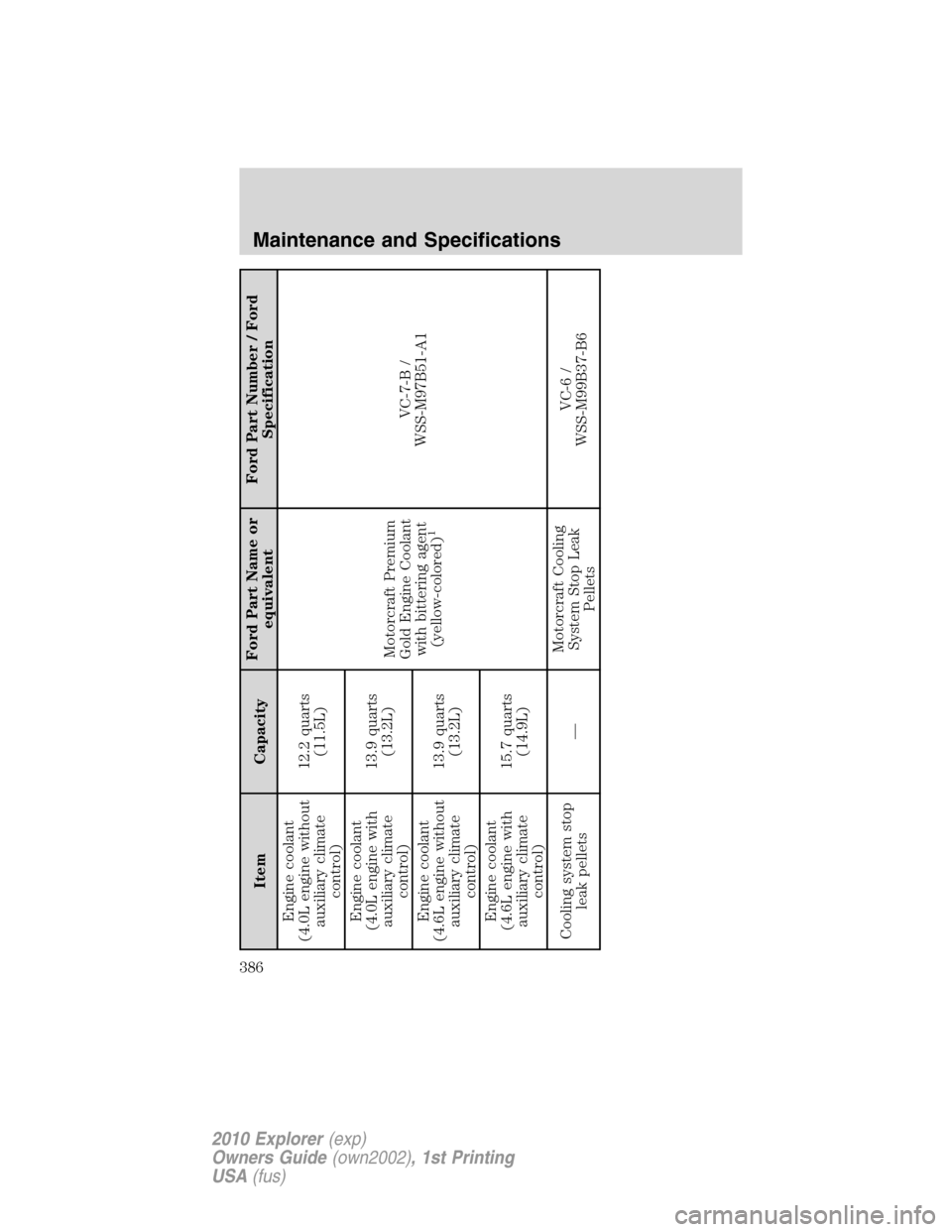
Item CapacityFord Part Name or
equivalentFord Part Number / Ford
Specification
Engine coolant
(4.0L engine without
auxiliary climate
control)12.2 quarts
(11.5L)
Motorcraft Premium
Gold Engine Coolant
with bittering agent
(yellow-colored)
1
VC-7-B /
WSS-M97B51-A1 Engine coolant
(4.0L engine with
auxiliary climate
control)13.9 quarts
(13.2L)
Engine coolant
(4.6L engine without
auxiliary climate
control)13.9 quarts
(13.2L)
Engine coolant
(4.6L engine with
auxiliary climate
control)15.7 quarts
(14.9L)
Cooling system stop
leak pellets—Motorcraft Cooling
System Stop Leak
PelletsVC-6 /
WSS-M99B37-B6
Maintenance and Specifications
386
2010 Explorer(exp)
Owners Guide(own2002), 1st Printing
USA(fus)
Page 399 of 404

Child safety seats - booster
seats ...........................................229
Cleaning your vehicle
engine compartment ..............342
instrument panel ....................344
interior .....................................345
plastic parts ............................343
washing ....................................340
waxing .....................................341
wheels ......................................341
wiper blades ............................343
Climate control (see Air
conditioning or Heating) ..........101
Clock adjust
6-CD in dash .............................52
AM/FM/CD .................................45
Compass, electronic
calibration .................................27
set zone adjustment ...........27, 36
Console ..............................120–121
overhead ..................................119
rear ..........................................121
Controls
power seat ...............................170
steering column ......................130
Coolant
checking and adding ..............361
refill capacities ................365, 385
specifications ..........................385
Cruise control
(see Speed control) ..................128
Customer Assistance ................305
Ford Extended Service
Plan ..........................................395
Getting assistance outside the
U.S. and Canada .....................337
Getting roadside assistance ...305
Getting the service you
need .........................................333Ordering additional owner’s
literature .................................338
Utilizing the
Mediation/Arbitration
Program ...................................337
D
Daytime running lamps
(see Lamps) ..............................107
Defrost
rear window ............................105
Dipstick
automatic transmission
fluid ..........................................380
engine oil .................................354
Driveline universal joint and
slip yoke ....................................382
Driving under special
conditions ..................291, 298, 302
sand .........................................300
snow and ice ...........................303
through water .................301, 304
Dual automatic temperature
control (DATC) .........................101
DVD system .................................66
E
Electronic message center ...21, 30
Emergencies, roadside
jump-starting ..........................325
running out of fuel .........325, 372
Emergency Flashers .................306
Emission control system ..........377
Engine ........................................390
cleaning ...................................342
coolant .....................................361
fail-safe cooling .......................366
Index
399
2010 Explorer(exp)
Owners Guide(own2002), 1st Printing
USA(fus)
Page 400 of 404

idle speed control ...................359
lubrication specifications .......385
refill capacities ........................385
service points ..................350–351
starting after a collision .........307
Engine block heater .................274
Engine oil ..................................354
checking and adding ..............354
dipstick ....................................354
filter, specifications ........357, 384
recommendations ...................357
refill capacities ........................385
specifications ..........................385
Event data recording ....................7
Exhaust fumes ..........................273
F
Fail safe cooling ........................366
Family entertainment system ....66
Fluid capacities .........................385
Fog lamps ..................................107
Four-Wheel Drive vehicles .......294
driving off road .......................296
indicator light .........................294
preparing to drive your
vehicle .....................................284
Fuel ............................................367
calculating fuel
economy ......................27, 32, 374
cap ...........................................370
capacity ...................................385
choosing the right fuel ...........371
comparisons with EPA fuel
economy estimates .................377
detergent in fuel .....................372
filler funnel .............................372
filling your vehicle with
fuel ...........................367, 370, 374filter, specifications ........367, 384
fuel pump shut-off switch .....307
improving fuel economy ........374
octane rating ...................371, 390
quality ......................................372
running out of fuel .........325, 372
safety information relating to
automotive fuels .....................367
Fuses ..................................308–309
G
Garage door opener ..........120, 133
Gas cap (see Fuel cap) ............370
Gas mileage
(see Fuel economy) .................374
Gauges .........................................18
GAWR (Gross Axle Weight
Rating)
calculating ...............................262
GVWR (Gross Vehicle Weight
Rating)
calculating ...............................262
H
Hazard flashers .........................306
Headlamps .................................106
aiming ......................................108
bulb specifications ..................112
daytime running lights ...........107
flash to pass ............................108
high beam ...............................107
turning on and off ..................106
Heating
heating and air conditioning
system ...............................99, 101
Homelink wireless control
system ........................................134
Index
400
2010 Explorer(exp)
Owners Guide(own2002), 1st Printing
USA(fus)