Page 339 of 420
Tire change procedure
WARNING:To help prevent the vehicle from moving when you
change a tire, be sure the parking brake is set, then block the
wheels (both front or both rear) on the opposite end of the vehicle
from the wheel being changed. If on a grade, block both opposite
wheels on the downward side of the hill.
WARNING:If the vehicle slips off the jack, you or someone else
could be seriously injured.
WARNING:On vehicles equipped with air suspension, turn off
the Air Suspension system prior to jacking, hoisting or towing
your vehicle.
WARNING:Turn off the running boards (if equipped) before
jacking or placing any object under the vehicle. Never place your
hand between the extended running board and the vehicle. A moving
running board may cause injury.
WARNING:Do not attempt to change a tire on the side of the
vehicle close to moving traffic. Pull far enough off the road to
avoid the danger of being hit when operating the jack and changing the
wheel.
Note:Passengers should not remain in the vehicle when the vehicle is
being jacked.
If your vehicle is equipped with air suspension, refer toMessage center
in theInstrument Clusterchapter for instructions on turning the air
suspension system off.
Refer to the instruction sheet (located in the rear floor compartment
behind the 3rd row seat with the jack tray tools assembly kit) for
detailed tire change instructions.
Roadside Emergencies
339
2010 Expedition(exd)
Owners Guide(own2002), 1st Printing
USA(fus)
Page 340 of 420
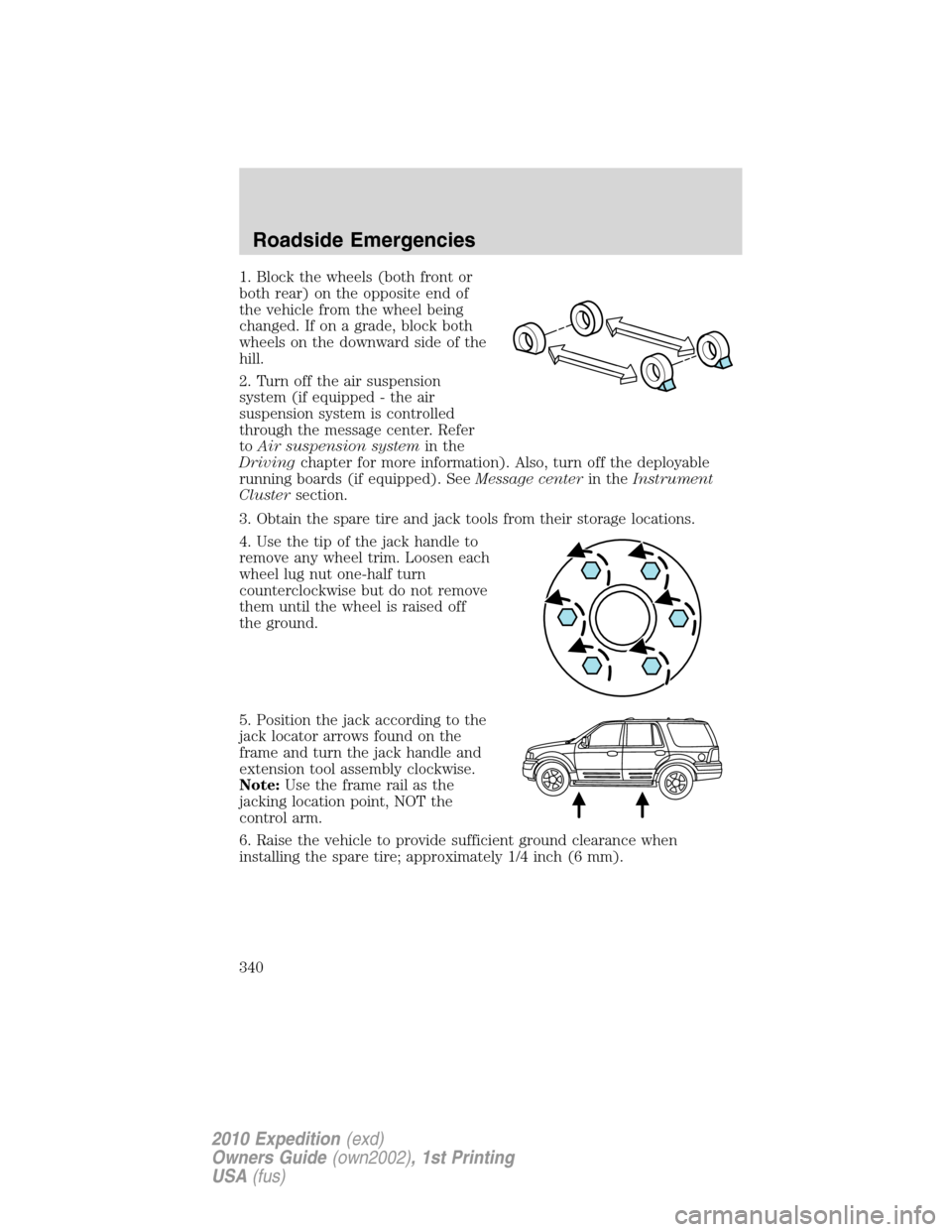
1. Block the wheels (both front or
both rear) on the opposite end of
the vehicle from the wheel being
changed. If on a grade, block both
wheels on the downward side of the
hill.
2. Turn off the air suspension
system (if equipped - the air
suspension system is controlled
through the message center. Refer
toAir suspension systemin the
Drivingchapter for more information). Also, turn off the deployable
running boards (if equipped). SeeMessage centerin theInstrument
Clustersection.
3. Obtain the spare tire and jack tools from their storage locations.
4. Use the tip of the jack handle to
remove any wheel trim. Loosen each
wheel lug nut one-half turn
counterclockwise but do not remove
them until the wheel is raised off
the ground.
5. Position the jack according to the
jack locator arrows found on the
frame and turn the jack handle and
extension tool assembly clockwise.
Note:Use the frame rail as the
jacking location point, NOT the
control arm.
6. Raise the vehicle to provide sufficient ground clearance when
installing the spare tire; approximately 1/4 inch (6 mm).
Roadside Emergencies
340
2010 Expedition(exd)
Owners Guide(own2002), 1st Printing
USA(fus)
Page 342 of 420
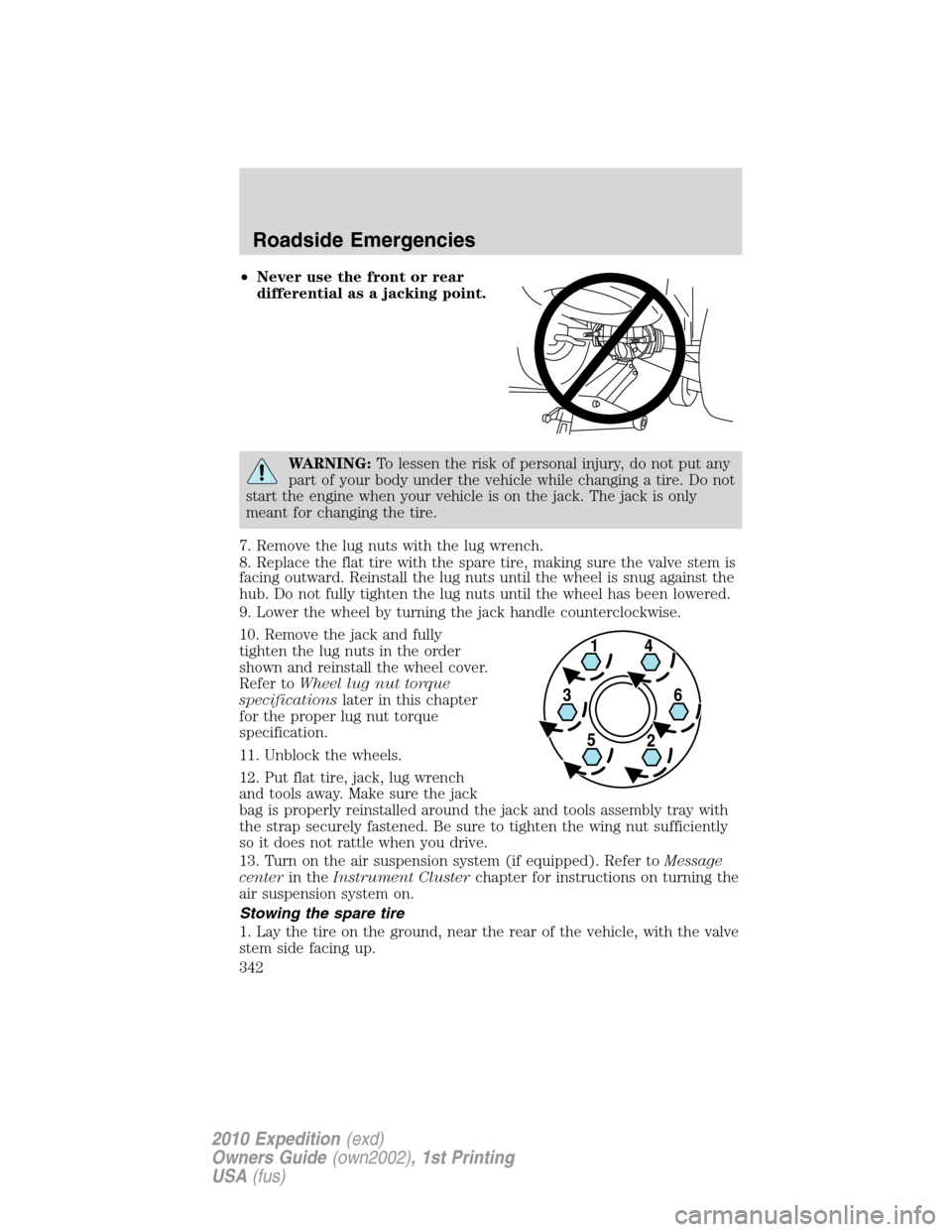
•Never use the front or rear
differential as a jacking point.
WARNING:To lessen the risk of personal injury, do not put any
part of your body under the vehicle while changing a tire. Do not
start the engine when your vehicle is on the jack. The jack is only
meant for changing the tire.
7. Remove the lug nuts with the lug wrench.
8. Replace the flat tire with the spare tire, making sure the valve stem is
facing outward. Reinstall the lug nuts until the wheel is snug against the
hub. Do not fully tighten the lug nuts until the wheel has been lowered.
9. Lower the wheel by turning the jack handle counterclockwise.
10. Remove the jack and fully
tighten the lug nuts in the order
shown and reinstall the wheel cover.
Refer toWheel lug nut torque
specificationslater in this chapter
for the proper lug nut torque
specification.
11. Unblock the wheels.
12. Put flat tire, jack, lug wrench
and tools away. Make sure the jack
bag is properly reinstalled around the jack and tools assembly tray with
the strap securely fastened. Be sure to tighten the wing nut sufficiently
so it does not rattle when you drive.
13. Turn on the air suspension system (if equipped). Refer toMessage
centerin theInstrument Clusterchapter for instructions on turning the
air suspension system on.
Stowing the spare tire
1. Lay the tire on the ground, near the rear of the vehicle, with the valve
stem side facing up.
Roadside Emergencies
342
2010 Expedition(exd)
Owners Guide(own2002), 1st Printing
USA(fus)
Page 350 of 420
WRECKER TOWING
If you need to have your vehicle towed, contact a professional towing
service or, if you are a member of a roadside assistance program, your
roadside assistance service provider.
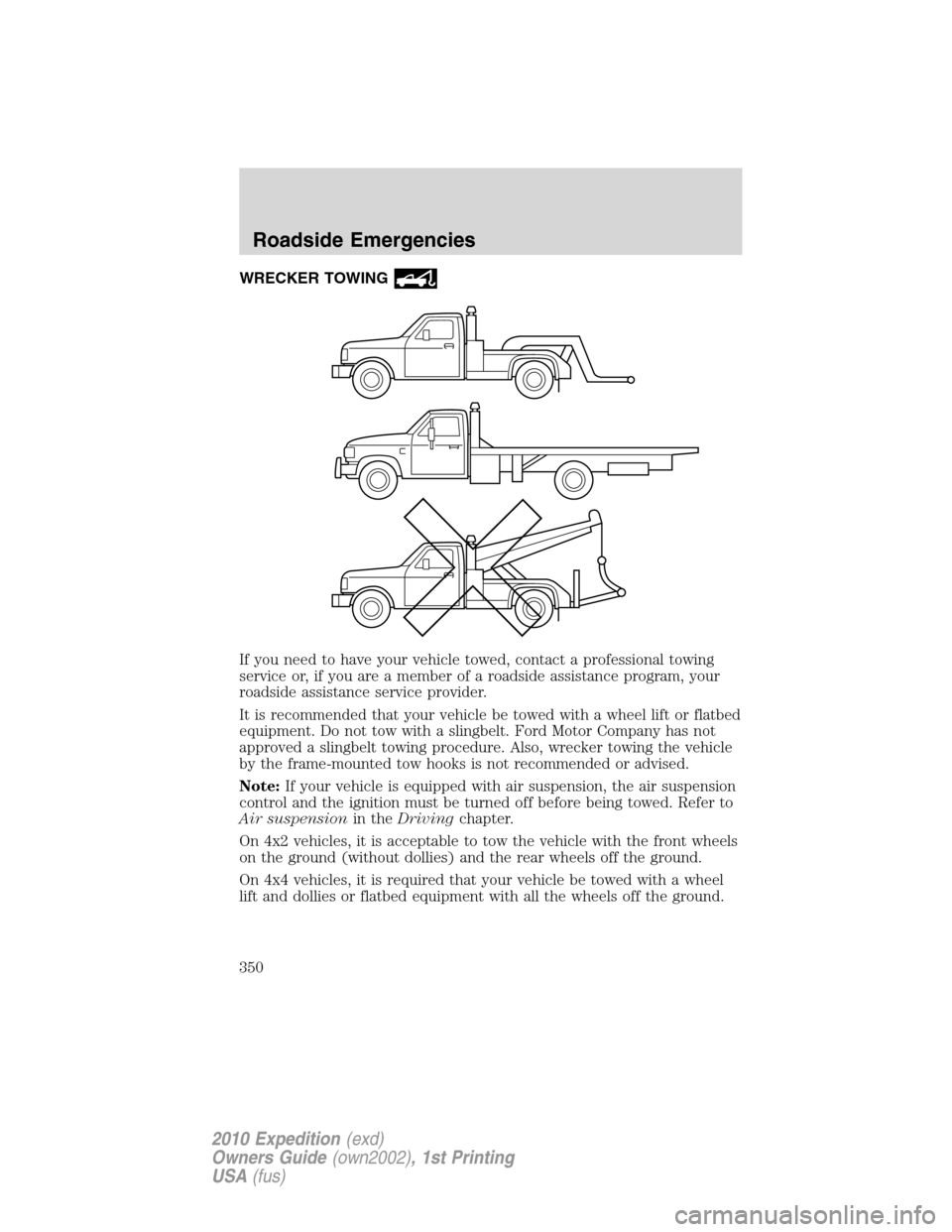
It is recommended that your vehicle be towed with a wheel lift or flatbed
equipment. Do not tow with a slingbelt. Ford Motor Company has not
approved a slingbelt towing procedure. Also, wrecker towing the vehicle
by the frame-mounted tow hooks is not recommended or advised.
Note:If your vehicle is equipped with air suspension, the air suspension
control and the ignition must be turned off before being towed. Refer to
Air suspensionin theDrivingchapter.
On 4x2 vehicles, it is acceptable to tow the vehicle with the front wheels
on the ground (without dollies) and the rear wheels off the ground.
On 4x4 vehicles, it is required that your vehicle be towed with a wheel
lift and dollies or flatbed equipment with all the wheels off the ground.
Roadside Emergencies
350
2010 Expedition(exd)
Owners Guide(own2002), 1st Printing
USA(fus)
Page 414 of 420
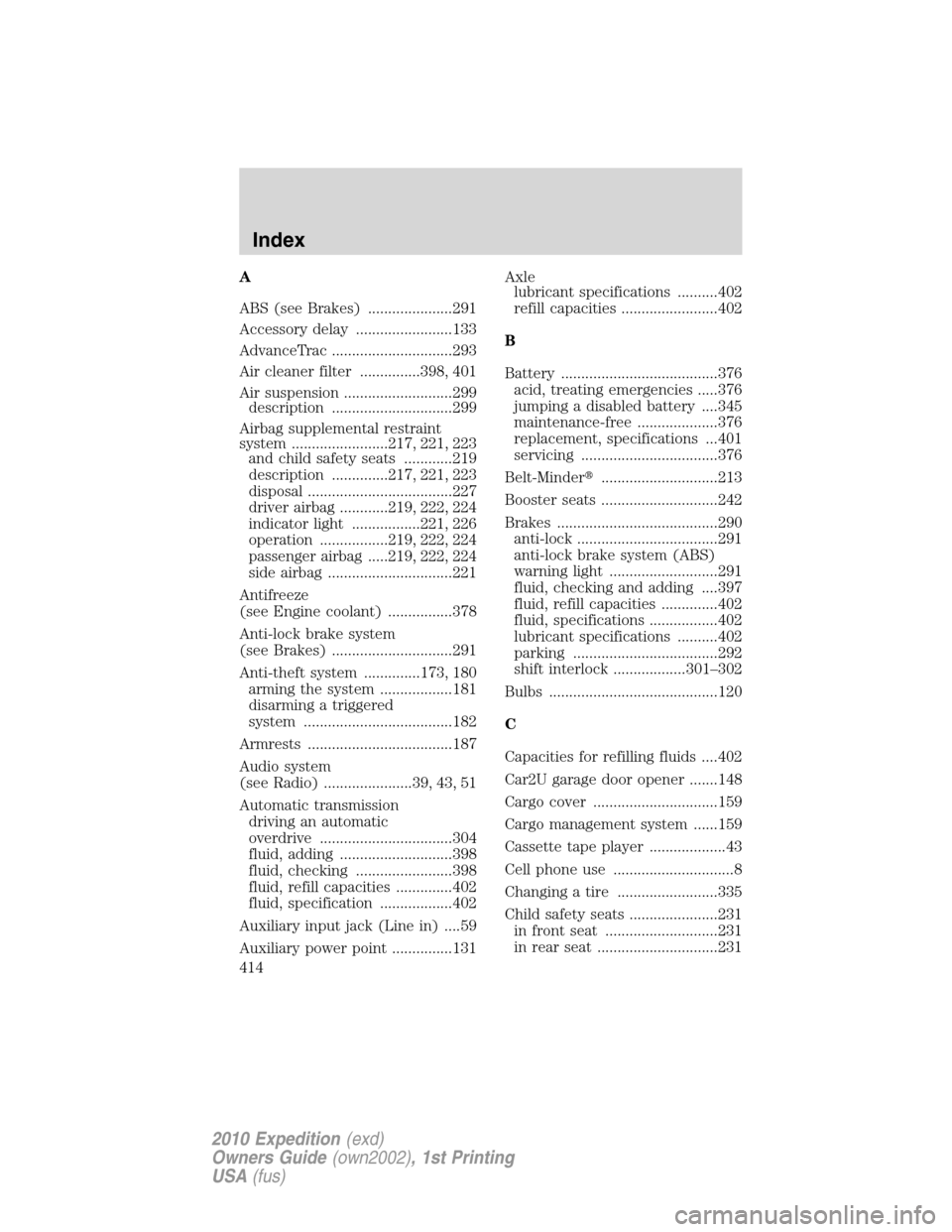
A
ABS (see Brakes) .....................291
Accessory delay ........................133
AdvanceTrac ..............................293
Air cleaner filter ...............398, 401
Air suspension ...........................299
description ..............................299
Airbag supplemental restraint
system ........................217, 221, 223
and child safety seats ............219
description ..............217, 221, 223
disposal ....................................227
driver airbag ............219, 222, 224
indicator light .................221, 226
operation .................219, 222, 224
passenger airbag .....219, 222, 224
side airbag ...............................221
Antifreeze
(see Engine coolant) ................378
Anti-lock brake system
(see Brakes) ..............................291
Anti-theft system ..............173, 180
arming the system ..................181
disarming a triggered
system .....................................182
Armrests ....................................187
Audio system
(see Radio) ......................39, 43, 51
Automatic transmission
driving an automatic
overdrive .................................304
fluid, adding ............................398
fluid, checking ........................398
fluid, refill capacities ..............402
fluid, specification ..................402
Auxiliary input jack (Line in) ....59
Auxiliary power point ...............131Axle
lubricant specifications ..........402
refill capacities ........................402
B
Battery .......................................376
acid, treating emergencies .....376
jumping a disabled battery ....345
maintenance-free ....................376
replacement, specifications ...401
servicing ..................................376
Belt-Minder�.............................213
Booster seats .............................242
Brakes ........................................290
anti-lock ...................................291
anti-lock brake system (ABS)
warning light ...........................291
fluid, checking and adding ....397
fluid, refill capacities ..............402
fluid, specifications .................402
lubricant specifications ..........402
parking ....................................292
shift interlock ..................301–302
Bulbs ..........................................120
C
Capacities for refilling fluids ....402
Car2U garage door opener .......148
Cargo cover ...............................159
Cargo management system ......159
Cassette tape player ...................43
Cell phone use ..............................8
Changing a tire .........................335
Child safety seats ......................231
in front seat ............................231
in rear seat ..............................231
Index
414
2010 Expedition(exd)
Owners Guide(own2002), 1st Printing
USA(fus)
Page:
< prev 1-8 9-16 17-24