Page 384 of 512
Spare Tire Location
The spare tire is stowed underneath the rear of the
vehicle and is held in place by means of a cable winch
mechanism.
Preparations For Jacking
1. Park the vehicle on a firm level surface as far from the
edge of the roadway as possible, avoid icy or slippery
areas.
WARNING!
Do not attempt to change a tire on the side of the
vehicle close to moving traffic. Pull far enough off
the road to avoid the danger of being hit when
operating the jack or changing the wheel.
2. Set the parking brake.
3. Place the shift lever in PARK. 4. Turn OFF the ignition.
5. Turn on the Hazard Warning flashers.
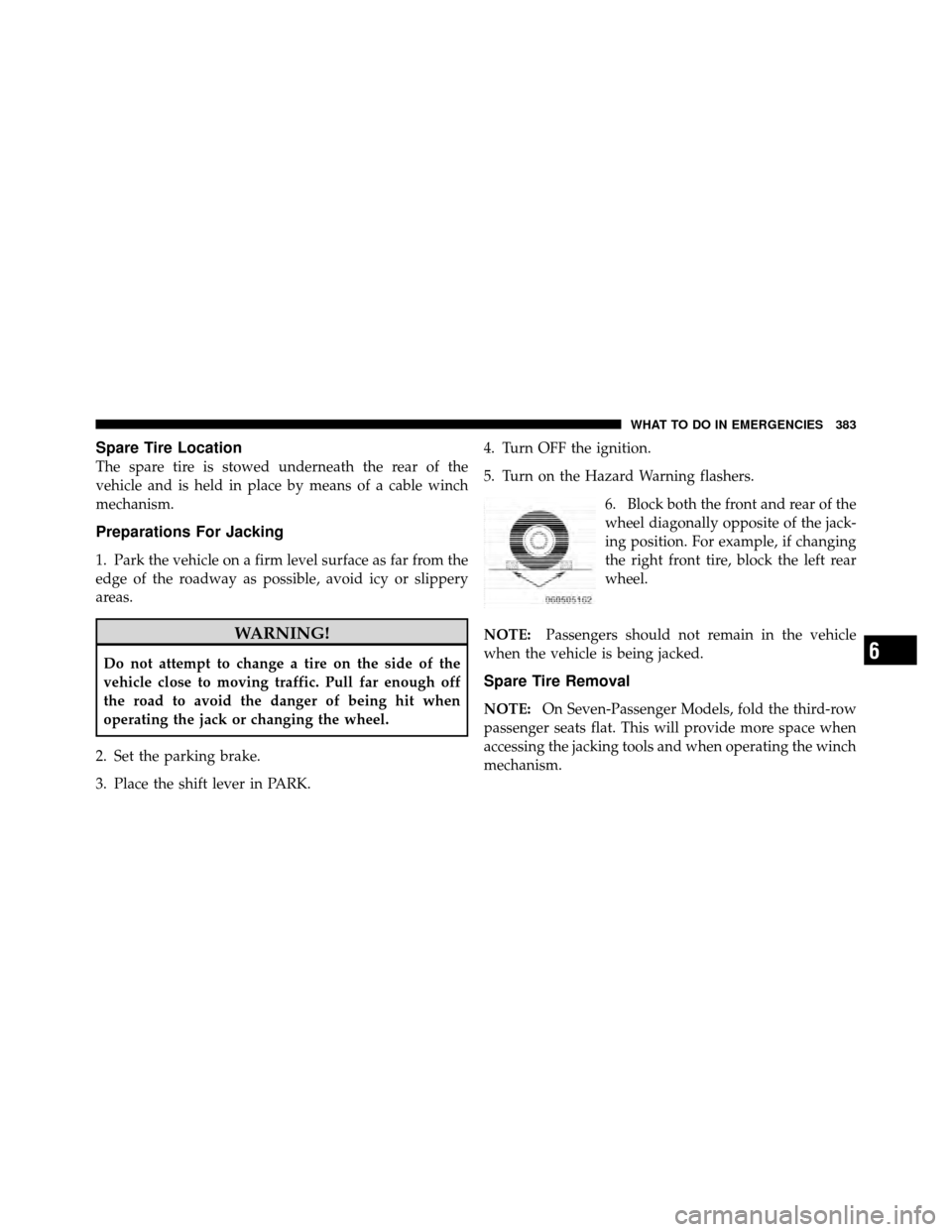
6. Block both the front and rear of the
wheel diagonally opposite of the jack-
ing position. For example, if changing
the right front tire, block the left rear
wheel.
NOTE: Passengers should not remain in the vehicle
when the vehicle is being jacked.
Spare Tire Removal
NOTE: On Seven-Passenger Models, fold the third-row
passenger seats flat. This will provide more space when
accessing the jacking tools and when operating the winch
mechanism.
6
WHAT TO DO IN EMERGENCIES 383
Page 388 of 512
4. Tilt the retainer at the end of the winch cable and drop
it through the center of the wheel. Then place the spare
tire with the cable and retainer underneath the vehicle.
5. Fit the assembled jack-handle over the winch drive
nut. Rotate the jack-handle assembly clockwise to raise
the spare tire into the storage area. Continue to rotate thejack-handle assembly until you hear the winch mecha-
nism click three times. It cannot be over tightened. Push
against the tire several times to be sure it is held securely
in place.
Jacking Instructions
WARNING!
Carefully follow these tire changing warnings to
help prevent personal injury or damage to your
vehicle:
•Always park on a firm, level surface as far from
the edge of the roadway as possible before raising
the vehicle.
•Block the wheel diagonally opposite the wheel to
be raised.
•Set the parking brake firmly and set an automatic
transmission in PARK.
(Continued)
Spare Tire Retainer
6
WHAT TO DO IN EMERGENCIES 387
Page 395 of 512

WARNING!
•Take care to avoid the radiator cooling fan when-
ever the hood is raised. It can start anytime the
ignition switch is on. You can be injured by
moving fan blades.
•Remove any metal jewelry such as watch bands or
bracelets that might make an inadvertent electrical
contact. You could be seriously injured.
•Batteries contain sulfuric acid that can burn your
skin or eyes and generate hydrogen gas which is
flammable and explosive. Keep open flames or
sparks away from the battery.
1. Set the parking brake, shift the automatic transmission
into PARK and turn the ignition to LOCK.
2. Turn off the heater, radio, and all unnecessary electri-
cal accessories. 3. Remove the protective cover over the remote positive
(+)
battery post. To remove the cover, press the locking
tab and pull upward on the cover.
4. If using another vehicle to jump-start the battery, park
the vehicle within the jumper cables reach, set the
parking brake and make sure the ignition is OFF.
Locking Tab
394 WHAT TO DO IN EMERGENCIES
Page 403 of 512

▫Exhaust System ..................... 421
▫ Cooling System ..................... 424
▫ Brake System ....................... 430
▫ Automatic Transmission ............... 432
▫ Appearance Care And Protection From
Corrosion .......................... 435
▫ Cleaning The Cupholders .............. 440
� Fuses .............................. 440
▫ Totally Integrated Power Module ......... 440
� Vehicle Storage ....................... 448
� Replacement Bulbs .................... 449
� Bulb Replacement ..................... 450 ▫
Low Beam Headlamp, High Beam
Headlamp, Front Turn Signal/Park Lamp,
Side Marker Lamp ................... 450
▫ Front Fog Lamp ..................... 451
▫ Tail/Stop Lamp, Rear Turn Signal Lamp, Tail
Lamp, Backup Lamp .................. 452
▫ License Plate Lamp ................... 454
� Fluid Capacities ...................... 455
� Fluids, Lubricants, And Genuine Parts ....... 456
▫ Engine ............................ 456
▫ Chassis ........................... 457
402 MAINTAINING YOUR VEHICLE
Page 404 of 512
ENGINE COMPARTMENT — 2.4L
1 — Engine Coolant Reservoir7 — Totally Integrated Power Module (TIPM)
2 — Power Steering Fluid Reservoir 8 — Automatic Transmission Dipstick
3 — Engine Oil Fill 9 — Washer Fluid Reservoir
4 — Brake Fluid Reservoir 10 — Coolant Pressure Cap
5 — Remote Jump Start (Positive Battery Post) 11 — Engine Oil Dipstick
6 — Remote Jump Start (Negative Battery Post)
7
MAINTAINING YOUR VEHICLE 403
Page 405 of 512
ENGINE COMPARTMENT — 3.5L
1 — Engine Coolant Reservoir6 — Totally Integrated Power Module (TIPM)
2 — Power Steering Fluid Reservoir 7 — Air Cleaner Filter
3 — Brake Fluid Reservoir 8 — Washer Fluid Reservoir
4 — Remote Jump Start (Positive Battery Post) 9 — Engine Oil Dipstick
5 — Remote Jump Start (Negative Battery Post) 10 — Engine Oil Fill
404 MAINTAINING YOUR VEHICLE
Page 431 of 512

Brake System
In order to assure brake system performance, all brake
system components should be inspected periodically.
Refer to “Maintenance Schedule” for further information.
WARNING!
Riding the brakes can lead to brake failure and
possibly an accident. Driving with your foot resting
or riding on the brake pedal can result in abnormally
high brake temperatures, excessive lining wear, and
possible brake damage. You would not have your full
braking capacity in an emergency.
Master Cylinder – Brake Fluid Level Check
Check the fluid level in the master cylinder immediately
if the “Brake Warning Light” indicates system failure.
Check the fluid level in the master cylinder when per-
forming underhood services.Clean the top of the master cylinder area before removing
the cap. If necessary, add fluid to bring the fluid level up
to the requirements described on the brake fluid reser-
voir.
Overfilling of fluid is not recommended because it may
cause leaking in the system.
Fluid level can be expected to fall as the brake pads wear.
Brake fluid level should be checked when pads are
replaced. However, low fluid level may be caused by a
leak and a checkup may be needed.
Use only manufacturer’s recommended brake fluid. Re-
fer to “Fluids, Lubricants, and Genuine Parts” in “Main-
taining Your Vehicle” for further information.
430 MAINTAINING YOUR VEHICLE
Page 432 of 512

WARNING!
•Use only manufacturer’s recommended brake
fluid. Refer to “Fluids, Lubricants, and Genuine
Parts” in “Maintaining Your Vehicle” for further
information. Using the wrong type of brake fluid
can severely damage your brake system and/or
impair its performance. The proper type of brake
fluid for your vehicle is also labeled on the origi-
nal factory installed hydraulic master cylinder
reservoir.(Continued)
WARNING! (Continued)
•To avoid contamination from foreign matter or
moisture, use only new brake fluid or fluid that
has been in a tightly closed container. Keep the
master cylinder reservoir cap secured at all times.
Brake fluid in a open container absorbs moisture
from the air resulting in a lower boiling point.
This may cause it to boil unexpectedly during hard
or prolonged braking, resulting in sudden brake
failure. This could result in a accident.
•Overfilling the brake fluid reservoir can result in
spilling brake fluid on hot engine parts, causing
the brake fluid to catch fire. Brake fluid can also
damage painted and vinyl surfaces, care should be
taken to avoid its contact with these surfaces.(Continued)
7
MAINTAINING YOUR VEHICLE 431


