Page 356 of 450
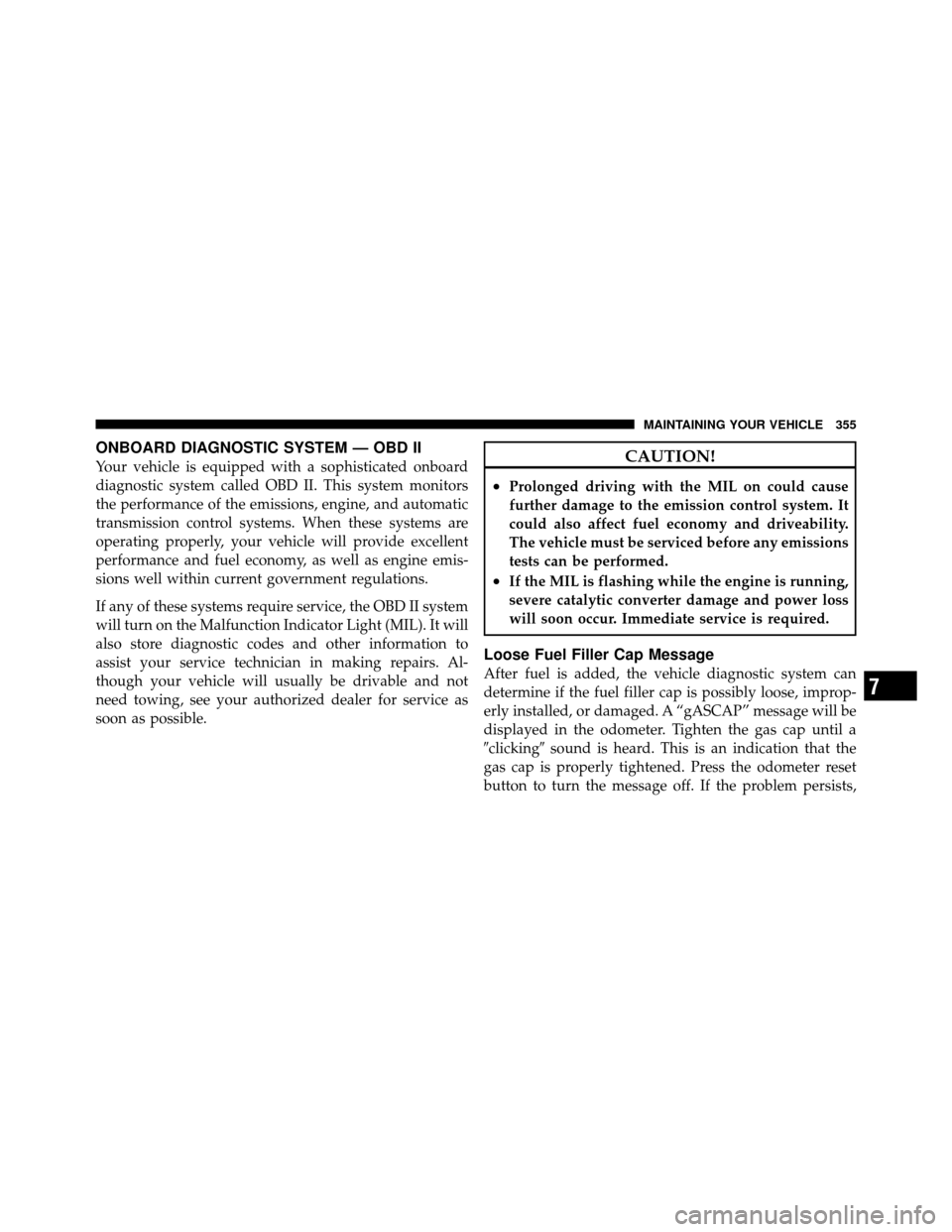
ONBOARD DIAGNOSTIC SYSTEM — OBD II
Your vehicle is equipped with a sophisticated onboard
diagnostic system called OBD II. This system monitors
the performance of the emissions, engine, and automatic
transmission control systems. When these systems are
operating properly, your vehicle will provide excellent
performance and fuel economy, as well as engine emis-
sions well within current government regulations.
If any of these systems require service, the OBD II system
will turn on the Malfunction Indicator Light (MIL). It will
also store diagnostic codes and other information to
assist your service technician in making repairs. Al-
though your vehicle will usually be drivable and not
need towing, see your authorized dealer for service as
soon as possible.CAUTION!
•Prolonged driving with the MIL on could cause
further damage to the emission control system. It
could also affect fuel economy and driveability.
The vehicle must be serviced before any emissions
tests can be performed.
•If the MIL is flashing while the engine is running,
severe catalytic converter damage and power loss
will soon occur. Immediate service is required.
Loose Fuel Filler Cap Message
After fuel is added, the vehicle diagnostic system can
determine if the fuel filler cap is possibly loose, improp-
erly installed, or damaged. A “gASCAP” message will be
displayed in the odometer. Tighten the gas cap until a
�clicking�sound is heard. This is an indication that the
gas cap is properly tightened. Press the odometer reset
button to turn the message off. If the problem persists,
7
MAINTAINING YOUR VEHICLE 355
Page 361 of 450
NOTE: Under no circumstances should oil change
intervals exceed 6,000 miles (10 000 km) or six months,
whichever occurs first.
Engine Oil Selection
For best performance and maximum protection under all
types of operating conditions, the manufacturer only
recommends engine oils that are API certified and meet
the requirements of Chrysler Material Standard MS-6395.
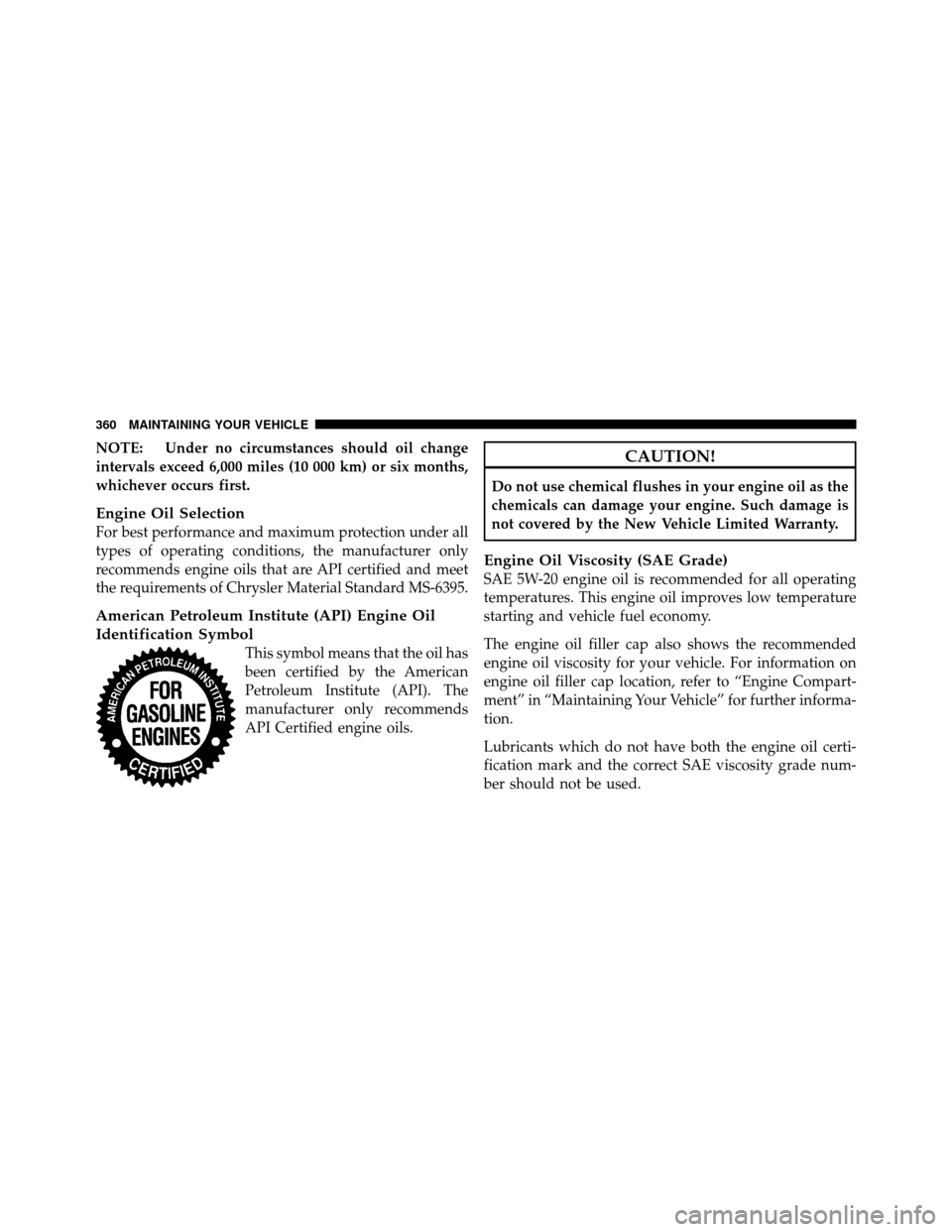
American Petroleum Institute (API) Engine Oil
Identification Symbol
This symbol means that the oil has
been certified by the American
Petroleum Institute (API). The
manufacturer only recommends
API Certified engine oils.
CAUTION!
Do not use chemical flushes in your engine oil as the
chemicals can damage your engine. Such damage is
not covered by the New Vehicle Limited Warranty.
Engine Oil Viscosity (SAE Grade)
SAE 5W-20 engine oil is recommended for all operating
temperatures. This engine oil improves low temperature
starting and vehicle fuel economy.
The engine oil filler cap also shows the recommended
engine oil viscosity for your vehicle. For information on
engine oil filler cap location, refer to “Engine Compart-
ment” in “Maintaining Your Vehicle” for further informa-
tion.
Lubricants which do not have both the engine oil certi-
fication mark and the correct SAE viscosity grade num-
ber should not be used.
360 MAINTAINING YOUR VEHICLE
Page 368 of 450
CAUTION!
The catalytic converter requires the use of unleaded
fuel only. Leaded gasoline will destroy the effective-
ness of the catalyst as an emissions control device
and may seriously reduce engine performance and
cause serious damage to the engine.
Under normal operating conditions, the catalytic con-
verter will not require maintenance. However, it is im-
portant to keep the engine properly tuned to assure
proper catalyst operation and prevent possible catalyst
damage.
CAUTION!
Damage to the catalytic converter can result if your
vehicle is not kept in proper operating condition. In
the event of engine malfunction, particularly involv-
ing engine misfire or other apparent loss of perfor-
mance, have your vehicle serviced promptly. Contin-
ued operation of your vehicle with a severe
malfunction could cause the converter to overheat,
resulting in possible damage to the converter and the
vehicle.
NOTE: Intentional tampering with emissions control
systems can result in civil penalties being assessed
against you.
7
MAINTAINING YOUR VEHICLE 367
Page 387 of 450
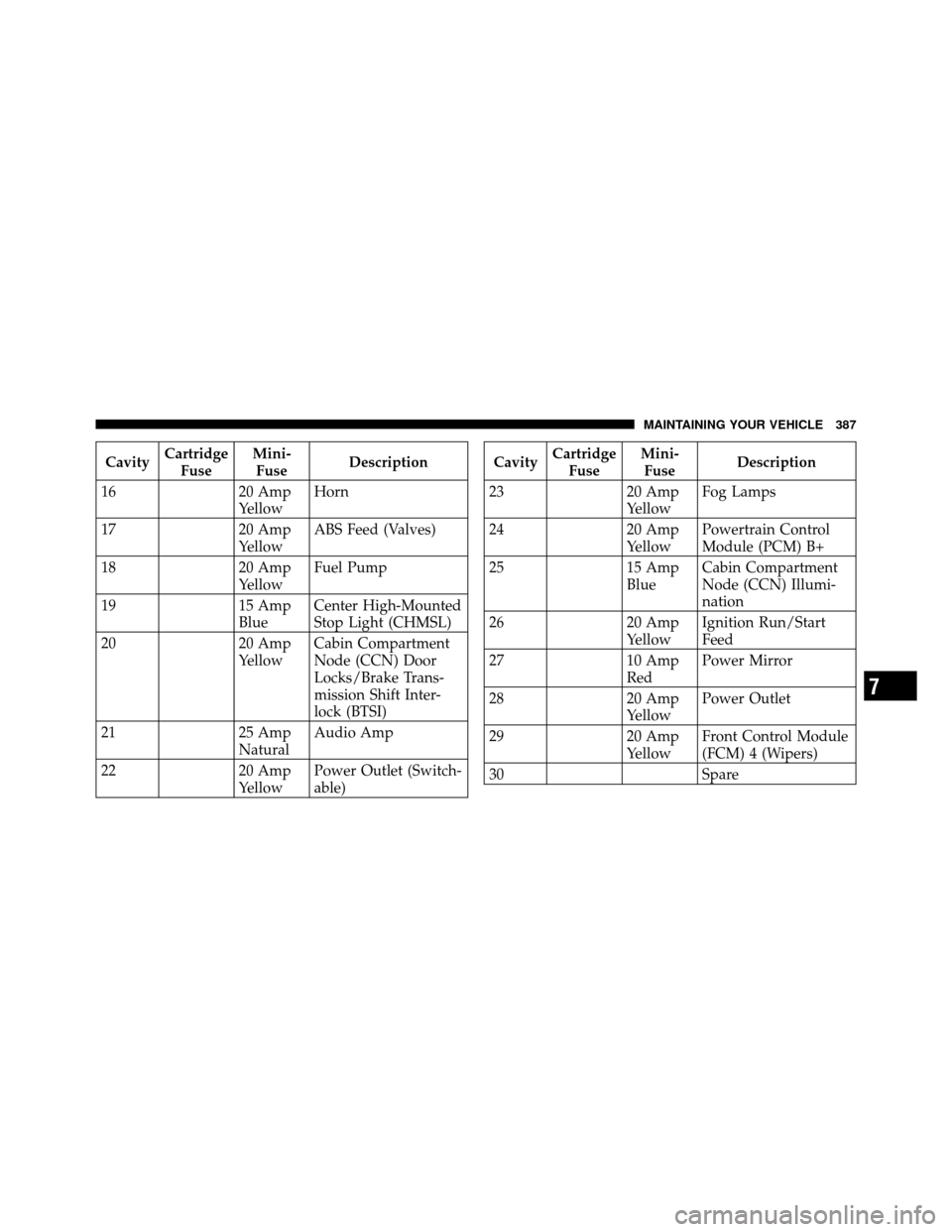
corresponds to the following chart. These fuses and
relays can be obtained from your authorized dealer.
CavityCartridge
Fuse Mini-
Fuse Description
1 Spare
2 Spare
3 30 Amp Pink Electric Brake
4 50 Amp Red Power Seat
5 Spare
6 20 Amp
YellowIgnition Off Draw
(IOD) Cabin Com-
partment Node
(CCN), Radio
7 10 Amp
RedPowertrain Control
Module (PCM)/Fuel/
RAD/AC Coils
Cavity
Cartridge
Fuse Mini-
Fuse Description
8 10 Amp
RedCabin Compartment
Node (CCN)/Mirror/
4x4
9 Spare
10 2 Amp
GrayRun/Start Ignition
Switch
11 10 Amp
RedAC Clutch
12 15 Amp
BlueTrailer Tow Lt Stop/
Turn
13 15 Amp
BlueTrailer Tow Rt Stop/
Turn
14 20 Amp
YellowIgnition Off Draw
(IOD) #2
15 25 Amp
NaturalTrans/Powertrain
Control Module
(PCM)
386 MAINTAINING YOUR VEHICLE
Page 388 of 450
CavityCartridge
Fuse Mini-
Fuse Description
16 20 Amp
YellowHorn
17 20 Amp
YellowABS Feed (Valves)
18 20 Amp
YellowFuel Pump
19 15 Amp
BlueCenter High-Mounted
Stop Light (CHMSL)
20 20 Amp
YellowCabin Compartment
Node (CCN) Door
Locks/Brake Trans-
mission Shift Inter-
lock (BTSI)
21 25 Amp
NaturalAudio Amp
22 20 Amp
YellowPower Outlet (Switch-
able)Cavity
Cartridge
Fuse Mini-
Fuse Description
23 20 Amp
YellowFog Lamps
24 20 Amp
YellowPowertrain Control
Module (PCM) B+
25 15 Amp
BlueCabin Compartment
Node (CCN) Illumi-
nation
26 20 Amp
YellowIgnition Run/Start
Feed
27 10 Amp
RedPower Mirror
28 20 Amp
YellowPower Outlet
29 20 Amp
YellowFront Control Module
(FCM) 4 (Wipers)
30 Spare
7
MAINTAINING YOUR VEHICLE 387
Page 400 of 450
Fog Lamps
1. Disconnect connector from the fog lamp by raising the
wire harness lock tab and pulling on wire harness
connector.2. Rotate the bulb 1/4-turn counterclockwise and pull to
remove from the fog lamp housing.
3. Reverse procedure to install.
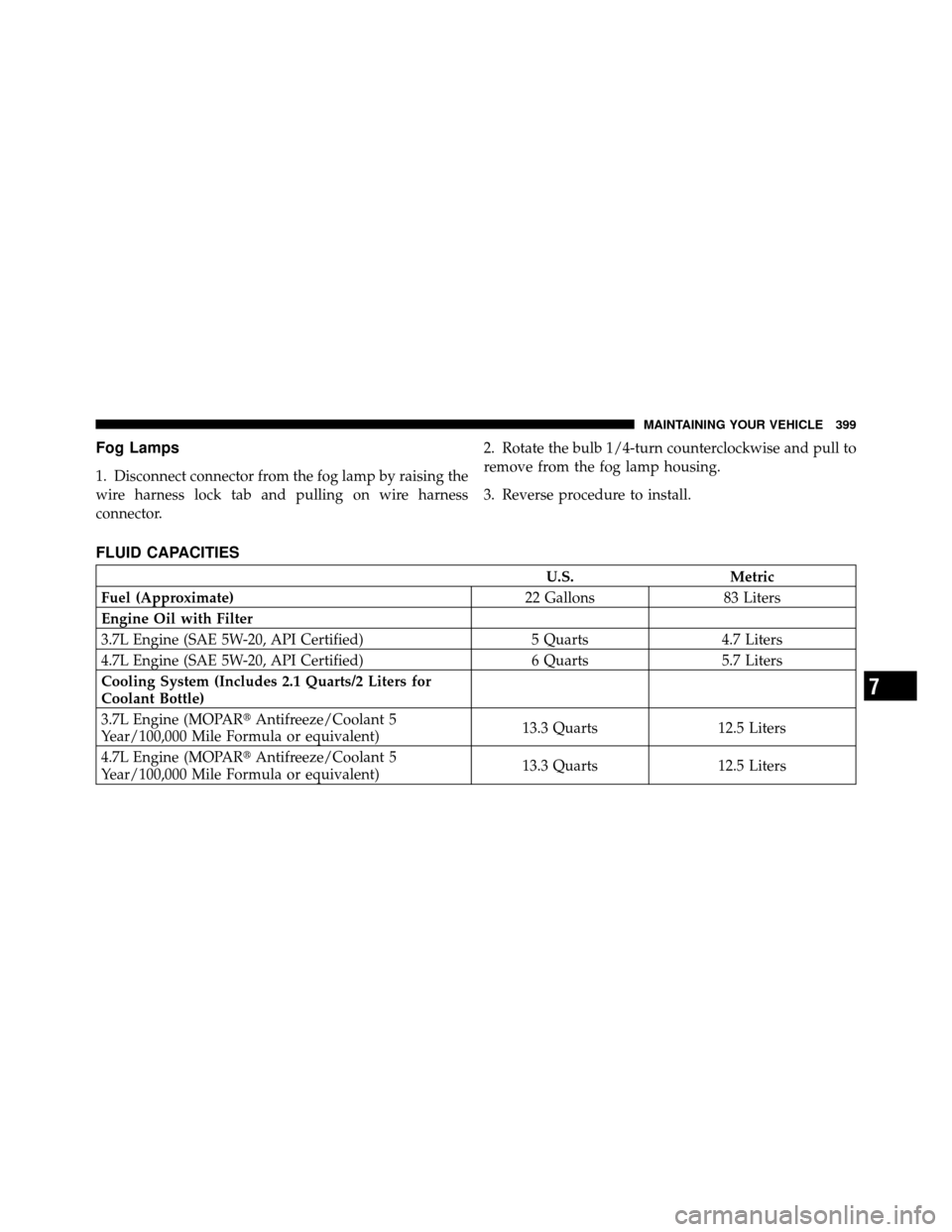
FLUID CAPACITIES
U.S.
Metric
Fuel (Approximate) 22 Gallons83 Liters
Engine Oil with Filter
3.7L Engine (SAE 5W-20, API Certified) 5 Quarts4.7 Liters
4.7L Engine (SAE 5W-20, API Certified) 6 Quarts5.7 Liters
Cooling System (Includes 2.1 Quarts/2 Liters for
Coolant Bottle)
3.7L Engine (MOPAR� Antifreeze/Coolant 5
Year/100,000 Mile Formula or equivalent) 13.3 Quarts
12.5 Liters
4.7L Engine (MOPAR� Antifreeze/Coolant 5
Year/100,000 Mile Formula or equivalent) 13.3 Quarts
12.5 Liters
7
MAINTAINING YOUR VEHICLE 399
Page 401 of 450
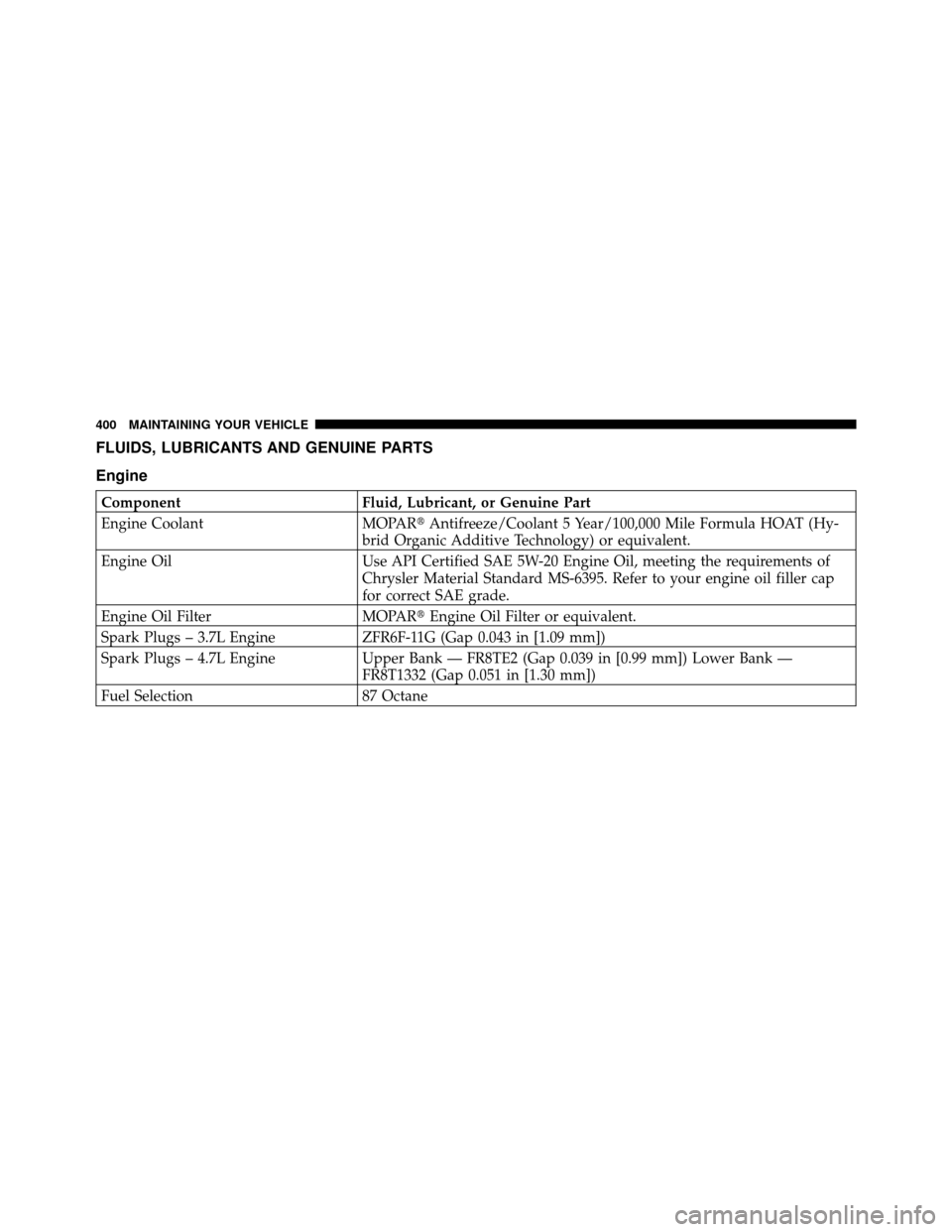
FLUIDS, LUBRICANTS AND GENUINE PARTS
Engine
ComponentFluid, Lubricant, or Genuine Part
Engine Coolant MOPAR�Antifreeze/Coolant 5 Year/100,000 Mile Formula HOAT (Hy-
brid Organic Additive Technology) or equivalent.
Engine Oil Use API Certified SAE 5W-20 Engine Oil, meeting the requirements of
Chrysler Material Standard MS-6395. Refer to your engine oil filler cap
for correct SAE grade.
Engine Oil Filter MOPAR�Engine Oil Filter or equivalent.
Spark Plugs – 3.7L Engine ZFR6F-11G (Gap 0.043 in [1.09 mm])
Spark Plugs – 4.7L Engine Upper Bank — FR8TE2 (Gap 0.039 in [0.99 mm]) Lower Bank —
FR8T1332 (Gap 0.051 in [1.30 mm])
Fuel Selection 87 Octane
400 MAINTAINING YOUR VEHICLE
Page 406 of 450
•Change your engine oil more often if you drive your
vehicle off-road for an extended period of time.
•Under no circumstances should oil change intervals
exceed 6,000 miles (10,000 km) or six months, which-
ever comes first.
Your authorized dealer will reset the oil change indicator
message after completing the scheduled oil change. If a
scheduled oil change is performed by someone other
than your authorized dealer, the message can be reset by
referring to the steps described under “Electronic Vehicle
Information Center (EVIC)/Oil Change Required” in
“Understanding Your Instrument Panel” or under “In-
strument Cluster Description/Odometer/Trip Odom-
eter” in “Understanding Your Instrument Panel” for
further information. At Each Stop for Fuel
•Check the engine oil level about five minutes after a
fully warmed engine is shut off. Checking the oil level
while the vehicle is on level ground will improve the
accuracy of the oil level reading. Add oil only when
the level is at or below the ADD or MIN mark.
•Check the windshield washer solvent and add if
required.
Once a Month
•Check tire pressure and look for unusual wear or
damage.
•Inspect the battery, and clean and tighten the terminals
as required.
8
M A I
N T
E
N A
N CE
S
C
H E
D
U L
E
SMAINTENANCE SCHEDULES 405