Page 185 of 450
WARNING!
A malfunctioning catalytic converter, as referenced
above, can reach higher temperatures than in normal
operating conditions. This can cause a fire if you
drive slowly or park over flammable substances such
as dry plants or wood or cardboard, etc. This could
result in death or serious injury to the driver, occu-
pants or others.
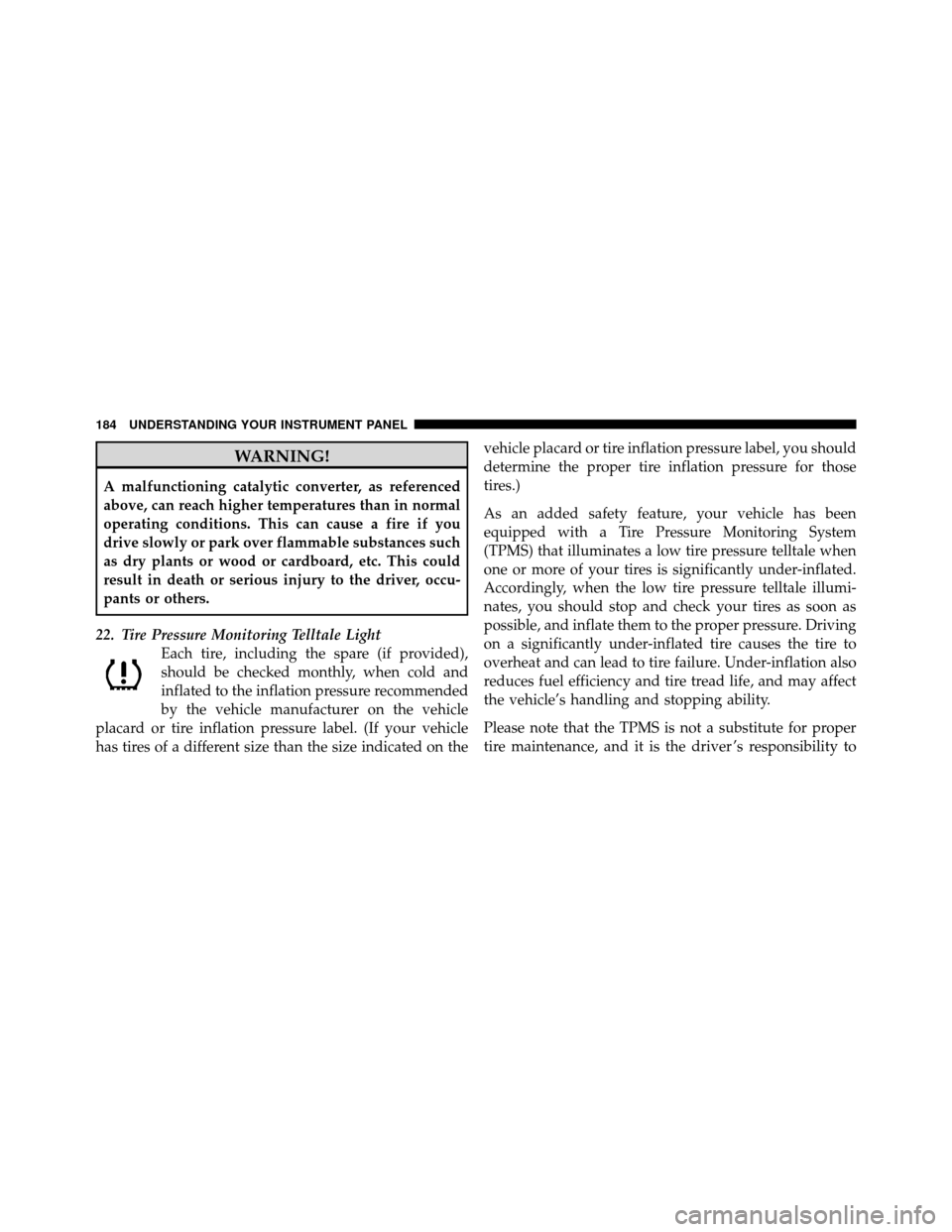
22. Tire Pressure Monitoring Telltale Light Each tire, including the spare (if provided),
should be checked monthly, when cold and
inflated to the inflation pressure recommended
by the vehicle manufacturer on the vehicle
placard or tire inflation pressure label. (If your vehicle
has tires of a different size than the size indicated on the vehicle placard or tire inflation pressure label, you should
determine the proper tire inflation pressure for those
tires.)
As an added safety feature, your vehicle has been
equipped with a Tire Pressure Monitoring System
(TPMS) that illuminates a low tire pressure telltale when
one or more of your tires is significantly under-inflated.
Accordingly, when the low tire pressure telltale illumi-
nates, you should stop and check your tires as soon as
possible, and inflate them to the proper pressure. Driving
on a significantly under-inflated tire causes the tire to
overheat and can lead to tire failure. Under-inflation also
reduces fuel efficiency and tire tread life, and may affect
the vehicle’s handling and stopping ability.
Please note that the TPMS is not a substitute for proper
tire maintenance, and it is the driver ’s responsibility to
184 UNDERSTANDING YOUR INSTRUMENT PANEL
Page 239 of 450
A light at the top of the SNOWFLAKE button shows that
the air conditioning is on. Press the button a second time
to turn the air conditioning off.
Slight changes in engine speed or power may be noticed
when the air conditioning compressor is on. This is a
normal occurrence as the compressor will cycle on and
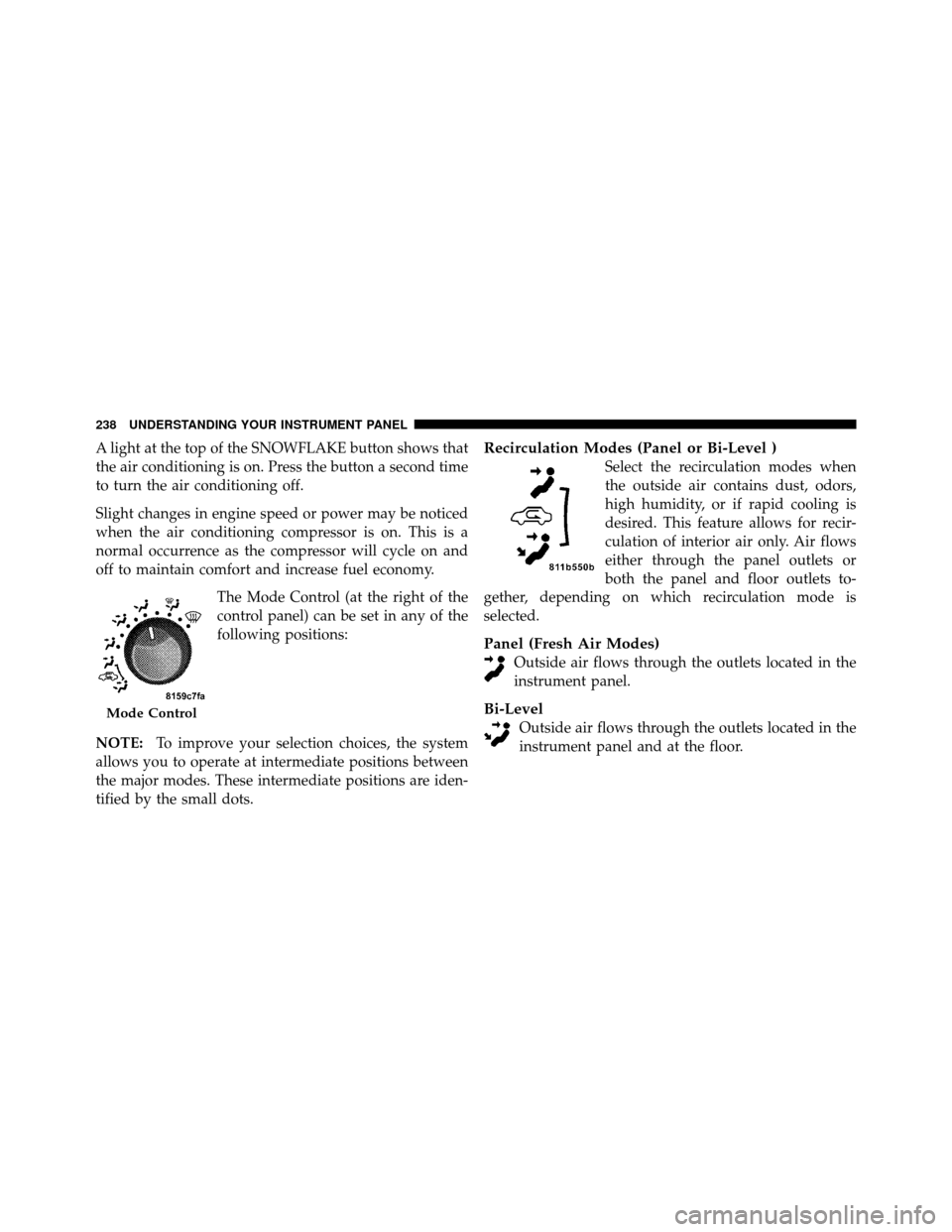
off to maintain comfort and increase fuel economy.The Mode Control (at the right of the
control panel) can be set in any of the
following positions:
NOTE: To improve your selection choices, the system
allows you to operate at intermediate positions between
the major modes. These intermediate positions are iden-
tified by the small dots.Recirculation Modes (Panel or Bi-Level )
Select the recirculation modes when
the outside air contains dust, odors,
high humidity, or if rapid cooling is
desired. This feature allows for recir-
culation of interior air only. Air flows
either through the panel outlets or
both the panel and floor outlets to-
gether, depending on which recirculation mode is
selected.
Panel (Fresh Air Modes)
Outside air flows through the outlets located in the
instrument panel.
Bi-Level
Outside air flows through the outlets located in the
instrument panel and at the floor.Mode Control
238 UNDERSTANDING YOUR INSTRUMENT PANEL
Page 248 of 450
�Tire Chains .......................... 290
� Snow Tires .......................... 292
� Tire Rotation Recommendations ........... 292
� Tire Pressure Monitor System (TPMS) ....... 293
▫ Base System ........................ 296
▫ General Information .................. 298
� Fuel Requirements ..................... 298
▫ Reformulated Gasoline ................ 299
▫ Gasoline/Oxygenate Blends ............. 299
▫ E-85 Usage In Non-Flex Fuel Vehicles ...... 300
▫ MMT In Gasoline .................... 300
▫ Materials Added To Fuel ............... 301
▫ Fuel System Cautions ................. 301 ▫
Carbon Monoxide Warnings ............ 302
� Flexible Fuel (4.7L Engine Only) —
If Equipped .......................... 303
▫ E85 General Information ............... 303
▫ Ethanol Fuel (E85) ................... 304
▫ Fuel Requirements ................... 304
▫ Selection Of Engine Oil For Flexible Fuel
Vehicles (E85) And Gasoline Vehicles ...... 305
▫ Starting ........................... 306
▫ Cruising Range ...................... 306
▫ Replacement Parts ................... 306
▫ Maintenance ........................ 306
� Adding Fuel ......................... 307
▫ Fuel Filler Cap (Gas Cap) .............. 307
5
STARTING AND OPERATING 247
Page 249 of 450
▫Loose Fuel Filler Cap Message ........... 308
� Vehicle Loading ...................... 309
▫ Certification Label ................... 309
▫ Curb Weight ........................ 310
▫ Loading ........................... 310
� Trailer Towing ........................ 311
▫ Common Towing Definitions ............ 312
▫ Trailer Hitch Classification .............. 316
▫ Trailer Towing Weights
(Maximum Trailer Weight Ratings) ........ 317▫
Trailer And Tongue Weight ............. 317
▫ Towing Requirements ................. 318
▫ Towing Tips ........................ 323
� Snowplow .......................... 324
� Recreational Towing
(Behind Motorhome, Etc.) ................ 325
▫ Two-Wheel Drive Models .............. 325
▫ Four-Wheel Drive Models .............. 325
248 STARTING AND OPERATING
Page 251 of 450
Extreme Cold Weather (below –20°F or –29°C)
To ensure reliable starting at these temperatures, use of
an externally powered electric engine block heater (avail-
able from your dealer) is recommended.
If Engine Fails To Start
WARNING!
•Never pour fuel or other flammable liquids into
the throttle body air inlet opening in an attempt to
start the vehicle. This could result in a flash fire
causing serious personal injury.(Continued)
WARNING! (Continued)
•Do not attempt to push or tow your vehicle to get
it started. Vehicles equipped with an automatic
transmission cannot be started this way. Unburned
fuel could enter the catalytic converter and once
the engine has started, ignite and damage the
converter and vehicle. If the vehicle has a dis-
charged battery, booster cables may be used to
obtain a start from a booster battery or the battery
in another vehicle. This type of start can be dan-
gerous if done improperly. Refer to “Jump Start-
ing” in “What To Do In Emergencies” for further
information.
If the engine fails to start after you have followed the
“Normal Starting” procedure, it may be flooded. Push
the accelerator pedal all the way to the floor and hold it
there while cranking the engine. This should clear any
excess fuel, in case the engine is flooded.
250 STARTING AND OPERATING
Page 257 of 450
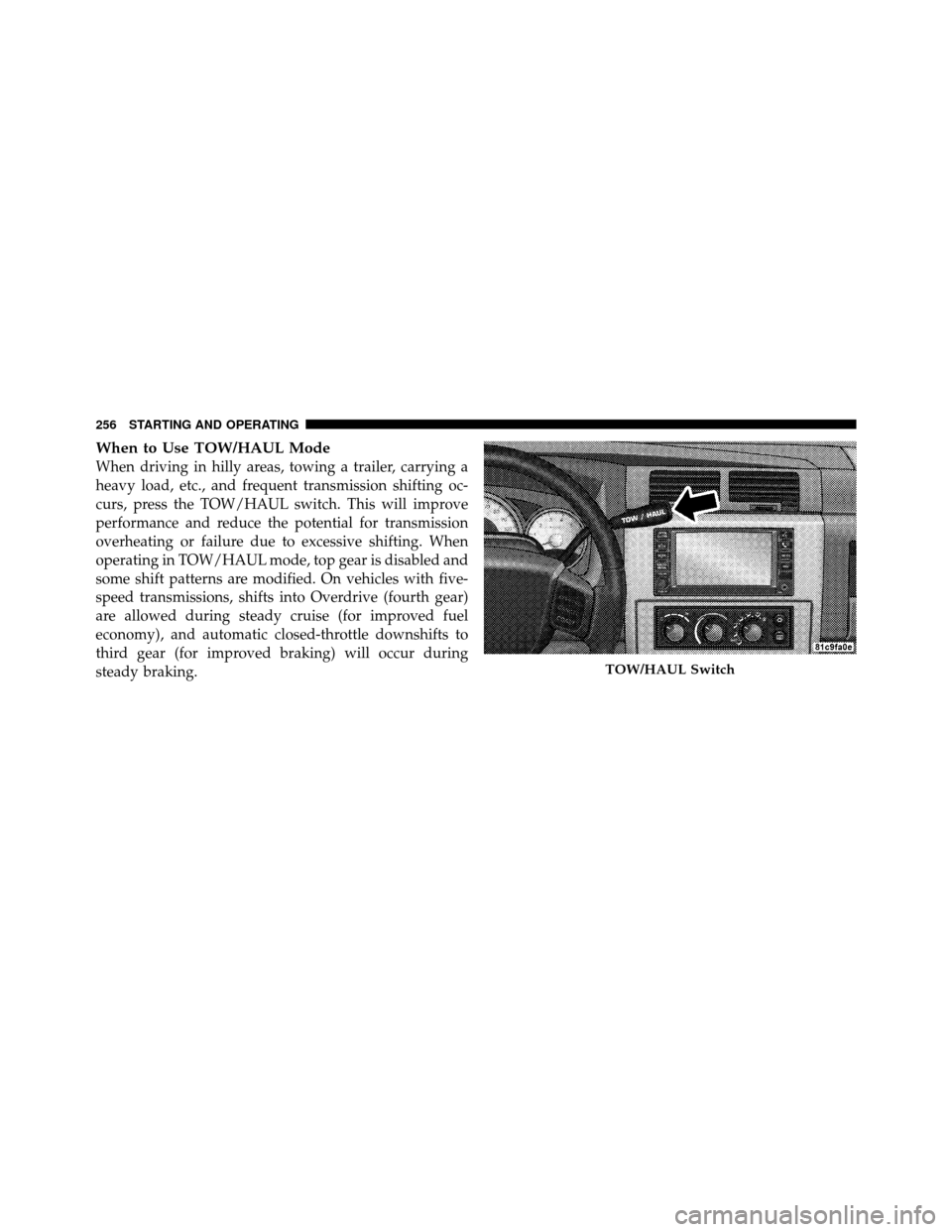
When to Use TOW/HAUL Mode
When driving in hilly areas, towing a trailer, carrying a
heavy load, etc., and frequent transmission shifting oc-
curs, press the TOW/HAUL switch. This will improve
performance and reduce the potential for transmission
overheating or failure due to excessive shifting. When
operating in TOW/HAUL mode, top gear is disabled and
some shift patterns are modified. On vehicles with five-
speed transmissions, shifts into Overdrive (fourth gear)
are allowed during steady cruise (for improved fuel
economy), and automatic closed-throttle downshifts to
third gear (for improved braking) will occur during
steady braking.
TOW/HAUL Switch
256 STARTING AND OPERATING
Page 258 of 450
The “TOW/HAUL Indicator Light” will illuminate in the
instrument cluster to indicate when the switch has been
activated. Pressing the switch a second time restores
normal operation. If the TOW/HAUL mode is desired,
the switch must be pressed each time the engine is
started.
Torque Converter Clutch
A feature designed to improve fuel economy is included
in all automatic transmissions. A clutch, within the
torque converter, engages automatically at a calibrated
speed at light throttle. It engages at higher speeds under
heavier acceleration. This may result in a slightly differ-
ent feeling or response during normal operation in high
gear. When the vehicle speed drops below a calibrated
speed, or during acceleration, the clutch automatically
and smoothly disengages. The feature is operational in
Overdrive and in Drive.NOTE:
•The torque converter clutch will not engage until the
transmission fluid and engine coolant are warm (usu-
ally after 1-3 miles [1.6 - 4.8 km] of driving). Because
the engine speed is higher when the torque converter
clutch is not engaged, it may seem as if the transmis-
sion is not shifting into Overdrive when cold. This is
normal. Pressing the TOW/HAUL switch, when the
transmission is sufficiently warm, will demonstrate
that the transmission is able to shift into, and out of
Overdrive.
•If the vehicle has not been driven in several days, the
first few seconds of operation after shifting the trans-
mission into gear may seem sluggish. This is due to the
fluid partially draining from the torque converter into
the transmission. This condition is normal and will not
cause damage to the transmission. The torque con-
verter will refill within five seconds of shifting from
PARK into any other gear position.
5
STARTING AND OPERATING 257
Page 285 of 450
WARNING! (Continued)
•Unequal tire pressures from one side of the ve-
hicle to the other can cause the vehicle to drift to
the right or left.
•Always drive with each tire inflated to the recom-
mended cold tire inflation pressure.
Economy
Improper inflation pressures can cause uneven wear
patterns to develop across the tire tread. These abnormal
wear patterns will reduce tread life resulting in a need for
earlier tire replacement. Under-inflation also increases
tire rolling resistance and results in higher fuel
consumption.
Ride Comfort and Vehicle Stability
Proper tire inflation contributes to a comfortable ride.
Over-inflation produces a jarring and uncomfortable
ride.
Tire Inflation Pressures
The proper cold tire inflation pressure is listed on the
driver’s side “B” Pillar.
The pressure should be checked and adjusted as well as
inspecting for signs of tire wear or visible damage at least
once a month. Use a good quality pocket-type gauge to
check tire pressure. Do not make a visual judgement
when determining proper inflation. Radial tires may look
properly inflated even when they are under-inflated.
CAUTION!
After inspecting or adjusting the tire pressure, al-
ways reinstall the valve stem cap. This will prevent
moisture and dirt from entering the valve stem,
which could damage the valve stem.
284 STARTING AND OPERATING