Page 324 of 450
Towing Tips
Before setting out on a trip, practice turning, stopping
and backing the trailer in an area away from heavy
traffic.
Automatic Transmission
The “DRIVE” range can be selected when towing. How-
ever, if frequent shifting occurs while in this range, the
TOW/HAUL feature should be selected.
NOTE:Using the TOW/HAUL feature while operating
the vehicle under heavy operating conditions will im-
prove performance and extend transmission life by re-
ducing excessive shifting and heat build up. This action
will also provide better engine braking.
The automatic transmission fluid and filter should be
changed if you REGULARLY tow a trailer for more than
45 minutes of continuous operation. Refer to “Mainte-
nance Schedule” for the proper maintenance intervals.
Seven-Pin Connector
1 — Battery 5 — Ground
2 — Backup Lamps 6 — Left Stop/Turn
3 — Right Stop/Turn 7 — Running Lamps
4 — Electric Brakes
5
STARTING AND OPERATING 323
Page 325 of 450

NOTE:Check the automatic transmission fluid level
before towing.
Tow/Haul – If Equipped
To reduce potential for automatic transmission overheat-
ing, turn the TOW/HAUL feature ON when driving in
hilly areas or shift the transmission to Drive position 2 on
more severe grades.
Electronic Speed Control – If Equipped
Do not use in hilly terrain or with heavy loads.
When using the speed control, if you experience speed
drops greater than 10 mph (16 km/h), disengage until
you can resume cruising speed.
Use speed control in flat terrain and with light loads to
maximize fuel efficiency.
Cooling System
To reduce potential for engine and transmission over-
heating, take the following actions:
City Driving
When stopped for short periods of time, shift the trans-
mission into NEUTRAL and increase engine idle speed.
Highway Driving
Reduce speed.
Air Conditioning
Turn off temporarily.
SNOWPLOW
Snow plows, winches, and other aftermarket equipment
should notbe added to the front end of your vehicle. The
airbag crash sensors may be affected by the change in the
front end structure. The airbags could deploy unexpect-
edly or could fail to deploy during a collision.
324 STARTING AND OPERATING
Page 326 of 450
WARNING!
Do not add a snow plow, winches, or any other
aftermarket equipment to the front of your vehicle.
This could adversely affect the functioning of the
airbag system and you could be injured.
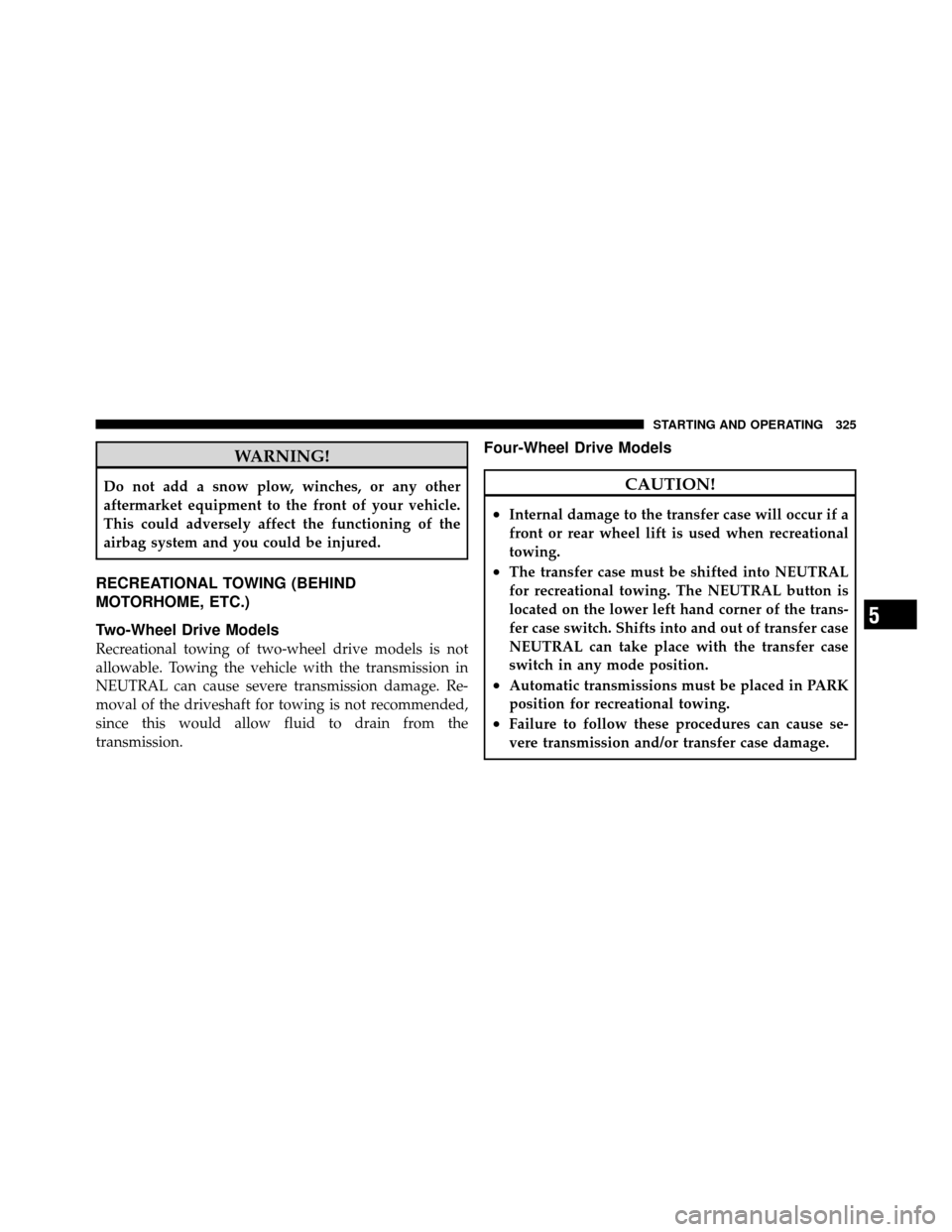
RECREATIONAL TOWING (BEHIND
MOTORHOME, ETC.)
Two-Wheel Drive Models
Recreational towing of two-wheel drive models is not
allowable. Towing the vehicle with the transmission in
NEUTRAL can cause severe transmission damage. Re-
moval of the driveshaft for towing is not recommended,
since this would allow fluid to drain from the
transmission.
Four-Wheel Drive Models
CAUTION!
•Internal damage to the transfer case will occur if a
front or rear wheel lift is used when recreational
towing.
•The transfer case must be shifted into NEUTRAL
for recreational towing. The NEUTRAL button is
located on the lower left hand corner of the trans-
fer case switch. Shifts into and out of transfer case
NEUTRAL can take place with the transfer case
switch in any mode position.
•Automatic transmissions must be placed in PARK
position for recreational towing.
•Failure to follow these procedures can cause se-
vere transmission and/or transfer case damage.
5
STARTING AND OPERATING 325
Page 327 of 450
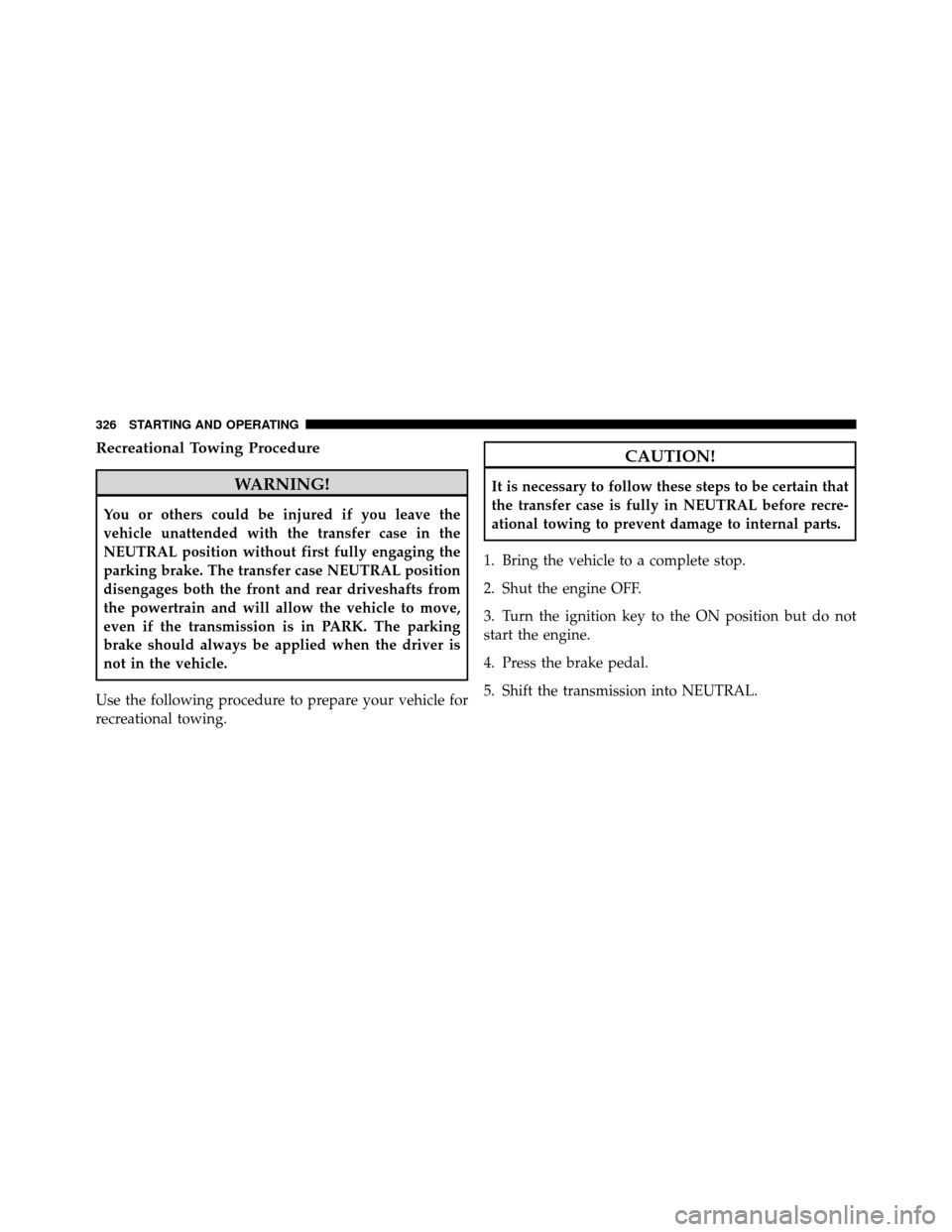
Recreational Towing Procedure
WARNING!
You or others could be injured if you leave the
vehicle unattended with the transfer case in the
NEUTRAL position without first fully engaging the
parking brake. The transfer case NEUTRAL position
disengages both the front and rear driveshafts from
the powertrain and will allow the vehicle to move,
even if the transmission is in PARK. The parking
brake should always be applied when the driver is
not in the vehicle.
Use the following procedure to prepare your vehicle for
recreational towing.
CAUTION!
It is necessary to follow these steps to be certain that
the transfer case is fully in NEUTRAL before recre-
ational towing to prevent damage to internal parts.
1. Bring the vehicle to a complete stop.
2. Shut the engine OFF.
3. Turn the ignition key to the ON position but do not
start the engine.
4. Press the brake pedal.
5. Shift the transmission into NEUTRAL.
326 STARTING AND OPERATING
Page 332 of 450
WHAT TO DO IN EMERGENCIES
CONTENTS
�Hazard Warning Flasher ................ 332
� Jacking And Tire Changing ............... 333
▫ Jack Location ....................... 333
▫ Removing The Spare Tire ............... 335
▫ Tire Changing Procedure ............... 337
▫ Preparations ........................ 338
▫ Instructions ........................ 338
▫ To Stow The Flat Or Spare .............. 343�
Jump-Starting Procedures ................ 343
▫ Preparations For Jump-Start ............. 344
▫ Jump-Starting Procedure ............... 345
� Freeing A Stuck Vehicle ................. 347
� Emergency Tow Hooks — If Equipped ...... 348
� Towing A Disabled Vehicle ............... 349
▫ Four-Wheel Drive Vehicles .............. 349
▫ Two-Wheel Drive Vehicles .............. 350
6
Page 350 of 450
WARNING!
•Chains are not recommended for freeing a stuck
vehicle. Chains may break, causing serious injury
or death.
•Stand clear of vehicles when pulling with tow
hooks. Tow straps and chains may break, causing
serious injury.
CAUTION!
Tow hooks are for emergency use only, to rescue a
vehicle stranded off road. Do not use tow hooks for
tow truck hookup or highway towing. You could
damage your vehicle.
TOWING A DISABLED VEHICLE
Proper towing or lifting equipment is required to prevent
damage to your vehicle. Use of safety chains is recom-
mended.Attach towing device to main structural mem-
bers of the vehicle, not to bumpers or associated brack-
ets. State and local laws, applying to vehicles under
tow, must be observed.
Four-Wheel Drive Vehicles
The manufacturer recommends towing with all wheels
OFF the ground. Acceptable methods are to tow the
vehicle on a flatbed or with one end of the vehicle raised
and the opposite end on a towing dolly.
6
WHAT TO DO IN EMERGENCIES 349
Page 351 of 450
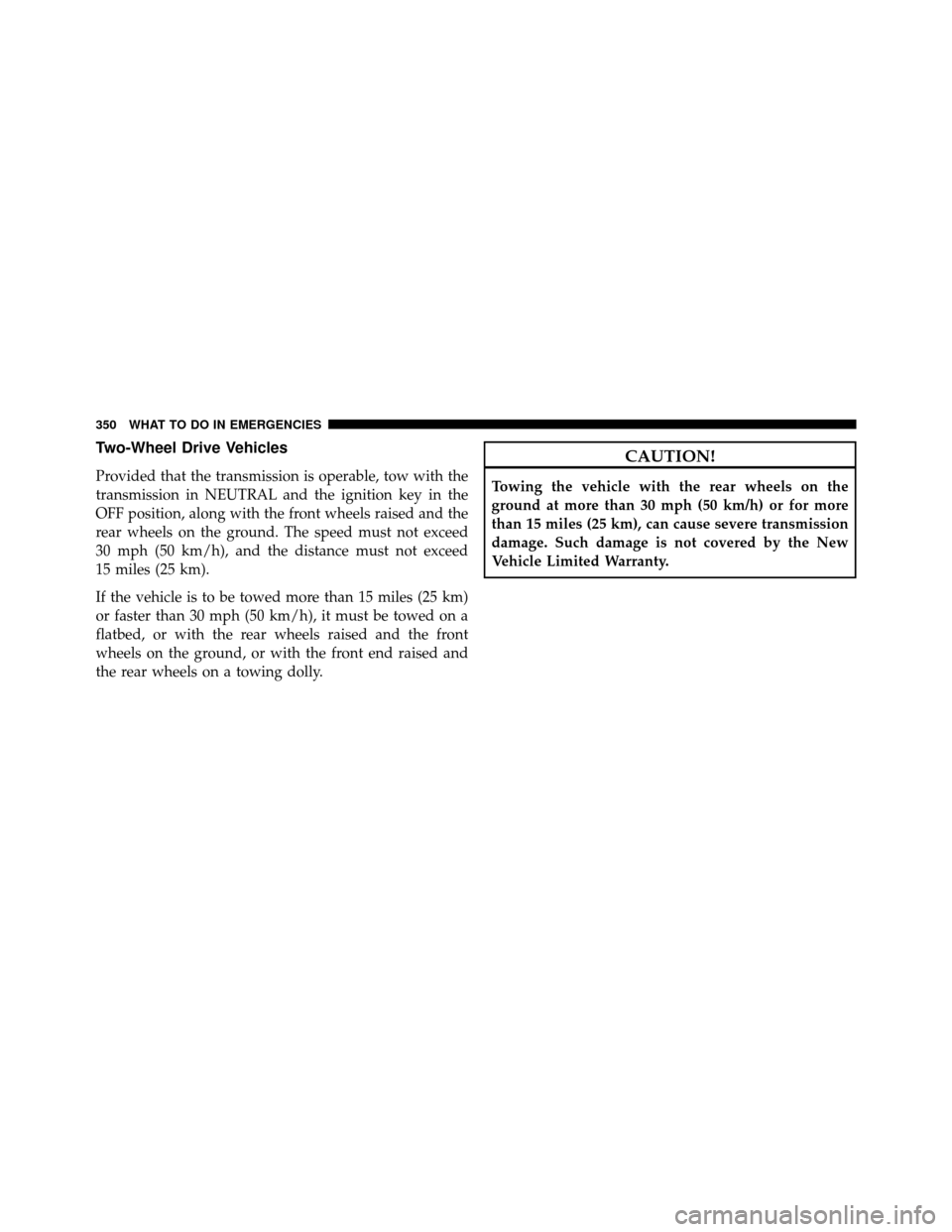
Two-Wheel Drive Vehicles
Provided that the transmission is operable, tow with the
transmission in NEUTRAL and the ignition key in the
OFF position, along with the front wheels raised and the
rear wheels on the ground. The speed must not exceed
30 mph (50 km/h), and the distance must not exceed
15 miles (25 km).
If the vehicle is to be towed more than 15 miles (25 km)
or faster than 30 mph (50 km/h), it must be towed on a
flatbed, or with the rear wheels raised and the front
wheels on the ground, or with the front end raised and
the rear wheels on a towing dolly.
CAUTION!
Towing the vehicle with the rear wheels on the
ground at more than 30 mph (50 km/h) or for more
than 15 miles (25 km), can cause severe transmission
damage. Such damage is not covered by the New
Vehicle Limited Warranty.
350 WHAT TO DO IN EMERGENCIES
Page 356 of 450
ONBOARD DIAGNOSTIC SYSTEM — OBD II
Your vehicle is equipped with a sophisticated onboard
diagnostic system called OBD II. This system monitors
the performance of the emissions, engine, and automatic
transmission control systems. When these systems are
operating properly, your vehicle will provide excellent
performance and fuel economy, as well as engine emis-
sions well within current government regulations.
If any of these systems require service, the OBD II system
will turn on the Malfunction Indicator Light (MIL). It will
also store diagnostic codes and other information to
assist your service technician in making repairs. Al-
though your vehicle will usually be drivable and not
need towing, see your authorized dealer for service as
soon as possible.CAUTION!
•Prolonged driving with the MIL on could cause
further damage to the emission control system. It
could also affect fuel economy and driveability.
The vehicle must be serviced before any emissions
tests can be performed.
•If the MIL is flashing while the engine is running,
severe catalytic converter damage and power loss
will soon occur. Immediate service is required.
Loose Fuel Filler Cap Message
After fuel is added, the vehicle diagnostic system can
determine if the fuel filler cap is possibly loose, improp-
erly installed, or damaged. A “gASCAP” message will be
displayed in the odometer. Tighten the gas cap until a
�clicking�sound is heard. This is an indication that the
gas cap is properly tightened. Press the odometer reset
button to turn the message off. If the problem persists,
7
MAINTAINING YOUR VEHICLE 355