Page 249 of 450
▫Loose Fuel Filler Cap Message ........... 308
� Vehicle Loading ...................... 309
▫ Certification Label ................... 309
▫ Curb Weight ........................ 310
▫ Loading ........................... 310
� Trailer Towing ........................ 311
▫ Common Towing Definitions ............ 312
▫ Trailer Hitch Classification .............. 316
▫ Trailer Towing Weights
(Maximum Trailer Weight Ratings) ........ 317▫
Trailer And Tongue Weight ............. 317
▫ Towing Requirements ................. 318
▫ Towing Tips ........................ 323
� Snowplow .......................... 324
� Recreational Towing
(Behind Motorhome, Etc.) ................ 325
▫ Two-Wheel Drive Models .............. 325
▫ Four-Wheel Drive Models .............. 325
248 STARTING AND OPERATING
Page 257 of 450
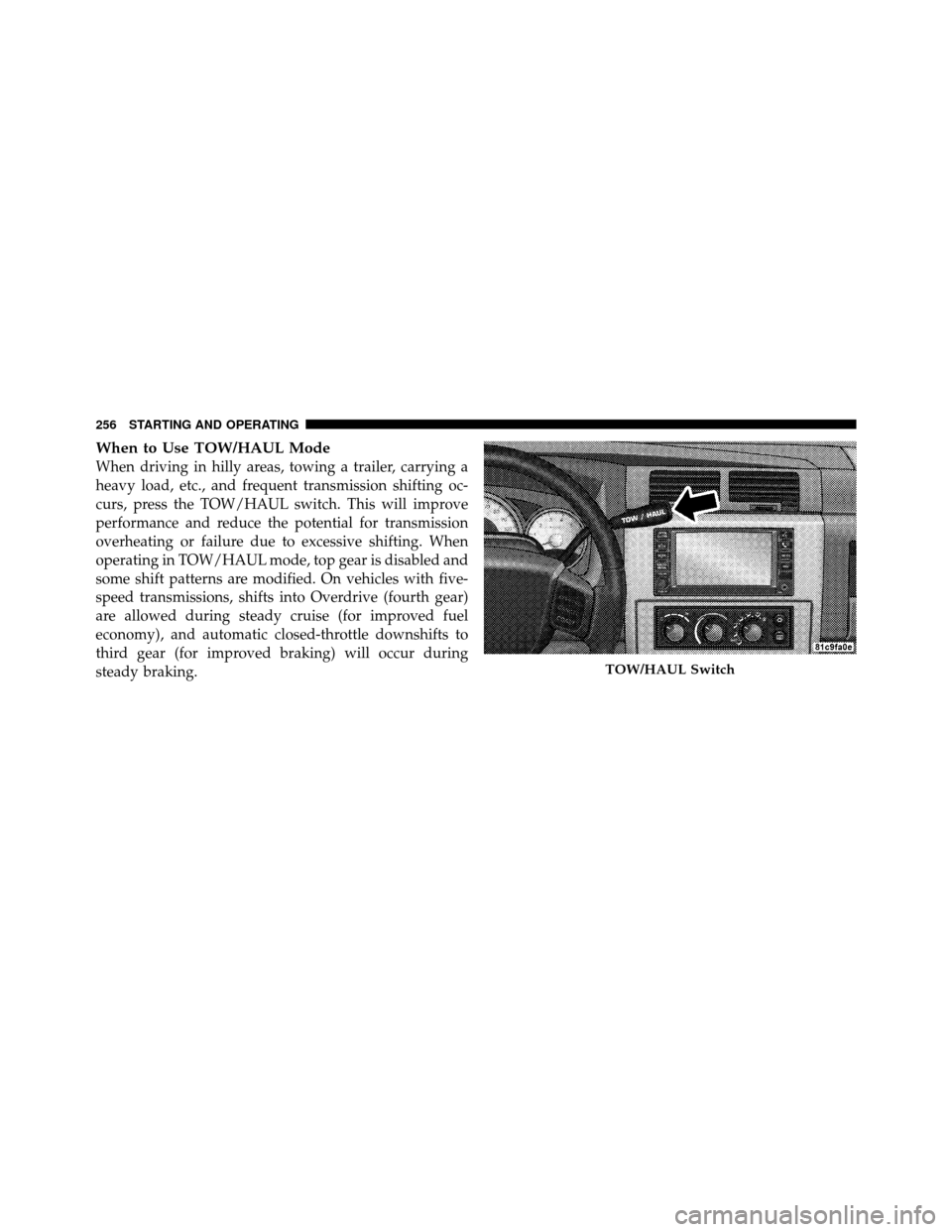
When to Use TOW/HAUL Mode
When driving in hilly areas, towing a trailer, carrying a
heavy load, etc., and frequent transmission shifting oc-
curs, press the TOW/HAUL switch. This will improve
performance and reduce the potential for transmission
overheating or failure due to excessive shifting. When
operating in TOW/HAUL mode, top gear is disabled and
some shift patterns are modified. On vehicles with five-
speed transmissions, shifts into Overdrive (fourth gear)
are allowed during steady cruise (for improved fuel
economy), and automatic closed-throttle downshifts to
third gear (for improved braking) will occur during
steady braking.
TOW/HAUL Switch
256 STARTING AND OPERATING
Page 260 of 450

positions are designed for loose or slippery road surfaces
only. Driving in the 4WD LOCK and 4WD LOW posi-
tions on dry hard-surfaced roads may cause increased
tire wear and damage to the driveline components.
NOTE:The transfer case NEUTRAL position is selected
by pressing the recessed button located on the lower
left-hand corner of the transfer case switch. The transfer
case NEUTRAL position is to be used for recreational
towing only. Refer to “Recreational Towing” in “Starting
and Operating” for further information.
Transfer Case Position Indicator Lights
The Transfer Case Position Indicator Lights (4WD and
4LOW) are located on the instrument cluster. If there is
no indicator light on or flashing, the transfer case is in
two-wheel drive (2WD). If the indicator light is on, the
desired position (4WD LOCK and 4WD LOW) has been
obtained. If one or more shift requirements are not met:
1. An indicator light will flash.
2. The transfer case
will notshift.
NOTE: Before retrying a selection, make certain that all
the necessary requirements for selecting a new transfer
case position have been met. To retry the selection, turn
the transfer case switch back to the current position, wait
five seconds, and retry selection. To find the shift require-
ments, refer to the �Shifting Procedure�for further
information.
The “SVC 4WD Warning Light” monitors the electronic
shift four-wheel drive system. If this light remains on
after engine start-up or illuminates during driving, it
means that the four-wheel drive system is not function-
ing properly and that service is required.
5
STARTING AND OPERATING 259
Page 262 of 450
WARNING!
You or others could be injured if you leave the
vehicle unattended with the transfer case in the
NEUTRAL position without first fully engaging the
parking brake. The transfer case NEUTRAL position
disengages both the front and rear driveshafts from
the powertrain and will allow the vehicle to move
regardless of the transmission position. The parking
brake should always be applied when the driver is
not in the vehicle.
For additional information on the appropriate use of each
transfer case mode position, refer to the following infor-
mation:
2WD
Rear-Wheel Drive High — This range is used for normal
street and highway driving on dry, hard-surfaced roads. 4WD LOCK
Four-Wheel Drive Lock — This range locks the front and
rear driveshafts together forcing the front and rear wheels
to rotate at the same speed. This range provides addi-
tional traction for loose or slippery road surfaces only.
4WD LOW
Four-Wheel Drive Low — This range provides low speed
four-wheel drive. It locks the front and rear driveshafts
together, forcing the front and rear wheels to rotate at the
same speed. This range provides additional traction and
maximum pulling power for loose or slippery road
surfaces only. Do not exceed 25 mph (40 km/h).
N
Neutral — This range disengages both the front and rear
driveshafts from the powertrain, and is used for flat
towing behind another vehicle. Refer to “Recreational
Towing” in “Starting and Operating” for further
information.
5
STARTING AND OPERATING 261
Page 281 of 450
Loading
The vehicle maximum load on the tire must not exceed
the load carrying capacity of the tire on your vehicle. You
will not exceed the tire’s load carrying capacity if you
adhere to the loading conditions, tire size, and cold tire
inflation pressures specified on the Tire and Loading
Information placard and in the “Vehicle Loading” section
of this manual.
NOTE:Under a maximum loaded vehicle condition,
gross axle weight ratings (GAWRs) for the front and rear
axles must not be exceeded. For further information on
GAWRs, vehicle loading, and trailer towing, refer to
“Vehicle Loading” in this section.
To determine the maximum loading conditions of your
vehicle, locate the statement “The combined weight of
occupants and cargo should never exceed XXX lbs or
XXX kg” on the Tire and Loading Information placard. The combined weight of occupants, cargo/luggage and
trailer tongue weight (if applicable) should never exceed
the weight referenced here.
Steps for Determining Correct Load Limit
1. Locate the statement “The combined weight of occu-
pants and cargo should never exceed XXX lbs or XXX kg”
on your vehicle’s placard.
2. Determine the combined weight of the driver and
passengers that will be riding in your vehicle.
3. Subtract the combined weight of the driver and pas-
sengers from XXX lbs or XXX kg.
4.
The resulting figure equals the available amount of cargo
and luggage load capacity. For example, if “XXX” amount
equals 1,400 lbs (635 kg) and there will be five 150 lb (68 kg)
passengers in your vehicle, the amount of available cargo
and luggage load capacity is 650 lbs (295 kg) (since5x150
= 750, and 1400 – 750 = 650 lbs [295 kg]).
280 STARTING AND OPERATING
Page 282 of 450
5. Determine the combined weight of luggage and cargo
being loaded on the vehicle. That weight may not safely
exceed the available cargo and luggage load capacity
calculated in Step 4.
6. If your vehicle will be towing a trailer, load from your
trailer will be transferred to your vehicle. Consult this
manual to determine how this reduces the available
cargo and luggage load capacity of your vehicle.NOTE:
•The following table shows examples on how to calcu-
late total load, cargo/luggage, and towing capacities
of your vehicle with varying seating configurations
and number and size of occupants. This table is for
illustration purposes only and may not be accurate for
the seating and load carry capacity of your vehicle.
•For the following example, the combined weight of
occupants and cargo should never exceed 865 lbs
(392 kg).
5
STARTING AND OPERATING 281
Page 312 of 450
should then be determined separately to be sure that the
load is properly distributed over front and rear axle.
Weighing the vehicle may show that the GAWR of either
the front or rear axles has been exceeded but the total
load is within the specified GVWR. If so, weight must be
shifted from front to rear or rear to front as appropriate
until the specified weight limitations are met.
Store heavier items down low and be sure that the weight
is distributed equally. Stow all loose items securely before
driving.
Improper weight distribution can have an adverse effect
on the way your vehicle steers and handles and the way
the brakes operate.WARNING!
Do not load your vehicle any heavier than the GVWR
or the maximum front and rear GAWR. If you do,
parts on your vehicle can break, or it can change the
way your vehicle handles. This could cause you to
lose control. Also, overloading can shorten the life of
your vehicle.
TRAILER TOWING
In this section you will find safety tips and information
on limits to the type of towing you can reasonably do
with your vehicle. Before towing a trailer carefully re-
view this information to tow your load as efficiently and
safely as possible.
To maintain warranty coverage, follow the requirements
and recommendations in this manual concerning ve-
hicles used for trailer towing.
5
STARTING AND OPERATING 311
Page 313 of 450
Common Towing Definitions
The following trailer towing related definitions will assist
you in understanding the following information:
Gross Vehicle Weight Rating (GVWR)
The GVWR is the total allowable weight of your vehicle.
This includes driver, passengers, cargo and tongue
weight. The total load must be limited so that you do not
exceed the GVWR.
Gross Trailer Weight (GTW)
The GTW is the weight of the trailer plus the weight of all
cargo, consumables and equipment (permanent or tem-
porary) loaded in or on the trailer in its�loaded and
ready for operation� condition. The recommended way to
measure GTW is to put your fully loaded trailer on a
vehicle scale. The entire weight of the trailer must be
supported by the scale.
Gross Combination Weight Rating (GCWR)
The GCWR is the total permissible weight of your vehicle
and trailer when weighed in combination.
NOTE: The GCWR rating includes a 150 lbs (68 kg)
allowance for the presence of a driver.
Gross Axle Weight Rating (GAWR)
The GAWR is the maximum capacity of the front and rear
axles. Distribute the load over the front and rear axles
evenly. Make sure that you do not exceed either front or
rear GAWR.
WARNING!
It is important that you do not exceed the maximum
front or rear GAWR. A dangerous driving condition
can result if either rating is exceeded. You could lose
control of the vehicle and have an accident.
312 STARTING AND OPERATING