Page 324 of 450
Towing Tips
Before setting out on a trip, practice turning, stopping
and backing the trailer in an area away from heavy
traffic.
Automatic Transmission
The “DRIVE” range can be selected when towing. How-
ever, if frequent shifting occurs while in this range, the
TOW/HAUL feature should be selected.
NOTE:Using the TOW/HAUL feature while operating
the vehicle under heavy operating conditions will im-
prove performance and extend transmission life by re-
ducing excessive shifting and heat build up. This action
will also provide better engine braking.
The automatic transmission fluid and filter should be
changed if you REGULARLY tow a trailer for more than
45 minutes of continuous operation. Refer to “Mainte-
nance Schedule” for the proper maintenance intervals.
Seven-Pin Connector
1 — Battery 5 — Ground
2 — Backup Lamps 6 — Left Stop/Turn
3 — Right Stop/Turn 7 — Running Lamps
4 — Electric Brakes
5
STARTING AND OPERATING 323
Page 325 of 450

NOTE:Check the automatic transmission fluid level
before towing.
Tow/Haul – If Equipped
To reduce potential for automatic transmission overheat-
ing, turn the TOW/HAUL feature ON when driving in
hilly areas or shift the transmission to Drive position 2 on
more severe grades.
Electronic Speed Control – If Equipped
Do not use in hilly terrain or with heavy loads.
When using the speed control, if you experience speed
drops greater than 10 mph (16 km/h), disengage until
you can resume cruising speed.
Use speed control in flat terrain and with light loads to
maximize fuel efficiency.
Cooling System
To reduce potential for engine and transmission over-
heating, take the following actions:
City Driving
When stopped for short periods of time, shift the trans-
mission into NEUTRAL and increase engine idle speed.
Highway Driving
Reduce speed.
Air Conditioning
Turn off temporarily.
SNOWPLOW
Snow plows, winches, and other aftermarket equipment
should notbe added to the front end of your vehicle. The
airbag crash sensors may be affected by the change in the
front end structure. The airbags could deploy unexpect-
edly or could fail to deploy during a collision.
324 STARTING AND OPERATING
Page 326 of 450
WARNING!
Do not add a snow plow, winches, or any other
aftermarket equipment to the front of your vehicle.
This could adversely affect the functioning of the
airbag system and you could be injured.
RECREATIONAL TOWING (BEHIND
MOTORHOME, ETC.)
Two-Wheel Drive Models
Recreational towing of two-wheel drive models is not
allowable. Towing the vehicle with the transmission in
NEUTRAL can cause severe transmission damage. Re-
moval of the driveshaft for towing is not recommended,
since this would allow fluid to drain from the
transmission.
Four-Wheel Drive Models
CAUTION!
•Internal damage to the transfer case will occur if a
front or rear wheel lift is used when recreational
towing.
•The transfer case must be shifted into NEUTRAL
for recreational towing. The NEUTRAL button is
located on the lower left hand corner of the trans-
fer case switch. Shifts into and out of transfer case
NEUTRAL can take place with the transfer case
switch in any mode position.
•Automatic transmissions must be placed in PARK
position for recreational towing.
•Failure to follow these procedures can cause se-
vere transmission and/or transfer case damage.
5
STARTING AND OPERATING 325
Page 339 of 450
Preparations
1. Park the vehicle on a firm, level surface. Avoid icy or
slippery areas.
WARNING!
Do not attempt to change a tire on the side of the
vehicle close to moving traffic. Pull far enough off
the road to avoid the danger of being hit when
operating the jack or changing the wheel.
2. Set the parking brake.
3. Place the shift lever in PARK (automatic transmission).
On 4-Wheel Drive vehicles, shift the transfer case to the
4L position.
4. Turn the ignition OFF.
5. Turn on the Hazard Warning flasher. 6. Block both the front and rear of the
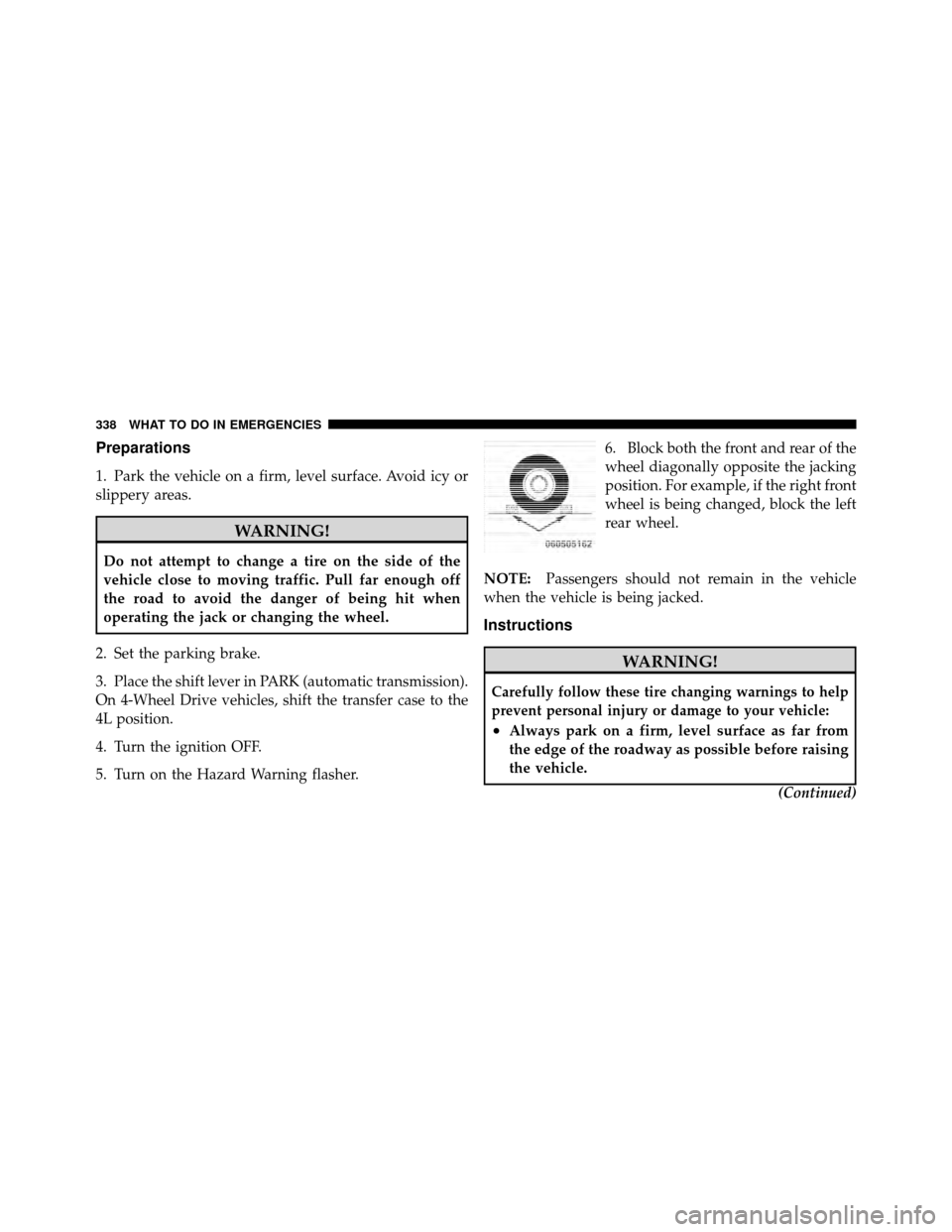
wheel diagonally opposite the jacking
position. For example, if the right front
wheel is being changed, block the left
rear wheel.
NOTE: Passengers should not remain in the vehicle
when the vehicle is being jacked.
Instructions
WARNING!
Carefully follow these tire changing warnings to help
prevent personal injury or damage to your vehicle:
•Always park on a firm, level surface as far from
the edge of the roadway as possible before raising
the vehicle.
(Continued)
338 WHAT TO DO IN EMERGENCIES
Page 340 of 450
WARNING! (Continued)
•Block the wheel diagonally opposite the wheel to
be raised.
•Set the parking brake firmly and set an automatic
transmission in PARK; a manual transmission in
REVERSE.
•Never start or run the engine with the vehicle on a
jack.
•Do not let anyone sit in the vehicle when it is on a
jack.
•Do not get under the vehicle when it is on a jack.
•Only use the jack in the positions indicated and
for lifting this vehicle during a tire change.
•If working on or near a roadway, be extremely
careful of motor traffic.(Continued)
WARNING! (Continued)
•To assure that spare tires, flat or inflated, are
securely stowed, spares must be stowed with the
valve stem facing the ground.
•Turn on the Hazard Warning flasher.
1. Lower and remove the spare wheel, jack, and tools
from stowage.
2. Using the wheel wrench, loosen, but do not remove,
the wheel nuts by turning them counterclockwise one
turn while the wheel is still on the ground.
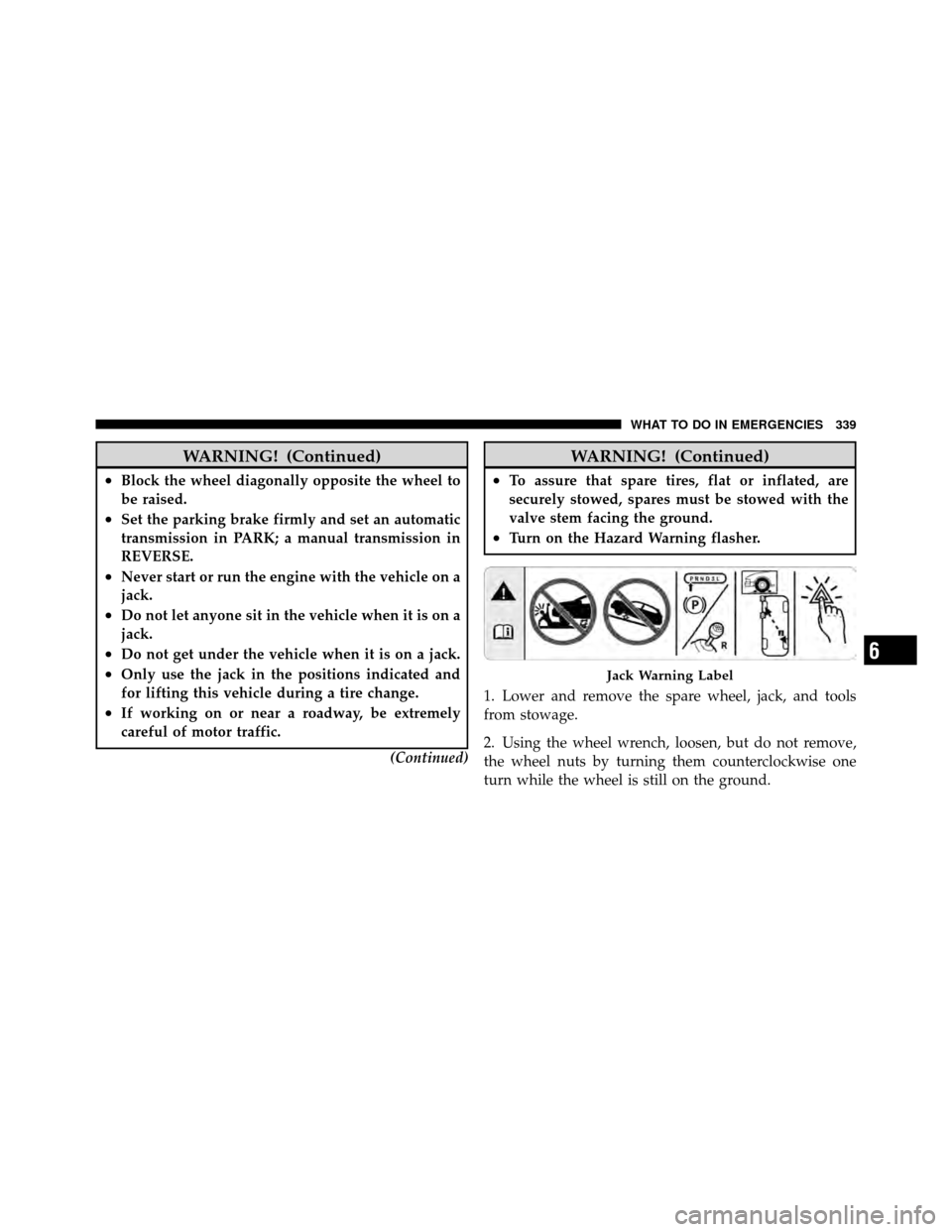
Jack Warning Label
6
WHAT TO DO IN EMERGENCIES 339
Page 346 of 450
WARNING!
•Take care to avoid the radiator cooling fan when-
ever the hood is raised. It can start anytime the
ignition switch is on. You can be injured by
moving fan blades.
•Remove any metal jewelry such as watch bands or
bracelets that might make an inadvertent electrical
contact. You could be seriously injured.
•Batteries contain sulfuric acid that can burn your
skin or eyes and generate hydrogen gas which is
flammable and explosive. Keep open flames or
sparks away from the battery.
1. Set the parking brake, shift the automatic transmission
into PARK and turn the ignition to LOCK.
2. Turn off the heater, radio, and all unnecessary electri-
cal accessories. 3. If using a another vehicle to jump-start the battery,
park the vehicle within the jumper cables reach, set the
parking brake and make sure the ignition is OFF.
WARNING!
Do not allow vehicles to touch each other as this
could establish a ground connection and personal
injury could result.
Jump-Starting Procedure
WARNING!
Failure to follow this procedure could result in per-
sonal injury or property damage due to battery ex-
plosion.
6
WHAT TO DO IN EMERGENCIES 345
Page 353 of 450

▫Exhaust System ..................... 366
▫ Cooling System ..................... 369
▫ Brake System ....................... 374
▫ Automatic Transmission ............... 376
▫ Transfer Case ....................... 379
▫ Axles ............................. 379
▫ Appearance Care And Protection From
Corrosion .......................... 380
� Fuses .............................. 385
▫ Underhood Fuses
(Power Distribution Center) ............. 385
� Vehicle Storage ....................... 390
� Replacement Bulbs .................... 390 �
Bulb Replacement ..................... 391
▫ Headlamp (Halogen)/Front Park And
Turn Signal Lamps ................... 391
▫ Rear Side Marker, Taillamps/Stop Lamps,
And Turn Signal Bulbs ................ 392
▫ Center High-Mounted Stop Lamp And
Cargo Lamp ........................ 395
▫ License Lamps ...................... 397
▫ Fog Lamps ......................... 399
� Fluid Capacities ...................... 399
� Fluids, Lubricants And Genuine Parts ....... 400
▫ Engine ............................ 400
▫ Chassis ........................... 401
352 MAINTAINING YOUR VEHICLE
Page 354 of 450
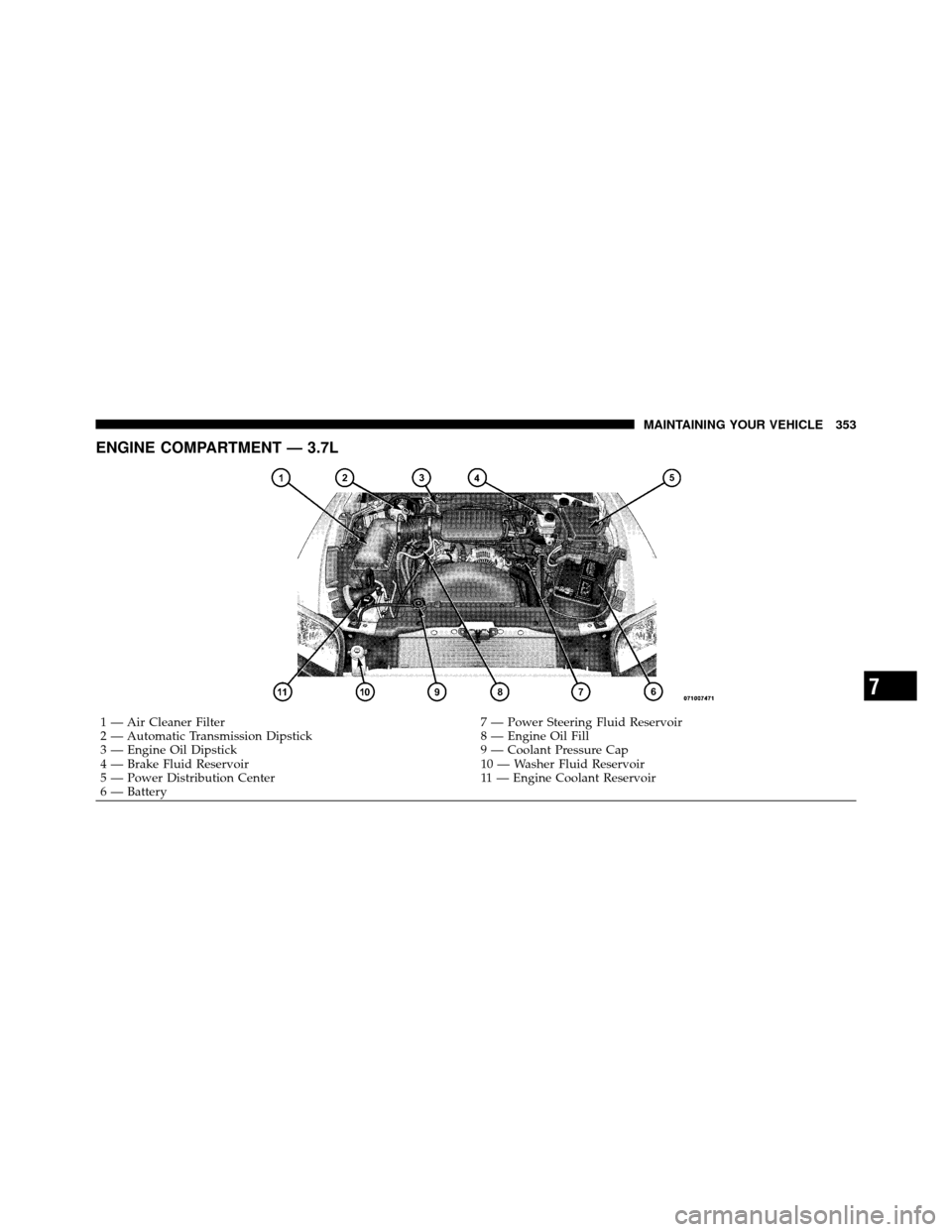
ENGINE COMPARTMENT — 3.7L
1 — Air Cleaner Filter7 — Power Steering Fluid Reservoir
2 — Automatic Transmission Dipstick 8 — Engine Oil Fill
3 — Engine Oil Dipstick 9 — Coolant Pressure Cap
4 — Brake Fluid Reservoir 10 — Washer Fluid Reservoir
5 — Power Distribution Center 11 — Engine Coolant Reservoir
6 — Battery
7
MAINTAINING YOUR VEHICLE 353