Page 248 of 450
�Tire Chains .......................... 290
� Snow Tires .......................... 292
� Tire Rotation Recommendations ........... 292
� Tire Pressure Monitor System (TPMS) ....... 293
▫ Base System ........................ 296
▫ General Information .................. 298
� Fuel Requirements ..................... 298
▫ Reformulated Gasoline ................ 299
▫ Gasoline/Oxygenate Blends ............. 299
▫ E-85 Usage In Non-Flex Fuel Vehicles ...... 300
▫ MMT In Gasoline .................... 300
▫ Materials Added To Fuel ............... 301
▫ Fuel System Cautions ................. 301 ▫
Carbon Monoxide Warnings ............ 302
� Flexible Fuel (4.7L Engine Only) —
If Equipped .......................... 303
▫ E85 General Information ............... 303
▫ Ethanol Fuel (E85) ................... 304
▫ Fuel Requirements ................... 304
▫ Selection Of Engine Oil For Flexible Fuel
Vehicles (E85) And Gasoline Vehicles ...... 305
▫ Starting ........................... 306
▫ Cruising Range ...................... 306
▫ Replacement Parts ................... 306
▫ Maintenance ........................ 306
� Adding Fuel ......................... 307
▫ Fuel Filler Cap (Gas Cap) .............. 307
5
STARTING AND OPERATING 247
Page 267 of 450

CAUTION!
•Always check the depth of the standing water
before driving through it. Never drive through
standing water that is deeper than the bottom of
the tire rims mounted on the vehicle.
•Determine the condition of the road or the path
that is under water and if there are any obstacles in
the way before driving through the standing wa-
ter.
•Do not exceed 5 mph (8 km/h) when driving
through standing water. This will minimize wave
effects.(Continued)
CAUTION! (Continued)
•Driving through standing water may cause dam-
age to your vehicle’s drivetrain components. Al-
ways inspect your vehicle’s fluids (i.e., engine oil,
transmission/transaxle, axle, etc.) for signs of con-
tamination (i.e., fluid that is milky or foamy in
appearance) after driving through standing water.
Do not continue to operate the vehicle if any fluid
appears contaminated, as this may result in further
damage. Such damage is not covered by the New
Vehicle Limited Warranty.
•Getting water inside your vehicle’s engine can
cause it to lock up and stall out, and cause serious
internal damage to the engine. Such damage is not
covered by the New Vehicle Limited Warranty.
266 STARTING AND OPERATING
Page 301 of 450

E-85 Usage In Non-Flex Fuel Vehicles
Non-FFV vehicles are compatible with gasoline contain-
ing 10% ethanol (E10). Gasoline with higher ethanol
content may void the vehicle’s warranty.
If a Non-FFV vehicle is inadvertently fueled with E-85
fuel, the engine will have some or all of these symptoms:
•operate in a lean mode
•OBD II “Malfunction Indicator Light” on
•poor engine performance
•poor cold start and cold drivability
•increased risk for fuel system component corrosion
To fix a Non-FFV vehicle inadvertently fueled once with
E-85 perform the following:
•drain the fuel tank (see your authorized dealer)
•change the engine oil and oil filter
•disconnect and reconnect the battery to reset the
engine controller memory
More extensive repairs will be required for prolonged
exposure to E-85 fuel.
MMT In Gasoline
MMT is a manganese containing metallic additive that is
blended into some gasoline to increase octane. Gasoline
blended with MMT provides no performance advantage
beyond gasoline of the same octane number without
MMT. Gasoline blended with MMT reduces spark plug
life and reduces emission system performance in some
vehicles. The manufacturer recommends that gasoline
without MMT be used in your vehicle. The MMT content
of gasoline may not be indicated on the gasoline pump,
therefore, you should ask your gasoline retailer whether
gasoline contains MMT. It is even more important to look
for gasolines without MMT in Canada, because MMT can
300 STARTING AND OPERATING
Page 306 of 450
For best results, a refueling pattern that avoids alternat-
ing between E85 and unleaded gasoline is recom-
mended.
When you do switch fuel types, it is recommended that:
•you do not add less than 5 gal (19 L) when refueling
•you drive the vehicle immediately after refueling for at
least 5 miles (8 km)
Observing these precautions will avoid possible hard
starting and/or significant deterioration in driveability
during warm up.
NOTE:
•Use seasonally adjusted E85 fuel (ASTM D5798). With
non-seasonally adjusted E85 fuel, you may experience
hard starting and rough idle following start up even if
the above recommendations are followed, especially
when the ambient temperature is below 32°F (0°C).
•Some additives used in regular gasoline are not fully
compatible with E85 and may form deposits in your
engine. To eliminate driveability issues that may be
caused by these deposits, a supplemental gasoline
additive, such as MOPAR� Injector Cleanup or
Techron may be used.
Selection Of Engine Oil For Flexible Fuel Vehicles
(E85) and Gasoline Vehicles
FFV vehicles operated on E85 require specially formu-
lated engine oils. These special requirements are included
in MOPAR� engine oils, and in equivalent oils meeting
Chrysler Specification MS-6395. The manufacturer only
recommends engine oils that are API Certified and meet
the requirements of Material Standard MS-6395. MS-6395
contains additional requirements, developed during ex-
tensive fleet testing, to provide additional protection to
Chrysler Group LLC engines. Use MOPAR� or an
equivalent oil meeting the specification MS-6395.5
STARTING AND OPERATING 305
Page 343 of 450
WARNING!
A loose tire or jack thrown forward in a collision or
hard stop could injure someone in the vehicle. Al-
ways stow the jack, tools and the extra tire and wheel
in the places provided.
8. Lower the jack to its fully closed position. Stow the
replaced tire, jack, and tools as previously described.
9. Adjust the tire pressure when possible.
NOTE: Do not oil wheel studs. For chrome wheels, do
not substitute with chrome plated wheel nuts.
WARNING!
Carefully follow these tire changing warnings to
help prevent personal injury or damage to your
vehicle:
(Continued)
WARNING! (Continued)
•Always park on a firm, level surface as far from
the edge of the roadway as possible before raising
the vehicle.
•Block the wheel diagonally opposite the wheel to
be raised.
•Apply the parking brake firmly before jacking.
•Never start the engine with the vehicle on a jack.
•Do not let anyone sit in the vehicle when it is on a
jack.
•Do not get under the vehicle when it is on a jack.
•Only use the jack in the positions indicated.
•If working on or near a roadway, be extremely
careful of motor traffic.
•To assure that spare tires, flat or inflated, are
securely stowed, spares must be stowed with the
valve stem facing the ground.
342 WHAT TO DO IN EMERGENCIES
Page 352 of 450
MAINTAINING YOUR VEHICLE
CONTENTS
�Engine Compartment — 3.7L ............. 353
� Engine Compartment — 4.7L ............. 354
� Onboard Diagnostic System — OBD II ...... 355
▫ Loose Fuel Filler Cap Message ........... 355
� Emissions Inspection And Maintenance
Programs ............................ 356
� Replacement Parts ..................... 357
� Dealer Service ........................ 358
� Maintenance Procedures ................. 358 ▫
Engine Oil ......................... 359
▫ Engine Oil Filter ..................... 361
▫ Engine Air Cleaner Filter ............... 362
▫ Maintenance-Free Battery .............. 362
▫ Air Conditioner Maintenance ............ 363
▫ Body Lubrication .................... 364
▫ Windshield Wiper Blades ............... 365
▫ Adding Washer Fluid ................. 365
7
Page 354 of 450
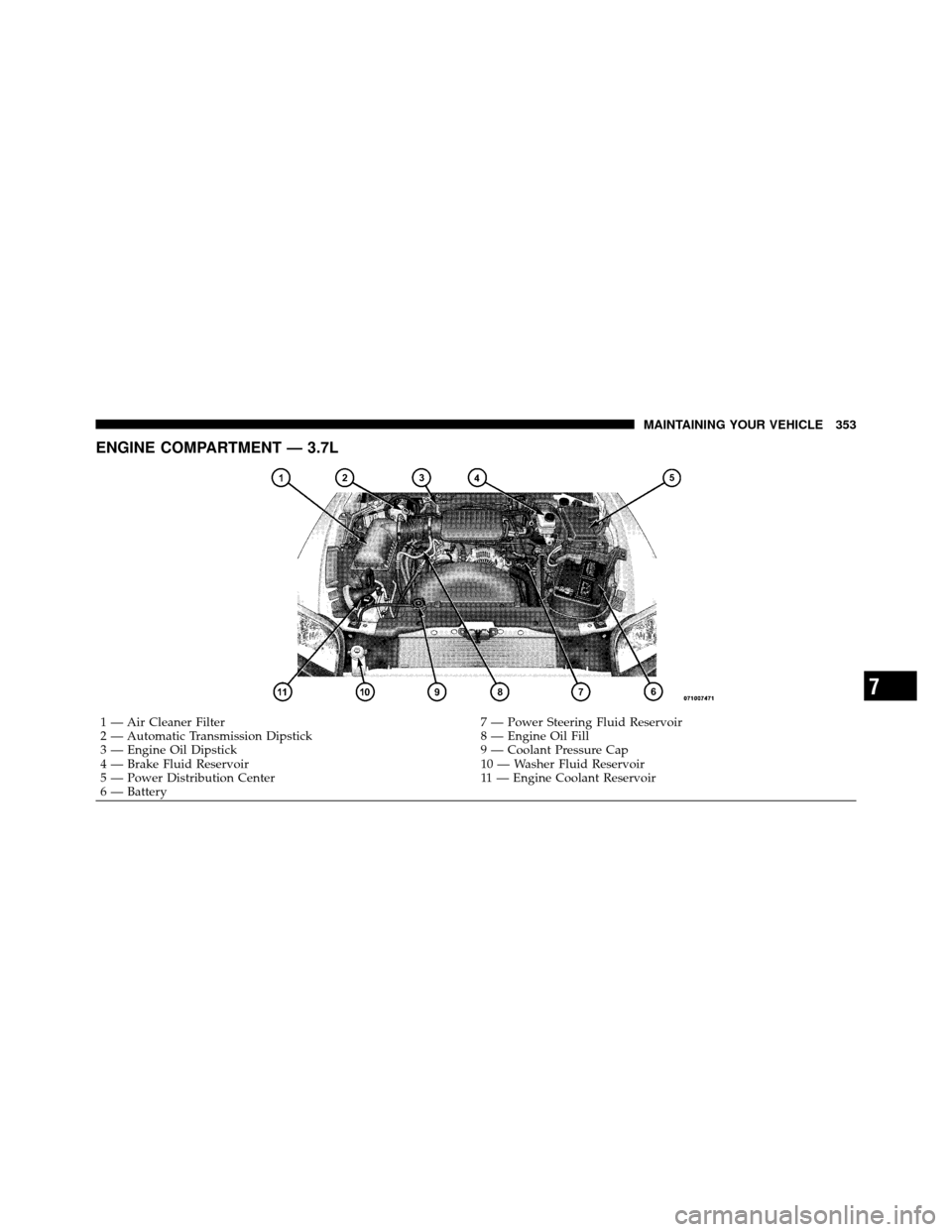
ENGINE COMPARTMENT — 3.7L
1 — Air Cleaner Filter7 — Power Steering Fluid Reservoir
2 — Automatic Transmission Dipstick 8 — Engine Oil Fill
3 — Engine Oil Dipstick 9 — Coolant Pressure Cap
4 — Brake Fluid Reservoir 10 — Washer Fluid Reservoir
5 — Power Distribution Center 11 — Engine Coolant Reservoir
6 — Battery
7
MAINTAINING YOUR VEHICLE 353
Page 355 of 450
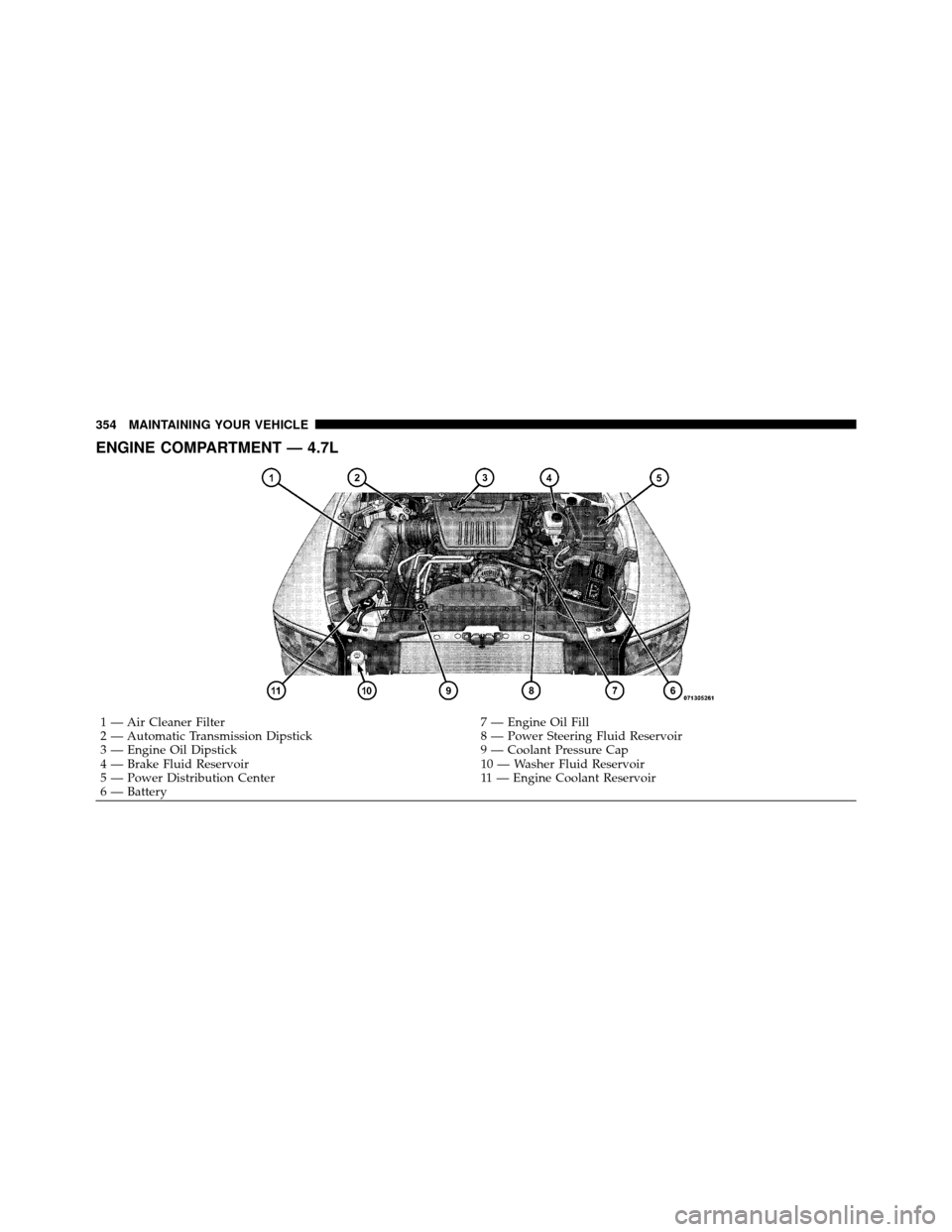
ENGINE COMPARTMENT — 4.7L
1 — Air Cleaner Filter7 — Engine Oil Fill
2 — Automatic Transmission Dipstick 8 — Power Steering Fluid Reservoir
3 — Engine Oil Dipstick 9 — Coolant Pressure Cap
4 — Brake Fluid Reservoir 10 — Washer Fluid Reservoir
5 — Power Distribution Center 11 — Engine Coolant Reservoir
6 — Battery
354 MAINTAINING YOUR VEHICLE