Page 377 of 450

WARNING! (Continued)
•Do not allow petroleum based fluid to contami-
nate the brake fluid. Brake seal components could
be damaged, causing partial or complete brake
failure. This could result in an accident.
Automatic Transmission
NOTE:If your vehicle is equipped with a dipstick, use
the following procedure. If your vehicle has a capped
dipstick, it is sealed and should not be tampered with.
Your authorized dealer has the proper tools to ensure that
the fluid level is set properly.
Fluid Level Check
Check the fluid level while the transmission is at normal
operating temperature 180° F (82° C). This occurs after at
least 15 miles (24 km) of driving. At normal operating
temperature the fluid cannot be held comfortably be-
tween the fingertips. To check the automatic transmission fluid level properly,
the following procedure must be used:
1. Operate the engine at idle speed and normal operating
temperature.
2. The vehicle must be on level ground.
3. Fully apply the parking brake and press the brake
pedal.
4. Place the shift lever momentarily into each gear posi-
tion, ending with the shift lever in PARK.
5. Remove the dipstick, wipe it clean and reinsert it until
seated.
6. Remove the dipstick again and note the fluid level on
both sides. The fluid level should be between the “HOT”
(upper) reference holes on the dipstick at normal operat-
ing temperature. Verify that solid coating of oil is seen on
both sides of the dipstick. If the fluid is low, add as
376 MAINTAINING YOUR VEHICLE
Page 379 of 450
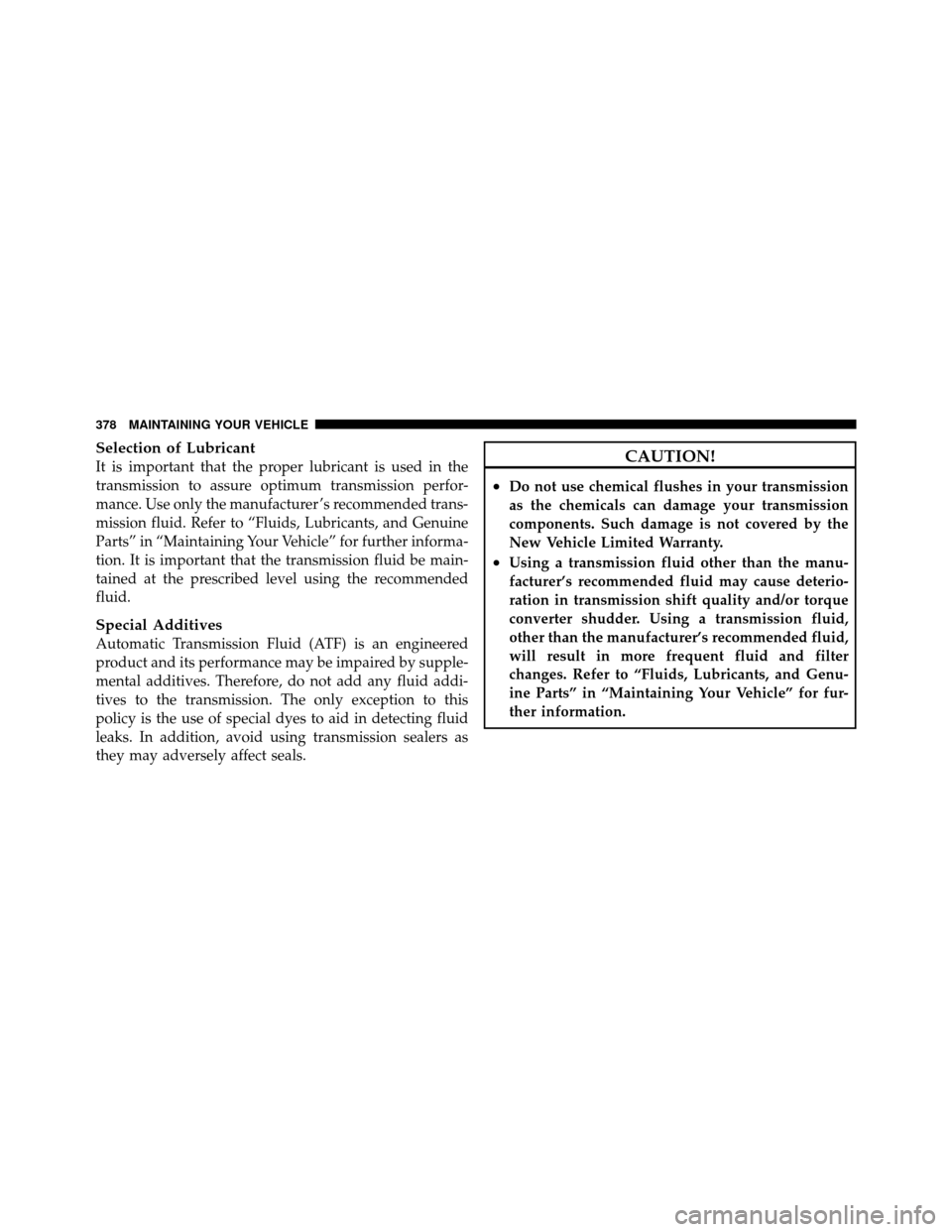
Selection of Lubricant
It is important that the proper lubricant is used in the
transmission to assure optimum transmission perfor-
mance. Use only the manufacturer ’s recommended trans-
mission fluid. Refer to “Fluids, Lubricants, and Genuine
Parts” in “Maintaining Your Vehicle” for further informa-
tion. It is important that the transmission fluid be main-
tained at the prescribed level using the recommended
fluid.
Special Additives
Automatic Transmission Fluid (ATF) is an engineered
product and its performance may be impaired by supple-
mental additives. Therefore, do not add any fluid addi-
tives to the transmission. The only exception to this
policy is the use of special dyes to aid in detecting fluid
leaks. In addition, avoid using transmission sealers as
they may adversely affect seals.
CAUTION!
•Do not use chemical flushes in your transmission
as the chemicals can damage your transmission
components. Such damage is not covered by the
New Vehicle Limited Warranty.
•Using a transmission fluid other than the manu-
facturer’s recommended fluid may cause deterio-
ration in transmission shift quality and/or torque
converter shudder. Using a transmission fluid,
other than the manufacturer’s recommended fluid,
will result in more frequent fluid and filter
changes. Refer to “Fluids, Lubricants, and Genu-
ine Parts” in “Maintaining Your Vehicle” for fur-
ther information.
378 MAINTAINING YOUR VEHICLE
Page 386 of 450
FUSES
CAUTION!
When replacing a blown fuse, it is important to use
only a fuse having the correct amperage rating. The
use of a fuse with a rating other than indicated may
result in a dangerous electrical system overload. If a
properly rated fuse continues to blow, it suggests a
problem in the circuit that must be corrected.
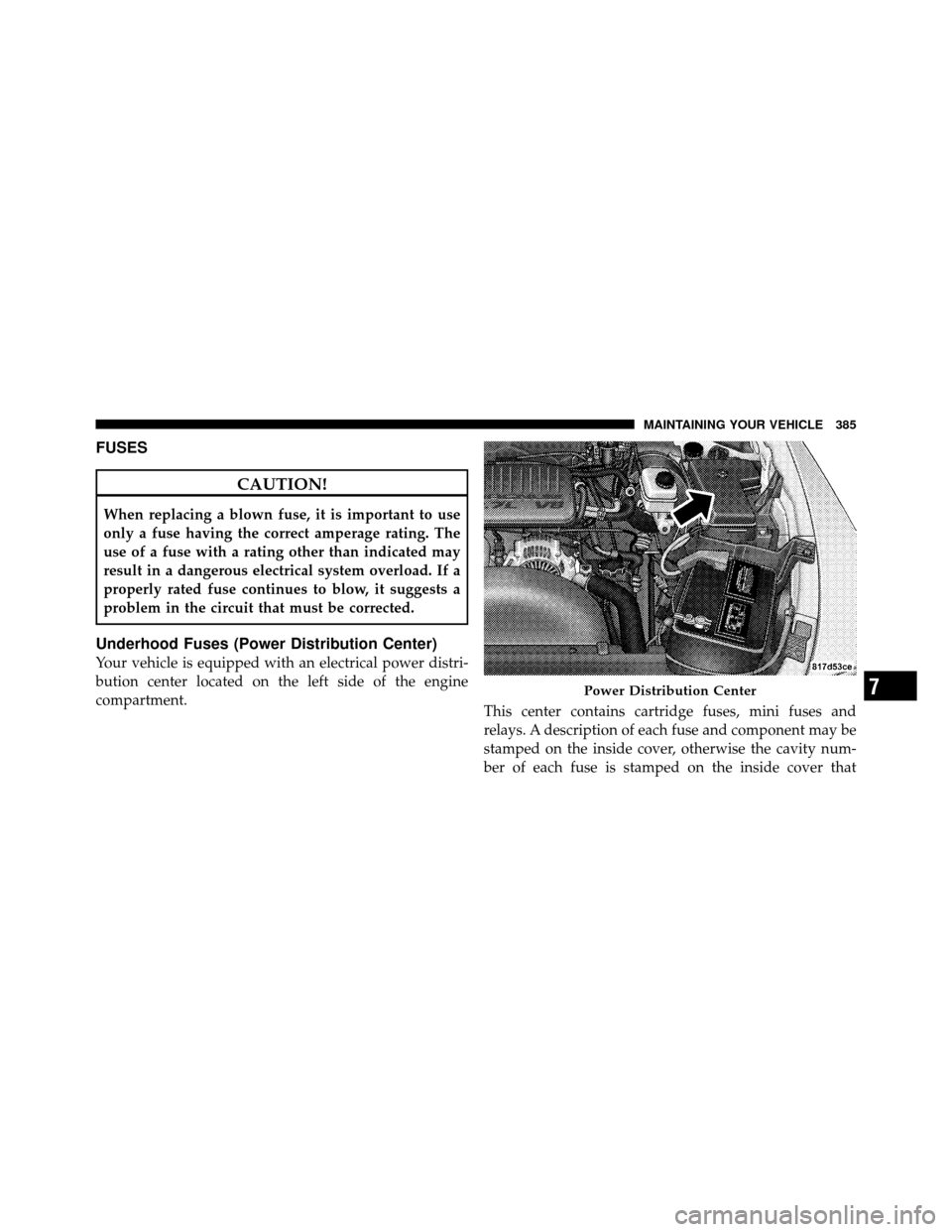
Underhood Fuses (Power Distribution Center)
Your vehicle is equipped with an electrical power distri-
bution center located on the left side of the engine
compartment.This center contains cartridge fuses, mini fuses and
relays. A description of each fuse and component may be
stamped on the inside cover, otherwise the cavity num-
ber of each fuse is stamped on the inside cover that
Power Distribution Center7
MAINTAINING YOUR VEHICLE 385
Page 400 of 450
Fog Lamps
1. Disconnect connector from the fog lamp by raising the
wire harness lock tab and pulling on wire harness
connector.2. Rotate the bulb 1/4-turn counterclockwise and pull to
remove from the fog lamp housing.
3. Reverse procedure to install.
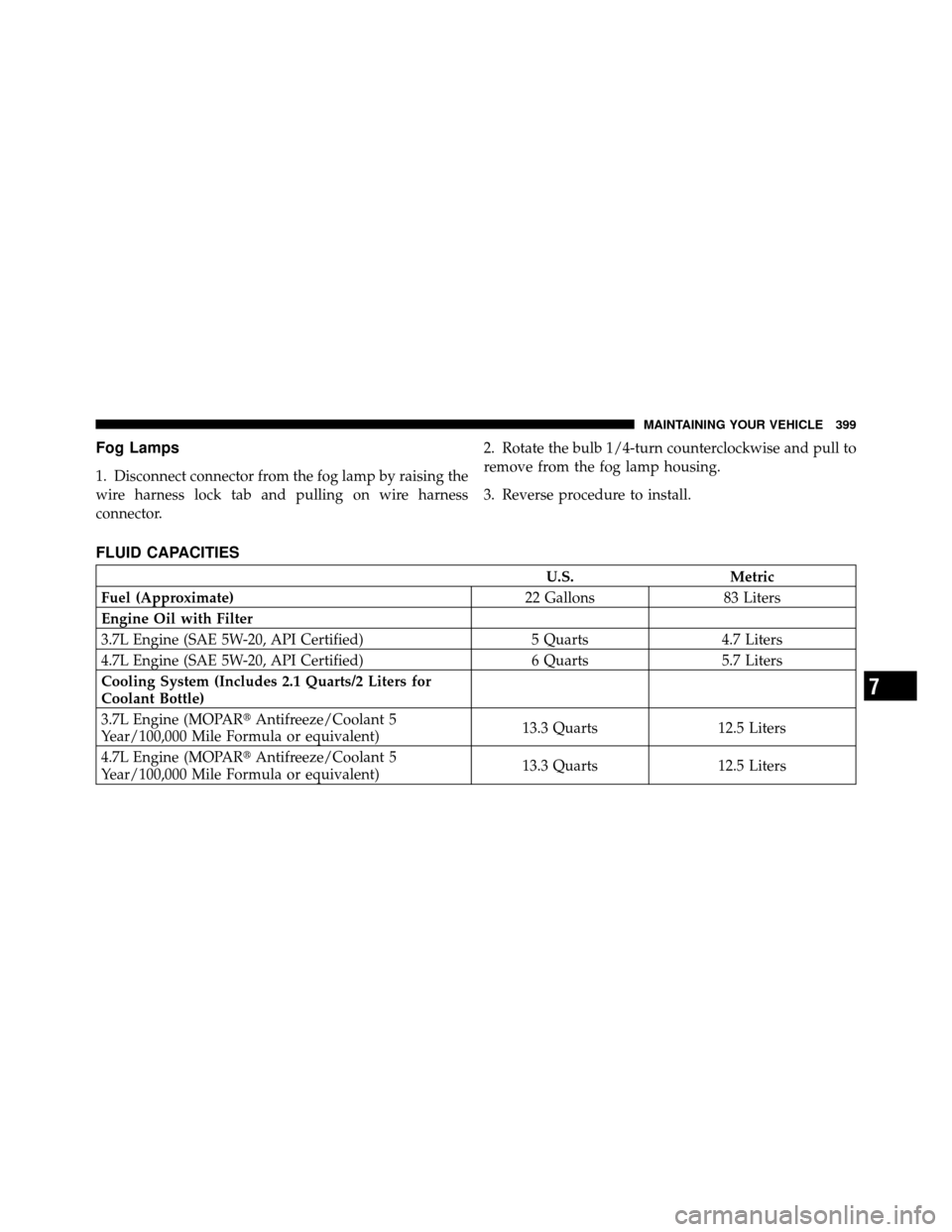
FLUID CAPACITIES
U.S.
Metric
Fuel (Approximate) 22 Gallons83 Liters
Engine Oil with Filter
3.7L Engine (SAE 5W-20, API Certified) 5 Quarts4.7 Liters
4.7L Engine (SAE 5W-20, API Certified) 6 Quarts5.7 Liters
Cooling System (Includes 2.1 Quarts/2 Liters for
Coolant Bottle)
3.7L Engine (MOPAR� Antifreeze/Coolant 5
Year/100,000 Mile Formula or equivalent) 13.3 Quarts
12.5 Liters
4.7L Engine (MOPAR� Antifreeze/Coolant 5
Year/100,000 Mile Formula or equivalent) 13.3 Quarts
12.5 Liters
7
MAINTAINING YOUR VEHICLE 399
Page 401 of 450
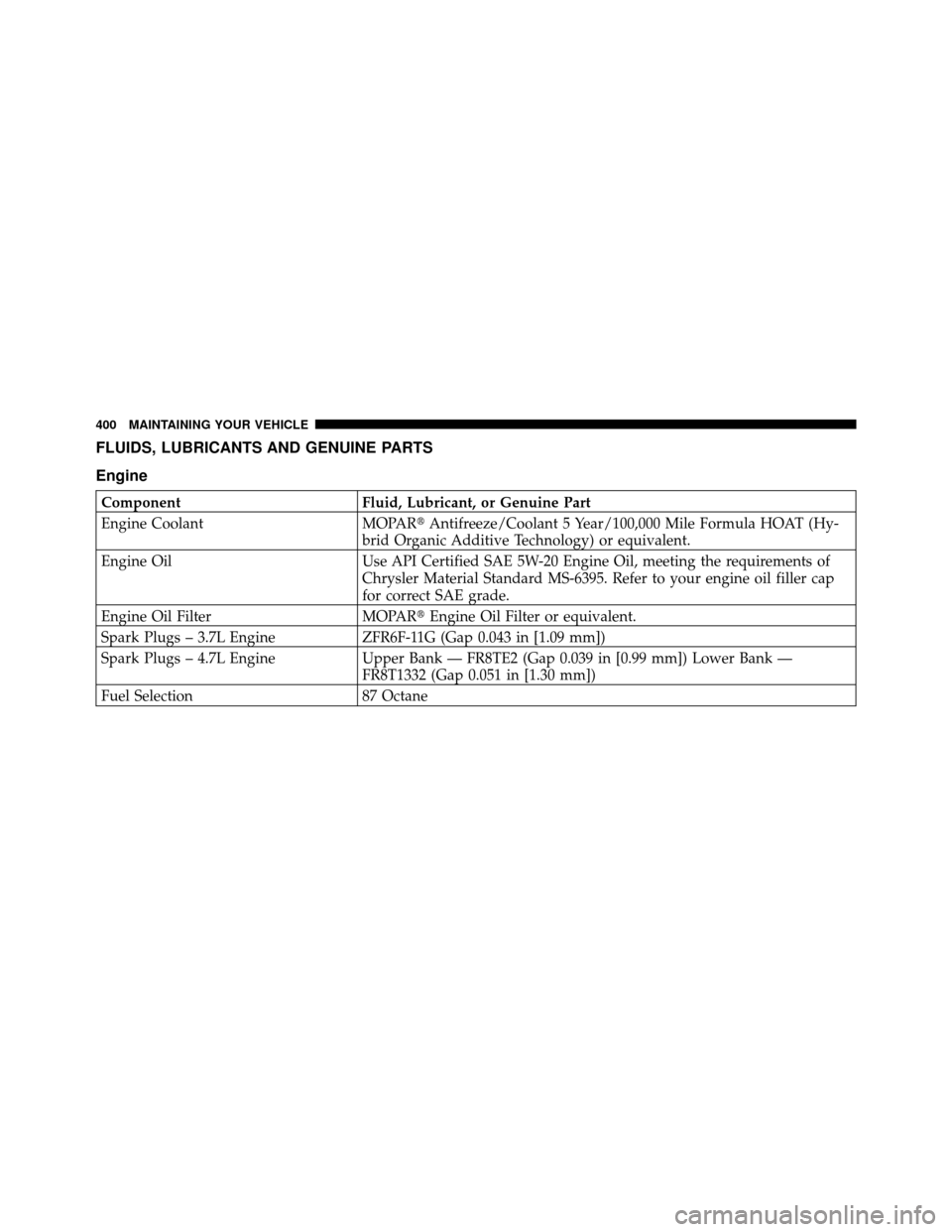
FLUIDS, LUBRICANTS AND GENUINE PARTS
Engine
ComponentFluid, Lubricant, or Genuine Part
Engine Coolant MOPAR�Antifreeze/Coolant 5 Year/100,000 Mile Formula HOAT (Hy-
brid Organic Additive Technology) or equivalent.
Engine Oil Use API Certified SAE 5W-20 Engine Oil, meeting the requirements of
Chrysler Material Standard MS-6395. Refer to your engine oil filler cap
for correct SAE grade.
Engine Oil Filter MOPAR�Engine Oil Filter or equivalent.
Spark Plugs – 3.7L Engine ZFR6F-11G (Gap 0.043 in [1.09 mm])
Spark Plugs – 4.7L Engine Upper Bank — FR8TE2 (Gap 0.039 in [0.99 mm]) Lower Bank —
FR8T1332 (Gap 0.051 in [1.30 mm])
Fuel Selection 87 Octane
400 MAINTAINING YOUR VEHICLE
Page 405 of 450
EMISSIONS CONTROL SYSTEM MAINTENANCE
The Scheduled Maintenance services listed inbold type
must be done at the times or mileages specified to ensure
the continued proper functioning of the emissions control
system. These and all other maintenance services in-
cluded in this manual, should be done to provide best
vehicle performance and reliability. More frequent main-
tenance may be needed for vehicles in severe operating
conditions, such as dusty areas and very short trip
driving.
Inspection and service should also be done anytime a
malfunction is suspected.
NOTE: Maintenance, replacement or repair of the emis-
sions control devices and systems on your vehicle may be
performed by any automotive repair establishment or
individual using any automotive part that has been
certified pursuant to U.S. EPA or in the State of Califor-
nia, California Air Resources Board regulations.
MAINTENANCE SCHEDULE
The oil change indicator system will remind you that it is
time to take your vehicle in for scheduled maintenance.
The “Change Oil” message will flash in the instrument
cluster odometer and a single chime will sound, indicat-
ing that an oil change is necessary.
Based on engine operation conditions the oil change
indicator message will illuminate, this means that service
is required for your vehicle. Have your vehicle serviced
as soon as possible, within the next 500 miles (805 km).
NOTE:
•The oil change indicator message will not monitor the
time since the last oil change. Change your vehicle’s
oil if it has been six months since your last oil change,
even if the oil change indicator message is NOT
illuminated.
8
M A I
N T
E
N A
N CE
S
C
H E
D
U L
E
S404 MAINTENANCE SCHEDULES
Page 406 of 450
•Change your engine oil more often if you drive your
vehicle off-road for an extended period of time.
•Under no circumstances should oil change intervals
exceed 6,000 miles (10,000 km) or six months, which-
ever comes first.
Your authorized dealer will reset the oil change indicator
message after completing the scheduled oil change. If a
scheduled oil change is performed by someone other
than your authorized dealer, the message can be reset by
referring to the steps described under “Electronic Vehicle
Information Center (EVIC)/Oil Change Required” in
“Understanding Your Instrument Panel” or under “In-
strument Cluster Description/Odometer/Trip Odom-
eter” in “Understanding Your Instrument Panel” for
further information. At Each Stop for Fuel
•Check the engine oil level about five minutes after a
fully warmed engine is shut off. Checking the oil level
while the vehicle is on level ground will improve the
accuracy of the oil level reading. Add oil only when
the level is at or below the ADD or MIN mark.
•Check the windshield washer solvent and add if
required.
Once a Month
•Check tire pressure and look for unusual wear or
damage.
•Inspect the battery, and clean and tighten the terminals
as required.
8
M A I
N T
E
N A
N CE
S
C
H E
D
U L
E
SMAINTENANCE SCHEDULES 405
Page 407 of 450
•Check the fluid levels of the coolant reservoir, brake
master cylinder, power steering and transmission, and
add as needed.
•Check all lights and other electrical items for correct
operation.
At Each Oil Change
•Change the engine oil filter.
•Inspect the brake hoses and lines.
CAUTION!
Failure to perform the required maintenance items
may result in damage to the vehicle.
Required Maintenance Intervals
NOTE: ** Vehicles built with the 4.7L engine are
equipped with sixteen spark plugs, one set is located on
the top of the engine under the coils, and the second set
is located on the side of the engine.
The spark plugs located under the coils are a standard
plug, and must be changed every 48,000 miles
(80 000 km).
The spark plugs located on the side of the engine are a
premium plug, and must be changed every 96,000 miles
(160 000 km).
8
M A I
N T
E
N A
N CE
S
C
H E
D
U L
E
S406 MAINTENANCE SCHEDULES