2010 DODGE CHALLENGER SRT brake light
[x] Cancel search: brake lightPage 274 of 436

Hill Start Assist (HSA) – Manual Transmission
Only
The HSA system is designed to assist the driver when
starting a vehicle from a stop on a hill. HSA will maintain
the level of brake pressure the driver applied for a short
period of time after the driver takes their foot off of the
brake pedal. If the driver does not apply the throttle
during this short period of time, the system will release
brake pressure and the vehicle will roll down the hill. The
system will release brake pressure in proportion to
amount of throttle applied as the vehicle starts to move in
the intended direction of travel.
HSA Activation Criteria
The following criteria must be met in order for HSA to
activate:
•Vehicle must be stopped.
•Vehicle must be on a 7% grade or greater hill.
•Gear selection matches vehicle uphill direction (i.e.,
vehicle facing uphill is in forward gear; vehicle back-
ing uphill is in REVERSE gear).
WARNING!
There may be situations on minor hills (i.e., less than
8%), with a loaded vehicle, or while pulling a trailer,
when the system will not activate and slight rolling
may occur. This could cause a collision with another
vehicle or object. Always remember the driver is
responsible for braking the vehicle.
Disabling/Enabling HSA
If you wish to turn on or off the HSA system, it can be
done using the Customer Programmable Features in the
Electronic Vehicle Information Center (EVIC). Refer to
“Electronic Vehicle Information Center (EVIC)” in “Un-
derstanding Your Instrument Panel” for further informa-
tion.
5
STARTING AND OPERATING 273
Page 275 of 436

For vehicles not equipped with the EVIC, perform the
following steps:
NOTE:You must complete Steps 1 through 8 within
90 seconds.
1. Center the steering wheel (front wheels pointing
straight forward).
2. Shift the transmission into NEUTRAL.
3. Apply the parking brake.
4. Start the engine.
5. Release the clutch pedal.
6. Rotate the steering wheel one-half turn to the left.
7. Press the “ESP OFF” switch (located in the lower
switch bank below the climate controls) four times within
20 seconds. The “ESP/TCS Indicator Light” should turn
on and turn off two times. 8. Rotate the steering wheel back to center and then an
additional half-turn to the right.
9. Turn the ignition switch to the OFF position and then
back to the ON position. If the sequence was completed
properly, the “ESP/TCS Indicator Light” will blink sev-
eral times to confirm HSA is disabled.
10. Repeat these steps if you want to return this feature
to it’s previous setting.
Electronic Stability Program (ESP)
This system enhances directional control and stability of
the vehicle under various driving conditions. The ESP
corrects for oversteering and understeering the vehicle
by applying the brake of the appropriate wheel. Engine
power may also be reduced to assist in counteracting the
condition of oversteer or understeer and help the vehicle
maintain the desired path.
274 STARTING AND OPERATING
Page 276 of 436

The ESP uses sensors in the vehicle to determine the path
that the driver intends to steer the vehicle and compares
it to the actual path of the vehicle. When the actual path
does not match the intended path, the ESP applies the
brake of the appropriate wheel to assist in counteracting
the condition of oversteer or understeer.
•Oversteer - when the vehicle is turning more than
appropriate for the steering wheel position.
•Understeer - when the vehicle is turning less than
appropriate for the steering wheel position.The “ESP/TCS Indicator Light” located in the
instrument cluster, starts to flash as soon as the
tires lose traction and the ESP system becomes
active. The “ESP/TCS Indicator Light” also
flashes when TCS is active. If the “ESP/TCS Indicator
Light” begins to flash during acceleration, ease up on the accelerator and apply as little throttle as possible. Be sure
to adapt your speed and driving to the prevailing road
conditions.
WARNING!
The ESP cannot prevent the natural laws of physics
from acting on the vehicle, nor can it increase the
traction afforded by prevailing road conditions. The
ESP cannot prevent accidents, including those result-
ing from excessive speed in turns, driving on very
slippery surfaces, or hydroplaning. Only a safe, at-
tentive, and skillful driver can prevent accidents. The
capabilities of an ESP-equipped vehicle must never
be exploited in a reckless or dangerous manner that
could jeopardize the user’s safety or the safety of
others.
5
STARTING AND OPERATING 275
Page 279 of 436

across an axle quite similarly to a limited slip differential.
If one wheel on an axle is spinning faster than the other,
the system will apply the brake of the spinning wheel
and allow more engine torque to be applied to the wheel
that is not spinning. To improve the vehicle’s traction
when driving with tire chains, or when starting off in
deep snow, sand, or gravel, it may be desirable to switch
to the “Partial Off” mode by momentarily pressing the
“ESP OFF” switch.
WARNING!
With the ESP switched OFF, the enhanced vehicle
stability offered by ESP is unavailable. In an emer-
gency evasive maneuver, the ESP system will not
engage to assist in maintaining stability. The “Full
Off” ESP mode is intended for off-highway or off-
road only.
Synchronizing ESP
The Malfunction Indicator Light for the ESP is
combined with BAS indicator. If the power
supply is interrupted (battery disconnected or
discharged), the “ESP/BAS Malfunction Indi-
cator Light” may illuminate with the engine running. If
this should occur, turn the steering wheel completely to
the left and then to the right. The “ESP/BAS Malfunction
Indicator Light” should go out. However, if the light
remains on, have the ESP and BAS checked at your
authorized dealer as soon as possible.
278 STARTING AND OPERATING
Page 360 of 436

•Do not change the thermostat for Summer or Winter
operation. If replacement is ever necessary, install
ONLY the correct type thermostat. Other designs may
result in unsatisfactory coolant performance, poor gas
mileage, and increased emissions.
Brake System
In order to assure brake system performance, all brake
system components should be inspected periodically.
Refer to “Maintenance Schedule” for further information.
WARNING!
Riding the brakes can lead to brake failure and
possibly an accident. Driving with your foot resting
or riding on the brake pedal can result in abnormally
high brake temperatures, excessive lining wear, and
possible brake damage. You would not have your full
braking capacity in an emergency.
Master Cylinder – Brake Fluid Level Check
Check the fluid level in the master cylinder immediately
if the “Brake Warning Light” indicates system failure.
Check the fluid level in the master cylinder when per-
forming underhood services.
Clean the top of the master cylinder area before removing
the cap. Add fluid to bring the level up to the “MAX”
mark on the side of the master cylinder reservoir.
Overfilling of fluid is not recommended because it may
cause leaking in the system.
Add enough fluid to bring the level up to the require-
ments described on the brake fluid reservoir. With disc
brakes, fluid level can be expected to fall as the brake
pads wear. However, low fluid level may be caused by a
leak and a checkup may be needed.
7
MAINTAINING YOUR VEHICLE 359
Page 389 of 436

Once a Month
•Check tire pressure and look for unusual wear or
damage.
•Inspect the battery, and clean and tighten the terminals
as required.
•Check the fluid levels of the coolant reservoir, brake
master cylinder, and power steering, and add as
needed.
•Check all lights and other electrical items for correct
operation.At Each Oil Change
•Change the engine oil filter.
•Inspect the brake hoses and lines.
CAUTION!
Failure to perform the required maintenance items
may result in damage to the vehicle.
Required Maintenance Intervals
Refer to the Maintenance Schedules on the following
pages for the required maintenance intervals.
8
M
A I
N T
E
N A
N CE
S
C
H E
D
U L
E
S388 MAINTENANCE SCHEDULES
Page 417 of 436
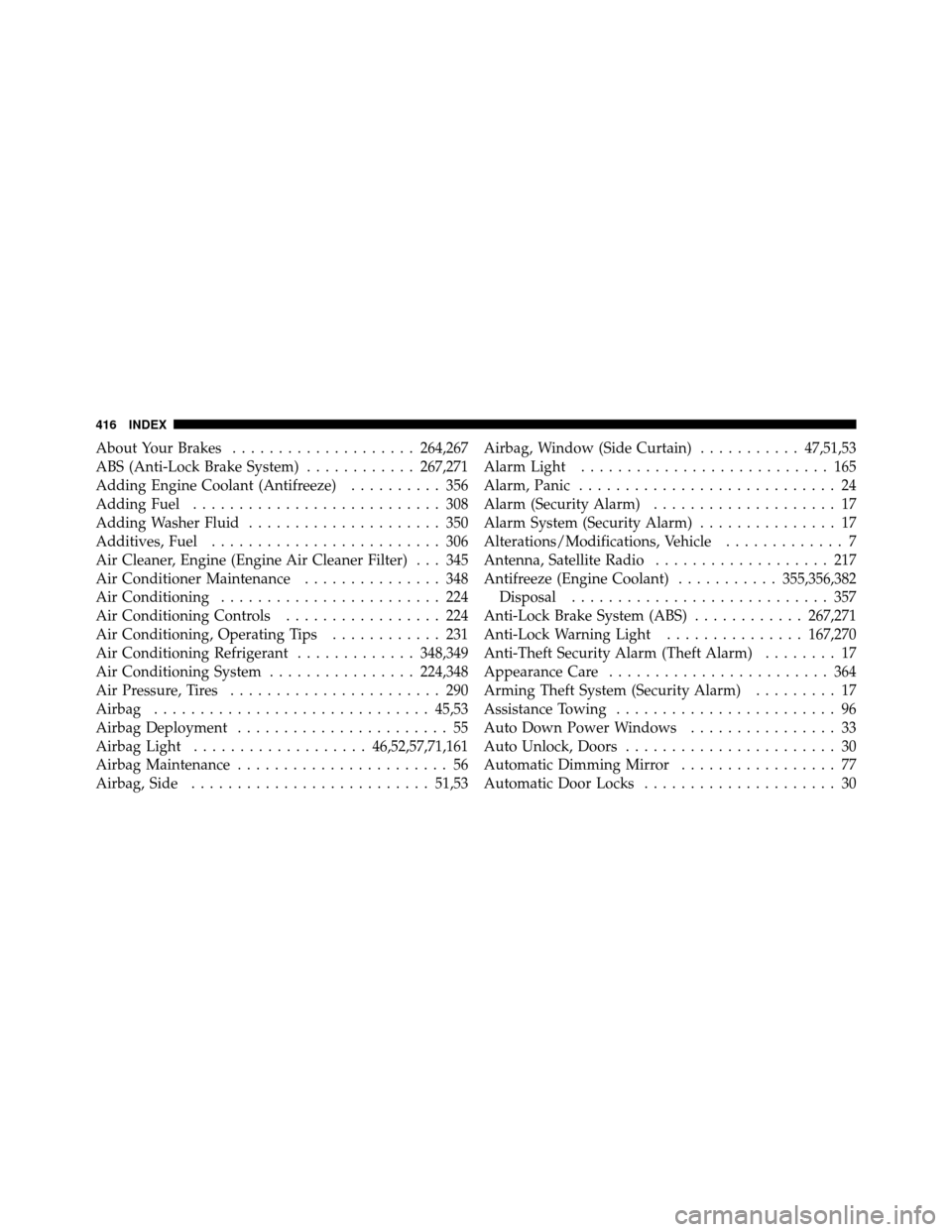
About Your Brakes.................... 264,267
ABS (Anti-Lock Brake System) ............267,271
Adding Engine Coolant (Antifreeze) .......... 356
Adding Fuel ........................... 308
Adding Washer Fluid ..................... 350
Additives, Fuel ......................... 306
Air Cleaner, Engine (Engine Air Cleaner Filter) . . . 345
Air Conditioner Maintenance ............... 348
Air Conditioning ........................ 224
Air Conditioning Controls ................. 224
Air Conditioning, Operating Tips ............ 231
Air Conditioning Refrigerant .............348,349
Air Conditioning System ................224,348
Air Pressure, Tires ....................... 290
Airbag .............................. 45,53
Airbag Deployment ....................... 55
Airbag Light ................... 46,52,57,71,161
Airbag Maintenance ....................... 56
Airbag, Side .......................... 51,53Airbag, Window (Side Curtain)
...........47,51,53
Alarm Light ........................... 165
Alarm, Panic ............................ 24
Alarm (Security Alarm) .................... 17
Alarm System (Security Alarm) ............... 17
Alterations/Modifications, Vehicle ............. 7
Antenna, Satellite Radio ................... 217
Antifreeze (Engine Coolant) ...........355,356,382
Disposal ............................ 357
Anti-Lock Brake System (ABS) ............267,271
Anti-Lock Warning Light ...............167,270
Anti-Theft Security Alarm (Theft Alarm) ........ 17
Appearance Care ........................ 364
Arming Theft System (Security Alarm) ......... 17
Assistance Towing ........................ 96
Auto Down Power Windows ................ 33
Auto Unlock, Doors ....................... 30
Automatic Dimming Mirror ................. 77
Automatic Door Locks ..................... 30
416 INDEX
Page 418 of 436

Automatic Headlights.................... 124
Automatic Transaxle Special Additives ...................... 363
Automatic Transmission .............254,361,362
Adding Fluid ...................... 362,384
Autostick ............................ 257
Fluid and Filter Changes ................. 362
Fluid Change ......................... 362
Fluid Level Check ..................... 361
Fluid Type ........................... 384
Shifting ............................. 254
Special Additives ...................... 363
Automatic Transmission Limp Home Mode ..... 256
Autostick ............................. 257
Axle Fluid ............................. 384
Axle Lubrication (Axle Fluid) ............... 384
Battery ............................... 346
Keyless Transmitter Replacement (RKE) ....... 24Location
............................ 346
Belts, Seat ............................ 37,71
Body Mechanism Lubrication ............... 349
B-Pillar Location ........................ 285
Brake Assist System ...................... 272
Brake Control System, Electronic ............. 270
Brake Fluid ............................ 384
Brake, Parking .......................... 264
Brake System ........................ 267,359
Anti-Lock (ABS) .................... 267,271
Fluid Check ....................... 359,384
Master Cylinder ....................... 359
Parking ............................. 264
Warning Light ..................... 164,267
Brakes ............................. 267,359
Brake/Transmission Interlock ............... 252
Break-In Recommendations, New Vehicle ........ 68
Brightness, Interior Lights .................. 129
Bulb Replacement ..................... 376,377
10
INDEX 417