Page 217 of 484

Manual Compass Calibration
If the compass appears erratic or inaccurate, and the
variance has been properly set, you may wish to manu-
ally recalibrate the compass. To manually calibrate the
compass:
1. Start the engine and leave the transmission in the
PARK position.
2. Using a quick button press (less than one second),
press and release the EVIC button several times until the
EVIC displays the “Personal Settings (Customer-
Programmable Features)” menu.
3. Once in the “Personal Settings (Customer-
Programmable Features)” menu, press and release (less
than one second) the EVIC button several times until
“Calibrate Compass (Yes)” is displayed.4. Using a long button press (more than one second)
press the EVIC button, this will place the Compass in
calibration mode. The CAL indicator will come on con-
tinuously in the EVIC display to indicate that the com-
pass is now in the calibration mode, and that the vehicle
can now be driven to calibrate.
5. To complete the compass calibration, drive the vehicle
in one or more complete 360–degree circle under 5 mph
(8 km/h) in an area free from power lines and large
metallic objects, until the “CAL” indicator turns off. The
compass will now function normally.
NOTE:
A short EVIC button press from the �Calibrate
Compass (Yes)� screen will exit the EVIC Customer-
Programmable Features, and return it to its normal
operating mode.
216 UNDERSTANDING YOUR INSTRUMENT PANEL
Page 290 of 484
STARTING AND OPERATING
CONTENTS
�Starting Procedures .................... 293
▫ Manual Transmission – If Equipped ....... 293
▫ Automatic Transmission – If Equipped ..... 293
▫ Normal Starting ..................... 293
▫ Extreme Cold Weather (Below �20°F Or
�29°C) ............................ 294
▫ If Engine Fails To Start ................ 294
▫ After Starting ....................... 295
� Engine Block Heater — If Equipped ........ 295�
Manual Transmission — If Equipped ........ 296
▫ Five–Speed Manual Transmission ......... 296
▫ Recommended Shift Speeds ............. 297
▫ Downshifting ....................... 297
� Automatic Transmission — If Equipped ...... 298
▫ Brake/Transmission Interlock System ...... 299
▫ Automatic Transmission Ignition Interlock
System ............................ 300
▫ Gear Ranges ........................ 300
5
Page 291 of 484

�AutoStick� — If Equipped ............... 302
▫ Operation ......................... 302
▫ General Information .................. 303
� Driving On Slippery Surfaces ............. 304
▫ Acceleration ........................ 304
▫ Traction ........................... 304
� Driving Through Water ................. 305
▫ Flowing/Rising Water ................. 305
▫ Shallow Standing Water ............... 305
� Power Steering ....................... 307
▫ Power Steering Fluid Check ............. 307
� Parking Brake ........................ 308
� Brake System ........................ 310 ▫
Anti-Lock Brake System (ABS) ........... 311
� Electronic Brake Control System ........... 314
▫ Anti-Lock Brake System (ABS) ........... 314
▫ Brake Assist System (BAS) .............. 314
▫ Traction Control System (TCS) ........... 315
▫ Hill Start Assist (HSA) – Manual
Transmission Only ................... 316
▫ Electronic Stability Control (ESC) ......... 318
� Tire Safety Information ................. 321
▫ Tire Markings ....................... 321
▫ Tire Identification Number (TIN) ......... 324
▫ Tire Terminology And Definitions ......... 325
▫ Tire Loading And Tire Pressure .......... 326
290 STARTING AND OPERATING
Page 294 of 484

STARTING PROCEDURES
Before starting your vehicle, adjust your seat, adjust both
inside and outside mirrors, and fasten your seat belts.
WARNING!
Never leave children alone in a vehicle. Leaving
unattended children in a vehicle is dangerous for a
number of reasons. A child or others could be seri-
ously or fatally injured. Do not leave the key in the
ignition. A child could operate power windows,
other controls, or move the vehicle.
Manual Transmission – If Equipped
Before starting the engine fully apply the parking brake,
press the clutch pedal to the floor, and place the shift
lever in NEUTRAL.NOTE:
•The engine will not start unless the clutch pedal is
pressed to the floor.
•If the key will not turn and the steering wheel is
locked, rotate the wheel in either direction to relieve
pressure on the locking mechanism and then turn the
key.
Automatic Transmission – If Equipped
The shift lever must be in the PARK or NEUTRAL
position before you can start the engine. Apply the brakes
before shifting to any driving gear.
NOTE:
You must press the brake pedal before shifting
out of PARK.
Normal Starting
Normal starting of either a cold or a warm engine does
not require pumping or pressing the accelerator pedal.
Simply turn the ignition switch to the START position
5
STARTING AND OPERATING 293
Page 297 of 484
MANUAL TRANSMISSION — IF EQUIPPED
Five–Speed Manual Transmission
WARNING!
You or others could be injured if you leave the
vehicle unattended without having the parking
brake fully applied. The parking brake should al-
ways be applied when the driver is not in the vehicle,
especially on an incline.
Fully press the clutch pedal before you shift gears. As you
release the clutch pedal, lightly press the accelerator
pedal. Use each gear in numerical order, do not skip a gear. Be
sure the transmission is in first gear, (not third), when
starting from a standing position. Damage to the clutch
can result from starting in third gear.
Shift Pattern
296 STARTING AND OPERATING
Page 298 of 484

For most city driving, you will find it easier to use only
the lower gears. For steady highway driving with light
accelerations, fifth gear is recommended.
Never drive with your foot resting on the clutch pedal,
and never try to hold the vehicle on a hill with the clutch
pedal partially engaged. This will cause abnormal wear
on the clutch.
Never shift into REVERSE until the vehicle has come to a
complete stop.
NOTE:During cold weather, until the transmission
lubricant is warm, you may experience slightly higher
shift efforts. This is normal and not harmful to the
transmission.
Recommended Shift Speeds
To use your manual transmission for optimal fuel
economy, it should be upshifted as listed in the following
table.
Manual Transmission Recommended Shift Speeds
Units in mph (km/h)
Engine Size Accel-
eration Rate 1to2 2to3 3to4 4to5
All En- gines Accel 14 (23) 23 (37) 29 (47) 45 (72)
Cruise 12 (19) 18 (29) 25 (40) 32 (52)
Downshifting
Proper downshifting will improve fuel economy and
prolong engine life.
CAUTION!
If you skip more than one gear while downshifting
or downshift at too high a vehicle speed, you could
damage the engine, transmission, or clutch.
5
STARTING AND OPERATING 297
Page 299 of 484
To maintain a safe speed and prolong brake life, shift
down to second or first gear when descending a steep
grade.
When turning a corner or driving up a steep grade,
downshift early so that the engine will not be
overburdened.
AUTOMATIC TRANSMISSION — IF EQUIPPED
NOTE:The Continuously Variable Automatic Transmis-
sion (CVT) changes ratios in a continuous manner. This
may sometimes �feel�as if it is slipping, but this is normal
and does not harm anything.
CAUTION!
Damage to the transmission may occur if the follow-
ing precautions are not observed:
•Shift into PARK only after the vehicle has come to
a complete stop.
•Shift into or out of REVERSE only after the
vehicle has come to a complete stop and the engine
is at idle speed.
•Do not shift from REVERSE, PARK, or NEUTRAL
into any forward gear when the engine is above
idle speed.
•Before shifting into any gear, make sure your foot
is firmly on the brake pedal.
298 STARTING AND OPERATING
Page 300 of 484
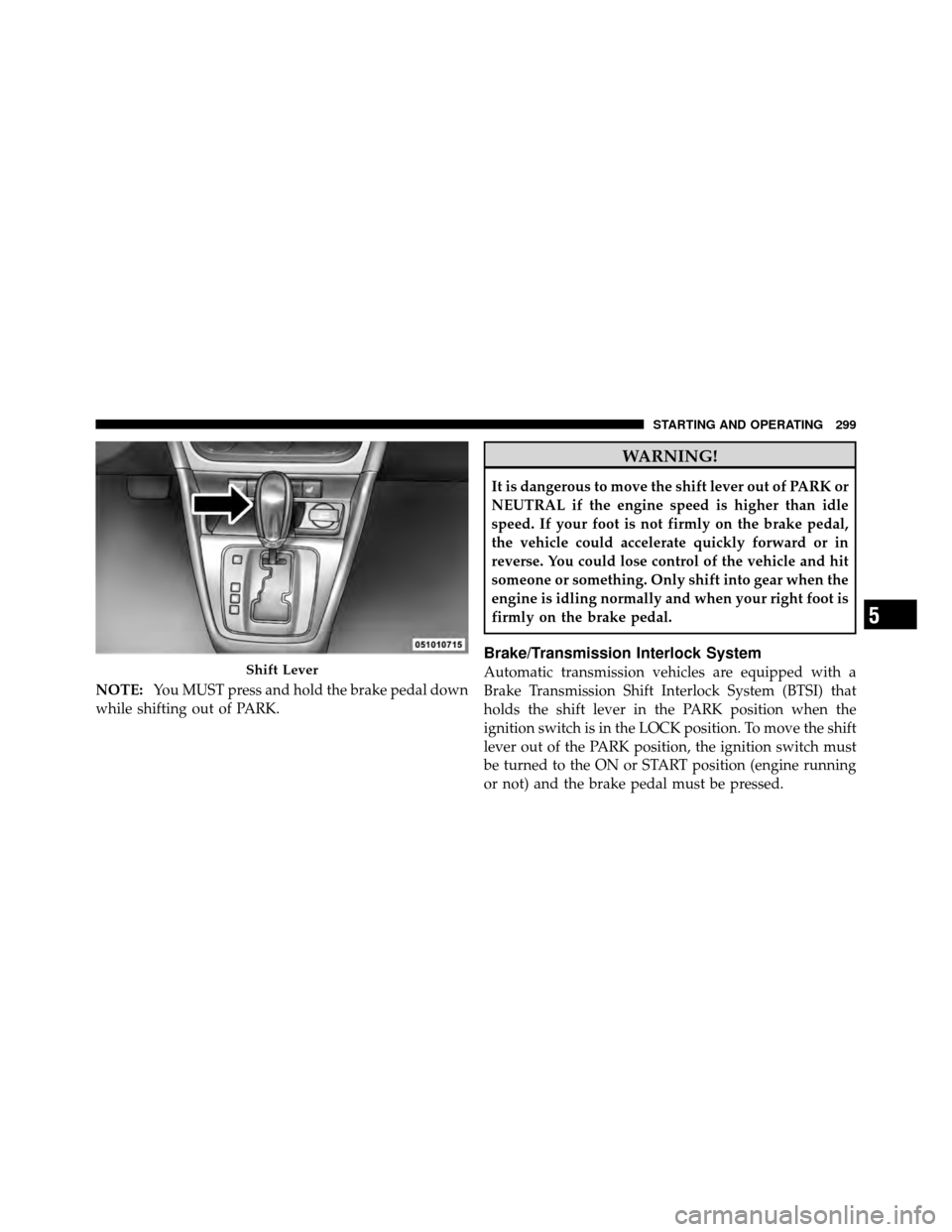
NOTE:You MUST press and hold the brake pedal down
while shifting out of PARK.
WARNING!
It is dangerous to move the shift lever out of PARK or
NEUTRAL if the engine speed is higher than idle
speed. If your foot is not firmly on the brake pedal,
the vehicle could accelerate quickly forward or in
reverse. You could lose control of the vehicle and hit
someone or something. Only shift into gear when the
engine is idling normally and when your right foot is
firmly on the brake pedal.
Brake/Transmission Interlock System
Automatic transmission vehicles are equipped with a
Brake Transmission Shift Interlock System (BTSI) that
holds the shift lever in the PARK position when the
ignition switch is in the LOCK position. To move the shift
lever out of the PARK position, the ignition switch must
be turned to the ON or START position (engine running
or not) and the brake pedal must be pressed.Shift Lever
5
STARTING AND OPERATING 299