Page 383 of 484
WARNING!
•Take care to avoid the radiator cooling fan when-
ever the hood is raised. It can start anytime the
ignition switch is on. You can be injured by
moving fan blades.
•Remove any metal jewelry such as watch bands or
bracelets that might make an inadvertent electrical
contact. You could be seriously injured.
•Batteries contain sulfuric acid that can burn your
skin or eyes and generate hydrogen gas which is
flammable and explosive. Keep open flames or
sparks away from the battery.
1. Set the parking brake, shift the automatic transmission
into PARK and turn the ignition to LOCK.
2. Turn off the heater, radio, and all unnecessary electri-
cal accessories.
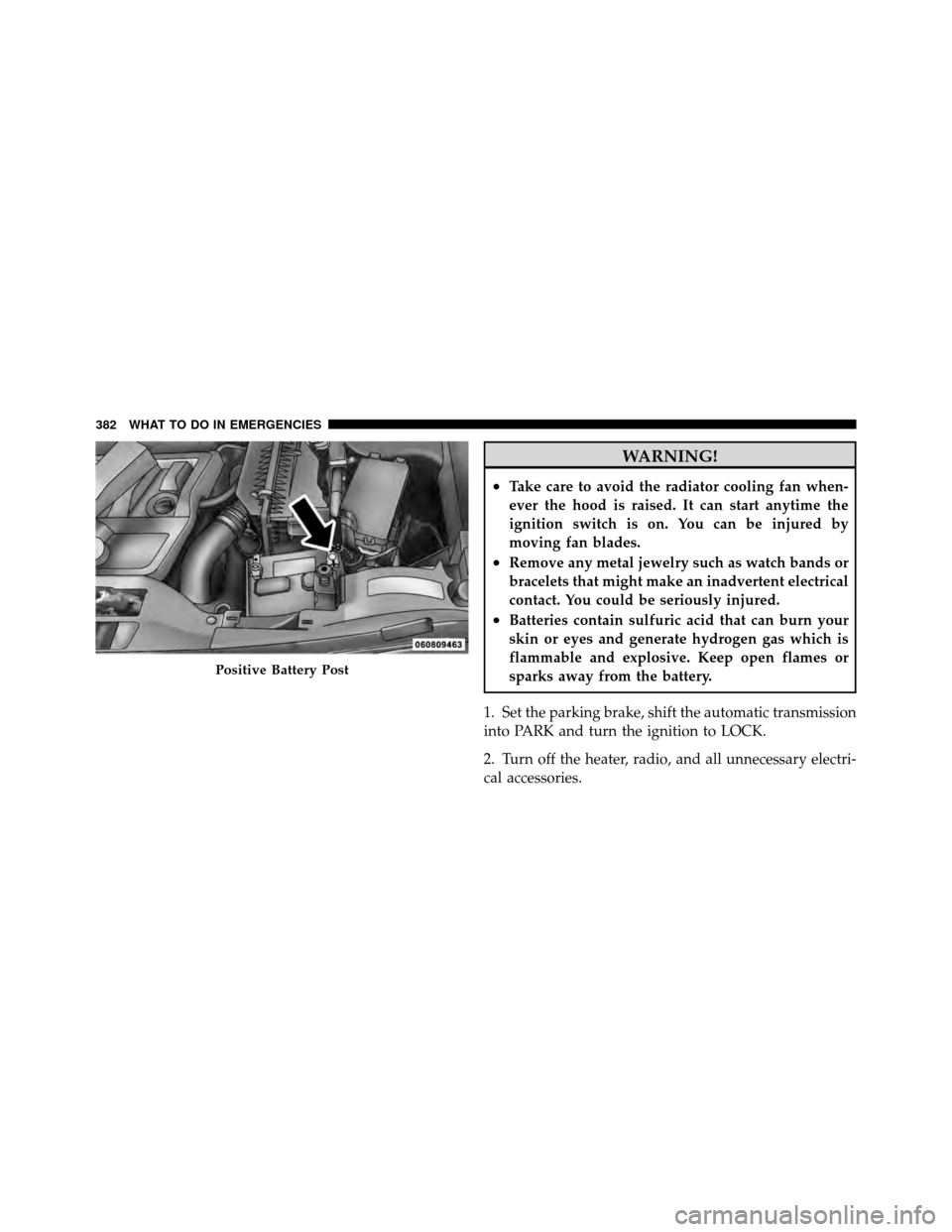
Positive Battery Post
382 WHAT TO DO IN EMERGENCIES
Page 388 of 484
CAUTION!
•If the vehicle being towed requires steering, the
ignition switch must be in the ACC position, not
in the LOCK position.
•Do not attempt to use sling-type equipment when
towing. When securing the vehicle to a flatbed
truck, do not attach to front or rear suspension
components. Damage to your vehicle may result
from improper towing.
Without The Ignition Key
Special care must be taken when the vehicle is towed
with the ignition in the LOCK position. A dolly should be
used under the front wheels if the rear wheels are raised.
Proper towing equipment is necessary to prevent dam-
age to the vehicle.
Battery power is required to release the brake/
transmission interlock system (automatic transmission
only). There is a removable plug in the right side of the
shift lever housing that allows you to insert your finger to
override the system. The ignition key must be in the ON
position to use the override lever.
6
WHAT TO DO IN EMERGENCIES 387
Page 404 of 484
WARNING!
•Use only refrigerants and compressor lubricants
approved by the manufacturer for your air condi-
tioning system. Some unapproved refrigerants are
flammable and can explode, injuring you. Other
unapproved refrigerants or lubricants can cause
the system to fail, requiring costly repairs. Refer to
Warranty Information Book, located on the DVD,
for further warranty information.
•The air conditioning system contains refrigerant
under high pressure. To avoid risk of personal
injury or damage to the system, adding refrigerant
or any repair requiring lines to be disconnected
should be done by an experienced repairman.
Refrigerant Recovery And Recycling
R-134a air conditioning refrigerant is a hydrofluoro-
carbon (HFC) that is endorsed by the EnvironmentalProtection Agency and is an ozone-saving product. How-
ever, the manufacturer recommends that air conditioning
service be performed by authorized dealers or other
service facilities using recovery and recycling equipment.
NOTE:
Use only manufacturer approved A/C system
sealers, stop leak products, seal conditioners, compressor
oil, or refrigerants.
Body Lubrication
Locks and all body pivot points, including such items as
seat tracks, door hinge pivot points and rollers, liftgate,
tailgate, sliding doors and hood hinges, should be lubri-
cated periodically with a lithium based grease, such as
MOPAR� Spray White Lube or equivalent to assure
quiet, easy operation and to protect against rust and
wear. Prior to the application of any lubricant, the parts
concerned should be wiped clean to remove dust and
grit; after lubricating excess oil and grease should be
removed. Particular attention should also be given to
7
MAINTAINING YOUR VEHICLE 403
Page 405 of 484
hood latching components to ensure proper function.
When performing other underhood services, the hood
latch, release mechanism and safety catch should be
cleaned and lubricated.
The external lock cylinders should be lubricated twice a
year, preferably in the Fall and Spring. Apply a small
amount of a high quality lubricant, such as MOPAR�
Lock Cylinder Lubricant or equivalent directly into the
lock cylinder.
Windshield Wiper Blades
Clean the rubber edges of the wiper blades and the
windshield periodically with a sponge or soft cloth and a
mild, nonabrasive cleaner or use the washer solvent. This
will remove accumulations of salt, waxes or road film
and help reduce streaking and smearing.
Operation of the wipers on dry glass for long periods
may cause deterioration of the wiper blades. Always use
washer fluid when using the wipers to remove salt or dirt from a dry windshield. Avoid using the wiper blades to
remove frost or ice from the windshield. Make sure that
they are not frozen to the glass before turning them on to
avoid damaging the blade. Keep the blade rubber out of
contact with petroleum products such as engine oil,
gasoline, etc.
NOTE:
Life expectancy of wiper blades varies depend-
ing on geographical area and frequency of use. Poor
performance of blades may be present with chattering,
marks, water lines or wet spots. If any condition is
present please proceed to clean wiper blades with humid
cloth removing any debris that may be affecting its
function.
Adding Washer Fluid
The windshield washer fluid reservoir is located in the
engine compartment (right rear side), and the fluid level
404 MAINTAINING YOUR VEHICLE
Page 425 of 484
Cavity CartridgeFuseMini-
Fuse Description
3 10 Amp
RedCHMSL Brake Switch
Feed
4 10 Amp
RedIgnition Switch Feed/
OCM
5 20 Amp
YellowTrailer Tow – If
Equipped
6 10 Amp
RedIOD Sw/Pwr Mir/
Steering Cntrl Sdar/
Hands-Free Phone –
If Equipped
7 30 Amp
GreenIOD Sense1
8 30 Amp
GreenIOD Sense2
9 40 Amp Green Power Seats – If
EquippedCavity Cartridge
FuseMini-
Fuse Description
10 20 Amp
YellowCCN Power Locks/
Interior Lighting
11 15 Amp
Lt BluePower Outlet
12 20 Amp
YellowIgn Run/Acc Inverter
13 20 Amp
YellowPwr Run/Acc Outlet
RR/Dome Lamp/
Cigar Lighter
14 10 Amp
RedIOD CCN
15 40 Amp Green RAD Fan Relay Bat-
tery Feed
16 15 Amp
Lt BlueIGN Run/Acc Dome
Lamp/Sunroof/Rear
Wiper Motor/ACC
Inverter
424 MAINTAINING YOUR VEHICLE
Page 429 of 484

1. Disconnect and isolate the negative battery cable.
2. Working in the appropriate wheel well, loosen the
front of the splash shield, but do not fully remove it.
3. Looking up through the front wheel well, locate the
bulb which needs replacing. The headlamp bulb is the
inboard bulb and the park/turn signal bulb is the out-
board bulb.
4. Disconnect the bulb electrical connector.
5. Grasp the bulb, twist 1/4 turn counterclockwise and
pull straight out of front lamp unit.
Fog Lamps
CAUTION!
Do not contaminate the bulb glass by touching it
with your fingers or by allowing it to contact other
oily surfaces. Shortened bulb life will result.1. Disconnect and isolate the negative battery cable.
2. Remove the front wheel and tire on the same side of
the vehicle as the fog lamp being serviced. Refer to
“Jacking and Tire Changing” in “What To Do In Emer-
gencies” for further information.
3. Remove the three screws that secure the outboard side
of the front wheel house splash shield to the front fascia.
4. Remove the push pin fastener that secures the inboard
side of the splash shield to the front end sheet metal.
5. Remove the two push pin fasteners that secure the
forward edge of the splash shield to the front fascia
closure panel.
6. Fold the front of the splash shield rearward far enough
to access the back of the front fascia.
428 MAINTAINING YOUR VEHICLE
Page 430 of 484
7. From behind the front fascia disconnect the engine
compartment wire harness connector from the front fog
lamp bulb connector receptacle.
8. Firmly grasp the bulb by the two latch features and
squeeze them together to unlock the bulb from the back
of the front fog lamp housing.
9. Pull the bulb straight out from the keyed opening in
the housing.
Rear Tail, Turn Signal, and Backup Lamps
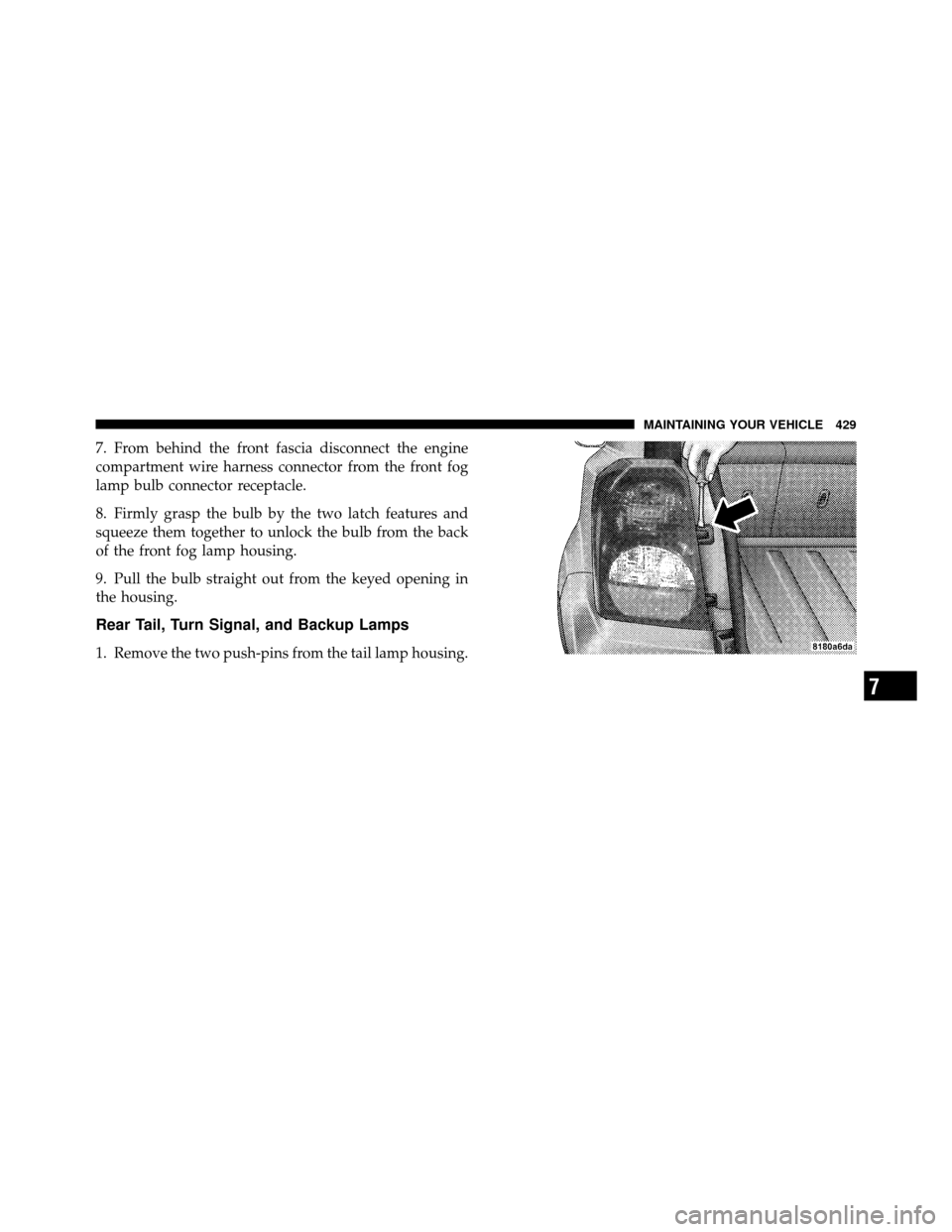
1. Remove the two push-pins from the tail lamp housing.
7
MAINTAINING YOUR VEHICLE 429
Page 433 of 484
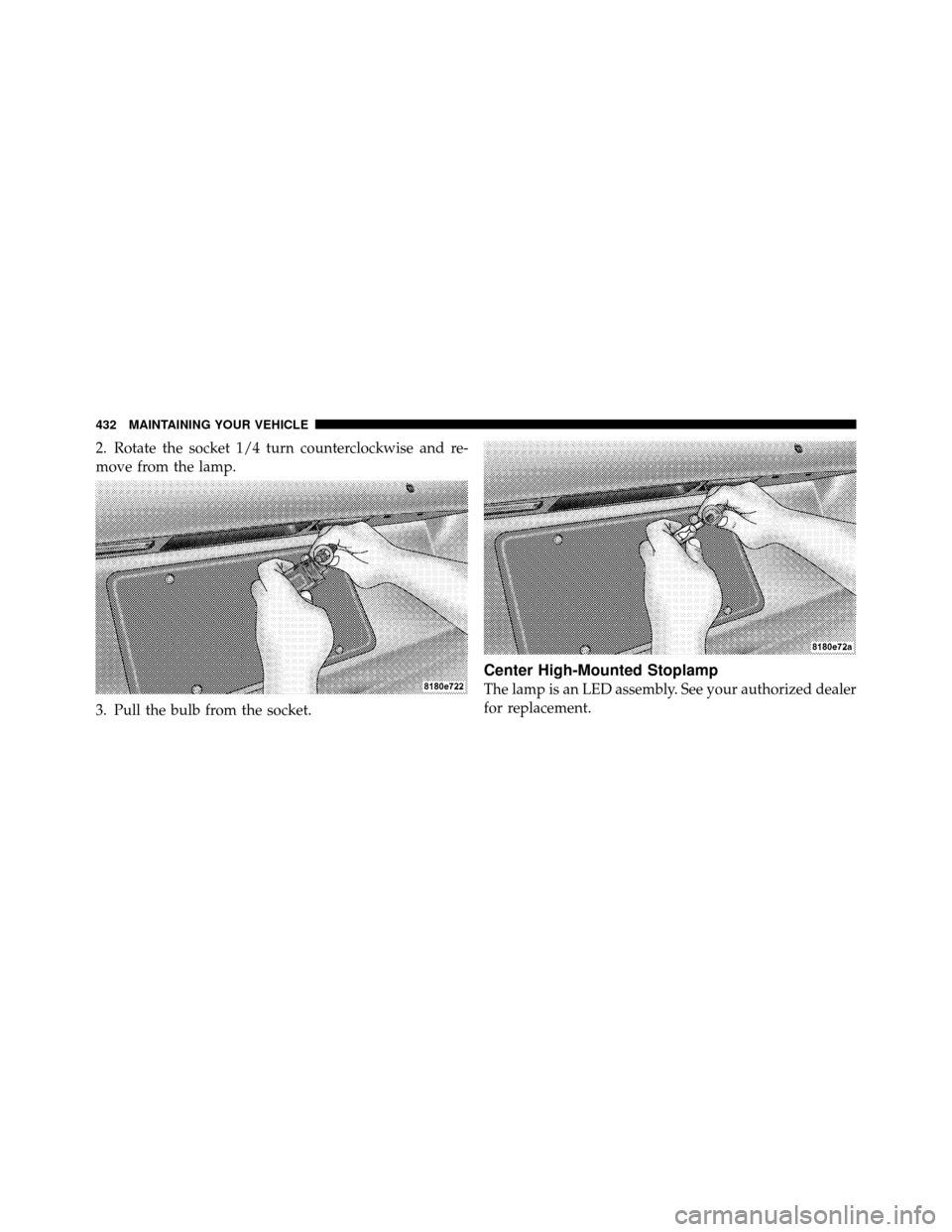
2. Rotate the socket 1/4 turn counterclockwise and re-
move from the lamp.
3. Pull the bulb from the socket.
Center High-Mounted Stoplamp
The lamp is an LED assembly. See your authorized dealer
for replacement.
432 MAINTAINING YOUR VEHICLE