Page 280 of 484
NOTE:
•Continuous use of the recirculation mode may make
the inside air stuffy and window fogging may occur.
Extended use of this mode is not recommended.
•The use of the recirculation mode in cold or damp
weather will cause windows to fog on the inside,
because of moisture buildup inside the vehicle. Select
the Outside Air position for maximum defogging.
•The A/C will engage automatically to prevent fogging
when the recirculation button is pressed and the mode
control is set to panel or panel / floor.
•The A/C can be deselected manually without disturb-
ing the mode control selection.
•When the ignition switch is turned to the LOCK
position, the recirculation feature will be cancelled.
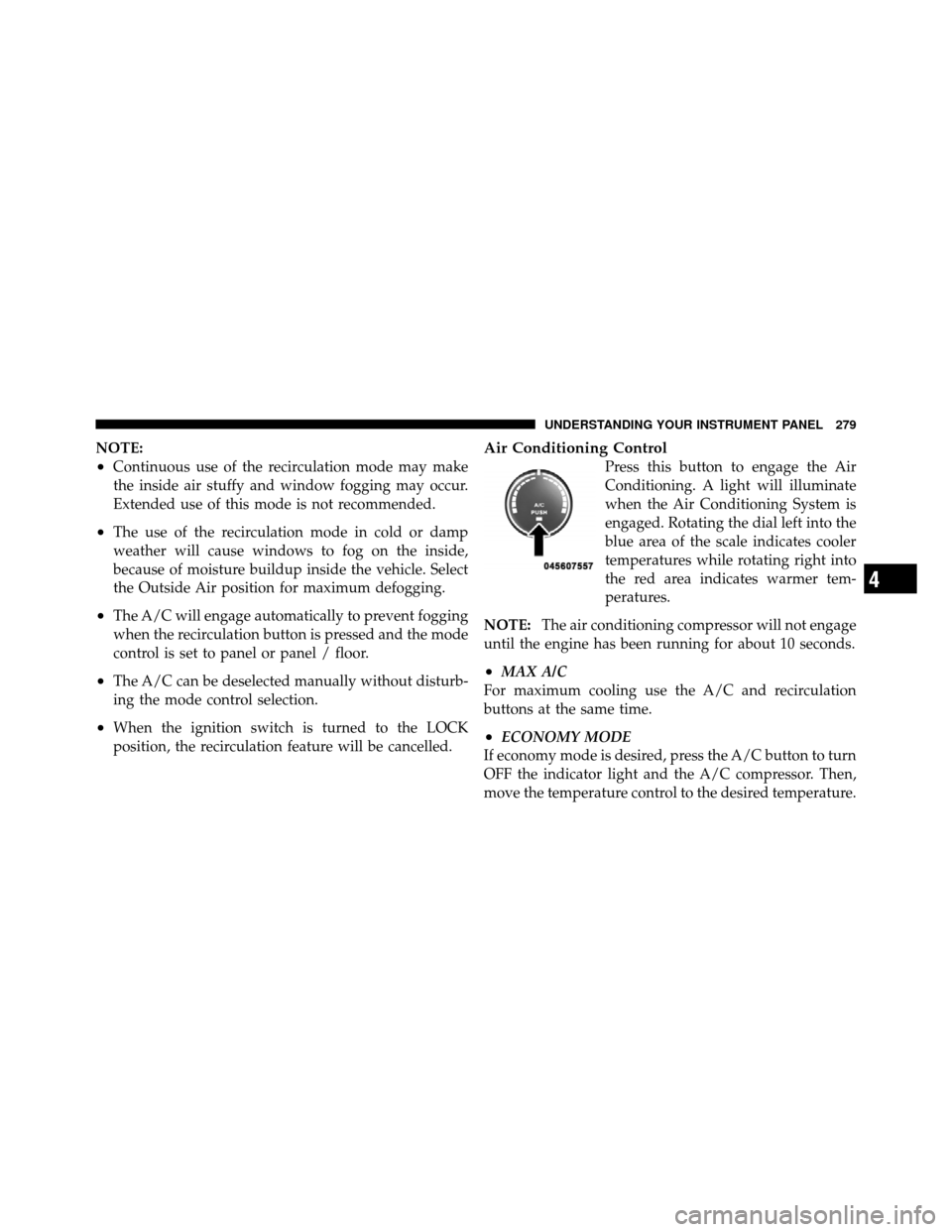
Air Conditioning Control
Press this button to engage the Air
Conditioning. A light will illuminate
when the Air Conditioning System is
engaged. Rotating the dial left into the
blue area of the scale indicates cooler
temperatures while rotating right into
the red area indicates warmer tem-
peratures.
NOTE: The air conditioning compressor will not engage
until the engine has been running for about 10 seconds.
•MAX A/C
For maximum cooling use the A/C and recirculation
buttons at the same time.
•ECONOMY MODE
If economy mode is desired, press the A/C button to turn
OFF the indicator light and the A/C compressor. Then,
move the temperature control to the desired temperature.
4
UNDERSTANDING YOUR INSTRUMENT PANEL 279
Page 285 of 484
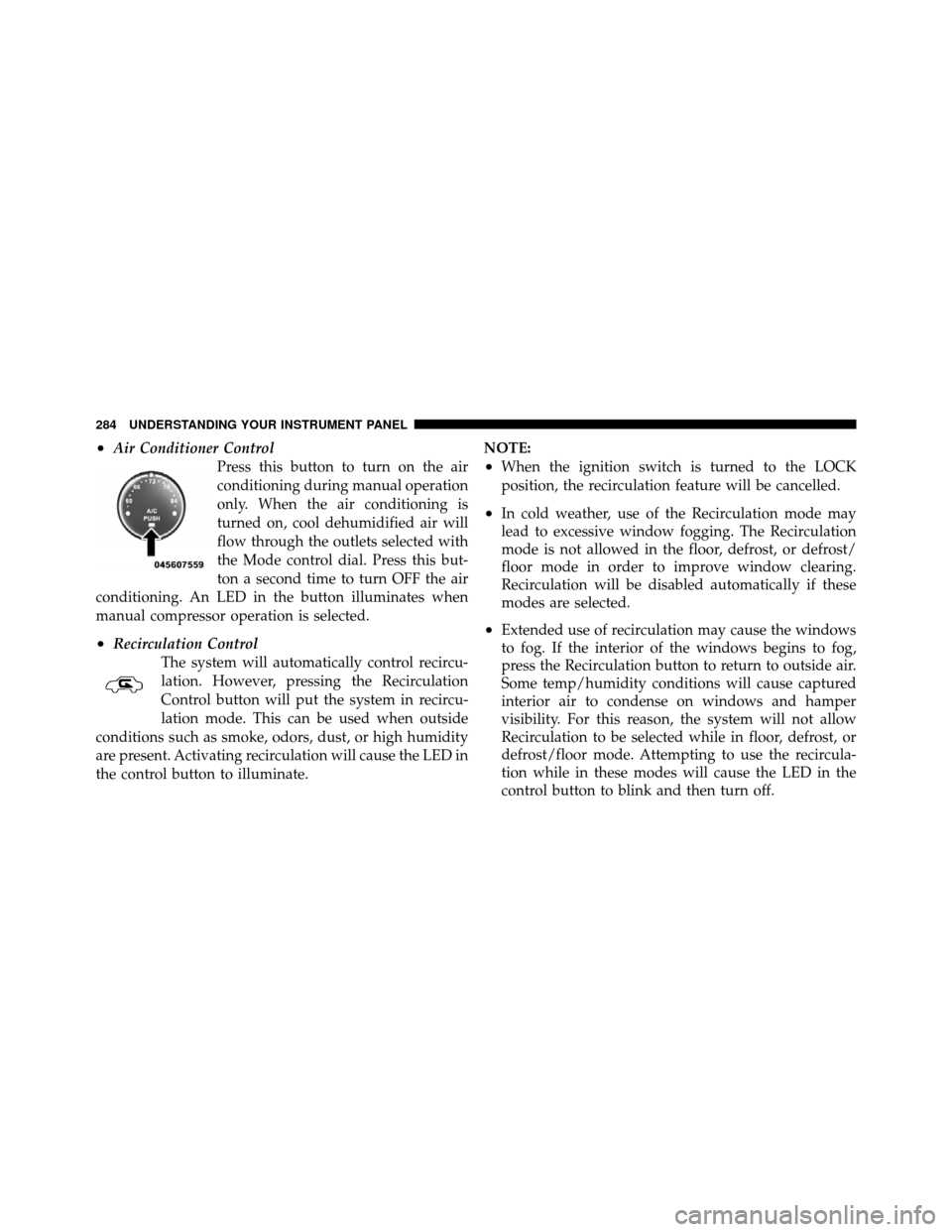
•Air Conditioner ControlPress this button to turn on the air
conditioning during manual operation
only. When the air conditioning is
turned on, cool dehumidified air will
flow through the outlets selected with
the Mode control dial. Press this but-
ton a second time to turn OFF the air
conditioning. An LED in the button illuminates when
manual compressor operation is selected.
•Recirculation Control The system will automatically control recircu-
lation. However, pressing the Recirculation
Control button will put the system in recircu-
lation mode. This can be used when outside
conditions such as smoke, odors, dust, or high humidity
are present. Activating recirculation will cause the LED in
the control button to illuminate. NOTE:
•When the ignition switch is turned to the LOCK
position, the recirculation feature will be cancelled.
•In cold weather, use of the Recirculation mode may
lead to excessive window fogging. The Recirculation
mode is not allowed in the floor, defrost, or defrost/
floor mode in order to improve window clearing.
Recirculation will be disabled automatically if these
modes are selected.
•Extended use of recirculation may cause the windows
to fog. If the interior of the windows begins to fog,
press the Recirculation button to return to outside air.
Some temp/humidity conditions will cause captured
interior air to condense on windows and hamper
visibility. For this reason, the system will not allow
Recirculation to be selected while in floor, defrost, or
defrost/floor mode. Attempting to use the recircula-
tion while in these modes will cause the LED in the
control button to blink and then turn off.
284 UNDERSTANDING YOUR INSTRUMENT PANEL
Page 290 of 484
STARTING AND OPERATING
CONTENTS
�Starting Procedures .................... 293
▫ Manual Transmission – If Equipped ....... 293
▫ Automatic Transmission – If Equipped ..... 293
▫ Normal Starting ..................... 293
▫ Extreme Cold Weather (Below �20°F Or
�29°C) ............................ 294
▫ If Engine Fails To Start ................ 294
▫ After Starting ....................... 295
� Engine Block Heater — If Equipped ........ 295�
Manual Transmission — If Equipped ........ 296
▫ Five–Speed Manual Transmission ......... 296
▫ Recommended Shift Speeds ............. 297
▫ Downshifting ....................... 297
� Automatic Transmission — If Equipped ...... 298
▫ Brake/Transmission Interlock System ...... 299
▫ Automatic Transmission Ignition Interlock
System ............................ 300
▫ Gear Ranges ........................ 300
5
Page 291 of 484

�AutoStick� — If Equipped ............... 302
▫ Operation ......................... 302
▫ General Information .................. 303
� Driving On Slippery Surfaces ............. 304
▫ Acceleration ........................ 304
▫ Traction ........................... 304
� Driving Through Water ................. 305
▫ Flowing/Rising Water ................. 305
▫ Shallow Standing Water ............... 305
� Power Steering ....................... 307
▫ Power Steering Fluid Check ............. 307
� Parking Brake ........................ 308
� Brake System ........................ 310 ▫
Anti-Lock Brake System (ABS) ........... 311
� Electronic Brake Control System ........... 314
▫ Anti-Lock Brake System (ABS) ........... 314
▫ Brake Assist System (BAS) .............. 314
▫ Traction Control System (TCS) ........... 315
▫ Hill Start Assist (HSA) – Manual
Transmission Only ................... 316
▫ Electronic Stability Control (ESC) ......... 318
� Tire Safety Information ................. 321
▫ Tire Markings ....................... 321
▫ Tire Identification Number (TIN) ......... 324
▫ Tire Terminology And Definitions ......... 325
▫ Tire Loading And Tire Pressure .......... 326
290 STARTING AND OPERATING
Page 294 of 484

STARTING PROCEDURES
Before starting your vehicle, adjust your seat, adjust both
inside and outside mirrors, and fasten your seat belts.
WARNING!
Never leave children alone in a vehicle. Leaving
unattended children in a vehicle is dangerous for a
number of reasons. A child or others could be seri-
ously or fatally injured. Do not leave the key in the
ignition. A child could operate power windows,
other controls, or move the vehicle.
Manual Transmission – If Equipped
Before starting the engine fully apply the parking brake,
press the clutch pedal to the floor, and place the shift
lever in NEUTRAL.NOTE:
•The engine will not start unless the clutch pedal is
pressed to the floor.
•If the key will not turn and the steering wheel is
locked, rotate the wheel in either direction to relieve
pressure on the locking mechanism and then turn the
key.
Automatic Transmission – If Equipped
The shift lever must be in the PARK or NEUTRAL
position before you can start the engine. Apply the brakes
before shifting to any driving gear.
NOTE:
You must press the brake pedal before shifting
out of PARK.
Normal Starting
Normal starting of either a cold or a warm engine does
not require pumping or pressing the accelerator pedal.
Simply turn the ignition switch to the START position
5
STARTING AND OPERATING 293
Page 295 of 484
and release when the engine starts. If the engine fails to
start within 15 seconds, turn the ignition switch to the
OFF position, wait 10 to 15 seconds, then repeat the
“Normal Starting” procedure.
WARNING!
Do not attempt to push or tow your vehicle to get it
started. Vehicles equipped with an automatic trans-
mission cannot be started this way. Unburned fuel
could enter the catalytic converter and once the
engine has started, ignite and damage the converter
and vehicle. If the vehicle has a discharged battery,
booster cables may be used to obtain a start from
another vehicle. This type of start can be dangerous if
done improperly, so follow the procedure carefully.
Refer to “Jump Starting” in “What To Do In Emer-
gencies” for further information.
Tip Start Feature
Do notpress the accelerator. Turn the ignition switch to
the START position and release it as soon as the starter
engages. The starter motor will continue to run, and it
will disengage automatically when the engine is running.
If the engine fails to start, the starter will disengage
automatically in 10 seconds. If this occurs, turn the
ignition switch to the LOCK position, wait 10 to 15 sec-
onds, then repeat the “Normal Starting” procedure.
Extreme Cold Weather (Below �20°F Or�29°C)
To ensure reliable starting at these temperatures, use of
an externally powered electric engine block heater (avail-
able from your authorized dealer) is recommended.
If Engine Fails to Start
If the engine fails to start after you have followed the
“Normal Starting” or “Extreme Cold Weather” proce-
dures, it may be flooded. Push the accelerator pedal all
the way to the floor and hold it there. Crank the engine
294 STARTING AND OPERATING
Page 296 of 484

for no more than 15 seconds. This should clear any excess
fuel in case the engine is flooded. Leave the ignition key
in the ON position, release the accelerator pedal and
repeat the “Normal Starting” procedure.
WARNING!
Never pour fuel or other flammable liquid into the
throttle body air inlet opening in an attempt to start
the vehicle. This could result in flash fire causing
serious personal injury.
CAUTION!
To prevent damage to the starter, do not crank the
engine for more than 15 seconds at a time. Wait 10 to
15 seconds before trying again.
After Starting
The idle speed will automatically decrease as the engine
warms up.
ENGINE BLOCK HEATER — IF EQUIPPED
The engine block heater warms engine coolant and
permits quicker starts in cold weather. Connect the cord
to a standard 110-115 Volt AC electrical outlet with a
grounded, three-wire extension cord.
WARNING!
Remember to disconnect the cord before driving.
Damage to the 110-115 Volt electrical cord could cause
electrocution.
5
STARTING AND OPERATING 295
Page 300 of 484
NOTE:You MUST press and hold the brake pedal down
while shifting out of PARK.
WARNING!
It is dangerous to move the shift lever out of PARK or
NEUTRAL if the engine speed is higher than idle
speed. If your foot is not firmly on the brake pedal,
the vehicle could accelerate quickly forward or in
reverse. You could lose control of the vehicle and hit
someone or something. Only shift into gear when the
engine is idling normally and when your right foot is
firmly on the brake pedal.
Brake/Transmission Interlock System
Automatic transmission vehicles are equipped with a
Brake Transmission Shift Interlock System (BTSI) that
holds the shift lever in the PARK position when the
ignition switch is in the LOCK position. To move the shift
lever out of the PARK position, the ignition switch must
be turned to the ON or START position (engine running
or not) and the brake pedal must be pressed.Shift Lever
5
STARTING AND OPERATING 299