Page 318 of 448
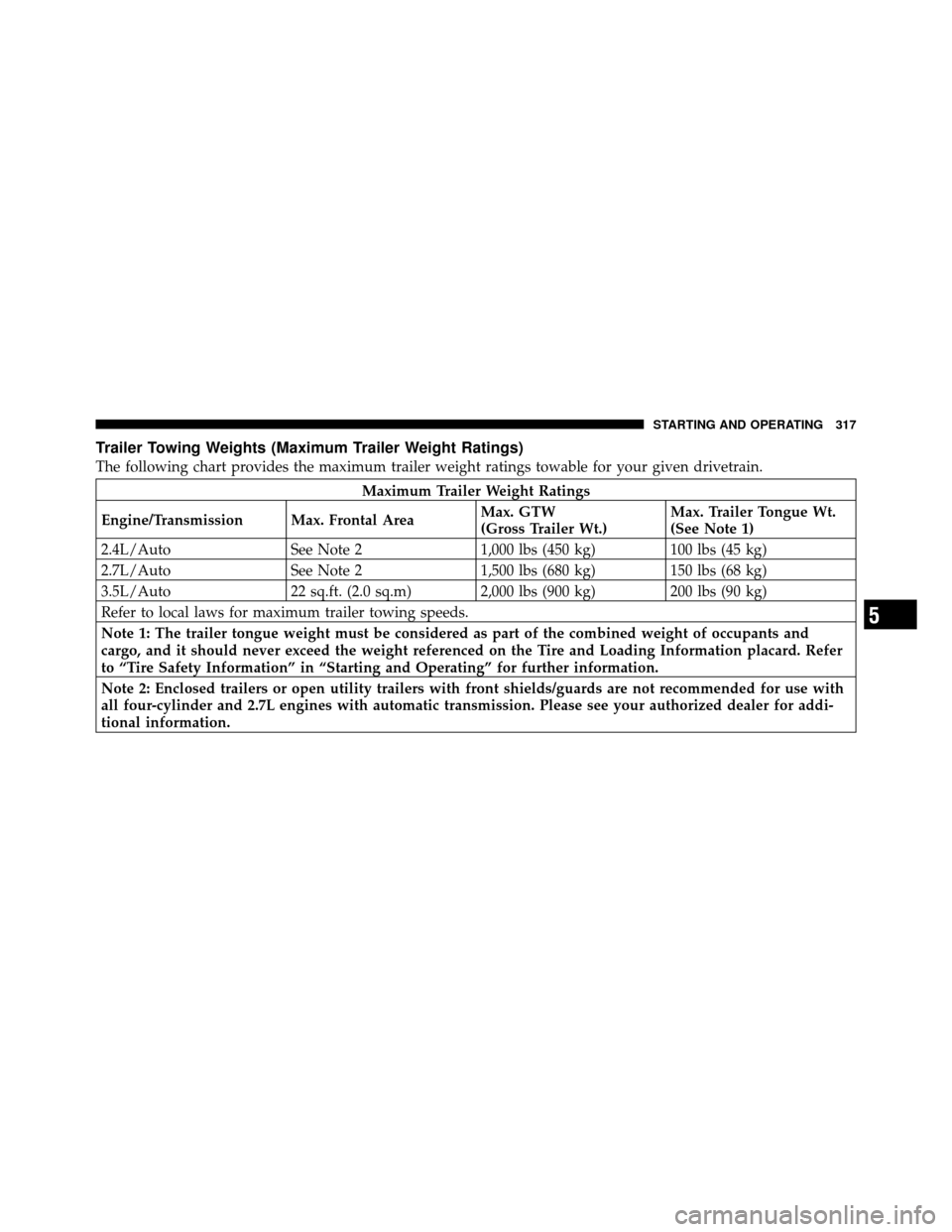
Trailer Towing Weights (Maximum Trailer Weight Ratings)
The following chart provides the maximum trailer weight ratings towable for your given drivetrain.
Maximum Trailer Weight Ratings
Engine/Transmission Max. Frontal Area Max. GTW
(Gross Trailer Wt.)Max. Trailer Tongue Wt.
(See Note 1)
2.4L/Auto See Note 21,000 lbs (450 kg)100 lbs (45 kg)
2.7L/Auto See Note 21,500 lbs (680 kg)150 lbs (68 kg)
3.5L/Auto 22 sq.ft. (2.0 sq.m) 2,000 lbs (900 kg) 200 lbs (90 kg)
Refer to local laws for maximum trailer towing speeds.
Note 1: The trailer tongue weight must be considered as part of the combined weight of occupants and
cargo, and it should never exceed the weight referenced on the Tire and Loading Information placard. Refer
to “Tire Safety Information” in “Starting and Operating” for further information.
Note 2: Enclosed trailers or open utility trailers with front shields/guards are not recommended for use with
all four-cylinder and 2.7L engines with automatic transmission. Please see your authorized dealer for addi-
tional information.
5
STARTING AND OPERATING 317
Page 321 of 448
WARNING!
Improper towing can lead to an injury accident.
Follow these guidelines to make your trailer towing
as safe as possible:
•Make certain that the load is secured in the trailer
and that it will not shift during travel. When
trailering cargo that is not fully secured, dynamic
load shifts can occur that may be difficult for the
driver to control. You could lose control of your
vehicle and have an accident.
•When hauling cargo, or towing a trailer, do not
overload your vehicle or trailer. Overloading can
cause a loss of control, poor performance, or dam-
age to brakes, axle, engine, transmission, steering,
suspension, chassis structure, or tires.(Continued)
WARNING! (Continued)
•Safety chains must always be used between your
vehicle and trailer. Always connect the chains to
the frame or hook retainers of the vehicle hitch.
Cross the chains under the trailer tongue and
allow enough slack for turning corners.
•Vehicles with trailers should not be parked on a
grade. When parking, apply the parking brake on
the tow vehicle. Put the tow vehicle automatic
transmission in PARK. Always, block or �chock�
the trailer wheels.
•GCWR must not be exceeded.
•Total weight must be distributed between the tow
vehicle and the trailer such that the following four
ratings are not exceeded:
1. GVWR
2. GTW
(Continued)
320 STARTING AND OPERATING
Page 324 of 448

Towing Tips
Before setting out on a trip, practice turning, stopping,
and backing the trailer in an area located away from
heavy traffic.
Make sure all trailer and vehicle lights are working
properly — including hazard flashers.
Automatic Transmission
The DRIVE range can be selected when towing. How-
ever, if frequent shifting occurs while in this range, third
gear for a four-speed automatic and the fifth gear for a
six-speed AutoStick�should be selected.
NOTE: Using third or fifth instead of DRIVE while
operating the vehicle under heavy operating conditions,
will improve performance and extend transmission life
by reducing excessive shifting and heat build-up. This
action will also provide better engine braking. If you
REGULARLY TOW a trailer for more than 45 min-
utes of continuous operation, then change the automatic
transmission fluid and filter according to the interval
specified for “police, taxi, fleet, or frequent trailer tow-
ing.” Refer to “Maintenance Schedule” for the proper
maintenance intervals.
NOTE: Check the four-speed automatic transmission
fluid level before towing. The AutoStick� six-speed trans-
mission is sealed and the fluid level cannot be checked.
See your authorized dealership service center for
assistance.
Electronic Speed Control – If Equipped
•
Do not use in hilly terrain or with heavy loads.
•When using the speed control, if you experience speed
drops greater than 10 mph (16 km/h), disengage until
you can get back to cruising speed.
5
STARTING AND OPERATING 323
Page 325 of 448
•Use speed control in flat terrain and with light loads to
maximize fuel efficiency.
Cooling System
To reduce potential for engine and transmission over-
heating, take the following actions:
•City Driving
When stopped for short periods of time, shift the trans-
mission into NEUTRAL and increase engine idle speed.
•Highway Driving
Reduce speed.
•Air Conditioning
Turn off temporarily.
RECREATIONAL TOWING
(BEHIND MOTORHOME, ETC.)
Towing This Vehicle Behind Another Vehicle
(Flat towing with all four wheels on the ground)
CAUTION!
DO NOT flat tow this vehicle. Damage to the drive-
train will result.
NOTE: If the vehicle requires towing make sure all four
wheels are off the ground.
324 STARTING AND OPERATING
Page 332 of 448
WARNING! (Continued)
•Always park on a firm, level surface as far from
the edge of the roadway as possible before raising
the vehicle.
•Block the wheel diagonally opposite the wheel to
be raised.
•Set the parking brake firmly and set an automatic
transmission in PARK; a manual transmission in
REVERSE.
•Never start or run the engine with the vehicle on a
jack.
•Do not let anyone sit in the vehicle when it is on a
jack.
•Do not get under the vehicle when it is on a jack.
•Only use the jack in the positions indicated and
for lifting this vehicle during a tire change.(Continued)
WARNING! (Continued)
•If working on or near a roadway, be extremely
careful of motor traffic.
•To assure that spare tires, flat or inflated, are
securely stowed, spares must be stowed with the
valve stem facing the ground.
•Turn on the Hazard Warning flasher.
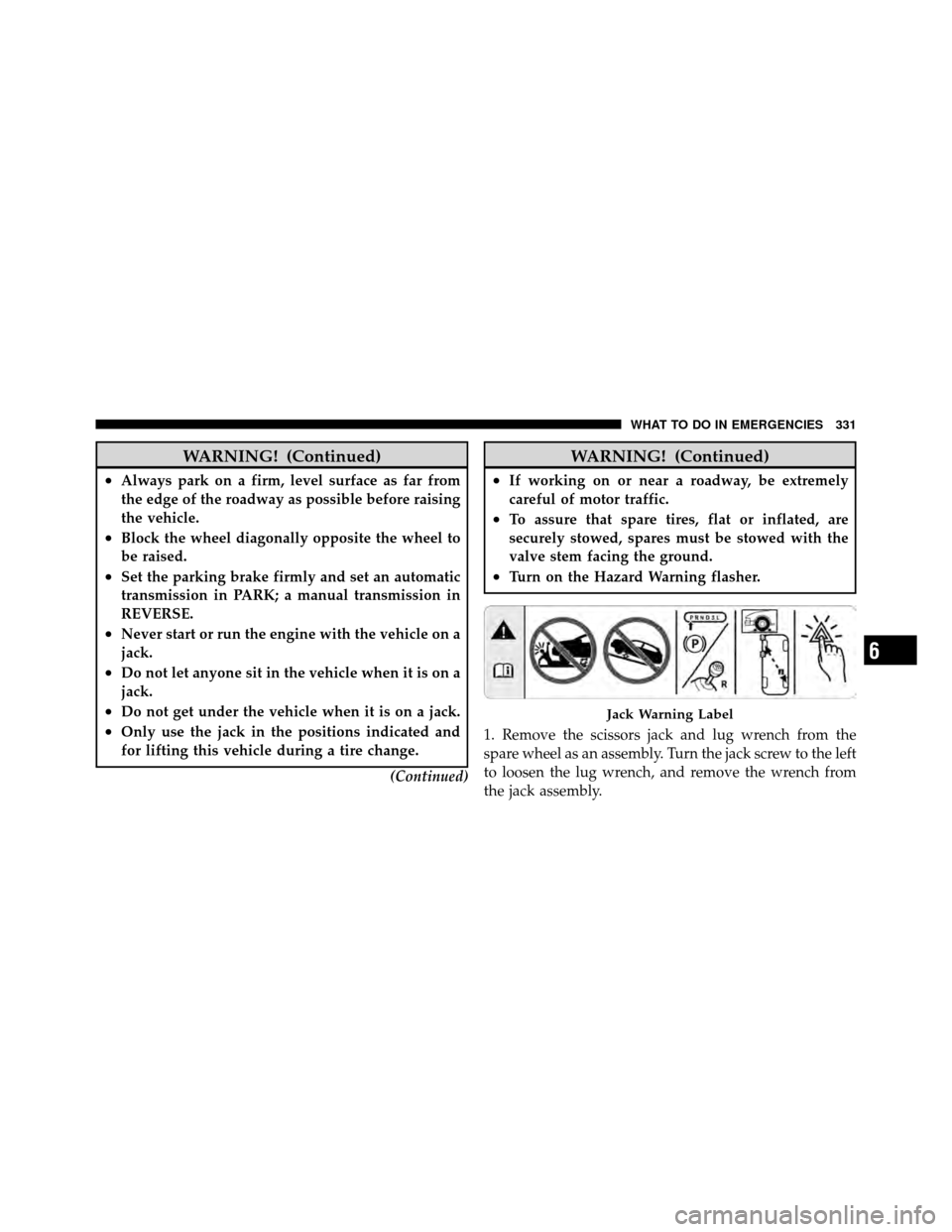
1. Remove the scissors jack and lug wrench from the
spare wheel as an assembly. Turn the jack screw to the left
to loosen the lug wrench, and remove the wrench from
the jack assembly.
Jack Warning Label
6
WHAT TO DO IN EMERGENCIES 331
Page 338 of 448
WARNING!
•Take care to avoid the radiator cooling fan when-
ever the hood is raised. It can start anytime the
ignition switch is on. You can be injured by
moving fan blades.
•Remove any metal jewelry such as watch bands or
bracelets that might make an inadvertent electrical
contact. You could be seriously injured.
•Batteries contain sulfuric acid that can burn your
skin or eyes and generate hydrogen gas which is
flammable and explosive. Keep open flames or
sparks away from the battery.
1. Set the parking brake, shift the automatic transmission
into PARK and turn the ignition to LOCK.
2. Turn off the heater, radio, and all unnecessary electri-
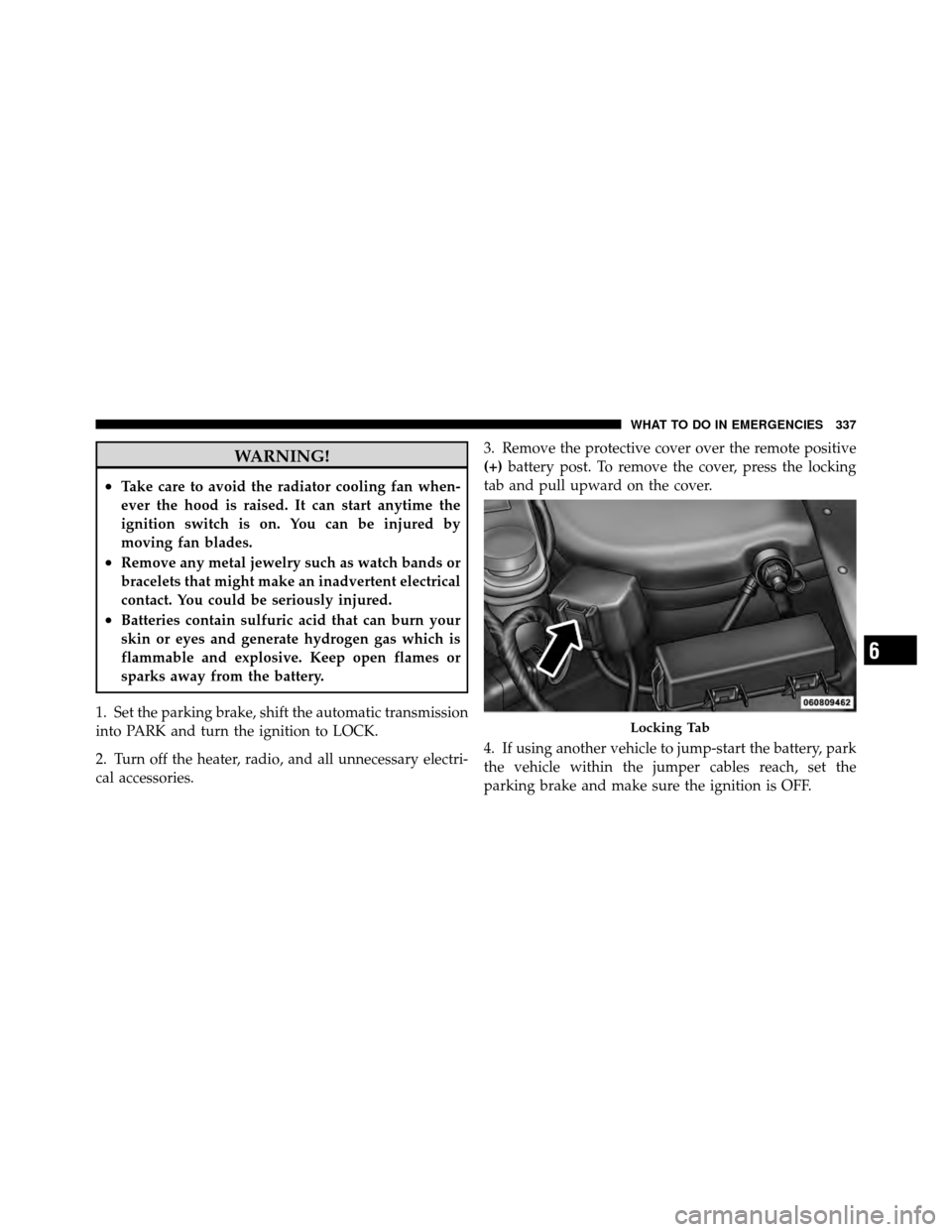
cal accessories. 3. Remove the protective cover over the remote positive
(+)
battery post. To remove the cover, press the locking
tab and pull upward on the cover.
4. If using another vehicle to jump-start the battery, park
the vehicle within the jumper cables reach, set the
parking brake and make sure the ignition is OFF.
Locking Tab
6
WHAT TO DO IN EMERGENCIES 337
Page 341 of 448

front wheels. Then shift back and forth between RE-
VERSE and FIRST gear. Using minimal accelerator pedal
pressure to maintain the rocking motion, without spin-
ning the wheels, is most effective.
NOTE:If your vehicle is equipped with Electronic
Stability Control (ESC), turn the system to Partial OFF
before attempting to “rock” the vehicle. Refer to “Elec-
tronic Brake Control” in “Starting and Operating” for
further information.
CAUTION!
•When “rocking” a stuck vehicle by moving be-
tween 1st and REVERSE, do not spin the wheels
faster than 15 mph (24 km/h), or drivetrain damage
may result.
(Continued)
CAUTION! (Continued)
•Revving the engine or spinning the wheels too fast
may lead to transmission overheating and failure.
It can also damage the tires. Do not spin the
wheels above 30 mph (48 km/h) while in gear (no
transmission shifting occurring).
WARNING!
Fast spinning tires can be dangerous. Forces gener-
ated by excessive wheel speeds may cause damage, or
even failure, of the axle and tires. A tire could
explode and injure someone. Do not spin your vehi-
cle’s wheels faster than 30 mph (48 km/h) or for
longer than 30 seconds continuously without stop-
ping when you are stuck and do not let anyone near
a spinning wheel, no matter what the speed.
340 WHAT TO DO IN EMERGENCIES
Page 343 of 448
If you must use the accessories (wipers, defrosters, etc.)
while being towed, the key must be in the ON position,
not the ACC position. Make certain the transaxle remains
in NEUTRAL.
Towing Without The Ignition Key
Special care must be taken when the vehicle is towed
with the ignition in the LOCK position. Flatbed towing is
the preferred towing method. However, if a flatbed
towing vehicle is not available, a wheel lift towing
vehicle may be used. Rear towing is not recommended
with the front wheels on the ground, as transaxle damage
can result. If rear towing is the only alternative, a front
end dolly must be used. Proper towing equipment is
necessary to prevent damage to the vehicle.
Towing This Vehicle Behind Another Vehicle
Flat towing with all four wheels on the ground of
vehicles equipped with an automatic transmission, is
only permitted within the limitations described in this
section.
Towing This Vehicle Behind Another Vehicle With
A Tow Dolly
Rear towing is not recommended with the front wheels
on the ground, as transaxle damage can result. If rear
towing is the only alternative, a front end dolly must be
used. Proper towing equipment is necessary to prevent
damage to the vehicle.
342 WHAT TO DO IN EMERGENCIES
