Page 315 of 444
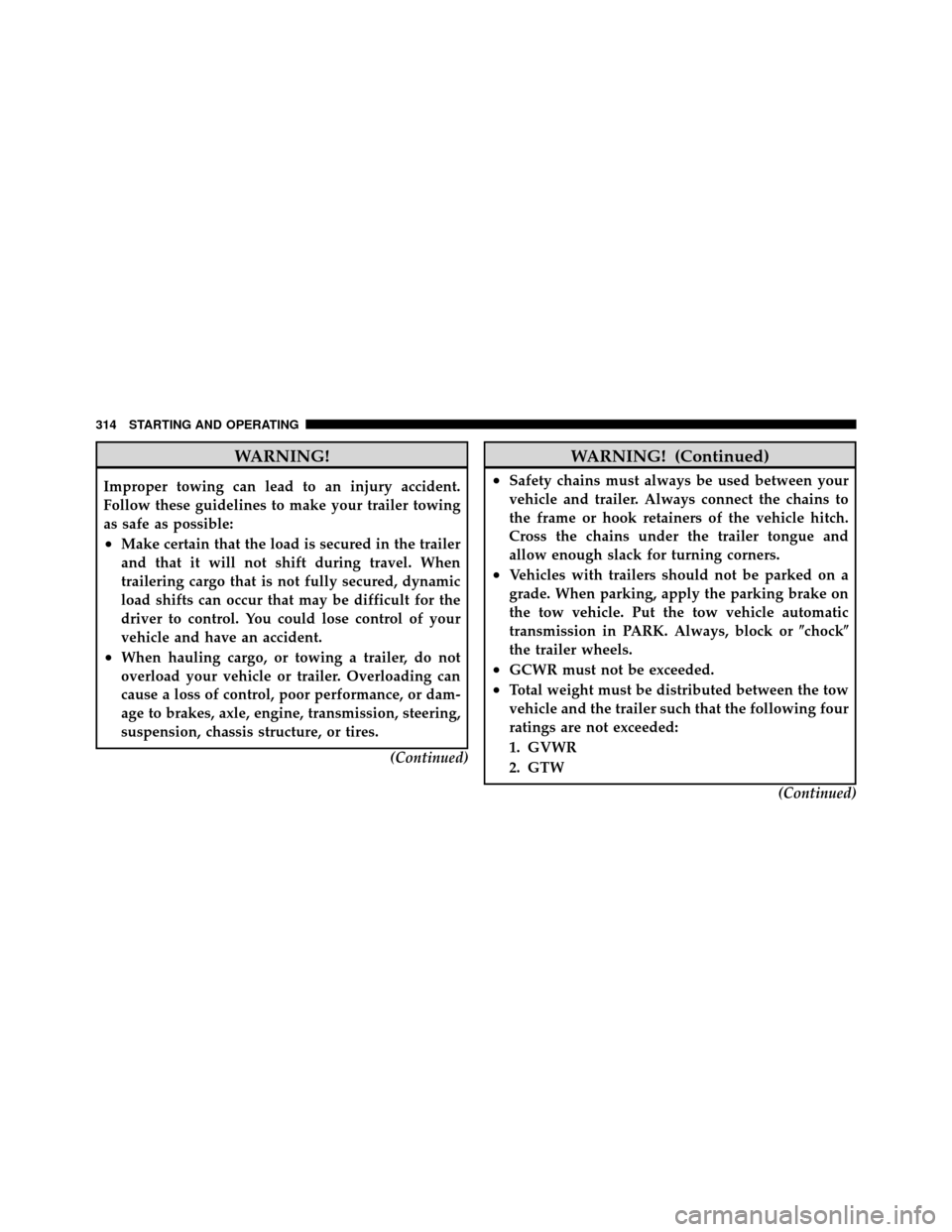
WARNING!
Improper towing can lead to an injury accident.
Follow these guidelines to make your trailer towing
as safe as possible:
•Make certain that the load is secured in the trailer
and that it will not shift during travel. When
trailering cargo that is not fully secured, dynamic
load shifts can occur that may be difficult for the
driver to control. You could lose control of your
vehicle and have an accident.
•When hauling cargo, or towing a trailer, do not
overload your vehicle or trailer. Overloading can
cause a loss of control, poor performance, or dam-
age to brakes, axle, engine, transmission, steering,
suspension, chassis structure, or tires.(Continued)
WARNING! (Continued)
•Safety chains must always be used between your
vehicle and trailer. Always connect the chains to
the frame or hook retainers of the vehicle hitch.
Cross the chains under the trailer tongue and
allow enough slack for turning corners.
•Vehicles with trailers should not be parked on a
grade. When parking, apply the parking brake on
the tow vehicle. Put the tow vehicle automatic
transmission in PARK. Always, block or �chock�
the trailer wheels.
•GCWR must not be exceeded.
•Total weight must be distributed between the tow
vehicle and the trailer such that the following four
ratings are not exceeded:
1. GVWR
2. GTW
(Continued)
314 STARTING AND OPERATING
Page 316 of 444
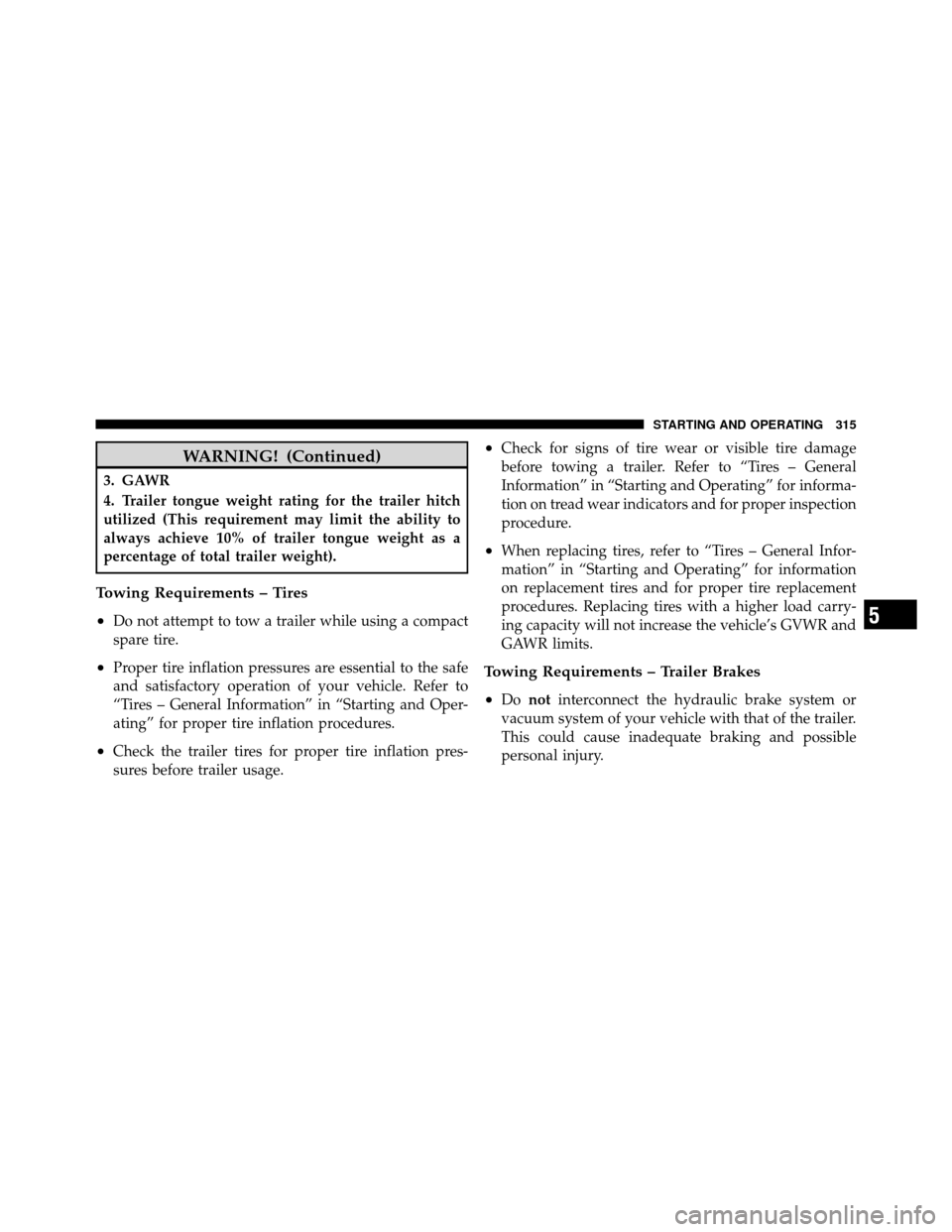
WARNING! (Continued)
3. GAWR
4. Trailer tongue weight rating for the trailer hitch
utilized (This requirement may limit the ability to
always achieve 10% of trailer tongue weight as a
percentage of total trailer weight).
Towing Requirements – Tires
•
Do not attempt to tow a trailer while using a compact
spare tire.
•Proper tire inflation pressures are essential to the safe
and satisfactory operation of your vehicle. Refer to
“Tires – General Information” in “Starting and Oper-
ating” for proper tire inflation procedures.
•Check the trailer tires for proper tire inflation pres-
sures before trailer usage.
•Check for signs of tire wear or visible tire damage
before towing a trailer. Refer to “Tires – General
Information” in “Starting and Operating” for informa-
tion on tread wear indicators and for proper inspection
procedure.
•When replacing tires, refer to “Tires – General Infor-
mation” in “Starting and Operating” for information
on replacement tires and for proper tire replacement
procedures. Replacing tires with a higher load carry-
ing capacity will not increase the vehicle’s GVWR and
GAWR limits.
Towing Requirements – Trailer Brakes
•
Donot interconnect the hydraulic brake system or
vacuum system of your vehicle with that of the trailer.
This could cause inadequate braking and possible
personal injury.
5
STARTING AND OPERATING 315
Page 317 of 444

•An electronically actuated trailer brake controller is
required when towing a trailer with electronically
actuated brakes. When towing a trailer equipped with
a hydraulic surge actuated brake system, an electronic
brake controller is not required.
•Trailer brakes are recommended for trailers over
1,000 lbs (450 kg) and required for trailers in excess of
2,000 lbs (907 kg).
CAUTION!
If the trailer weighs more than 1,000 lbs (450 kg)
loaded, it should have its own brakes with adequate
braking capacity. Failure to do this could lead to
accelerated brake lining wear, higher brake pedal
effort, and longer stopping distances.
WARNING!
•Do not connect trailer brakes to your vehicle’s
hydraulic brake lines. It can overload your brake
system and cause it to fail. You might not have
brakes when you need them and could have an
accident.
•Towing any trailer will increase your stopping
distance. When towing, you should allow for ad-
ditional space between your vehicle and the ve-
hicle in front of you. Failure to do so could result
in an accident.
Towing Requirements – Trailer Lights and Wiring
Whenever you pull a trailer, regardless of the trailer size,
stop lights and turn signals on the trailer are required for
motoring safety.
316 STARTING AND OPERATING
Page 318 of 444

Towing Tips
Before setting out on a trip, practice turning, stopping,
and backing the trailer in an area located away from
heavy traffic.
Make sure all trailer and vehicle lights are working
properly — including hazard flashers.
Automatic Transmission
The DRIVE range can be selected when towing. How-
ever, if frequent shifting occurs while in this range, third
gear for a four-speed automatic and the fifth gear for a
six-speed AutoStick�should be selected.
NOTE: Using third or fifth instead of DRIVE while
operating the vehicle under heavy operating conditions,
will improve performance and extend transmission life
by reducing excessive shifting and heat build-up. This
action will also provide better engine braking. If you
REGULARLY TOW a trailer for more than 45 min-
utes of continuous operation, then change the automatic
transmission fluid and filter according to the interval
specified for “police, taxi, fleet, or frequent trailer tow-
ing.” Refer to “Maintenance Schedule” for the proper
maintenance intervals.
NOTE: Check the four-speed automatic transmission
fluid level before towing. The AutoStick� six-speed trans-
mission is sealed and the fluid level cannot be checked.
See your authorized dealership service center for
assistance.
Electronic Speed Control – If Equipped
•
Do not use in hilly terrain or with heavy loads.
•When using the speed control, if you experience speed
drops greater than 10 mph (16 km/h), disengage until
you can get back to cruising speed.
5
STARTING AND OPERATING 317
Page 323 of 444

NOTE:There are steps that you can take to slow down
an impending overheat condition:
•If your air conditioner (A/C) is on, turn it off. The A/C
system adds heat to the engine cooling system and
turning the A/C off can help remove this heat.
•You can also turn the temperature control to maximum
heat, the mode control to floor and the blower control
to high. This allows the heater core to act as a
supplement to the radiator and aids in removing heat
from the engine cooling system.
WARNING!
You or others can be badly burned by hot engine
coolant (antifreeze) or steam from your radiator. If
you see or hear steam coming from under the hood,
do not open the hood until the radiator has had time
to cool. Never try to open a cooling system pressure
cap when the radiator or coolant bottle is hot.
Engine Oil Overheating (2.4L Engine Only) —
If Equipped
During sustained high-speed driving or trailer tow up
long grades on a hot day, the engine oil temperature may
become too hot. If this happens, the “HOTOIL” message
flashes in the odometer and the vehicle speed will be
reduced to 53 mph (85 km/h) until the engine oil
temperature is reduced.
NOTE: The vehicle speed is reduced to a maximum of
53 mph (85 km/h). You may of course, reduce your
vehicle speed further if needed.
322 WHAT TO DO IN EMERGENCIES
Page 379 of 444
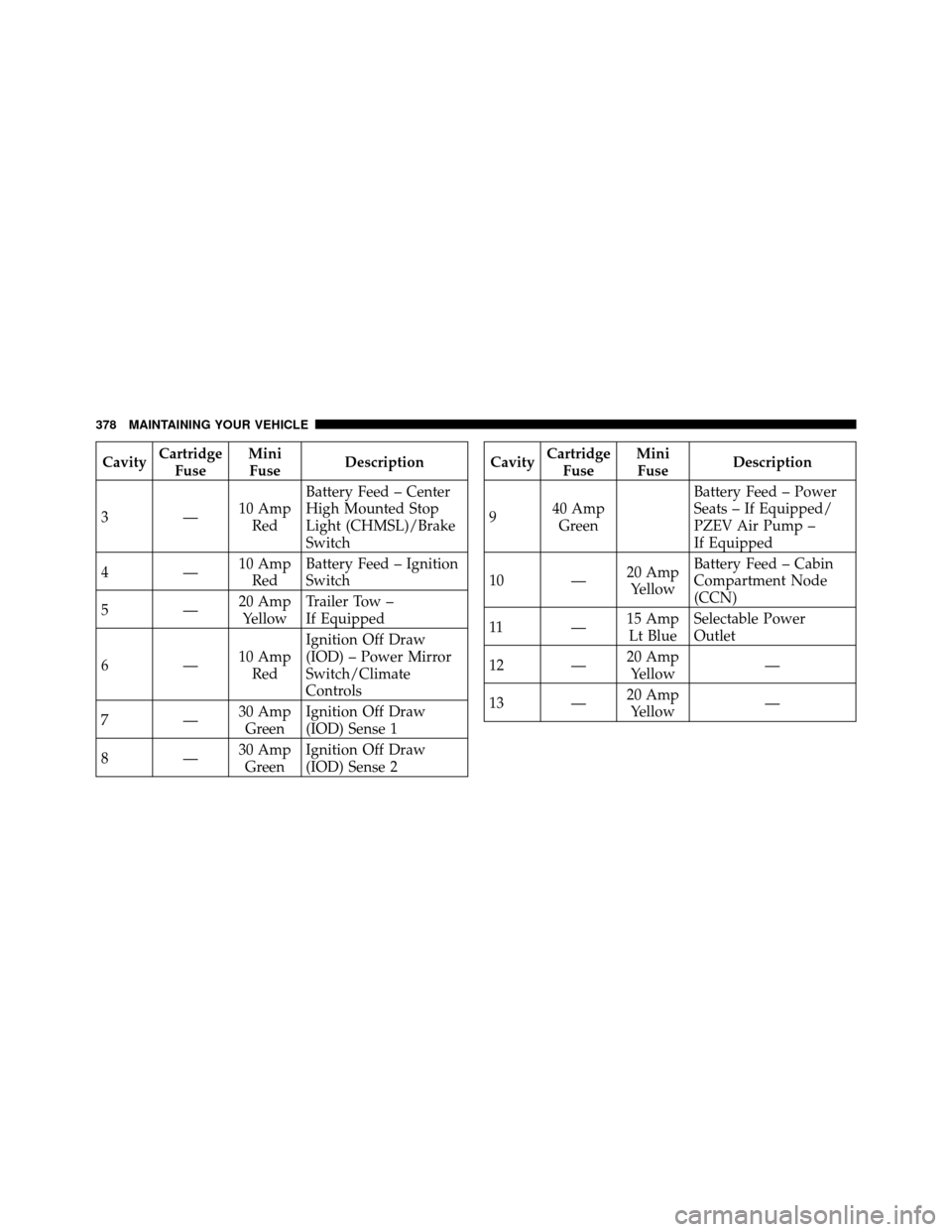
CavityCartridge
Fuse Mini
Fuse Description
3— 10 Amp
Red Battery Feed – Center
High Mounted Stop
Light (CHMSL)/Brake
Switch
4— 10 Amp
Red Battery Feed – Ignition
Switch
5— 20 Amp
Yellow Trailer Tow –
If Equipped
6— 10 Amp
Red Ignition Off Draw
(IOD) – Power Mirror
Switch/Climate
Controls
7— 30 Amp
Green Ignition Off Draw
(IOD) Sense 1
8— 30 Amp
Green Ignition Off Draw
(IOD) Sense 2Cavity
Cartridge
Fuse Mini
Fuse Description
9 40 Amp
Green Battery Feed – Power
Seats – If Equipped/
PZEV Air Pump –
If Equipped
10 — 20 Amp
Yellow Battery Feed – Cabin
Compartment Node
(CCN)
11 — 15 Amp
Lt Blue Selectable Power
Outlet
12 — 20 Amp
Yellow —
13 — 20 Amp
Yellow —
378 MAINTAINING YOUR VEHICLE
Page 404 of 444

54,000 Miles (90,000 km) or
54 Months Maintenance
Service Schedule
❏Change the engine oil and engine oil
filter.
❏ Rotate tires.
Odometer Reading Date
Repair Order #Dealer Code
Signature Authorized Chrysler Dealer
60,000 Miles (100,000 km) or 60 Months Maintenance Service
Schedule
❏Change the engine oil and engine oil filter.
❏ Rotate tires.
❏ Replace the engine air cleaner filter.
❏ Replace the spark plugs (2.4L Engine except PZEV*).
❏ Inspect the brake linings, and replace as necessary.
❏ Replace the air conditioning filter (if equipped).
❏ Change the automatic transmission fluid & filter if using your vehicle for any of the
following: police, taxi, fleet, or frequent trailer towing.
❏ Inspect the front suspension, tie rod ends and boot seals for cracks or leaks and all parts for
damage, wear, improper looseness or end play; replace if necessary.
❏ Adjust parking brake on vehicles equipped with four wheel disc brakes.
Odometer Reading Date
Repair Order #Dealer Code
Signature Authorized Chrysler Dealer
8
M
A I
N T
E
N A
N CE
S
C
H E
D
U L
E
SMAINTENANCE SCHEDULES 403
Page 432 of 444

GaugesCoolant Temperature ................... 145
Fuel ............................... 145
Odometer ........................... 149
Tachometer .......................... 149
Gear Ranges ........................... 244
Gearshift .............................. 244
General Information .................... 17,293
General Maintenance ..................... 347
Glass Cleaning .......................... 375
Gross Axle Weight Rating ...............306,308
Gross Vehicle Weight Rating .............306,308
GVWR ............................... 306
Hands-Free Phone (Uconnect™) .............. 93
Hazard Driving Through Flowing, Rising,
or Shallow Standing Water ............... 251
Hazard Warning Flasher ................... 321 Head Restraints
.......................... 98
Headlights ............................ 383
Bulb Replacement ...................... 383
Cleaning ............................ 373
High Beam ........................ 108,158
High Beam/Low Beam Select Switch ........ 108
On With Wipers ....................... 115
Passing ............................. 108
Replacing ........................... 383
Switch .............................. 106
Heated Seats ........................... 101
Heater ............................... 219
Heater, Engine Block ..................... 241
Hitches Trailer Towing ........................ 310
HomeLink� (Garage Door Opener) Transmitter . . . 120
Hood Prop ............................ 104
Hood Release .......................... 104
10
INDEX 431