Page 57 of 444
WARNING! (Continued)
•Do not drill, cut or tamper with the knee bolster in
any way.
•Do not mount any accessories to the knee bolster
such as alarm lights, stereos, citizen band radios,
etc.
Supplemental Seat-Mounted Side Airbags (SAB) —
If Equipped
Supplemental Seat-Mounted Side Airbags provide en-
hanced protection to help protect an occupant during a
side impact. The Supplemental Seat-Mounted Side Air-
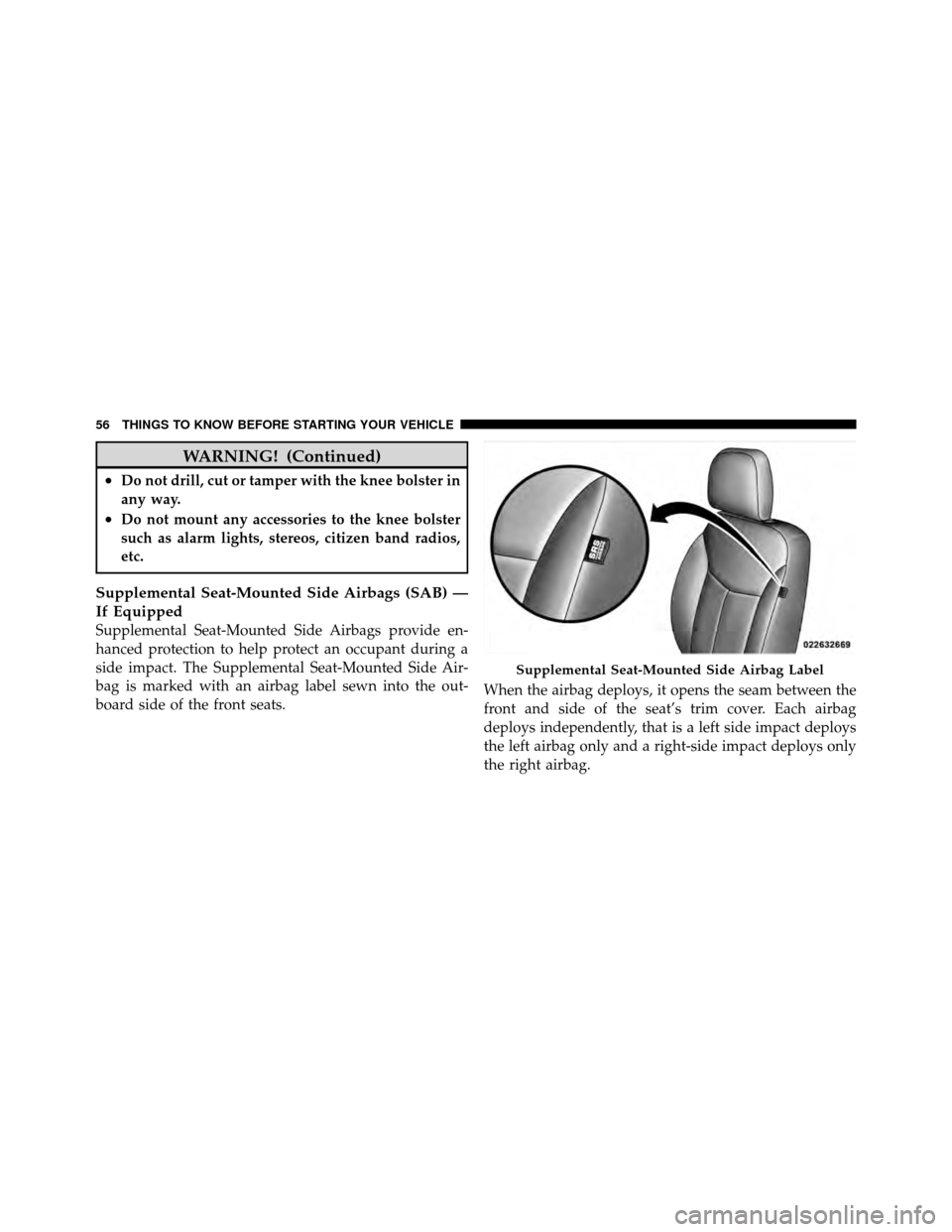
bag is marked with an airbag label sewn into the out-
board side of the front seats.When the airbag deploys, it opens the seam between the
front and side of the seat’s trim cover. Each airbag
deploys independently, that is a left side impact deploys
the left airbag only and a right-side impact deploys only
the right airbag.
Supplemental Seat-Mounted Side Airbag Label
56 THINGS TO KNOW BEFORE STARTING YOUR VEHICLE
Page 65 of 444

covers the window. The airbag inflates in about 30 ms
(about one-quarter of the time that it takes to blink your
eyes) with enough force to injure you if you are not belted
and seated properly, or if items are positioned in the area
where the side curtain airbag inflates. This especially
applies to children. The side curtain airbag is only about
3-1/2 in (9 cm) thick when it is inflated.
Because airbag sensors estimate deceleration over time,
vehicle speed and damage are not good indicators of
whether or not an airbag should have deployed.
NOTE:In a rollover the pretensioners and/or SABIC
airbags may deploy on both sides of the vehicle.
Front and Side Impact Sensors
In front and side impacts, impact sensors can aid the
ORC in determining appropriate response to impact
events. Additional sensors in the ORC determine the
level of airbag deployment and provide verification.
Enhanced Accident Response System
In the event of an impact causing airbag deployment, if
the communication network remains intact, and the
power remains intact, depending on the nature of the
event the ORC will determine whether to have the
Enhanced Accident Response System perform the follow-
ing functions:
•Cut off fuel to the engine.
•Flash hazard lights as long as the battery has power or
until the ignition key is turned off.
•Turn on the interior lights, which remain on as long as
the battery has power or until the ignition key is
removed.
•Unlock the doors automatically.
If a Deployment Occurs
The front airbags are designed to deflate immediately
after deployment.
64 THINGS TO KNOW BEFORE STARTING YOUR VEHICLE
Page 85 of 444
Periodic Safety Checks You Should Make Outside
the Vehicle
Tires
Examine tires for excessive tread wear and uneven wear
patterns. Check for stones, nails, glass, or other objects
lodged in the tread. Inspect the tread and sidewall for
cuts and cracks. Check the wheel nuts for tightness.
Check the tires (including spare) for proper pressure.
Lights
Have someone observe the operation of exterior lights
while you work the controls. Check turn signal and high
beam indicator lights on the instrument panel.
Door Latches
Check for positive closing, latching, and locking.
Fluid Leaks
Check area under vehicle after overnight parking for fuel,
engine coolant, oil, or other fluid leaks. Also, if gasoline
fumes are detected or if fuel, power steering fluid, or
brake fluid leaks are suspected, the cause should be
located and corrected immediately.
84 THINGS TO KNOW BEFORE STARTING YOUR VEHICLE
Page 87 of 444

▫Fold-Flat Passenger Seatback ............ 102
▫ Folding Rear Seat .................... 102
▫ Folding Rear Seat Center Armrest ........ 103
� To Open And Close The Hood ............ 104
� Lights ............................. 105
▫ Multifunction Lever .................. 105
▫ Headlights And Parking Lights .......... 106
▫ Automatic Headlights — If Equipped ...... 107
▫ Headlight Time Delay ................. 107
▫ Turn Signals ........................ 108
▫ Lane Change Assist ................... 108
▫ High/Low Beam Switch ............... 108
▫ Flash-To-Pass ....................... 108 ▫
Fog Lights — If Equipped .............. 109
▫ Daytime Running Lights — If Equipped .... 109
▫ Lights On Reminder .................. 110
▫ Instrument Panel Dimmer .............. 110
▫ Map/Reading/Interior Lights ............111
� Windshield Wipers And Washers .......... 112
▫ Intermittent Wiper System .............. 113
▫ Windshield Washers .................. 114
▫ Mist Feature ........................ 114
▫ Headlights With Wipers Feature (Available
With Automatic Headlights Only) ......... 115
� Tilt/Telescoping Steering Column .......... 116
86 UNDERSTANDING THE FEATURES OF YOUR VEHICLE
Page 93 of 444
Outside Mirror — Passenger Side
Adjust the convex outside mirror so you can just see the
side of your vehicle in the part of the mirror closest to the
vehicle.
WARNING!
Vehicles and other objects seen in the passenger side
convex mirror will look smaller and farther away
than they really are. Relying too much on your
passenger side mirror could cause you to collide with
another vehicle or other object. Use your inside
mirror when judging the size or distance of a vehicle
seen in the passenger side mirror.
Illuminated Vanity Mirrors — If Equipped
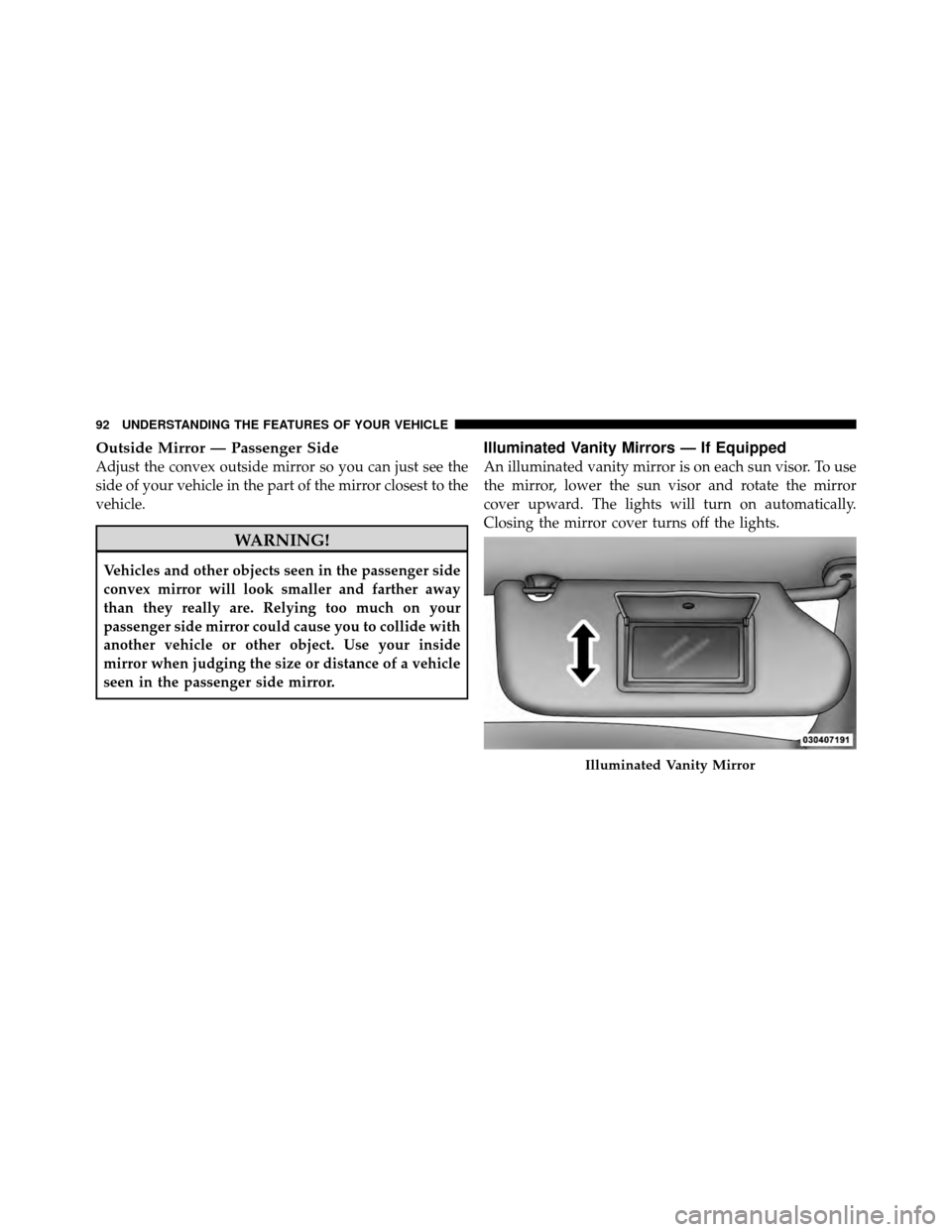
An illuminated vanity mirror is on each sun visor. To use
the mirror, lower the sun visor and rotate the mirror
cover upward. The lights will turn on automatically.
Closing the mirror cover turns off the lights.
Illuminated Vanity Mirror
92 UNDERSTANDING THE FEATURES OF YOUR VEHICLE
Page 102 of 444

Heated Seats — If Equipped
This feature heats leather or cloth front driver and
passenger seats. The switches for the heated seats are
located in the center console above the climate controls.
After turning the ignition ON, you can choose from High,
Low, or Off heat settings. Amber indicator lights in each
switch indicate the level of heat in use. Two indicator
lights will illuminate for High, one for Low and none for
Off.Press the switch once to select High-level heat-
ing. Press the switch a second time to select
Low-level heating. Press the switch a third time
to shut the heating elements Off.WARNING!
•Persons who are unable to feel pain to the skin
because of advanced age, chronic illness, diabetes,
spinal cord injury, medication, alcohol use, ex-
haustion or other physical condition must exercise
care when using the seat heater. It may cause burns
even at low temperatures, especially if used for
long periods of time.
•Do not place anything on the seat that insulates
against heat, such as a blanket or cushion. This may
cause the seat heater to overheat. Sitting in a seat
that has been overheated could cause serious burns
due to the increased surface temperature of the seat.
CAUTION!
Repeated overheating of the seat could damage the
heating element and/or degrade the material of the seat.
3
UNDERSTANDING THE FEATURES OF YOUR VEHICLE 101
Page 106 of 444
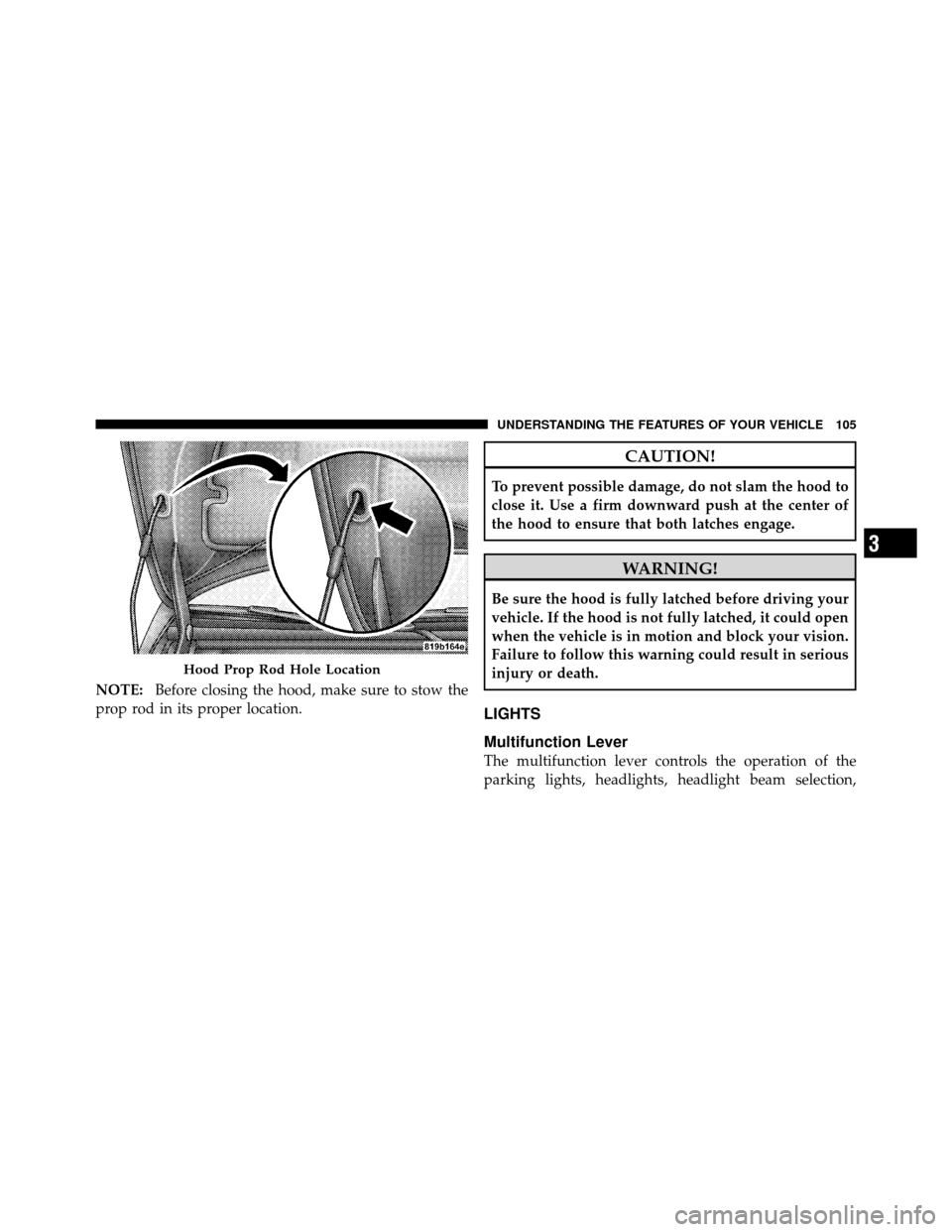
NOTE:Before closing the hood, make sure to stow the
prop rod in its proper location.
CAUTION!
To prevent possible damage, do not slam the hood to
close it. Use a firm downward push at the center of
the hood to ensure that both latches engage.
WARNING!
Be sure the hood is fully latched before driving your
vehicle. If the hood is not fully latched, it could open
when the vehicle is in motion and block your vision.
Failure to follow this warning could result in serious
injury or death.
LIGHTS
Multifunction Lever
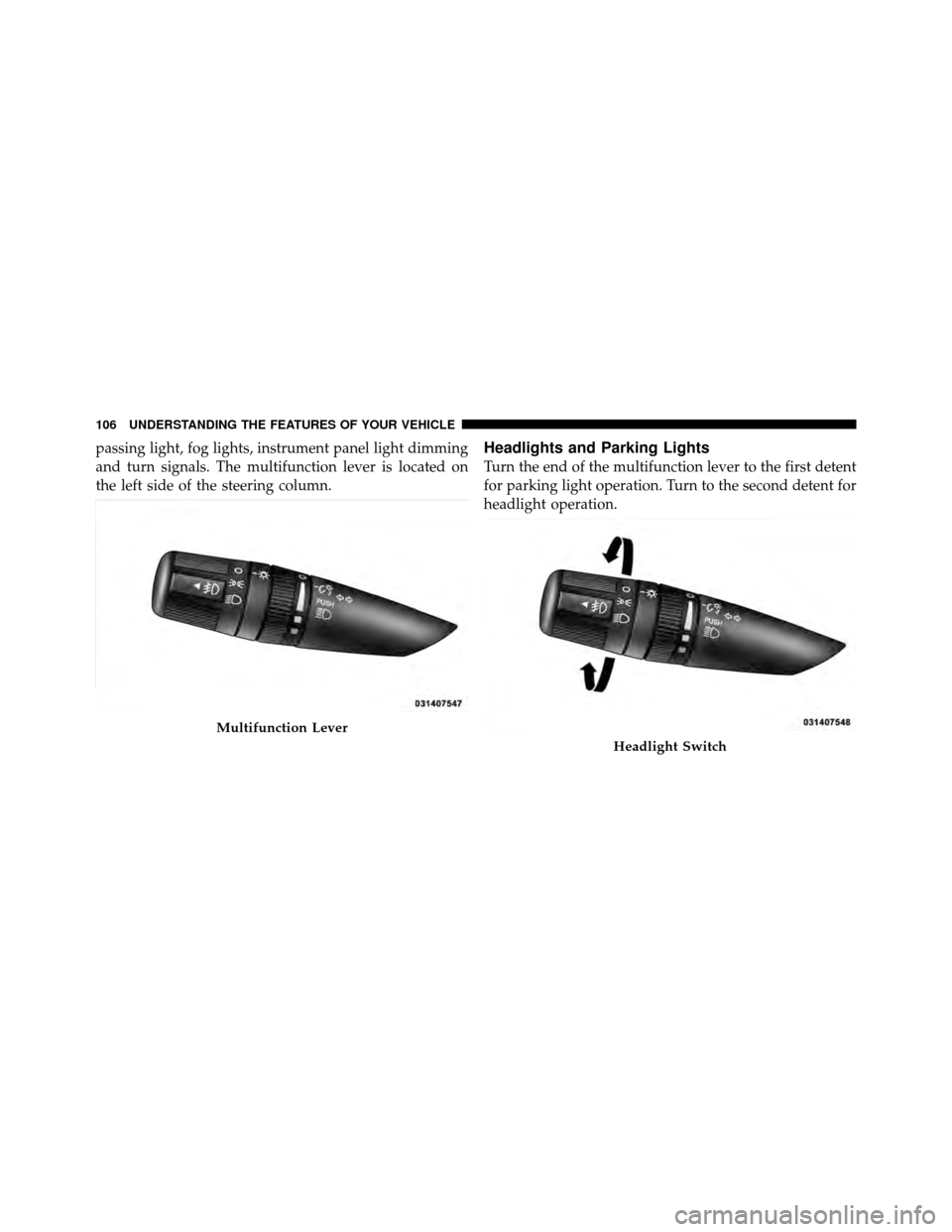
The multifunction lever controls the operation of the
parking lights, headlights, headlight beam selection,
Hood Prop Rod Hole Location
3
UNDERSTANDING THE FEATURES OF YOUR VEHICLE 105
Page 107 of 444
passing light, fog lights, instrument panel light dimming
and turn signals. The multifunction lever is located on
the left side of the steering column.Headlights and Parking Lights
Turn the end of the multifunction lever to the first detent
for parking light operation. Turn to the second detent for
headlight operation.
Multifunction Lever
Headlight Switch
106 UNDERSTANDING THE FEATURES OF YOUR VEHICLE