Page 338 of 444
Towing Without Power — Override Transaxle
Interlock System
Special care must be taken when the vehicle is towed
with the ignition in the LOCK position. A dolly should be
used under the front wheels if the rear wheels are raised.
Proper towing equipment is necessary to prevent dam-
age to the vehicle.
Battery power is required to release the brake/transaxle
interlock system. There is an override system that allows
you to shift out of PARK in case of loss of power. To
activate the override system:
•Firmly apply the parking brake.
•Insert the ignition key and rotate it to the ON position.
•Remove the cupholder liner.
•Insert a key, screwdriver, or similar object into the
front hole then push and hold the manual override
release lever forward.
•While holding the release lever forward, move the
shift lever from PARK to NEUTRAL.
•Release the override.
6
WHAT TO DO IN EMERGENCIES 337
Page 346 of 444

the gas cap is properly tightened. Press the trip odometer
“Reset” button to turn off the message. If the problem
persists, the message will appear the next time the
vehicle is started. This might indicate a damaged cap. If
the problem is detected twice in a row, the system will
turn on the “Malfunction Indicator Light (MIL).” Resolv-
ing the problem will turn the MIL light off.
EMISSIONS INSPECTION AND MAINTENANCE
PROGRAMS
In some localities, it may be a legal requirement to pass
an inspection of your vehicle’s emissions control system.
Failure to pass could prevent vehicle registration.For states that require an Inspection and Mainte-
nance (I/M), this check verifies the “Malfunction
Indicator Light (MIL)” is functioning and is not
on when the engine is running, and that the OBD II
system is ready for testing. Normally, the OBD II system will be ready. The OBD II
system may
notbe ready if your vehicle was recently
serviced, recently had a dead battery or a battery replace-
ment. If the OBD II system should be determined not
ready for the I/M test, your vehicle may fail the test.
Your vehicle has a simple ignition key-actuated test,
which you can use prior to going to the test station. To
check if your vehicle’s OBD II system is ready, you must
do the following:
1. Turn the ignition switch to the ON position, but do not
crank or start the engine.
2. If you crank or start the engine, you will have to start
this test over.
3. As soon as you turn the ignition switch to the ON
position, you will see the MIL symbol come on as part of
a normal bulb check.
7
MAINTAINING YOUR VEHICLE 345
Page 347 of 444

4. Approximately 15 seconds later, one of two things will
happen:a. The MIL will flash for about 10 seconds and then
return to being fully illuminated until you turn OFF
the ignition or start the engine. This means that your
vehicle’s OBD II system is not readyand you should
not proceed to the I/M station.
b. The MIL will not flash at all and will remain fully
illuminated until you turn OFF the ignition or start the
engine. This means that your vehicle’s OBD II system
is ready and you can proceed to the I/M station.
If your OBD II system is not ready,you should see your
authorized dealer or repair facility. If your vehicle was
recently serviced or had a battery failure or replacement,
you may need to do nothing more than drive your
vehicle as you normally would in order for your OBD II
system to update. A recheck with the above test routine
may then indicate that the system is now ready. Regardless of whether your vehicle’s OBD II system is
ready or not, if the MIL is illuminated during normal
vehicle operation you should have your vehicle serviced
before going to the I/M station. The I/M station can fail
your vehicle because the MIL is on with the engine
running.
REPLACEMENT PARTS
Use of genuine MOPAR�
parts for normal/scheduled
maintenance and repairs is highly recommended to en-
sure the designed performance. Damage or failures
caused by the use of non-MOPAR� parts for maintenance
and repairs will not be covered by the manufacturer’s
warranty.
DEALER SERVICE
Your authorized dealer has the qualified service person-
nel, special tools, and equipment to perform all service
operations in an expert manner. Service Manuals are
available which include detailed service information for
346 MAINTAINING YOUR VEHICLE
Page 361 of 444

Under normal operating conditions, the catalytic con-
verter will not require maintenance. However, it is im-
portant to keep the engine properly tuned to assure
proper catalyst operation and prevent possible catalyst
damage.
NOTE:Intentional tampering with emissions control
systems can result in civil penalties being assessed
against you.
In unusual situations involving grossly malfunctioning
engine operation, a scorching odor may suggest severe
and abnormal catalyst overheating. If this occurs, stop
the vehicle, turn off the engine and allow it to cool.
Service, including a tune-up to manufacturer’s specifica-
tions, should be obtained immediately. To minimize the possibility of catalytic converter dam-
age:
•Do not shut off the engine or interrupt the ignition,
when the transmission is in gear and the vehicle is in
motion.
•Do not try to start the engine by pushing or towing the
vehicle.
•Do not idle the engine with any spark plug wires
disconnected or removed, such as when diagnostic
testing, or for prolonged periods during very rough
idle or malfunctioning operating conditions.
360 MAINTAINING YOUR VEHICLE
Page 362 of 444

Cooling System
WARNING!
•When working near the radiator cooling fan, dis-
connect the fan motor lead or turn the ignition
switch to the LOCK position. The fan is tempera-
ture controlled and can start at anytime the igni-
tion switch is in the ON position.
•You or others can be badly burned by hot engine
coolant (antifreeze) or steam from your radiator. If
you see or hear steam coming from under the
hood, do not open the hood until the radiator has
had time to cool. Never try to open a cooling
system pressure cap when the radiator is hot.
Coolant Checks
Check engine coolant (antifreeze) protection every
12 months (before the onset of freezing weather, where
applicable). If the engine coolant (antifreeze) is dirty orrusty in appearance, the system should be drained,
flushed, and refilled with fresh engine coolant (anti-
freeze). Check the front of the A/C condenser for any
accumulation of bugs, leaves, etc. If dirty, clean by gently
spraying water from a garden hose vertically down the
face of the condenser.
Check the coolant recovery bottle tubing for brittle rub-
ber, cracking, tears, cuts, and tightness of the connection
at the bottle and radiator. Inspect the entire system for
leaks.
Cooling System – Drain, Flush, and Refill
If the engine coolant (antifreeze) is dirty or contains a
considerable amount of sediment, clean and flush with a
reliable cooling system cleaner. Follow with a thorough
rinsing to remove all deposits and chemicals. Properly
dispose of the old engine coolant (antifreeze).
Refer to “Maintenance Schedule” for further information.
7
MAINTAINING YOUR VEHICLE 361
Page 379 of 444
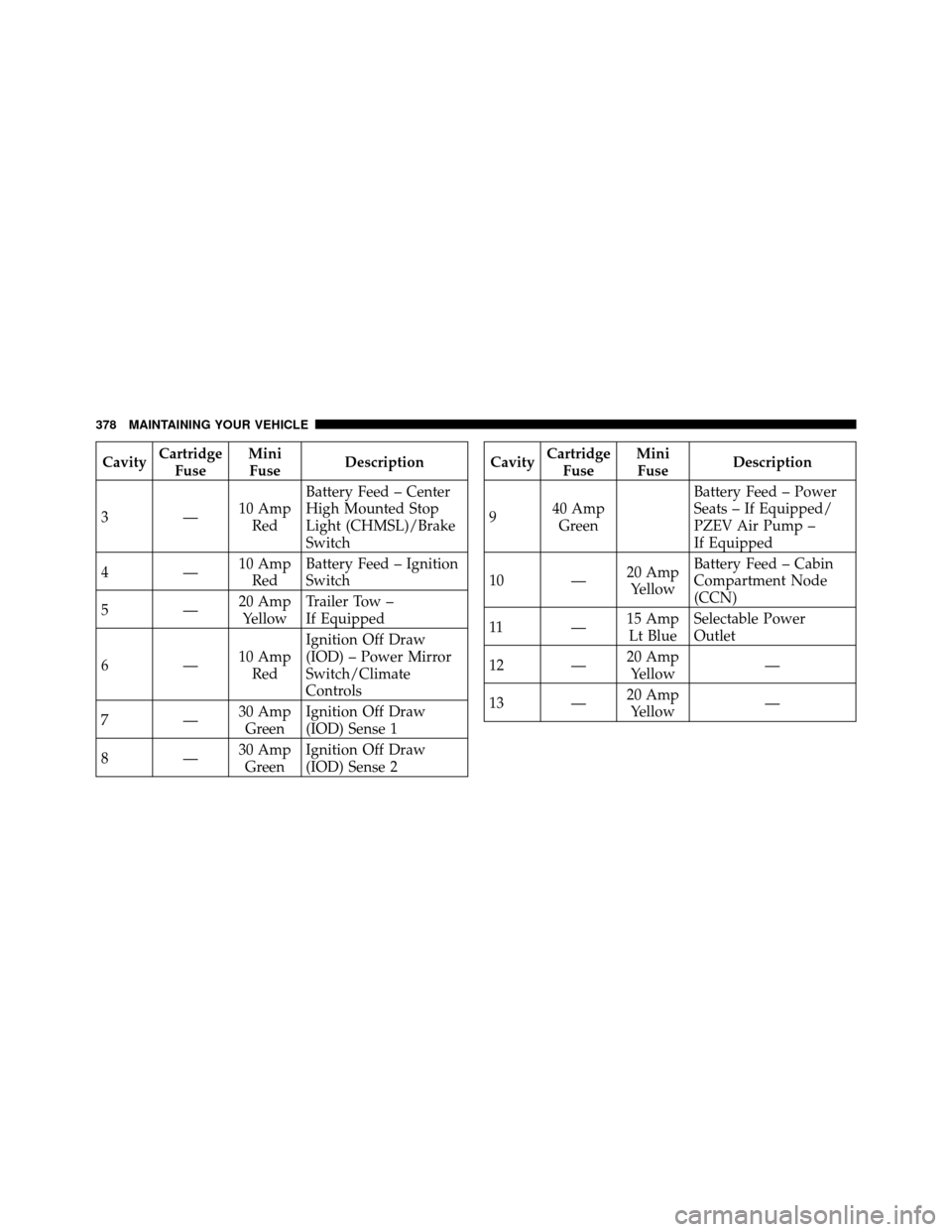
CavityCartridge
Fuse Mini
Fuse Description
3— 10 Amp
Red Battery Feed – Center
High Mounted Stop
Light (CHMSL)/Brake
Switch
4— 10 Amp
Red Battery Feed – Ignition
Switch
5— 20 Amp
Yellow Trailer Tow –
If Equipped
6— 10 Amp
Red Ignition Off Draw
(IOD) – Power Mirror
Switch/Climate
Controls
7— 30 Amp
Green Ignition Off Draw
(IOD) Sense 1
8— 30 Amp
Green Ignition Off Draw
(IOD) Sense 2Cavity
Cartridge
Fuse Mini
Fuse Description
9 40 Amp
Green Battery Feed – Power
Seats – If Equipped/
PZEV Air Pump –
If Equipped
10 — 20 Amp
Yellow Battery Feed – Cabin
Compartment Node
(CCN)
11 — 15 Amp
Lt Blue Selectable Power
Outlet
12 — 20 Amp
Yellow —
13 — 20 Amp
Yellow —
378 MAINTAINING YOUR VEHICLE
Page 380 of 444
CavityCartridge
Fuse Mini
Fuse Description
14 — 10 Amp
Red Ignition Off Draw
(IOD) – Cabin
Compartment Node
(CCN)/Interior
Lighting
15 40 Amp
Green —Battery Feed –
Radiator Fan Relay
16 — 15 Amp
Lt. Blue IGN Run/ACC – Cigar
Lighter/PWR Sunroof
Mod
17 — 10 Amp
Red Ignition Off Draw
(IOD) – Wireless Con-
trol Module (WCM)/
Clock/Steering Control
Module (SCM)
18 40 Amp
Green —Battery Feed – Auto
Shutdown (ASD) RelayCavity Cartridge
Fuse Mini
Fuse Description
19 — 20 Amp
Yellow Ignition Off Draw
(IOD) – Power Amp
Feed2–IfEquipped
20 — 15 Amp
Lt. Blue Ignition Off Draw
(IOD) – Radio
21 — 10 Amp
Red —
22 — 10 Amp
Red Ignition Run – Climate
Controls/Hot Cup-
holder – If Equipped
23 — 15 Amp
Lt. Blue Auto Shutdown (ASD)
Relay Feed 3
24 — 25 Amp
Natural Battery Feed — PWR
Sunroof Feed
25 — 10 Amp
Red Ignition Run — Heated
Mirrors - If Equipped
7
MAINTAINING YOUR VEHICLE 379
Page 381 of 444
CavityCartridge
Fuse Mini
Fuse Description
26 — 15 Amp
Lt. Blue Auto Shutdown (ASD)
Relay Feed 2
27 — 10 Amp
Red Ignition Run – Occu-
pant Classification
Module (OCM)/
Occupant Restraint
Controller (ORC)
28 — 10 Amp
Red Ignition Run — Occu-
pant Classification
Module (OCM)/
Occupant Restraint
Controller (ORC)
29 — — Hot Car
(No Fuse Required)
30 — 20 Amp
Yellow Ignition Run – Heated
Seats – If EquippedCavity
Cartridge
Fuse Mini
Fuse Description
31 — 10 Amp
Red —
32 30 Amp
Pink —Auto Shutdown (ASD)
Relay Feed 1
33 — 10 Amp
Red Battery Feed – Switch
Bank/Diagnostic Link
Connector/Powertrain
Control Module (PCM)
34 30 Amp
Pink —Battery Feed – Anti-
Lock Brakes (ABS)
Module – If Equipped/
Electronic Stability
Control (ESC) Module
– If Equipped
380 MAINTAINING YOUR VEHICLE