Page 253 of 368

CAUTION!
•Do not tow a trailer at all during the first 500 miles
(805 km) the new vehicle is driven. The engine,
axle or other parts could be damaged.
•Then, during the first 500 miles (805 km) that a
trailer is towed, do not drive over 50 mph
(80 km/h) and do not make starts at full throttle.
This helps the engine and other parts of the
vehicle wear in at the heavier loads.
Perform the maintenance listed in the “Maintenance
Schedule.” When towing a trailer, never exceed the
GAWR, or GCWR ratings. Refer to “Maintenance Sched-
ule” for further information.
WARNING!
•Improper towing can lead to an injury accident.
•Make certain that the load is secured in the trailer
and will not shift during travel. When trailering
cargo that is not fully secured, dynamic load shifts
can occur that may be difficult for the driver to
control. You could lose control of your vehicle and
have an accident.
•When hauling cargo or towing a trailer, do not over-
load your vehicle or trailer. Overloading can cause a
loss of control, poor performance or damage to brakes,
axle, engine, transmission, steering, suspension, chas-
sis structure or tires.
•Safety chains must always be used between your
vehicle and trailer. Always connect the chains to the
252 STARTING AND OPERATING
Page 266 of 368
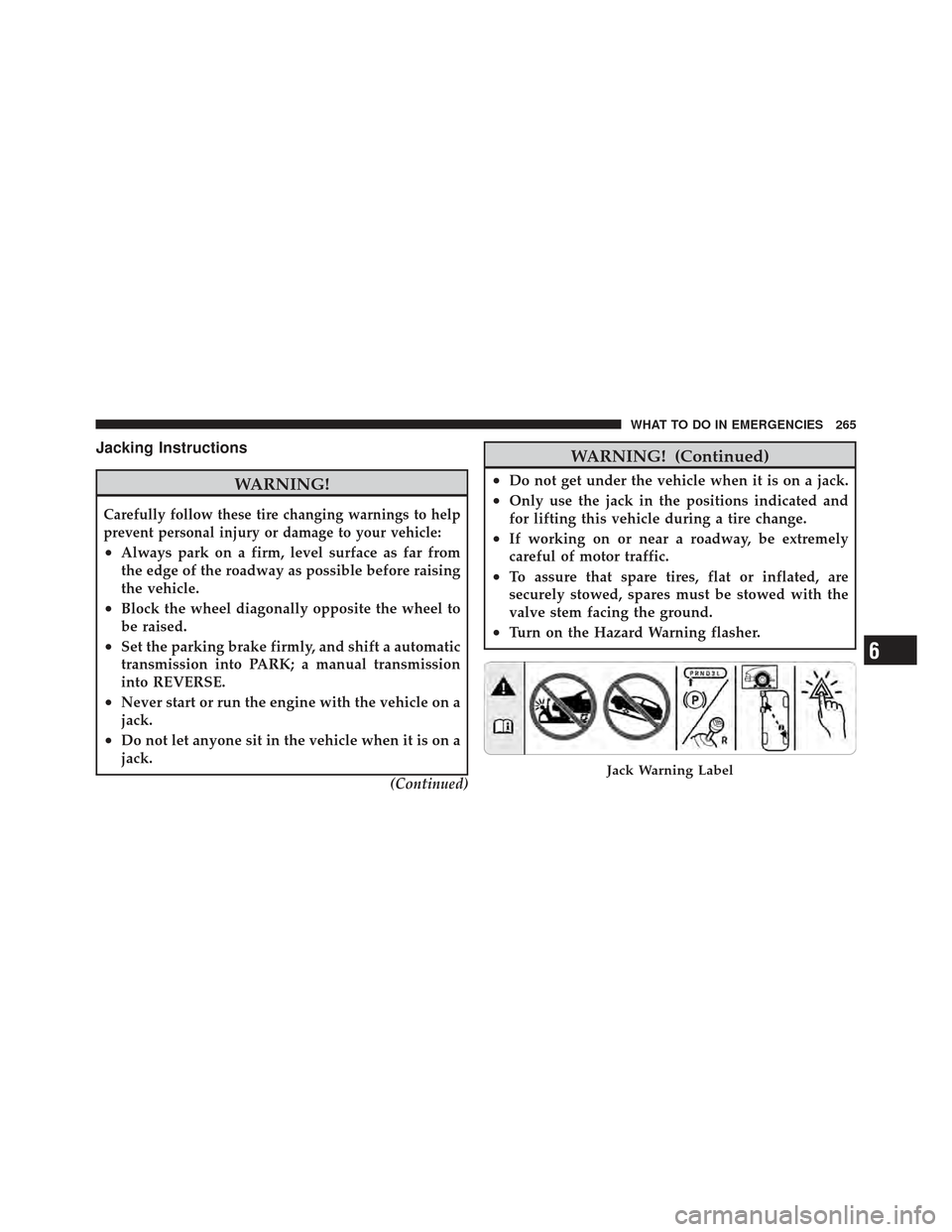
Jacking Instructions
WARNING!
Carefully follow these tire changing warnings to help
prevent personal injury or damage to your vehicle:
•Always park on a firm, level surface as far from
the edge of the roadway as possible before raising
the vehicle.
•Block the wheel diagonally opposite the wheel to
be raised.
•Set the parking brake firmly, and shift a automatic
transmission into PARK; a manual transmission
into REVERSE.
•Never start or run the engine with the vehicle on a
jack.
•Do not let anyone sit in the vehicle when it is on a
jack.(Continued)
WARNING! (Continued)
•Do not get under the vehicle when it is on a jack.
•Only use the jack in the positions indicated and
for lifting this vehicle during a tire change.
•If working on or near a roadway, be extremely
careful of motor traffic.
•To assure that spare tires, flat or inflated, are
securely stowed, spares must be stowed with the
valve stem facing the ground.
•Turn on the Hazard Warning flasher.
Jack Warning Label
6
WHAT TO DO IN EMERGENCIES 265
Page 268 of 368
Do not raise the vehicle until you are sure the jack is
securely engaged.
3. Raise the vehicle by turning the jack screw to the right,
using the swivel wrench. Raise the vehicle only until thetire just clears the surface and enough clearance is
obtained to install the spare tire. Minimum tire lift
provides maximum stability.
WARNING!
Raising the vehicle higher than necessary can make
the vehicle less stable. It could slip off the jack and
hurt someone near it. Raise the vehicle only enough
to remove the tire.
4. Remove the wheel nuts and pull the wheel and wheel
covers where applicable off the hub. Install the spare
wheel and wheel nuts with the cone-shaped end of the
nuts toward the wheel. Lightly tighten the nuts. To avoid
the risk of forcing the vehicle off the jack, do not tighten
the nuts fully until the vehicle has been lowered.
Rear Jacking Location6
WHAT TO DO IN EMERGENCIES 267
Page 269 of 368

WARNING!
To avoid possible personal injury, handle the wheel
covers with care to avoid contact with any sharp
edges.
NOTE: The wheel cover is held on the wheel by the
wheel nuts. When reinstalling original wheel, properly
align the wheel cover to the valve stem, place the wheel
cover onto the wheel, then install the wheel nuts.
5. Lower the vehicle by turning the jack screw to the left.
6. Finish tightening the nuts. Push down on the wrench
while tightening the wheel nuts. Alternate nuts until each
nut has been tightened twice. The correct wheel nut
torque is 100 ft lbs (135 N m). If you doubt that you have
tightened the nuts correctly, have them checked with a
torque wrench by your authorized dealer or at a qualified
service station. 7. Remove the wheel blocks and lower the jack until it is
free. Stow the lug wrench, and jack in their designated
location. Secure all parts using the means provided.
WARNING!
A loose tire or jack thrown forward in a collision or
hard stop could endanger the occupants of the ve-
hicle. Always stow the jack parts and the spare tire in
the places provided. Have the deflated (flat) tire
repaired or replaced immediately.
8. Place the deflated (flat) tire in the cargo area, have the
tire repaired or replaced as soon as possible.
9. Check the tire pressure as soon as possible. The correct
pressure as required.
JUMP-STARTING
If your vehicle has a discharged battery it can be jump-
started using a set of jumper cables and a battery in
268 WHAT TO DO IN EMERGENCIES
Page 275 of 368

All Transaxles
CAUTION!
If the vehicle being towed requires steering, the
ignition switch must be in the ACC position, not in
the LOCK position.
Do not attempt to use sling-type equipment when
towing. When securing the vehicle to a flatbed truck,
do not attach it to front or rear suspension compo-
nents. Damage to your vehicle may result from
improper towing.
If it is necessary to use the accessories while being towed
(wipers, defrosters, etc.), the key must be in the ON
position, not the ACC position. Make certain the trans-
axle remains in NEUTRAL.
Towing Without The Key-In-Ignition
Special care must be taken when the vehicle is towed
with the ignition in the LOCK position. A dolly should be
used under the front wheels if the rear wheels are raised.
Proper towing equipment is necessary to prevent dam-
age to the vehicle.
Towing Behind Another Vehicle (Flat Towing with
all four wheels on the ground)
If your vehicle is equipped with a manual transaxle, it
may be towed in a forward direction, at any legal
highway speed, for any distance, if the transaxle is in
NEUTRAL.
If the ignition key is not available, vehicles with auto-
matic transaxles can not be flat towed at any time.
274 WHAT TO DO IN EMERGENCIES
Page 300 of 368

WARNING! (Continued)
•To avoid contamination from foreign matter or
moisture, use only new brake fluid or fluid that
has been in a tightly closed container. Keep the
master cylinder reservoir cap secured at all times.
Brake fluid in a open container absorbs moisture
from the air resulting in a lower boiling point.
This may cause it to boil unexpectedly during hard
or prolonged braking, resulting in sudden brake
failure. This could result in a accident.
•Overfilling the brake fluid reservoir can result in
spilling brake fluid on hot engine parts, causing
the brake fluid to catch fire. Brake fluid can also
damage painted and vinyl surfaces, care should be
taken to avoid its contact with these surfaces.(Continued)
WARNING! (Continued)
•Do not allow petroleum based fluid to contami-
nate the brake fluid. Brake seal components could
be damaged, causing partial or complete brake
failure. This could result in an accident.
Automatic Transmission
The automatic transmission and differential assembly are
contained within a single housing.
The fluid level in the automatic transmission should be
checked whenever the vehicle is serviced. Operation with
an improper fluid level will greatly reduce the life of the
transmission and the fluid.
7
MAINTAINING YOUR VEHICLE 299
Page 309 of 368
FUSES
Integrated Power Module (IPM)
The Integrated Power Module is located in the engine
compartment near the air cleaner assembly. This center
contains cartridge fuses and mini fuses.
CavityCartridge
Fuse Mini-Fuse Description
1 EMPTY
2 20 Amp Yellow AWD ECU
Feed — If
Equipped
3 10 Amp Red CHMSL Brake
Switch Feed
4 10 Amp Red Ignition Switch
Feed
5 20 Amp Yellow Trailer Tow
6 10 Amp Red IOD Sw/Pwr
Mir/Ocm Steer-
ing Cntrl Sdar/
Hfm
7 30 Amp Green IOD Sense1
8 30 Amp Green IOD Sense2
Integrated Power Module
308 MAINTAINING YOUR VEHICLE
Page 351 of 368

ABS (Anti-Lock Brake System).............. 210
Adding Engine Coolant (Antifreeze) .......... 294
Adding Fuel ........................... 241
Additives, Fuel ......................... 239
Air Cleaner, Engine (Engine Air Cleaner Filter) . . . 285
Air Conditioner Maintenance ............... 287
Air Conditioning Controls ................. 180
Air Conditioning, Operating Tips ............ 185
Air Conditioning Refrigerant .............287,288
Air Conditioning System ................180,287
Air Pressure, Tires ....................... 224
Airbag ................................ 46
Airbag Deployment ....................... 58
Airbag Light ....................... 61,75,153
Airbag Maintenance ....................... 60
Airbag, Side ............................ 56
Alarm Light ........................... 152
Alarm, Panic ............................ 22 Alarm System (Security Alarm)
............... 18
Alterations/Modifications, Vehicle ............. 7
Antenna, Satellite Radio ................... 178
Antifreeze (Engine Coolant) ...........293,316,317
Capacities ........................... 316
Disposal ............................ 296
Anti-Lock Brake System (ABS) .............. 210
Anti-Lock Warning Light .................. 153
Anti-Theft Security Alarm (Theft Alarm) ........ 18
Appearance Care ........................ 302
Auto Down Power Windows ................ 32
Automatic Door Locks ................... 28,29
Automatic Transaxle ..............12,192,194,299
Adding Fluid ......................... 300
Filter ............................... 301
Fluid and Filter Changes ................. 301
Fluid Level Check ..................... 300
Interlock System ..................... 15,196
Reset Mode .......................... 197
350 INDEX

