Page 254 of 368

frame or hook retainers of the vehicle hitch. Cross the
chains under the trailer tongue and allow enough
slack for turning corners.
•Vehicles with trailers should not be parked on a grade.
When parking, apply the parking brake on the tow
vehicle. Put the tow vehicle automatic transmission in
PARK. Always, block or�chock�the trailer wheels.
•GCWR must not be exceeded.
•Total weight must be distributed between the tow
vehicle and the trailer such that the following four
ratings are not exceeded:
1. GVWR
2. GTW
3. GAWR
4. TW (Trailer Tongue Weight rating for the trailer
hitch utilized. This requirement may limit the ability to always achieve the 10% to 15% range of trailer tongue
weight as a percentage of total trailer weight.)
Towing Requirements – Tires
•
Do not attempt to tow a trailer while using a compact
spare tire.
•Proper tire inflation pressures are essential to the safe
and satisfactory operation of your vehicle. Refer to
“Tires-General Information” in “Starting and Operat-
ing” for proper tire inflation procedures.
•Check the trailer tires for proper tire inflation pres-
sures before trailer usage.
•Check for signs of tire wear or visible tire damage
before towing a trailer. Refer to “Tires-General Infor-
mation” in “Starting and Operating” for the proper
inspection procedure.
5
STARTING AND OPERATING 253
Page 258 of 368

Towing Tips
Before setting out on a trip, practice turning, stopping
and backing the trailer in an area away from heavy
traffic.
Automatic Transmission
The OVERDRIVE/DRIVE gear range can be selected
when towing. However, if frequent shifting occurs while
in this range, third gear should be selected.
NOTE:Using the third gear range while operating the
vehicle under heavy operating conditions will improve
performance and extend transmission life by reducing
excessive shifting and heat build up. This action will also
provide better engine braking.
The automatic transmission fluid and filter should be
changed if you REGULARLY tow a trailer for more than 45 minutes of continuous operation. Refer to “Mainte-
nance Schedule” for the proper maintenance intervals.
NOTE:
Check the automatic transmission fluid level
before towing.Electronic Speed Control – If Equipped
•
Do not use in hilly terrain or with heavy loads.
•When using the speed control, if you experience speed
drops greater than 10 mph (16 km/h), disengage until
you can get back to cruising speed.
•Use speed control in flat terrain and with light loads to
maximize fuel efficiency.
5
STARTING AND OPERATING 257
Page 259 of 368
Cooling System
To reduce potential for engine and transmission over-
heating, take the following actions:
•City Driving
When stopped for short periods of time, shift the trans-
mission into NEUTRAL but do not increase engine idle
speed.
•Highway Driving
Reduce speed.
•Air Conditioning
Turn off temporarily.
RECREATIONAL TOWING (BEHIND
MOTORHOME, ETC.)
Automatic Transmission
CAUTION!
Recreational towing on vehicle’s equipped with a
automatic transmission is not recommended.
NOTE: If the vehicle requires towing, make sure all four
wheels are off the ground.
258 STARTING AND OPERATING
Page 266 of 368
Jacking Instructions
WARNING!
Carefully follow these tire changing warnings to help
prevent personal injury or damage to your vehicle:
•Always park on a firm, level surface as far from
the edge of the roadway as possible before raising
the vehicle.
•Block the wheel diagonally opposite the wheel to
be raised.
•Set the parking brake firmly, and shift a automatic
transmission into PARK; a manual transmission
into REVERSE.
•Never start or run the engine with the vehicle on a
jack.
•Do not let anyone sit in the vehicle when it is on a
jack.(Continued)
WARNING! (Continued)
•Do not get under the vehicle when it is on a jack.
•Only use the jack in the positions indicated and
for lifting this vehicle during a tire change.
•If working on or near a roadway, be extremely
careful of motor traffic.
•To assure that spare tires, flat or inflated, are
securely stowed, spares must be stowed with the
valve stem facing the ground.
•Turn on the Hazard Warning flasher.
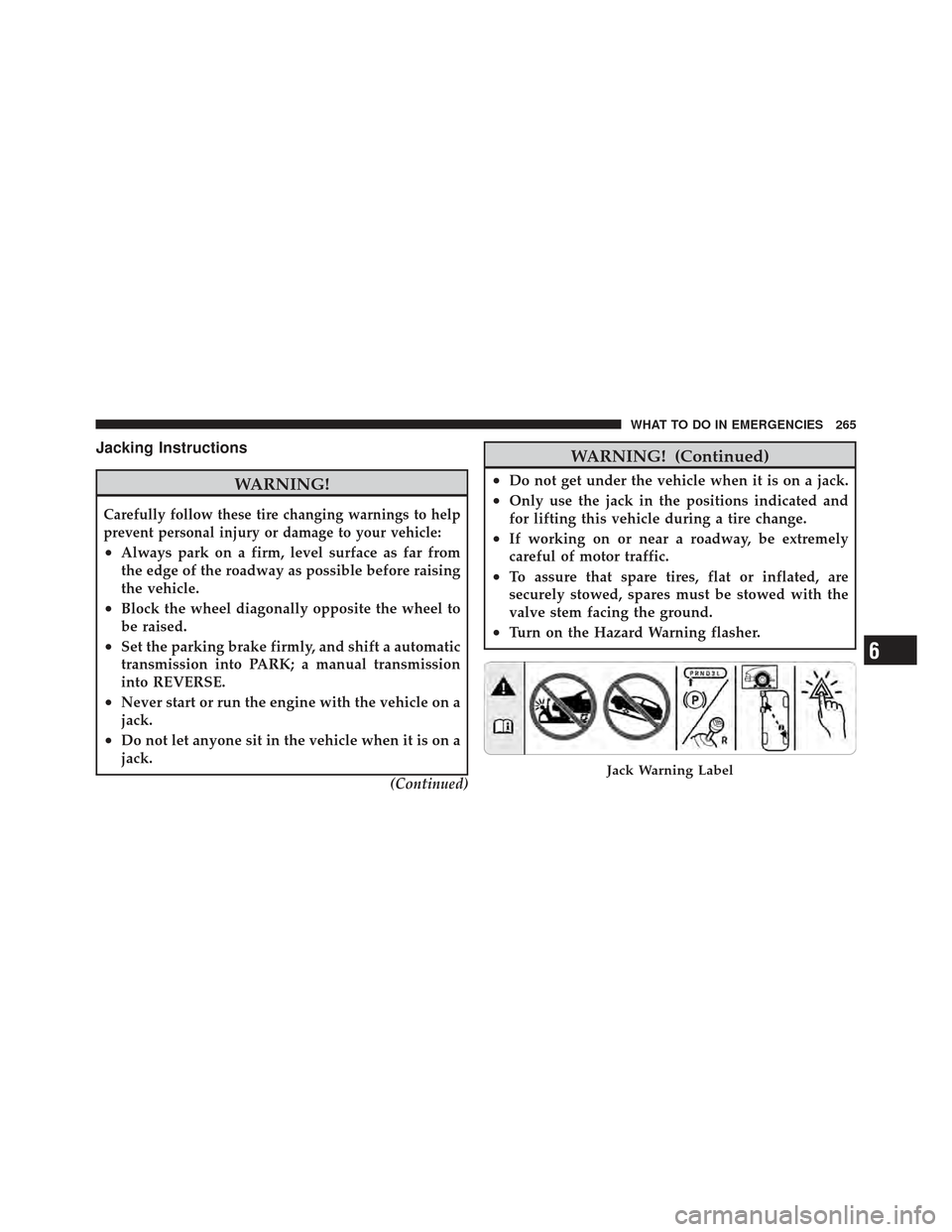
Jack Warning Label
6
WHAT TO DO IN EMERGENCIES 265
Page 271 of 368

WARNING!
•Take care to avoid the radiator cooling fan when-
ever the hood is raised. It can start anytime the
ignition switch is on. You can be injured by
moving fan blades.
•Remove any metal jewelry such as watch bands or
bracelets that might make an inadvertent electrical
contact. You could be seriously injured.
•Batteries contain sulfuric acid that can burn your
skin or eyes and generate hydrogen gas which is
flammable and explosive. Keep open flames or
sparks away from the battery.
1. Set the parking brake, shift the automatic transmission
into PARK and turn the ignition to LOCK.
2. Turn off the heater, radio, and all unnecessary electri-
cal accessories. 3. If using another vehicle to jump-start the battery, park
the vehicle within the jumper cables reach, set the
parking brake and make sure the ignition is OFF.
WARNING!
Do not allow vehicles to touch each other as this
could establish a ground connection and personal
injury could result.
Jump-Starting Procedure
WARNING!
Failure to follow this procedure could result in per-
sonal injury or property damage due to battery ex-
plosion.
270 WHAT TO DO IN EMERGENCIES
Page 277 of 368
▫Brake System ...................... 298
▫ Automatic Transmission .............. 299
▫ Appearance Care And Protection From
Corrosion .......................... 302
� Fuses ............................. 308
▫ Integrated Power Module (IPM) ......... 308
� Vehicle Storage ...................... 311
� Replacement Bulbs ................... 311
� Bulb Replacement .................... 312
▫ Headlamps ....................... 312
▫ Front Parking, Turn Signal, And Side Marker
Lamps ............................ 313 ▫
Front Fog Lamps – If Equipped ......... 314
▫ Rear Tail, Stop And Turn Signal Lamps . . . 314
▫ Backup Lamps ..................... 315
▫ Center High-Mounted Stop Lamp
(CHMSL) .......................... 315
� Fluid Capacities ..................... 316
� Fluids, Lubricants And Genuine Parts ...... 317
▫ Engine ........................... 317
▫ Chassis .......................... 318
276 MAINTAINING YOUR VEHICLE
Page 278 of 368
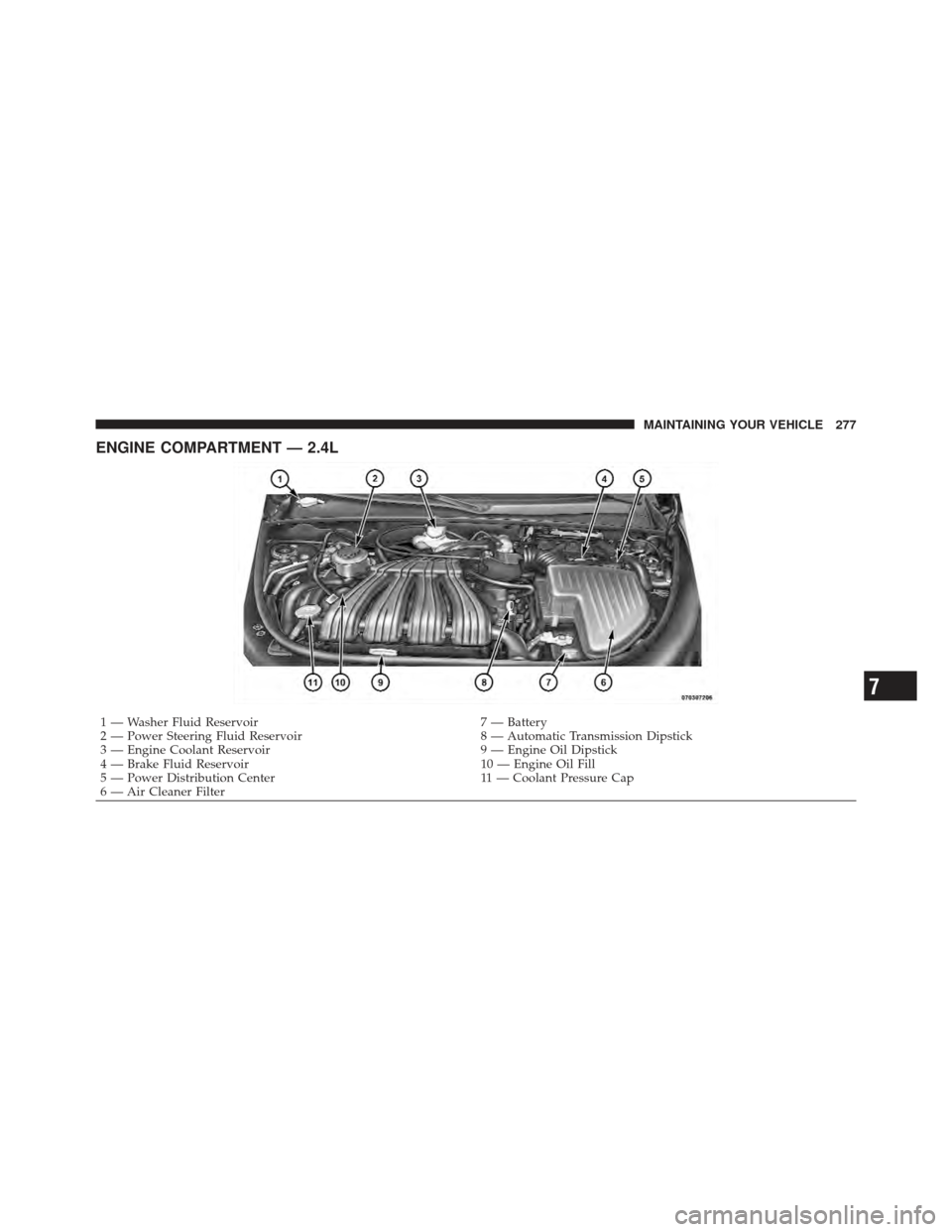
ENGINE COMPARTMENT — 2.4L
1 — Washer Fluid Reservoir7 — Battery
2 — Power Steering Fluid Reservoir 8 — Automatic Transmission Dipstick
3 — Engine Coolant Reservoir 9 — Engine Oil Dipstick
4 — Brake Fluid Reservoir 10 — Engine Oil Fill
5 — Power Distribution Center 11 — Coolant Pressure Cap
6 — Air Cleaner Filter
7
MAINTAINING YOUR VEHICLE 277
Page 279 of 368

ONBOARD DIAGNOSTIC SYSTEM — OBD II
Your vehicle is equipped with a sophisticated onboard
diagnostic system called OBD II. This system monitors
the performance of the emissions, engine, and automatic
transmission control systems. When these systems are
operating properly, your vehicle will provide excellent
performance and fuel economy, as well as engine emis-
sions well within current government regulations.
If any of these systems require service, the OBD II system
will turn on the Malfunction Indicator Light (MIL). OBD
II will also store diagnostic codes and other information
to assist an authorized service technician in making
repairs. Although your vehicle will usually be drivable
and not need towing, see your authorized dealer for
service as soon as possible.
Loose Fuel Filler Cap Message
After fuel is added, the vehicle diagnostic system can
determine if the fuel filler cap is loose, improperlyinstalled, or damaged. A “gASCAP” message will be
displayed in the instrument cluster. Tighten the gas cap
until a
�clicking� sound is heard. This is an indication that
the gas cap is properly tightened. Press the odometer
reset button to turn the message off. If the problem
persists, the message will appear the next time the
vehicle is started. This might indicate a damaged cap. If
the problem is detected twice in a row, the system will
turn on the MIL. Resolving the problem will turn the MIL
light off.
EMISSIONS INSPECTION AND MAINTENANCE
PROGRAMS
In some localities, it may be a legal requirement to pass
an inspection of your vehicle’s emissions control system.
Failure to pass could prevent vehicle registration.
For states that require an Inspection and Mainte-
nance (I/M), this check verifies the “Malfunction
278 MAINTAINING YOUR VEHICLE