Page 162 of 538
To decrease speed while Electronic Speed Control is set,
push down and hold the lever in SET DECEL. If the lever
is continually held in the SET DECEL position, the set
speed will continue to until the lever is released. Release
the lever when the desired speed is reached, and a new
set speed will be established.
Tapping the Electronic Speed Control lever to SET DE-
CEL once will result in a 1 mph (1.6 km/h) speed
decrease. Each time the lever is tapped, speed decreases.
To Accelerate For Passing
Press the accelerator as you would normally. When the
pedal is released, the vehicle will return to the set speed.
Using Electronic Speed Control on Hills
NOTE:The Electronic Speed Control system maintains
speed up and down hills. A slight speed change on
moderate hills is normal. The automatic transmission will downshift while climb-
ing uphill or descending downhill. This downshift is
necessary to maintain vehicle set speed.
On steep hills, a greater speed loss or gain may occur, so
it may be preferable to drive without Electronic Speed
Control.
WARNING!
Electronic Speed Control can be dangerous where the
system cannot maintain a constant speed. Your ve-
hicle could go too fast for the conditions and you
could lose control. An accident could be the result.
Do not use Electronic Speed Control in heavy traffic
or on roads that are winding, icy, snow-covered or
slippery.
3
UNDERSTANDING THE FEATURES OF YOUR VEHICLE 161
Page 163 of 538

ADAPTIVE CRUISE CONTROL (ACC) — IF
EQUIPPED
Adaptive Cruise Control (ACC) increases the driving
convenience provided by cruise control while traveling
on highways and major roadways. However, it is not a
safety system and not designed to prevent collisions.
ACC will allow you to keep cruise control engaged in
light to moderate traffic conditions without the constant
need to reset your cruise control. ACC utilizes an infrared
sensor designed to detect a vehicle directly ahead of you.
NOTE:
•If the sensor does not detect a vehicle ahead of you,
ACC will maintain a fixed set speed.
•If the ACC sensor detects a vehicle ahead, ACC will
apply limited braking or acceleration automatically to
maintain a preset following distance, while matching
the speed of the vehicle ahead.
WARNING!
•Adaptive Cruise Control (ACC) is a convenience
system. It is not a substitute for active driving
involvement. It is always the driver ’s responsibil-
ity to be attentive of road, traffic, and weather
conditions, vehicle speed, distance to the vehicle
ahead; and, most importantly, brake operation to
ensure safe operation of the vehicle under all road
conditions. Your complete attention is always re-
quired while driving to maintain safe control of
your vehicle. Failure to follow these warnings can
result in an accident or serious personal injury.The
ACC system:
•Does not react to pedestrians, oncoming vehicles,
and stationary objects (i.e., a stopped vehicle in a
traffic jam or a disabled vehicle).(Continued)
162 UNDERSTANDING THE FEATURES OF YOUR VEHICLE
Page 164 of 538
WARNING! (Continued)
•Cannot take street, traffic, and weather conditions
into account, and may be limited upon adverse
sight distance conditions.
•Does not predict the lane curvature or the move-
ment of preceding vehicles and will not compen-
sate for such changes.
•Does not always fully recognize complex driving
conditions, which can result in wrong or missing
distance warnings.
•May not detect a vehicle ahead when strong light
(for example, sunrise or sunset) is directly shining
on the front of the vehicle.
•Can only apply a maximum of 25% of the vehicle’s
braking capability, and will not bring the vehicle
to a complete stop.
WARNING!
You should switch off the ACC system:
•When driving in fog, heavy rain, heavy snow,
sleet, heavy traffic, and complex driving situations
(i.e., in highway construction zones).
•When entering a turn lane or highway off ramp;
when driving on roads that are winding, icy,
snow-covered, slippery, or have steep uphill or
downhill slopes; and when towing a trailer.
•When circumstances do not allow safe driving at a
constant speed.
Failure to follow these warnings can result in an
accident or serious personal injury.
3
UNDERSTANDING THE FEATURES OF YOUR VEHICLE 163
Page 167 of 538
WARNING!
Leaving the Adaptive Cruise Control (ACC) system
on when not in use is dangerous. You could acciden-
tally set the system or cause it to go faster than you
want. You could lose control and have an accident.
Always leave the system off when you are not using
it.
To Set a Desired ACC Speed
When the vehicle reaches the speed desired, push the
lever downward (SET/DECEL) and release. The EVIC
will display the set speed.Remove your foot from the accelerator pedal. If you do
not, the vehicle may continue to accelerate beyond the set
speed. If this occurs:
•The message “DRIVER OVERRIDE” will display in
the EVIC.
166 UNDERSTANDING THE FEATURES OF YOUR VEHICLE
Page 169 of 538
To Turn Off
The system will turn off and erase the set speed in
memory if:
•You push and release the ON/OFF/MODE button.
•You turn OFF the ignition.
•You switch off ESP.
To Resume Speed
Push the lever upward (RESUME/ACCEL) and release.
Then remove your foot from the accelerator pedal. The
EVIC will display the last set speed.
WARNING!
The Resume function should only be used if traffic
and road conditions permit. Resuming a set speed
that is too high or too low for prevailing traffic and
road conditions could cause the vehicle to accelerate
or decelerate too sharply for safe operation. This
could cause an accident and/or serious injury.
To Vary the Speed Setting
While ACC is set, you can increase the set speed by lifting
and holding the lever up (RESUME/ACCEL). If the lever
is continually held, the set speed will continue to increase
in 5 mph (10 km/h) increments until the lever is released.
The increase in set speed is reflected in the EVIC display.
Tapping the lever up once will result in a 1 mph (1 km/h)
increase in set speed. Each subsequent tap of the lever
results in an increase of 1 mph (1 km/h).
168 UNDERSTANDING THE FEATURES OF YOUR VEHICLE
Page 172 of 538
•The vehicle ahead slows to a speed below 15 mph
(24 km/h) and the system automatically disengages
itself.
•The distance setting is changed.
•The system disengages. (Refer to the information on
ACC Activation).
The maximum braking applied by ACC is limited; how-
ever, the driver can always apply the brakes manually, if
necessary.
NOTE: The brake lights will illuminate whenever the
ACC system applies the brakes.
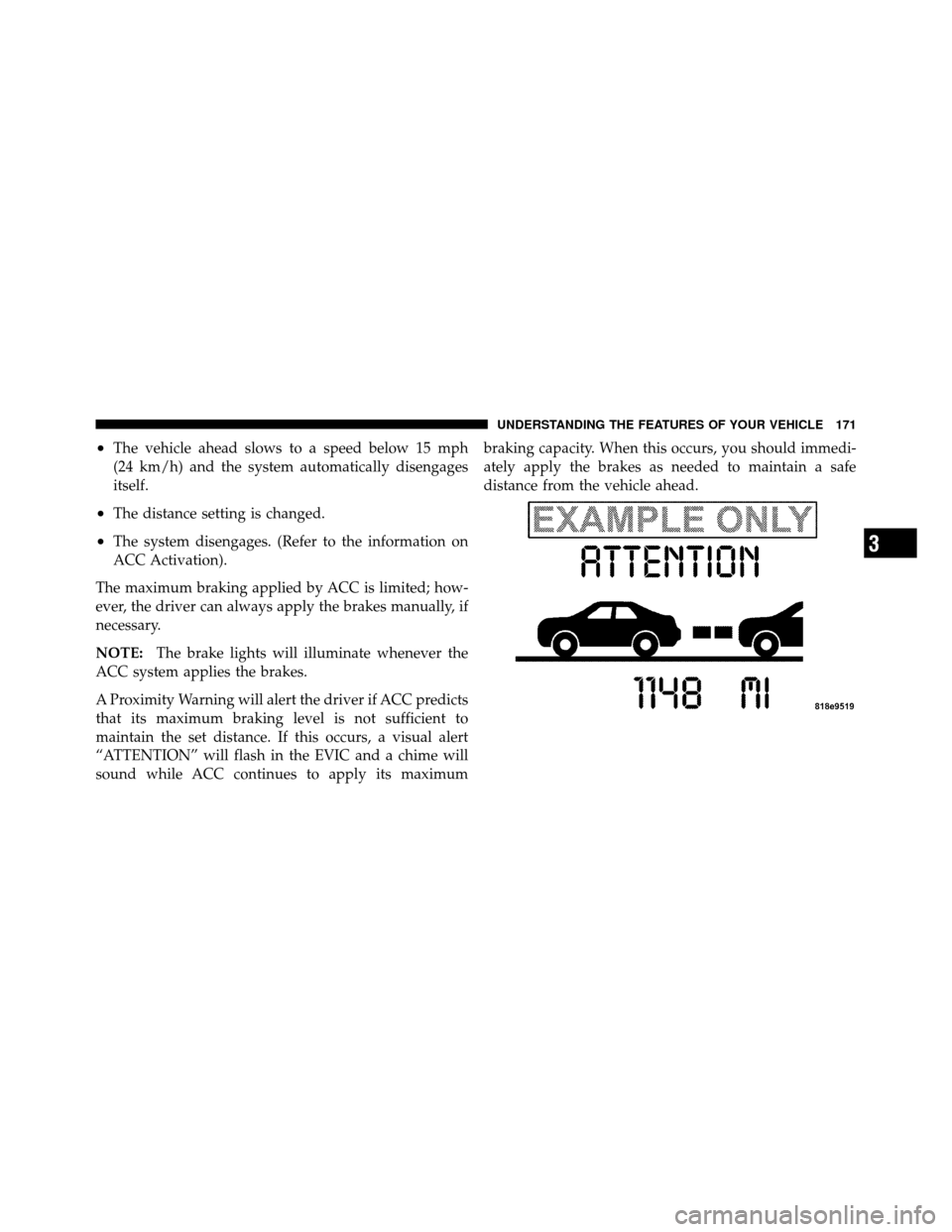
A Proximity Warning will alert the driver if ACC predicts
that its maximum braking level is not sufficient to
maintain the set distance. If this occurs, a visual alert
“ATTENTION” will flash in the EVIC and a chime will
sound while ACC continues to apply its maximum braking capacity. When this occurs, you should immedi-
ately apply the brakes as needed to maintain a safe
distance from the vehicle ahead.3
UNDERSTANDING THE FEATURES OF YOUR VEHICLE 171
Page 175 of 538
The set speed will continue to display in place of the
odometer reading when changing the EVIC display
while ACC is set.The ACC SET screen will display once again if any ACC
activity occurs, which may include any of the following:
•Set speed change
•Distance setting change
•System cancel
•Acquisition/loss of Target
•Driver override
•System off
•Proximity warning
•ACC warning
The EVIC will return to the last display selected
after five seconds of no ACC display activity.
174 UNDERSTANDING THE FEATURES OF YOUR VEHICLE
Page 176 of 538
Display Warnings and Maintenance
ACC Blinded Warning
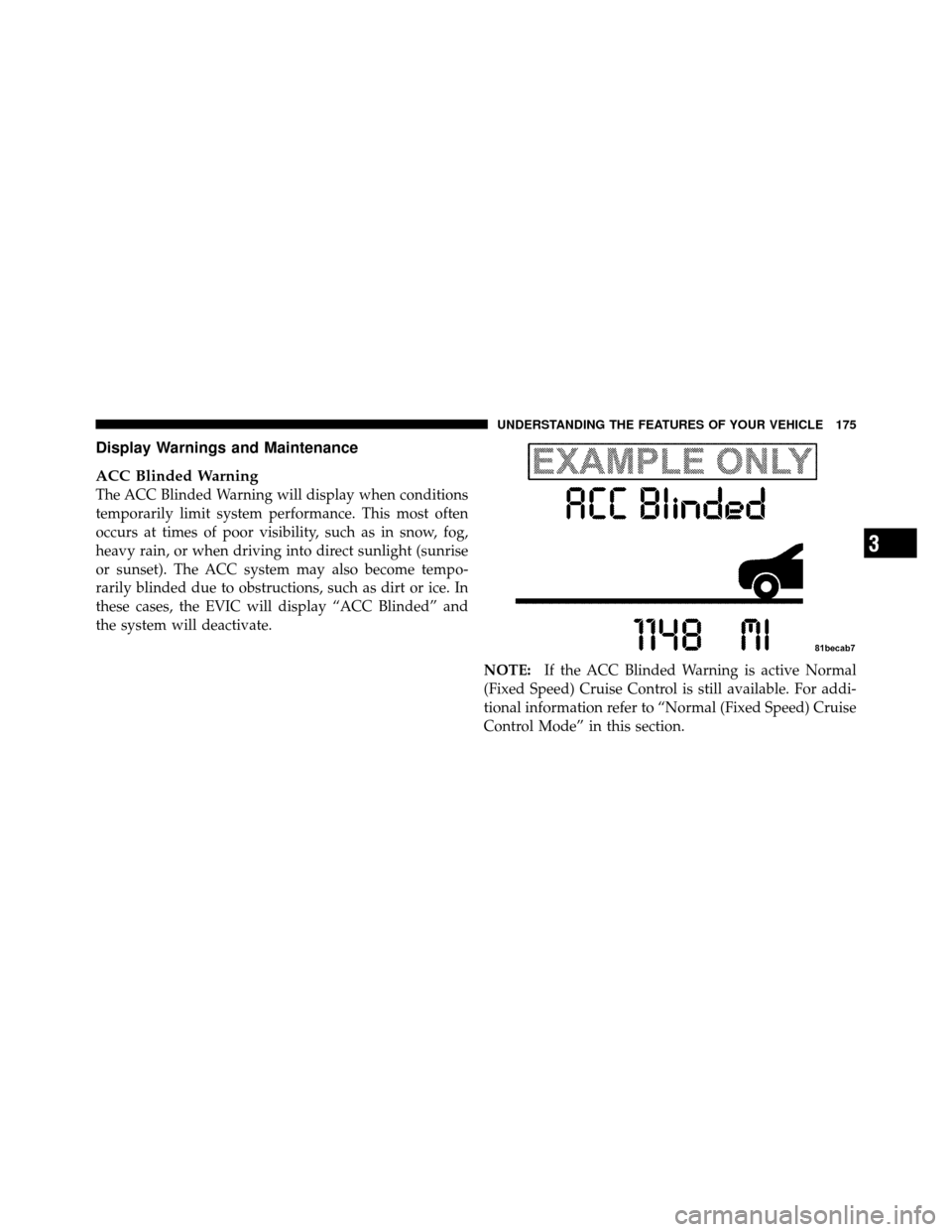
The ACC Blinded Warning will display when conditions
temporarily limit system performance. This most often
occurs at times of poor visibility, such as in snow, fog,
heavy rain, or when driving into direct sunlight (sunrise
or sunset). The ACC system may also become tempo-
rarily blinded due to obstructions, such as dirt or ice. In
these cases, the EVIC will display “ACC Blinded” and
the system will deactivate.NOTE:If the ACC Blinded Warning is active Normal
(Fixed Speed) Cruise Control is still available. For addi-
tional information refer to “Normal (Fixed Speed) Cruise
Control Mode” in this section.
3
UNDERSTANDING THE FEATURES OF YOUR VEHICLE 175