Page 388 of 608
Tire and Loading Information Label
Label Example
A vehicle specific Tire and Loading Information
label is attached to the center pillar (B-pillar).
With the driver's door open, you will find the
label attached below the door lock post (striker).The tire and loading information label shows the
number of occupant seating positions (A), and the
maximum vehicle capacity weight (B) in kilograms
and pounds.
The Tire and Loading Information label also
shows the size of the original equipment
tires (C) and the recommended cold tire inflation
pressures (D). For more information on tires and
inflation see
Tires
on page 6‑63andInflation - Tire
Pressure
on page 6‑72.
There is also important loading information on
the vehicle Certification/Tire label. It tells you the
Gross Vehicle Weight Rating (GVWR) and the
Gross Axle Weight Rating (GAWR) for the front
and rear axles. See “Certification/Tire Label” later
in this section.
5-30
Page 389 of 608

Steps for Determining Correct Load Limit
1.Locate the statement“The combined weight
of occupants and cargo should never exceed
XXX kg or XXX lbs” on your vehicle's placard.
2.Determine the combined weight of the driver
and passengers that will be riding in your
vehicle.
3.Subtract the combined weight of the driver
and passengers from XXX kg or XXX lbs.
4.The resulting figure equals the available
amount of cargo and luggage load capacity.
For example, if the“XXX”amount equals
1400 lbs and there will be five 150 lb
passengers in your vehicle, the amount of
available cargo and luggage load capacity is
650 lbs (1400 −750 (5 x 150) = 650 lbs).
5.Determine the combined weight of luggage
and cargo being loaded on the vehicle. That
weight may not safely exceed the available
cargo and luggage load capacity calculated in
Step 4.
6.If your vehicle will be towing a trailer, the load
from your trailer will be transferred to your
vehicle. Consult this manual to determine
how this reduces the available cargo and
luggage load capacity of your vehicle. See
Towing a Trailer
on page 5‑47for important
information on towing a trailer, towing safety
rules and trailering tips.
5-31
Page 390 of 608
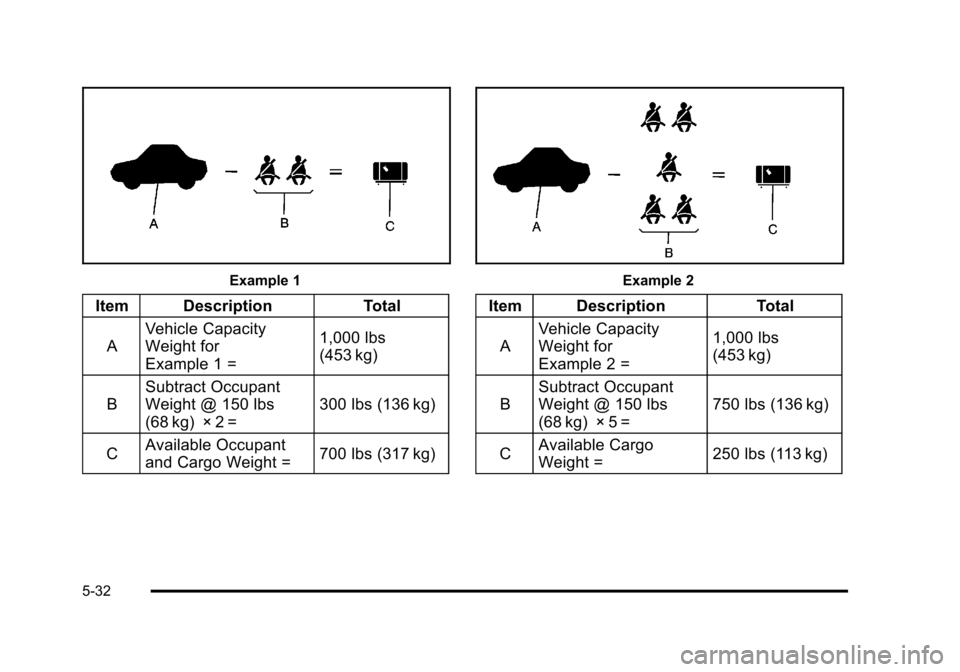
Example 1
Item DescriptionTotal
A Vehicle Capacity
Weight for
Example 1 = 1,000 lbs
(453 kg)
B Subtract Occupant
Weight @ 150 lbs
(68 kg) × 2 = 300 lbs (136 kg)
C Available Occupant
and Cargo Weight =
700 lbs (317 kg)
Example 2
Item Description
Total
A Vehicle Capacity
Weight for
Example 2 = 1,000 lbs
(453 kg)
B Subtract Occupant
Weight @ 150 lbs
(68 kg) × 5 = 750 lbs (136 kg)
C Available Cargo
Weight =
250 lbs (113 kg)
5-32
Page 391 of 608
Example 3
Item DescriptionTotal
A Vehicle Capacity
Weight for
Example 3 = 1,000 lbs
(453 kg)
B Subtract Occupant
Weight @ 200 lbs
(91 kg) × 5 = 1,000 lbs
(453 kg)
C Available Cargo
Weight =
0 lbs (0 kg)Refer to your vehicle's tire and loading information
label for specific information about your vehicle's
capacity weight and seating positions. The
combined weight of the driver, passengers, and
cargo should never exceed your vehicle's capacity
weight.
Certification/Tire Label
A vehicle specific Certification/Tire label is
found on the rear edge of the driver's door.
The label shows the size of your vehicle's
original tires and the inflation pressures needed to
obtain the gross weight capacity of your vehicle.
5-33
Page 392 of 608

This is called Gross Vehicle Weight Rating
(GVWR). The GVWR includes the weight of the
vehicle, all occupants, fuel, and cargo.
The Certification/Tire label also tells you the
maximum weights for the front and rear axles,
called Gross Axle Weight Rating (GAWR). To find
out the actual loads on your front and rear axles,
you need to go to a weigh station and weigh your
vehicle. Your dealer can help you with this. Be
sure to spread out your load equally on both sides
of the centerline.
Never exceed the GVWR for your vehicle, or the
GAWR for either the front or rear axle.
The Certification/Tire label also contains
information about your Front Axle Reserve
Capacity.
And, if you do have a heavy load, you should
spread it out.
{CAUTION:
Do not load the vehicle any heavier than
the Gross Vehicle Weight Rating (GVWR),
or either the maximum front or rear Gross
Axle Weight Rating (GAWR). If you do, parts
on the vehicle can break, and it can change
the way your vehicle handles. These could
cause you to lose control and crash. Also,
overloading can shorten the life of the
vehicle.
Notice :Overloading the vehicle may cause
damage. Repairs would not be covered by the
vehicle warranty. Do not overload the vehicle.
The label will help you decide how much cargo
and installed equipment your truck can carry.
Using heavier suspension components to get
added durability might not change your weight
ratings. Ask your dealer to help you load your
vehicle the right way.
5-34
Page 393 of 608
If you put things inside your vehicle—like
suitcases, tools, packages, or anything
else —they go as fast as the vehicle goes. If you
have to stop or turn quickly, or if there is a crash,
they will keep going.
{WARNING:
Things you put inside your vehicle can strike
and injure people in a sudden stop or turn,
or in a crash.
.Put things in the cargo area of your
vehicle. Try to spread the weight evenly.
.Never stack heavier things, like
suitcases, inside the vehicle so that some
of them are above the tops of the seats.
(Continued)
WARNING: (Continued)
.Do not leave an unsecured child restraint
in your vehicle.
.When you carry something inside the
vehicle, secure it whenever you can.
.Do not leave a seat folded down unless
you need to.
There is also important loading information for
off-road driving in this manual. See “Loading Your
Vehicle for Off-Road Driving” underOff-Road
Driving
on page 5‑11.
5-35
Page 394 of 608
Adding a Snow Plow or Similar
Equipment
Before installing a snow plow on your vehicle, here are
some things you will need to know:
Notice:If your vehicle does not have the snow plow
prep package, adding a plow can damage your
vehicle, and the repairs would not be covered by
warranty. Unless your vehicle was built to carry a
snow plow, do not add one to your vehicle. If your
vehicle has the snow plow prep package, called
RPO VYU, then the payload your vehicle can carry
will be reduced when a snow plow is installed. Your
vehicle can be damaged if either the front or rear
axle ratings or the Gross Vehicle Weight (GVW) are
exceeded.
Some vehicles are built with a special snow plow prep
package, called RPO VYU. If your vehicle has this
option, you can add a plow to it, provided certain
weights, such as the weights on the vehicle's axles and
the Gross Vehicle Weight (GVW), are not exceeded. The plow your vehicle can carry depends on many
things, such as:
.The options your vehicle came with, and the
weight of those options.
.The weight and number of passengers you intend
to carry.
.The weight of items you have added to your
vehicle.
.The total weight of any additional cargo you intend
to carry.
Say, for example, you have a 700 lb (318 kg) snow plow.
The total weight of all occupants and cargo inside the
cab should not exceed 300 lb (135 kg). This means that
you may only be able to carry one passenger. But, even
this may be too much if you have got other equipment
already adding to the weight of your vehicle.
5-36
Page 395 of 608
Here are some guidelines for safely carrying a snow
plow on your vehicle:
.Make sure the weight on the front and rear axles
does not exceed the axle rating for each.
.For the front axle, if more cargo or passengers
must be carried, appropriate counter ballast must
be installed rear of the rear axle. Counter ballast
must be properly secured so it will not move during
driving.
.Follow the snow plow manufacturer's
recommendations regarding rear ballast. Rear
ballast may be required to ensure a proper front
and rear weight distribution ratio, even though the
actual weight at the front axle may be less than the
front axle rating.
.The snow plow manufacturer or installer can assist
you in determining the amount of rear ballast
required, to help make sure your snowplow/vehicle
combination does not exceed the GVW rating, the
front and rear axle ratings, and the front and rear
weight distribution ratio.
.The total vehicle must not exceed the GVW rating.Front axle reserve capacity is the difference between
your front Gross Axle Weight Rating (GAWR) and the
front axle weight of your vehicle with full fuel and
passengers. Basically, it is the amount of weight you
can add to your front axle before reaching your
front GAWR.
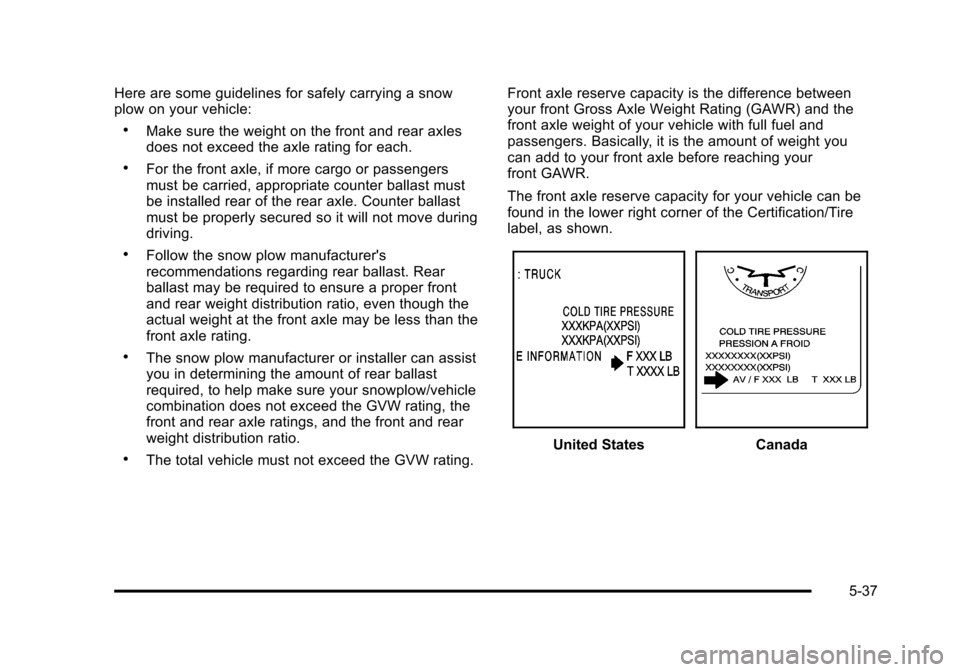
The front axle reserve capacity for your vehicle can be
found in the lower right corner of the Certification/Tire
label, as shown.United StatesCanada
5-37