2010 CHEVROLET SILVERADO warning
[x] Cancel search: warningPage 91 of 626
{WARNING:
A child in a child restraint in the center front seat
can be badly injured or killed by the frontal
airbags if they inflate. Never secure a child
restraint in the center front seat. It is always better
to secure a child restraint in a rear seat.
Do not use child restraints in the center front seat
position.
When securing a child restraint in a rear seating
position, study the instructions that came with your child
restraint to make sure it is compatible with this vehicle.
If the vehicle does not have a rear seat that will
accommodate a rear-facing child restraint, a rear-facing
child restraint should not be installed in the vehicle,
even if the airbag is off.
Wherever a child restraint is installed, be sure to secure
the child restraint properly.
Keep in mind that an unsecured child restraint can
move around in a collision or sudden stop and injure
people in the vehicle. Be sure to properly secure any
child restraint in your vehicle —even when no child is
in it.
Lower Anchors and Tethers for
Children (LATCH)
The LATCH system holds a child restraint during driving
or in a crash. This system is designed to make
installation of a child restraint easier. The LATCH
system uses anchors in the vehicle and attachments on
the child restraint that are made for use with the LATCH
system.
Make sure that a LATCH-compatible child restraint is
properly installed using the anchors, or use the vehicle's
safety belts to secure the restraint, following the
instructions that came with that restraint, and also the
instructions in this manual. When installing a child
restraint with a top tether, you must also use either the
lower anchors or the safety belts to properly secure the
child restraint. A child restraint must never be installed
using only the top tether and anchor.
In order to use the LATCH system in your vehicle, you
need a child restraint that has LATCH attachments. The
child restraint manufacturer will provide you with
instructions on how to use the child restraint and its
attachments. The following explains how to attach a
child restraint with these attachments in your vehicle.
Not all vehicle seating positions or child restraints have
lower anchors and attachments or top tether anchors
and attachments.
2-49
Page 96 of 626
Do not secure a child restraint in a position without a
top tether anchor if a national or local law requires that
the top tether be attached, or if the instructions that
come with the child restraint say that the top tether must
be attached.
According to accident statistics, children and infants are
safer when properly restrained in a child restraint
system or infant restraint system secured in a rear
seating position. SeeWhere to Put the Restraint
on
page 2‑48for additional information.
Securing a Child Restraint Designed for the
LATCH System
{WARNING:
If a LATCH-type child restraint is not attached to
anchors, the child restraint will not be able to
protect the child correctly. In a crash, the child
could be seriously injured or killed. Install a
LATCH-type child restraint properly using the
anchors, or use the vehicle's safety belts to
secure the restraint, following the instructions that
came with the child restraint and the instructions
in this manual.
{WARNING:
Do not attach more than one child restraint to a
single anchor, except for the center top tether
anchors in the crew and extended cabs. Attaching
more than one child restraint to a single anchor
could cause the anchor or attachment to come
loose or even break during a crash. A child or
others could be injured. To reduce the risk of
serious or fatal injuries during a crash, attach only
one child restraint per anchor.
{WARNING:
Children can be seriously injured or strangled if a
shoulder belt is wrapped around their neck and
the safety belt continues to tighten. Buckle any
unused safety belts behind the child restraint so
children cannot reach them. Pull the shoulder belt
all the way out of the retractor to set the lock,
if your vehicle has one, after the child restraint
has been installed.
2-54
Page 103 of 626
Securing a Child Restraint in the
Center Front Seat Position
{WARNING:
A child in a child restraint in the center front seat
can be badly injured or killed by the frontal
airbags if they inflate. Never secure a child
restraint in the center front seat. It is always better
to secure a child restraint in a rear seat.
Do not use child restraints in the center front seat
position.
Securing a Child Restraint in the
Right Front Seat Position (With
Passenger Sensing System)
This vehicle has airbags. A rear seat is a safer place to
secure a forward-facing child restraint. See Where to
Put the Restraint on page 2‑48.
In addition, the vehicle may have a passenger sensing
system which is designed to turn off the right front
passenger frontal airbag under certain conditions. See
Passenger Sensing System
on page 2‑86and
Passenger Airbag Status Indicatoron page 4‑34for
more information on this, including important safety
information.
2-61
Page 104 of 626
A label on the sun visor says,“Never put a rear-facing
child seat in the front.” This is because the risk to the
rear-facing child is so great, if the airbag deploys.
{WARNING:
A child in a rear-facing child restraint can be
seriously injured or killed if the right front
passenger airbag inflates. This is because the
back of the rear-facing child restraint would be
very close to the inflating airbag. A child in a
forward-facing child restraint can be seriously
injured or killed if the right front passenger airbag
inflates and the passenger seat is in a forward
position.
The vehicle may have a passenger sensing
system which is designed to turn off the right front
passenger frontal airbag under certain conditions.
Even if the passenger sensing system,
if equipped, has turned off the right front
passenger frontal airbag, no system is fail-safe.
No one can guarantee that an airbag will not
deploy under some unusual circumstance, even
though it is turned off.
(Continued)
WARNING: (Continued)
Secure rear-facing child restraints in a rear seat,
even if the airbag is off. If you secure a
forward-facing child restraint in the right front seat,
always move the front passenger seat as far back
as it will go. It is better to secure the child restraint
in a rear seat.
SeePassenger Sensing System
on page 2‑86
for additional information.
If the vehicle does not have a rear seat that will
accommodate a rear-facing child restraint, a rear-facing
child restraint should not be installed in the vehicle,
even if the airbag is off.
If your child restraint has the LATCH system, see Lower
Anchors and Tethers for Children (LATCH)
on
page 2‑49for how and where to install your child
restraint using LATCH. If you secure a child restraint
using a safety belt and it uses a top tether, see Lower
Anchors and Tethers for Children (LATCH)
on
page 2‑49for top tether anchor locations.
2-62
Page 108 of 626
A label on the sun visor says,“Never put a rear-facing
child seat in the front unless airbag is off.” This is
because the risk to the rear-facing child is so great,
if the airbag deploys.
{WARNING:
A child in a rear-facing child restraint can be
seriously injured or killed if the right front
passenger airbag inflates. This is because the
back of the rear-facing child restraint would be
very close to the inflating airbag. A child in a
forward-facing child restraint can be seriously
injured or killed if the right front passenger airbag
inflates and the passenger seat is in a forward
position.
Even if the airbag switch has turned off the right
front passenger frontal airbag, no system is
fail-safe. No one can guarantee that an airbag will
not deploy under some unusual circumstance,
even though it is turned off.
Secure rear-facing child restraints in a rear seat,
even if the airbag is off. If you secure a
forward-facing child restraint in the right front seat,
(Continued)
WARNING: (Continued)
always move the front passenger seat as far back
as it will go. It is better to secure the child restraint
in a rear seat.
{WARNING:
If the airbag readiness light ever comes on and
stays on, it means that something may be wrong
with the airbag system. For example, the right
front passenger airbag could inflate even though
the airbag on-off switch is turned off.
To help avoid injury to yourself or others, have the
vehicle serviced right away. SeeAirbag
Readiness Light
on page 4‑32for more
information, including important safety information.
If the vehicle does not have a rear seat that will
accommodate a rear-facing child restraint, a rear-facing
child restraint should not be installed in the vehicle,
even if the airbag is off.
2-66
Page 112 of 626
Securing a Child Restraint in the
Right Front Seat Position (Heavy
Duty Crew Cab Only)
Your vehicle has airbags. A rear seat is a safer place to
secure a forward-facing child restraint. SeeWhere to
Put the Restraint
on page 2‑48.
A label on the sun visor says, “Never put a rear-facing
child seat in the front.” This is because the risk to the
rear-facing child is so great, if the airbag deploys.
Never put a rear-facing child restraint in the right front
passenger seat. Here is why:
{WARNING:
A child in a rear-facing child restraint can be
seriously injured or killed if the right front
passenger's airbag inflates. This is because the
back of the rear-facing child restraint would be
very close to the inflating airbag. Always secure a
rear-facing child restraint in a rear seat.
If the vehicle does not have a rear seat that will
accommodate a rear-facing child restraint, a rear-facing
child restraint should not be installed in the vehicle,
even if the airbag is off. If your child restraint has the LATCH system, see
Lower
Anchors and Tethers for Children (LATCH)
on
page 2‑49for how and where to install your child
restraint using LATCH. If you secure a child restraint
using a safety belt and it uses a top tether, see Lower
Anchors and Tethers for Children (LATCH)
on
page 2‑49for top tether anchor locations.
Do not secure a child seat in a position without a top
tether anchor if a national or local law requires that the
top tether be anchored, or if the instructions that come
with the child restraint say that the top strap must be
anchored.
In Canada, the law requires that forward-facing child
restraints have a top tether, and that the tether be
attached.
You will be using the lap-shoulder belt to secure the
child restraint in this position. Follow the instructions
that came with the child restraint. 1. Move the seat as far back as it will go before securing the forward-facing child restraint.
2. Put the child restraint on the seat.
3. Pick up the latch plate, and run the lap and shoulder portions of the vehicle's safety belt
through or around the restraint. The child restraint
instructions will show you how.
2-70
Page 116 of 626
Here are the most important things to know about the
airbag system:
{WARNING:
You can be severely injured or killed in a crash if
you are not wearing your safety belt—even if you
have airbags. Airbags are designed to work with
safety belts, but do not replace them. Also,
airbags are not designed to deploy in every crash.
In some crashes safety belts are your only
restraint. See When Should an Airbag Inflate?
on
page 2‑78
.
Wearing your safety belt during a crash helps
reduce your chance of hitting things inside the
vehicle or being ejected from it. Airbags are
“supplemental restraints” to the safety belts.
Everyone in your vehicle should wear a safety belt
properly —whether or not there is an airbag for
that person.
{WARNING:
Airbags inflate with great force, faster than the
blink of an eye. Anyone who is up against, or very
close to, any airbag when it inflates can be
seriously injured or killed. Do not sit unnecessarily
close to the airbag, as you would be if you were
sitting on the edge of your seat or leaning forward.
Safety belts help keep you in position before and
during a crash. Always wear your safety belt,
even with airbags. The driver should sit as far
back as possible while still maintaining control of
the vehicle.
Occupants should not lean on or sleep against the
door or side windows in seating positions with
seat-mounted side impact airbags and/or roof-rail
airbags.
2-74
Page 117 of 626
{WARNING:
Children who are up against, or very close to, any
airbag when it inflates can be seriously injured or
killed. Airbags plus lap-shoulder belts offer
protection for adults and older children, but not for
young children and infants. Neither the vehicle's
safety belt system nor its airbag system is
designed for them. Young children and infants
need the protection that a child restraint system
can provide. Always secure children properly in
your vehicle. To read how, seeOlder Children
on
page 2‑39
or Infants and Young Childrenon
page 2‑42
.
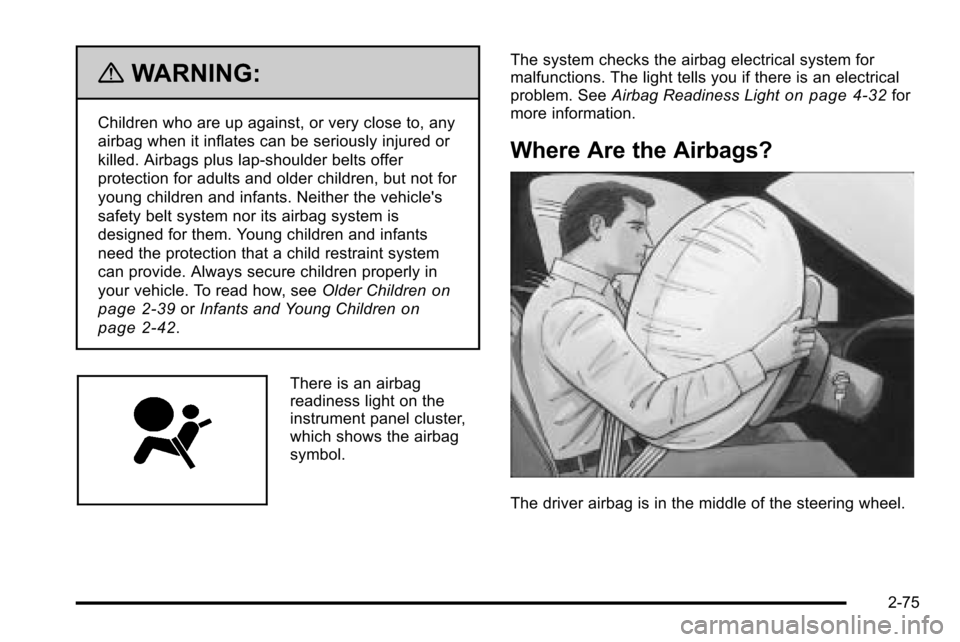
There is an airbag
readiness light on the
instrument panel cluster,
which shows the airbag
symbol. The system checks the airbag electrical system for
malfunctions. The light tells you if there is an electrical
problem. See
Airbag Readiness Light
on page 4‑32for
more information.
Where Are the Airbags?
The driver airbag is in the middle of the steering wheel.
2-75