2010 CHEVROLET IMPALA phone
[x] Cancel search: phonePage 231 of 432
Receiving a CallWhen an incoming call is received, the audio system
mutes and a ring tone is heard in the vehicle.•
Press
bg
and begin speaking to answer the call.
•
Press
cx
to ignore a call.
Call WaitingCall waiting must be supported on the Bluetooth phone
and enabled by the wireless service carrier to work.•
Press
bg
to answer an incoming call when
another call is active. The original call is placed
on hold.
•
Press
bg
again to return to the original call.
•
To ignore the incoming call, continue with the
original call with no action.
•
Press
cx
to disconnect the current call and
switch to the call on hold.
Three-Way CallingThree-Way Calling must be supported on the Bluetooth
phone and enabled by the wireless service carrier
to work.
1. While on a call press
bg
. The system responds
with “Ready” followed by a tone.
2. Say “Three-way call”. The system responds with
“Three-way call, please say dial or call”.
3. Use the dial or call command to dial the number of
the third party to be called.
4. Once the call is connected, press
bg
to link all
the callers together.
Ending a CallPress
cx
to end a call.
Muting a CallDuring a call, all sounds from inside the vehicle can
be muted so that the person on the other end of the
call cannot hear them.
4-81
Page 232 of 432
To Mute a call1. Press
bg
. The system responds with “Ready”
followed by a tone.
2. Say “Mute Call”. The system responds with “Call
muted”.
To Cancel Mute1. Press
bg
. The system responds with “Ready”
followed by a tone.
2. After the tone, say “Mute Call”. The system
responds with “Resuming call”.
Transferring a CallAudio can be transferred between the in-vehicle
Bluetooth system and the cell phone.To Transfer Audio to the Cell PhoneDuring a call with the audio in the vehicle:
1. Press
bg
. The system responds with “Ready”
followed by a tone.
2. Say “Transfer Call.” The system responds with
“Transferring call” and the audio will switch from
the vehicle to the cell phone.
To Transfer Audio to the In-Vehicle
Bluetooth SystemThe cellular phone must be paired and connected with
the Bluetooth system before a call can be transferred.
The connection process can take up to two minutes after
the key is turned to the ON/RUN or ACC/ACCESSORY
position.
During a call with the audio on the cell phone,
press
bg
for more than two seconds. The audio
switches from the cell phone to the vehicle.
Voice Pass-ThruVoice Pass-Thru allows access to the voice recognition
commands on the cell phone. See the cell phone
manufacturers user guide to see if the cell phone
supports this feature. This feature can be used to
verbally access contacts stored in the cell phone.
1. Press and hold
bg
for two seconds. The system
responds with “Ready” followed by a tone.
2. Say “Bluetooth”. The system responds with
“Bluetooth ready” followed by a tone.
3. Say “Voice”. The system responds with
“OK, accessing
•
The cell phone’s normal prompt messages will
go through its cycle according to the phone’s
operating instructions.
4-82
Page 233 of 432
Dual Tone Multi-Frequency (DTMF)
TonesThe in-vehicle Bluetooth system can send numbers and
numbers stored as name tags during a call. This is used
when calling a menu driven phone system. Account
numbers can be programmed into the phonebook for
retrieval during menu driven calls.Sending a Number During a Call1. Press
bg
. The system responds with “Ready”
followed by a tone.
2. Say “Dial”. The system responds with “Say a
number to send tones” followed by a tone.
3. Say the number to send.
•
If the system clearly recognizes the number it
responds with “OK, Sending Number” and the
dial tones are sent and the call continues.
•
If the system is not sure it recognized the
number properly, it responds “Dial Number,
Please say yes or no?” followed by a tone.
If the number is correct, say “Yes”. The system
responds with “OK, Sending Number” and
the dial tones are sent and the call continues.
Sending a Stored Name Tag During a Call1. Press
bg
. The system responds with “Ready”
followed by a tone.
2. Say “Send name tag.” The system responds with
“Say a name tag to send tones” followed by a tone.
3. Say the name tag to send.
•
If the system clearly recognizes the name tag it
responds with “OK, Sending
the dial tones are sent and the call continues.
•
If the system is not sure it recognized the name
tag properly, it responds “Dial
Please say yes or no?” followed by a tone. If the
name tag is correct, say “Yes”. The system
responds with “OK, Sending
the dial tones are sent and the call continues.
Clearing the SystemUnless information is deleted out of the in-vehicle
Bluetooth system, it will be retained indefinitely. This
includes all saved name tags in the phonebook and
phone pairing information. For information on how to
delete this information, see the above sections on
Deleting a Paired Phone and Deleting Name Tags.
4-83
Page 235 of 432
bg
(Mute/Push to Talk):Press to silence the vehicle
speakers only. Press again to turn the sound on. For
vehicles with OnStar
®or Bluetooth
®systems, press and
hold
bg
for longer than two seconds to interact with
those systems. See the OnStar Owner’s Guide and
Bluetooth®on page 4-74for more information.
SRCE (Source):Press to choose between the radio
(AM, FM, XM), CD, and auxiliary input jack.
+
e
−
e
(Volume):Press to increase or to decrease
the radio volume.
¨
(Seek):Press to go to the next radio station while in
AM, FM, or XM™. Press
¨
to go to the next track or
chapter while sourced to the CD.
Radio ReceptionFrequency interference and static can occur during
normal radio reception if items such as cell phone
chargers, vehicle convenience accessories, and external
electronic devices are plugged into the accessory
power outlet. If there is interference or static, unplug
the item from the accessory power outlet.
AMThe range for most AM stations is greater than for FM,
especially at night. The longer range can cause station
frequencies to interfere with each other. For better radio
reception, most AM radio stations boost the power levels
during the day, and then reduce these levels during the
night. Static can also occur when things like storms and
power lines interfere with radio reception. When this
happens, try reducing the treble on the radio.FM StereoFM signals only reach about 10 to 40 miles
(16 to 65 km). Although the radio has a built-in electronic
circuit that automatically works to reduce interference,
some static can occur, especially around tall buildings
or hills, causing the sound to fade in and out.XM™ Satellite Radio ServiceXM Satellite Radio Service gives digital radio reception
from coast-to-coast in the 48 contiguous United States,
and in Canada. Just as with FM, tall buildings or hills can
interfere with satellite radio signals, causing the sound to
fade in and out. In addition, traveling or standing under
heavy foliage, bridges, garages, or tunnels may cause
loss of the XM signal for a period of time.
4-85
Page 236 of 432
Cellular Phone UsageCellular phone usage may cause interference with
the vehicle’s radio. This interference may occur when
making or receiving phone calls, charging the phone’s
battery, or simply having the phone on. This interference
causes an increased level of static while listening to
the radio. If static is received while listening to the radio,
unplug the cellular phone and turn it off.Backglass AntennaThe AM-FM antenna is integrated with the rear window
defogger, located in the rear window. Make sure that
the inside surface of the rear window is not scratched
and that the lines on the glass are not damaged. If the
inside surface is damaged, it could interfere with radio
reception. For proper radio reception, the antenna
connector needs to be properly attached to the post
on the glass.
If a cellular telephone antenna needs to be attached to
the glass, make sure that the grid lines for the AM-FM
antenna are not damaged. There is enough space
between the grid lines to attach a cellular telephone
antenna without interfering with radio reception.Notice:Using a razor blade or sharp object to clear
the inside rear window can damage the rear window
antenna and/or the rear window defogger. Repairs
would not be covered by the vehicle warranty. Do not
clear the inside rear window with sharp objects.
Notice:Do not apply aftermarket glass tinting with
metallic film. The metallic film in some tinting
materials will interfere with or distort the incoming
radio reception. Any damage caused to your
backglass antenna due to metallic tinting materials
will not be covered by the vehicle warranty.
XM™ Satellite Radio Antenna
SystemThe XM Satellite Radio antenna is located on the roof of
the vehicle. Keep the antenna clear of obstructions for
clear radio reception.
If the vehicle has a sunroof, the performance of the
XM system may be affected if the sunroof is open.
4-86
Page 280 of 432
Filling the Tank
{
WARNING:
Fuel vapor burns violently and a fuel fire can
cause bad injuries. To help avoid injuries to you
and others, read and follow all the instructions on
the fuel pump island. Turn off the engine when
refueling. Do not smoke near fuel or when
refueling the vehicle. Do not use cellular phones.
Keep sparks, flames, and smoking materials away
from fuel. Do not leave the fuel pump unattended
when refueling the vehicle. This is against the law
in some places. Do not re-enter the vehicle while
pumping fuel. Keep children away from the fuel
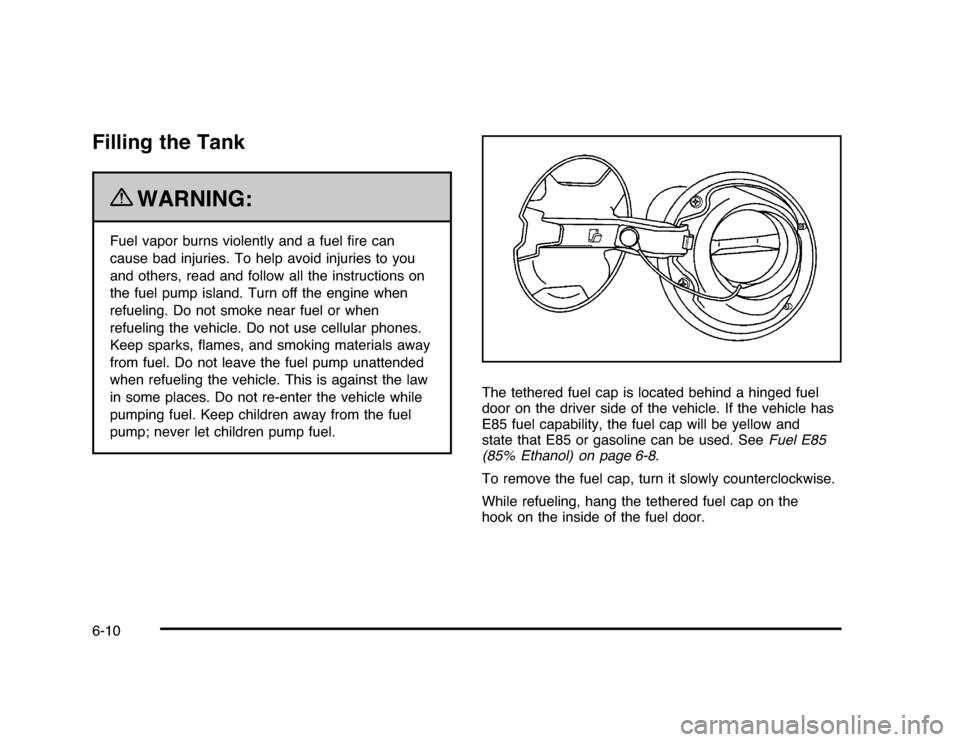
pump; never let children pump fuel.The tethered fuel cap is located behind a hinged fuel
door on the driver side of the vehicle. If the vehicle has
E85 fuel capability, the fuel cap will be yellow and
state that E85 or gasoline can be used. SeeFuel E85
(85% Ethanol) on page 6-8.
To remove the fuel cap, turn it slowly counterclockwise.
While refueling, hang the tethered fuel cap on the
hook on the inside of the fuel door.
6-10
Page 282 of 432
Filling a Portable Fuel Container
{
WARNING:
Never fill a portable fuel container while it is in the
vehicle. Static electricity discharge from the
container can ignite the fuel vapor. You can be
badly burned and the vehicle damaged if this
occurs. To help avoid injury to you and others:
•
Dispense fuel only into approved containers.
•
Do not fill a container while it is inside a
vehicle, in a vehicle’s trunk, pickup bed, or on
any surface other than the ground.
•
Bring the fill nozzle in contact with the inside
of the fill opening before operating the nozzle.
Contact should be maintained until the filling
is complete.
•
Do not smoke while pumping fuel.
•
Do not use a cellular phone while
pumping fuel.
Checking Things Under
the Hood
{
WARNING:
An electric fan under the hood can start up and
injure you even when the engine is not running.
Keep hands, clothing, and tools away from any
underhood electric fan.{
WARNING:
Things that burn can get on hot engine parts and
start a fire. These include liquids like fuel, oil,
coolant, brake fluid, windshield washer and other
fluids, and plastic or rubber. You or others could
be burned. Be careful not to drop or spill things
that will burn onto a hot engine.
6-12
Page 389 of 432
Customer Assistance and Information...............8-2
Customer Satisfaction Procedure......................8-2
Online Owner Center......................................8-5
Customer Assistance for Text Telephone
(TTY) Users...............................................8-6
Customer Assistance Offices............................8-6
GM Mobility Reimbursement Program................8-7
Roadside Assistance Program..........................8-7
Scheduling Service Appointments....................8-11
Courtesy Transportation Program....................8-11
Collision Damage Repair................................8-13Reporting Safety Defects................................8-16
Reporting Safety Defects to the United States
Government..............................................8-16
Reporting Safety Defects to the Canadian
Government..............................................8-16
Reporting Safety Defects to General Motors . . . . .8-16
Service Publications Ordering Information . . . . . . . . .8-17
Vehicle Data Recording and Privacy................8-18
Event Data Recorders . . .................................8-19
Navigation System........................................8-20
Radio Frequency
Identification (RFID) . . .................................8-20
Radio Frequency Statement...........................8-20
Section 8 Customer Assistance Information
8-1