2010 CHEVROLET HHR tires size
[x] Cancel search: tires sizePage 30 of 480
Driving for Better Fuel Economy
Driving habits can affect fuel mileage. Here are some
driving tips to get the best fuel economy possible.
.Avoid fast starts and accelerate smoothly.
.Brake gradually and avoid abrupt stops.
.Avoid idling the engine for long periods of time.
.When road and weather conditions are
appropriate, use cruise control, if equipped.
.Always follow posted speed limits or drive more
slowly when conditions require.
.Keep vehicle tires properly inflated.
.Combine several trips into a single trip.
.Replace the vehicle's tires with the same TPC
Spec number molded into the tire's sidewall near
the size.
.Follow recommended scheduled maintenance.
Battery
This vehicle has a maintenance free battery located in
the cargo area. Access to the battery is not necessary
to jump start the vehicle. There are positive (+) and
negative (−) terminals in the engine compartment.
SeeBattery
on page 6‑40andJump Startingon
page 6‑41.
Roadside Assistance Program
U.S.: 1-800-CHEV-USA (1-800-243-8872)
TTY Users: 1-888-889-2438
Canada: 1-800-268-6800
As the owner of a new Chevrolet, you are automatically
enrolled in the Roadside Assistance program. This
program provides technically trained advisors who are
available 24 hours a day, 365 days a year, minor repair
information or towing arrangements.
Roadside Assistance and OnStar
If you have a current OnStar subscription, press the
OnStar button and the current GPS location will be sent
to an OnStar Advisor who will assess your problem,
contact Roadside Assistance, and relay exact location
to get you the help you need.
Online Owner Center
The Online Owner Center is a complimentary service
that includes online service reminders, vehicle
maintenance tips, online owner manual, special
privileges and more.
Sign up today at: www.gmownercenter.com/chevrolet
(U.S.) or www.gm.ca (Canada).
1-24
Page 109 of 480

Adding Equipment to Your
Airbag-Equipped Vehicle
Q: Is there anything I might add to or change aboutthe vehicle that could keep the airbags from
working properly?
A: Yes. If you add things that change the vehicle's
frame, bumper system, height, front end or side
sheet metal, they may keep the airbag system from
working properly. Changing or moving any parts of
the front seats, safety belts, the airbag sensing and
diagnostic module, steering wheel, instrument panel,
roof-rail airbag modules, ceiling headliner or pillar
garnish trim, front sensors, side impact sensors,
rollover sensor module, or airbag wiring can affect
the operation of the airbag system.
In addition, the vehicle may have a passenger
sensing system for the right front passenger
position, which includes sensors that are part of the
passenger seat. The passenger sensing system
may not operate properly if the original seat trim is
replaced with non-GM covers, upholstery or trim,
or with GM covers, upholstery or trim designed for a
different vehicle. Any object, such as an aftermarket
seat heater or a comfort enhancing pad or device,
installed under or on top of the seat fabric, could
also interfere with the operation of the passenger sensing system. This could either prevent proper
deployment of the passenger airbag(s) or prevent
the passenger sensing system from properly turning
off the passenger airbag(s). See
Passenger Sensing
Systemon page 2‑70.
If you have questions, call Customer Assistance.
The phone numbers and addresses for Customer
Assistance are in Step Two of the Customer
Satisfaction Procedure in this manual. See
Customer Satisfaction Procedure on page 8‑2.
If the vehicle has rollover roof-rail airbags, see
Different Size Tires and Wheels
on page 6‑74for
additional important information.
Q: Because I have a disability, I have to get my vehicle modified. How can I find out whether this
will affect my airbag system?
A: If you have questions, call Customer Assistance.
The phone numbers and addresses for Customer
Assistance are in Step Two of the Customer
Satisfaction Procedure in this manual. See
Customer Satisfaction Procedure on page 8‑2.
In addition, your dealer/retailer and the service manual
have information about the location of the airbag
sensors, sensing and diagnostic module and airbag
wiring.
2-77
Page 287 of 480
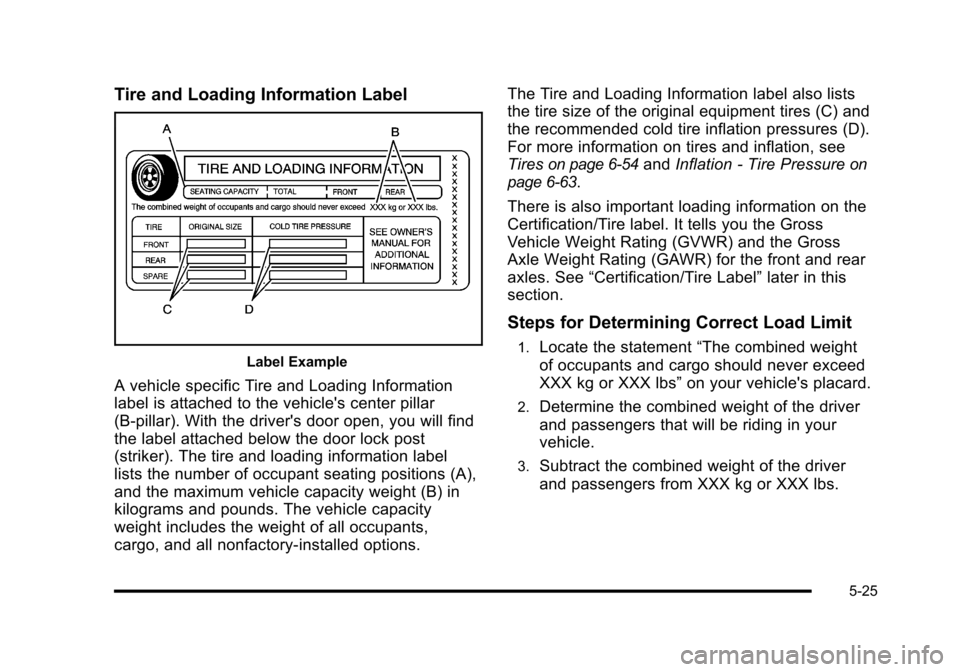
Tire and Loading Information Label
Label Example
A vehicle specific Tire and Loading Information
label is attached to the vehicle's center pillar
(B-pillar). With the driver's door open, you will find
the label attached below the door lock post
(striker). The tire and loading information label
lists the number of occupant seating positions (A),
and the maximum vehicle capacity weight (B) in
kilograms and pounds. The vehicle capacity
weight includes the weight of all occupants,
cargo, and all nonfactory‐installed options. The Tire and Loading Information label also lists
the tire size of the original equipment tires (C) and
the recommended cold tire inflation pressures (D).
For more information on tires and inflation, see
Tires
on page 6‑54and
Inflation - Tire Pressureon
page 6‑63
.
There is also important loading information on the
Certification/Tire label. It tells you the Gross
Vehicle Weight Rating (GVWR) and the Gross
Axle Weight Rating (GAWR) for the front and rear
axles. See “Certification/Tire Label” later in this
section.
Steps for Determining Correct Load Limit
1.Locate the statement “The combined weight
of occupants and cargo should never exceed
XXX kg or XXX lbs” on your vehicle's placard.
2.Determine the combined weight of the driver
and passengers that will be riding in your
vehicle.
3.Subtract the combined weight of the driver
and passengers from XXX kg or XXX lbs.
5-25
Page 290 of 480
positions. The combined weight of the driver,
passengers, and cargo should never exceed your
vehicle's maximum vehicle capacity weight.
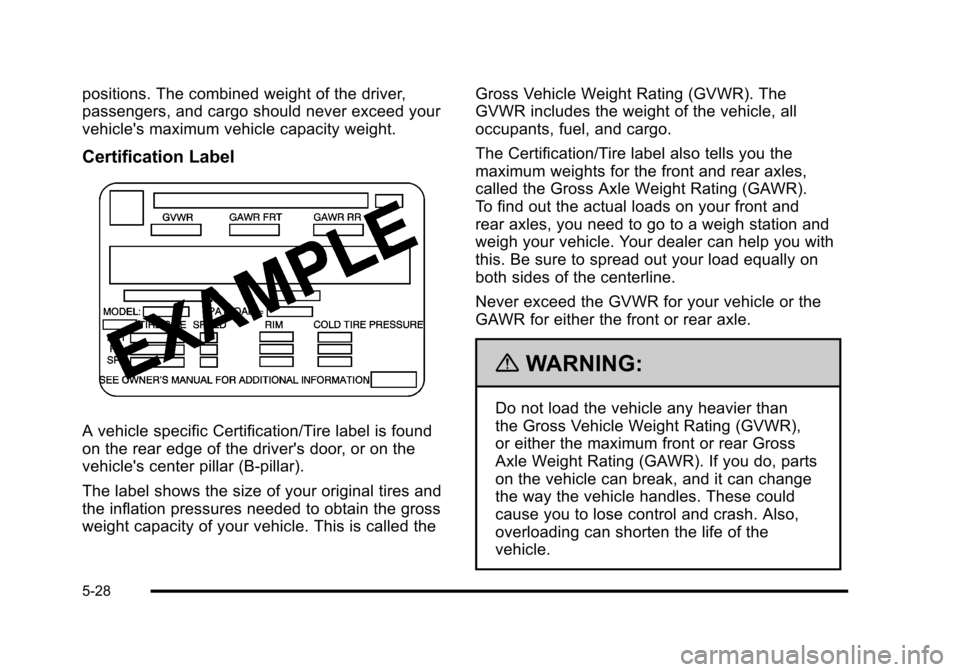
Certification Label
A vehicle specific Certification/Tire label is found
on the rear edge of the driver's door, or on the
vehicle's center pillar (B‐pillar).
The label shows the size of your original tires and
the inflation pressures needed to obtain the gross
weight capacity of your vehicle. This is called theGross Vehicle Weight Rating (GVWR). The
GVWR includes the weight of the vehicle, all
occupants, fuel, and cargo.
The Certification/Tire label also tells you the
maximum weights for the front and rear axles,
called the Gross Axle Weight Rating (GAWR).
To find out the actual loads on your front and
rear axles, you need to go to a weigh station and
weigh your vehicle. Your dealer can help you with
this. Be sure to spread out your load equally on
both sides of the centerline.
Never exceed the GVWR for your vehicle or the
GAWR for either the front or rear axle.
{WARNING:
Do not load the vehicle any heavier than
the Gross Vehicle Weight Rating (GVWR),
or either the maximum front or rear Gross
Axle Weight Rating (GAWR). If you do, parts
on the vehicle can break, and it can change
the way the vehicle handles. These could
cause you to lose control and crash. Also,
overloading can shorten the life of the
vehicle.
5-28
Page 304 of 480

Section 6 Service and Appearance Care
When It Is Time for New Tires . . . . . . . . . . . . . . . . . 6-71
Buying New Tires . . . . . . . . . . . . . . . . . . . . . . . . . . . . . . 6-72
Different Size Tires and Wheels . . . . . . . . . . . . . . . 6-74
Uniform Tire Quality Grading . . . . . . . . . . . . . . . . . . . 6-74
Wheel Alignment and Tire Balance . . . . . . . . . . . . 6-76
Wheel Replacement . . . . . . . . . . . . . . . . . . . . . . . . . . . 6-76
Tire Chains . . . . . . . . . . . . . . . . . . . . . . . . . . . . . . . . . . . . 6-77
If a Tire Goes Flat . . . . . . . . . . . . . . . . . . . . . . . . . . . . . 6-77
Tire Sealant and Compressor Kit . . . . . . . . . . . . . . 6-78
Tire Sealant and Compressor Kit Storage . . . . . . 6-87
Changing a Flat Tire . . . . . . . . . . . . . . . . . . . . . . . . . . . 6-88
Removing the Spare Tire and Tools . . . . . . . . . . . . 6-89
Removing the Flat Tire and Installing the SpareTire (All Models Except SS) . . . . . . . . . . . . . . . . . 6-92
Removing the Flat Tire and Installing the Spare Tire (SS Model) . . . . . . . . . . . . . . . . . . . . . . . . . . . . . . 6-96
Storing a Flat or Spare Tire and Tools . . . . . . . . 6-106
Compact Spare Tire . . . . . . . . . . . . . . . . . . . . . . . . . . 6-110
Appearance Care . . . . . . . . . . . . . . . . . . . . . . . . . . . . . . . . 6-111
Interior Cleaning . . . . . . . . . . . . . . . . . . . . . . . . . . . . . 6-111
Fabric/Carpet . . . . . . . . . . . . . . . . . . . . . . . . . . . . . . . . . 6-112
Leather . . . . . . . . . . . . . . . . . . . . . . . . . . . . . . . . . . . . . . . 6-113
Instrument Panel, Vinyl, and Other Plastic Surfaces . . . . . . . . . . . . . . . . . . . . . . . . . . . . . . . . . . . . 6-113
Care of Safety Belts . . . . . . . . . . . . . . . . . . . . . . . . . . 6-113 Weatherstrips . . . . . . . . . . . . . . . . . . . . . . . . . . . . . . . . . 6-114
Washing Your Vehicle . . . . . . . . . . . . . . . . . . . . . . . . 6-114
Cleaning Exterior Lamps/Lenses . . . . . . . . . . . . . 6-114
Finish Care . . . . . . . . . . . . . . . . . . . . . . . . . . . . . . . . . . . 6-114
Windshield and Wiper Blades . . . . . . . . . . . . . . . . . 6-115
Aluminum or Chrome-Plated Wheels
and Trim . . . . . . . . . . . . . . . . . . . . . . . . . . . . . . . . . . . . 6-116
Tires . . . . . . . . . . . . . . . . . . . . . . . . . . . . . . . . . . . . . . . . . . 6-117
Sheet Metal Damage . . . . . . . . . . . . . . . . . . . . . . . . . 6-117
Finish Damage . . . . . . . . . . . . . . . . . . . . . . . . . . . . . . . 6-117
Underbody Maintenance . . . . . . . . . . . . . . . . . . . . . . 6-117
Chemical Paint Spotting . . . . . . . . . . . . . . . . . . . . . . 6-117
Vehicle Identification . . . . . . . . . . . . . . . . . . . . . . . . . . . . 6-118
Vehicle Identification Number (VIN) . . . . . . . . . . . 6-118
Service Parts Identification Label . . . . . . . . . . . . . 6-118
Electrical System . . . . . . . . . . . . . . . . . . . . . . . . . . . . . . . . 6-118
Add-On Electrical Equipment . . . . . . . . . . . . . . . . . 6-118
Headlamp Wiring . . . . . . . . . . . . . . . . . . . . . . . . . . . . . 6-119
Windshield Wiper Fuses . . . . . . . . . . . . . . . . . . . . . . 6-119
Power Windows and Other Power Options . . . 6-119
Fuses and Circuit Breakers . . . . . . . . . . . . . . . . . . . 6-119
Floor Console Fuse Block . . . . . . . . . . . . . . . . . . . . 6-120
Engine Compartment Fuse Block . . . . . . . . . . . . . 6-122
Capacities and Specifications . . . . . . . . . . . . . . . . . . 6-125
6-2
Page 357 of 480
WARNING: (Continued)
.Underinflated tires pose the same
danger as overloaded tires. The resulting
accident could cause serious injury.
Check all tires frequently to maintain the
recommended pressure. Tire pressure
should be checked when your vehicle's
tires are cold. SeeInflation - Tire
Pressure
on page 6‑63.
.Overinflated tires are more likely to be
cut, punctured, or broken by a sudden
impact —such as when you hit a pothole.
Keep tires at the recommended pressure.
.Worn, old tires can cause accidents.
If the tire's tread is badly worn, or if your
vehicle's tires have been damaged,
replace them.
Low-Profile Performance Tire
If your vehicle has P225/45R18 size tires, they are
classified as low‐profile performance tires. These
tires are designed for very responsive driving on
wet or dry pavement. You may also notice more
road noise with low‐profile performance tires and
that they tend to wear faster.
Notice:If the vehicle has low‐profile tires, they
are more susceptible to damage from road
hazards or curb impact than standard profile
tires. Tire and/or wheel assembly damage can
occur when coming into contact with road
hazards like, potholes, or sharp edged objects,
or when sliding into a curb. The vehicle
warranty does not cover this type of damage.
Keep tires set to the correct inflation pressure
and, when possible avoid contact with curbs,
potholes, and other road hazards.
6-55
Page 358 of 480
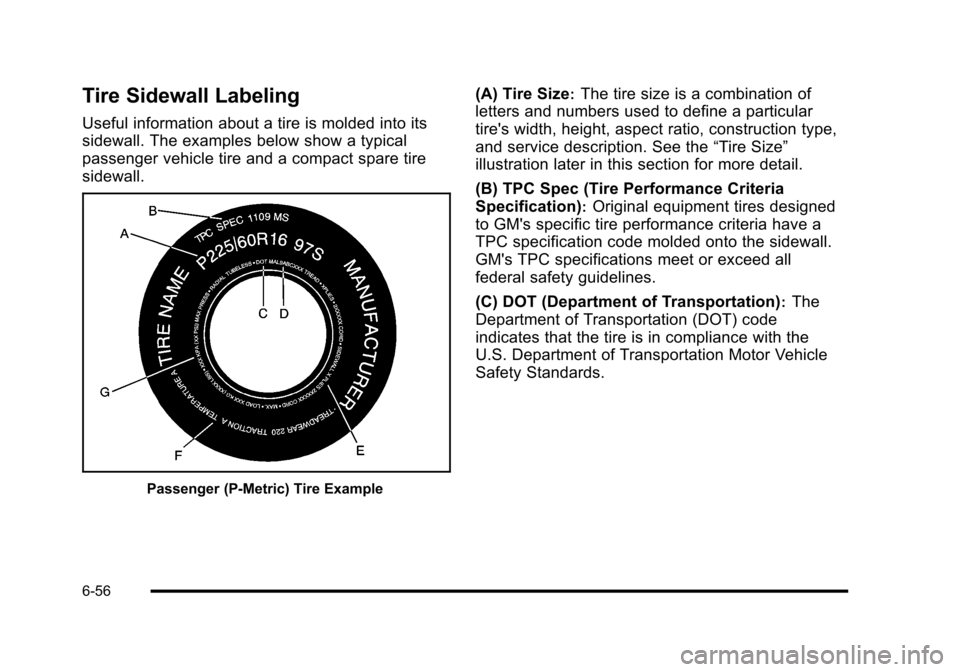
Tire Sidewall Labeling
Useful information about a tire is molded into its
sidewall. The examples below show a typical
passenger vehicle tire and a compact spare tire
sidewall.
Passenger (P‐Metric) Tire Example
(A) Tire Size:The tire size is a combination of
letters and numbers used to define a particular
tire's width, height, aspect ratio, construction type,
and service description. See the “Tire Size”
illustration later in this section for more detail.
(B) TPC Spec (Tire Performance Criteria
Specification)
:Original equipment tires designed
to GM's specific tire performance criteria have a
TPC specification code molded onto the sidewall.
GM's TPC specifications meet or exceed all
federal safety guidelines.
(C) DOT (Department of Transportation)
:The
Department of Transportation (DOT) code
indicates that the tire is in compliance with the
U.S. Department of Transportation Motor Vehicle
Safety Standards.
6-56
Page 359 of 480

(D) Tire Identification Number (TIN):The letters
and numbers following DOT (Department of
Transportation) code is the Tire Identification
Number (TIN). The TIN shows the manufacturer
and plant code, tire size, and date the tire was
manufactured. The TIN is molded onto both sides
of the tire, although only one side may have the
date of manufacture.
(E) Tire Ply Material
:The type of cord and
number of plies in the sidewall and under the
tread.
(F) Uniform Tire Quality Grading (UTQG)
:Tire
manufacturers are required to grade tires based
on three performance factors: treadwear, traction,
and temperature resistance. For more information
see Uniform Tire Quality Grading
on page 6‑74.
(G) Maximum Cold Inflation Load Limit
:
Maximum load that can be carried and the
maximum pressure needed to support that load.
Compact Spare Tire Example
(A) Temporary Use Only:The compact spare
tire or temporary use tire has a tread life of
approximately 3,000 miles (5 000 km) and should
not be driven at speeds over 65 mph (105 km/h).
The compact spare tire is for emergency use
when a regular road tire has lost air and gone flat.
If your vehicle has a compact spare tire, see
Compact Spare Tire
on page 6‑110andIf a Tire
Goes Flat
on page 6‑77.
6-57