2010 CHEVROLET HHR airbag off
[x] Cancel search: airbag offPage 16 of 480

Sensing System for Passenger
Airbag
The passenger sensing system, if equipped, will turn off
the right front passenger frontal airbag under certain
conditions. The driver airbags and roof‐rail airbags are
not affected by this.
If the vehicle has a passenger sensing system, the
passenger airbag status indicator will be visible on the
instrument panel when the vehicle is started.
United StatesCanada
See Passenger Sensing System
on page 2‑70for
important information.
Mirror Adjustment
Exterior Mirrors
Controls for the outside
power mirrors are located
on the driver door
armrest.
1. Press the left or right side of the selector, located beneath the control pad, to adjust the driver or
passenger mirror.
2. Press the control pad to move the mirror to the desired direction.
Manually fold the mirrors inward to prevent damage
when going through an automatic car wash. To fold, pull
the mirror toward the vehicle. Push the mirror outward,
to return to its original position.
1-10
Page 62 of 480
Shoulder Belt Height Adjuster
The vehicle has a shoulder belt height adjuster for the
driver and right front passenger seating positions.
Adjust the height so that the shoulder portion of the belt
is centered on the shoulder. The belt should be away
from the face and neck, but not falling off the shoulder.
Improper shoulder belt height adjustment could reduce
the effectiveness of the safety belt in a crash.
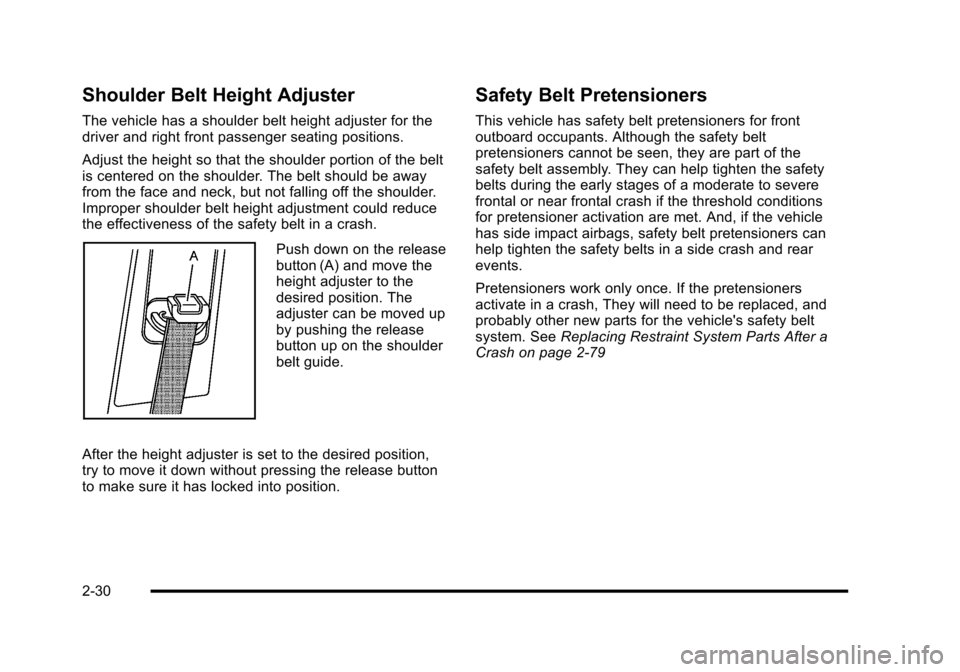
Push down on the release
button (A) and move the
height adjuster to the
desired position. The
adjuster can be moved up
by pushing the release
button up on the shoulder
belt guide.
After the height adjuster is set to the desired position,
try to move it down without pressing the release button
to make sure it has locked into position.
Safety Belt Pretensioners
This vehicle has safety belt pretensioners for front
outboard occupants. Although the safety belt
pretensioners cannot be seen, they are part of the
safety belt assembly. They can help tighten the safety
belts during the early stages of a moderate to severe
frontal or near frontal crash if the threshold conditions
for pretensioner activation are met. And, if the vehicle
has side impact airbags, safety belt pretensioners can
help tighten the safety belts in a side crash and rear
events.
Pretensioners work only once. If the pretensioners
activate in a crash, They will need to be replaced, and
probably other new parts for the vehicle's safety belt
system. See Replacing Restraint System Parts After a
Crash on page 2‑79
2-30
Page 70 of 480
Infants and Young Children
Everyone in a vehicle needs protection! This includes
infants and all other children. Neither the distance
traveled nor the age and size of the traveler changes
the need, for everyone, to use safety restraints. In fact,
the law in every state in the United States and in every
Canadian province says children up to some age must
be restrained while in a vehicle.
{WARNING:
Children can be seriously injured or strangled if a
shoulder belt is wrapped around their neck and
the safety belt continues to tighten. Never leave
children unattended in a vehicle and never allow
children to play with the safety belts.
Airbags plus lap‐shoulder belts offer protection for
adults and older children, but not for young children
and infants. Neither the vehicle's safety belt system
nor its airbag system is designed for them. Every time infants and young children ride in vehicles, they
should have the protection provided by appropriate
child restraints.
Children who are not restrained properly can strike
other people, or can be thrown out of the vehicle.
{WARNING:
Never do this.
Never hold an infant or a child while riding in a
vehicle. Due to crash forces, an infant or a child
will become so heavy it is not possible to hold it
during a crash. For example, in a crash at only
40 km/h (25 mph), a 5.5 kg (12 lb) infant will
suddenly become a 110 kg (240 lb) force on a
person's arms. An infant should be secured in an
appropriate restraint.
2-38
Page 76 of 480
A label on the sun visor says,“Never put a rear-facing
child restraint in the front.” This is because the risk to
the rear-facing child is so great, if the airbag deploys.
{WARNING:
A child in a rear-facing child restraint can be
seriously injured or killed if the right front
passenger airbag inflates. This is because the
back of the rear-facing child restraint would be
very close to the inflating airbag. A child in a
forward-facing child restraint can be seriously
injured or killed if the right front passenger airbag
inflates and the passenger seat is in a forward
position.
The vehicle may have a passenger sensing
system which is designed to turn off the right front
passenger frontal airbag under certain conditions.
Even if the passenger sensing system,
if equipped, has turned off the right front
passenger frontal airbag, no system is fail-safe.
No one can guarantee that an airbag will not
deploy under some unusual circumstance, even
though it is turned off.
(Continued)
WARNING: (Continued)
Secure rear-facing child restraints in a rear
seat, even if the airbag is off. If you secure a
forward-facing child restraint in the right front seat,
always move the front passenger seat as far back
as it will go. It is better to secure the child restraint
in a rear seat.
SeePassenger Sensing System
on page 2‑70
for additional information.
If the vehicle does not have a rear seat that will
accommodate a rear-facing child restraint, a rear-facing
child restraint should not be installed in the vehicle,
even if the airbag is off.
When securing a child restraint in a rear seating
position, study the instructions that came with your child
restraint to make sure it is compatible with this vehicle.
Wherever a child restraint is installed, be sure to secure
the child restraint properly.
Keep in mind that an unsecured child restraint can
move around in a collision or sudden stop and injure
people in the vehicle. Be sure to properly secure any
child restraint in the vehicle —even when no child
is in it.
2-44
Page 88 of 480
Securing a Child Restraint in the
Right Front Seat Position
This vehicle has airbags. A rear seat is a safer place to
secure a forward-facing child restraint. SeeWhere to
Put the Restraint on page 2‑43.
In addition, the vehicle may have a passenger sensing
system which is designed to turn off the right front
passenger frontal airbag under certain conditions. See
Passenger Sensing System
on page 2‑70and
Passenger Airbag Status Indicatoron page 4‑28for
more information, including important safety information.
A label on the sun visor says, “Never put a rear-facing
child seat in the front.” This is because the risk to the
rear-facing child is so great, if the airbag deploys.
{WARNING:
A child in a rear-facing child restraint can be
seriously injured or killed if the right front
passenger airbag inflates. This is because the
back of the rear-facing child restraint would be
very close to the inflating airbag. A child in a
forward-facing child restraint can be seriously
(Continued)
WARNING: (Continued)
injured or killed if the right front passenger airbag
inflates and the passenger seat is in a forward
position.
The vehicle may have a passenger sensing
system which is designed to turn off the right front
passenger frontal airbag under certain conditions.
Even if the passenger sensing system,
if equipped, has turned off the right front
passenger frontal airbag, no system is fail-safe.
No one can guarantee that an airbag will not
deploy under some unusual circumstance, even
though it is turned off.
Secure rear-facing child restraints in a rear
seat, even if the airbag is off. If you secure a
forward-facing child restraint in the right front seat,
always move the front passenger seat as far back
as it will go. It is better to secure the child restraint
in a rear seat.
SeePassenger Sensing System
on page 2‑70
for additional information.
2-56
Page 89 of 480
If the vehicle does not have a rear seat that will
accomodate a rear‐facing child restraint, a rear-facing
child restraint should not be installed in the vehicle,
even if the airbag is off.
If your child restraint has the LATCH system, see
Lower Anchors and Tethers for Children (LATCH)
on
page 2‑45for how and where to install the child
restraint using LATCH. If a child restraint is secured
using a safety belt and it uses a top tether, see Lower
Anchors and Tethers for Children (LATCH)
on
page 2‑45for top tether anchor locations.
Do not secure a child seat in a position without a top
tether anchor if a national or local law requires that the
top tether be anchored, or if the instructions that come
with the child restraint say that the top strap must be
anchored. In Canada, the law requires that forward-facing child
restraints have a top tether, and that the tether be
attached.
You will be using the lap-shoulder belt to secure the
child restraint in this position. Follow the instructions
that came with the child restraint.
1. Move the seat as far back as it will go before securing the forward-facing child restraint.
2. Put the child restraint on the seat.
3. Pick up the latch plate, and run the lap and shoulder portions of the vehicle's safety belt
through or around the restraint. The child restraint
instructions will show you how.
2-57
Page 91 of 480
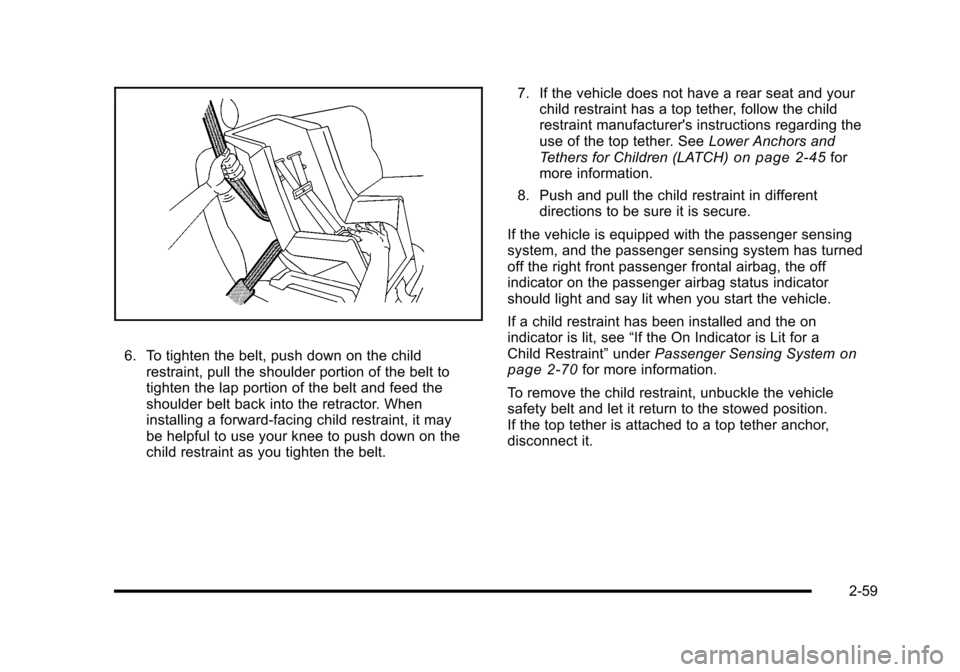
6. To tighten the belt, push down on the childrestraint, pull the shoulder portion of the belt to
tighten the lap portion of the belt and feed the
shoulder belt back into the retractor. When
installing a forward-facing child restraint, it may
be helpful to use your knee to push down on the
child restraint as you tighten the belt. 7. If the vehicle does not have a rear seat and your
child restraint has a top tether, follow the child
restraint manufacturer's instructions regarding the
use of the top tether. See Lower Anchors and
Tethers for Children (LATCH)
on page 2‑45for
more information.
8. Push and pull the child restraint in different directions to be sure it is secure.
If the vehicle is equipped with the passenger sensing
system, and the passenger sensing system has turned
off the right front passenger frontal airbag, the off
indicator on the passenger airbag status indicator
should light and say lit when you start the vehicle.
If a child restraint has been installed and the on
indicator is lit, see “If the On Indicator is Lit for a
Child Restraint” underPassenger Sensing System
on
page 2‑70for more information.
To remove the child restraint, unbuckle the vehicle
safety belt and let it return to the stowed position.
If the top tether is attached to a top tether anchor,
disconnect it.
2-59
Page 94 of 480
{WARNING:
Children who are up against, or very close to, any
airbag when it inflates can be seriously injured or
killed. Airbags plus lap-shoulder belts offer
protection for adults and older children, but not for
young children and infants. Neither the vehicle's
safety belt system nor its airbag system is
designed for them. Young children and infants
need the protection that a child restraint system
can provide. Always secure children properly in
your vehicle. To read how, seeOlder Children
on
page 2‑35
or Infants and Young Childrenon
page 2‑38
.
There is an airbag
readiness light on the
instrument panel cluster,
which shows the airbag
symbol.
The system checks the airbag electrical system for
malfunctions. The light tells you if there is an electrical
problem. See Airbag Readiness Light
on page 4‑27for
more information.
2-62