2010 CHEVROLET CAMARO SS charging
[x] Cancel search: chargingPage 151 of 372

Radio Reception
Frequency interference and static
can occur during normal radio
reception if items such as cell phone
chargers, vehicle convenience
accessories, and external electronic
devices are plugged into the
accessory power outlet. If there is
interference or static, unplug the item
from the accessory power outlet.
FM
FM signals only reach about
16 to 65 km (10 to 40 miles).
Although the radio has a built-in
electronic circuit that automatically
works to reduce interference,
some static can occur, especially
around tall buildings or hills, causing
the sound to fade in and out.
AM
The range for most AM stations is
greater than for FM, especially at
night. The longer range can cause
station frequencies to interfere with
each other. For better radio
reception, most AM radio stations
boost the power levels during the
day, and then reduce these levels
during the night. Static can also
occur when things like storms and
power lines interfere with radio
reception. When this happens, try
reducing the treble on the radio.
XM™ Satellite Radio Service
XM Satellite Radio Service gives
digital radio reception from
coast-to-coast in the 48 contiguous
United States, and in Canada.
Just as with FM, tall buildings or hills
can interfere with satellite radio
signals, causing the sound to fade
in and out. In addition, traveling
or standing under heavy foliage,
bridges, garages, or tunnels may
cause loss of the XM signal for
a period of time.
Cellular Phone Usage
Cellular phone usage may cause
interference with the vehicle’s radio.
This interference may occur when
making or receiving phone calls,
charging the phone’s battery,
or simply having the phone on.
This interference can cause
an increased level of static while
listening to the radio. If static
is received while listening to the
radio, unplug the cellular phone and
turn it off.
Backglass Antenna
The AM-FM antenna is integrated
with the rear window defogger,
located in the rear window. Make
sure that the inside surface of
the rear window is not scratched
and that the lines on the glass are
not damaged. If the inside surface
is damaged, it could interfere
with radio reception. For proper
radio reception, the antenna
connector needs to be properly
attached to the post on the glass.
Infotainment System 6-13
Page 194 of 372

A (LOCK/OFF):This is the only
position from which the key can be
removed. This locks the steering
wheel, ignition and automatic
transmission.
On vehicles with an automatic
transmission, the shift lever must
be in P (Park) to turn the ignition
switch to the LOCK/OFF position.
The ignition switch can bind in the
LOCK/OFF position with the wheels
turned off center. If this happens,
move the steering wheel from right
to left while turning the key to
ACC/ACCESSORY. If this does not
work, then the vehicle needs service.
B (ACC/ACCESSORY):This
position provides power to some of
the electrical accessories. It unlocks
the steering wheel and ignition. The
transmission is also unlocked in this
position on automatic transmission
vehicles. To move the key from
ACC/ACCESSORY to LOCK/OFF,
push in the key and then turn it to
LOCK/OFF.C (ON/RUN):The ignition switch
stays in this position when the engine
is running. This position can be used
to operate the electrical accessories,
including the ventilation fan and
12 volt power outlet, as well as to
display some warning and indicator
lights.
The battery could be drained if the
key is left in the ACC/ACCESSORY
or ON/RUN position with the engine
off. The vehicle might not start if the
battery is allowed to drain for an
extended period of time.
D (START):This position starts
the engine. When the engine starts,
release the key. The ignition switch
will return to ON/RUN for normal
driving.
A warning tone sounds when the
driver door is opened if the ignition
is still in ACC/ACCESSORY and the
key is in the ignition.Key Lock Release
This vehicle is equipped with an
electronic key lock release system.
The key lock release is designed
to prevent ignition key removal
unless the shift lever is in P (Park).
The key lock release is always
functional except in the case of an
uncharged or low voltage (less than
9 volt) battery. If the vehicle has an
uncharged battery or a battery with
low voltage, try charging or jump
starting the battery. SeeJump
Starting on page 9-84.
8-18 Driving and Operating
Page 195 of 372

If charging or jump starting the
battery does not work, remove the
plug covering the hole below the
ignition lock. Insert a screwdriver into
the opening as far as it will go and
remove the key from the ignition.
Retained Accessory
Power (RAP)
These vehicle accessories may be
used for up to 10 minutes after
the engine is turned off:
•Audio System
•Power Windows
The power windows will continue to
work for up to 10 minutes or until any
door is opened. The radio will work
when the key is in ON/RUN or
ACC/ACCESSORY. Once the key is
turned from ON/RUN to LOCK/OFF,
the radio will continue to work for
10 minutes, or until the driver door
is opened or the key is removed
from the ignition.
Starting the Engine
Place the transmission in the
proper gear.
Automatic Transmission
Move the shift lever to P (Park) or
N (Neutral). The engine will not start
in any other position. To restart the
vehicle when it is already moving,
use N (Neutral) only.
Notice:Do not try to shift to
P (Park) if the vehicle is moving.
If you do, you could damage
the transmission. Shift to P (Park)
only when the vehicle is stopped.
Manual Transmission
The shift lever should be in
N (Neutral) and the parking brake
engaged. Hold the clutch pedal
down to the floor and start the
engine. The vehicle will not start
if the clutch pedal is not all the
way down.Starting Procedure
1. With your foot off the accelerator
pedal, turn the ignition key to
START. When the engine starts,
let go of the key. The idle speed
will go down as the engine
warms. Do not race the engine
immediately after starting it. Allow
the oil to warm up and lubricate all
moving parts.
The vehicle has a
Computer-Controlled Cranking
System. This feature assists in
starting the engine and protects
components. If the ignition key
is turned to the START position,
and then released when the
engine begins cranking, the
engine will continue cranking
for a few seconds or until the
vehicle starts. If the engine
does not start and the key
is held in START for many
seconds, cranking stops
after 15 seconds to prevent
cranking motor damage.
Driving and Operating 8-19
Page 199 of 372

If the vehicle has an uncharged
battery or a battery with low voltage,
try charging or jump starting the
battery. SeeJump Starting on
page 9-84
To shift out of P (Park):
1. Apply the brake pedal.
2. Press the shift lever button.
3. Move the shift lever to the
desired position.
If still unable to shift out of P (Park):
1. Fully release the shift lever
button.
2. Hold the brake pedal down and
press the shift lever button again.
3. Move the shift lever to the
desired position.
If the shift lever still cannot be
moved from P (Park), see Shift
Lock Manual Release.Shift Lock Manual Release
The transmission has an electric
park lock called a shift lock manual
release. The key must be in the
ON/RUN position, and the brake
pedal pressed so the transmission
gear selector can be moved from the
P (Park) position. If the battery has
lost power, the selector cannot be
moved from P (Park) unless the shift
lock manual release is disengaged
manually.To access the shift lock manual
release:
1. Apply the park brake.
2. Pull the passenger side console
trim away from the front half of
the console to expose the shifter
mechanism.
Driving and Operating 8-23
Page 361 of 372
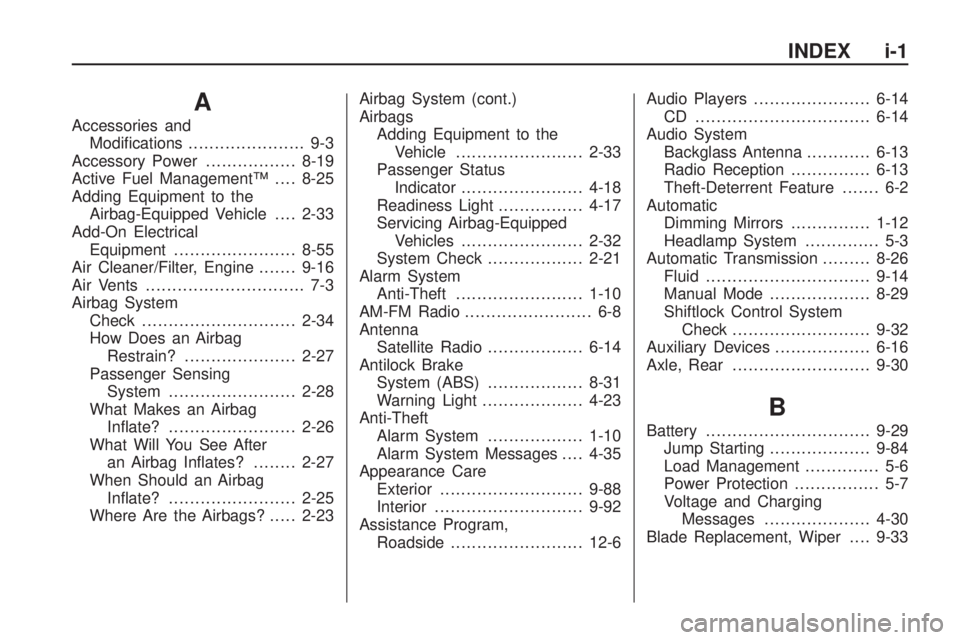
A
Accessories and
Modifications...................... 9-3
Accessory Power.................8-19
Active Fuel Management™....8-25
Adding Equipment to the
Airbag-Equipped Vehicle....2-33
Add-On Electrical
Equipment.......................8-55
Air Cleaner/Filter, Engine.......9-16
Air Vents.............................. 7-3
Airbag System
Check.............................2-34
How Does an Airbag
Restrain?.....................2-27
Passenger Sensing
System........................2-28
What Makes an Airbag
Inflate?........................2-26
What Will You See After
an Airbag Inflates?........2-27
When Should an Airbag
Inflate?........................2-25
Where Are the Airbags?.....2-23Airbag System (cont.)
Airbags
Adding Equipment to the
Vehicle........................2-33
Passenger Status
Indicator.......................4-18
Readiness Light................4-17
Servicing Airbag-Equipped
Vehicles.......................2-32
System Check..................2-21
Alarm System
Anti-Theft........................1-10
AM-FM Radio........................ 6-8
Antenna
Satellite Radio..................6-14
Antilock Brake
System (ABS)..................8-31
Warning Light...................4-23
Anti-Theft
Alarm System..................1-10
Alarm System Messages....4-35
Appearance Care
Exterior...........................9-88
Interior............................9-92
Assistance Program,
Roadside.........................12-6Audio Players......................6-14
CD .................................6-14
Audio System
Backglass Antenna............6-13
Radio Reception...............6-13
Theft-Deterrent Feature....... 6-2
Automatic
Dimming Mirrors...............1-12
Headlamp System.............. 5-3
Automatic Transmission.........8-26
Fluid...............................9-14
Manual Mode...................8-29
Shiftlock Control System
Check..........................9-32
Auxiliary Devices..................6-16
Axle, Rear..........................9-30
B
Battery...............................9-29
Jump Starting...................9-84
Load Management.............. 5-6
Power Protection................ 5-7
Voltage and Charging
Messages....................4-30
Blade Replacement, Wiper....9-33
INDEX i-1
Page 362 of 372

Bluetooth............6-22, 6-23, 6-26
Brakes...............................9-27
Antilock...........................8-31
Assist.............................8-33
Fluid...............................9-28
Parking...........................8-32
System Messages.............4-31
Braking................................ 8-4
Break-In, New Vehicle..........8-16
Bulb Replacement................9-41
Fog Lamps ......................9-40
Halogen Bulbs..................9-37
Headlamp Aiming..............9-34
Headlamps......................9-37
Headlamps, Front Turn
Signal and Parking
Lamps .................9-37, 9-38
High Intensity Discharge
(HID) Lighting...............9-37
License Plate Lamps.........9-40
Taillamps, Turn Signal and
Stoplamps....................9-40
Buying New Tires.................9-63C
Calibration............................ 4-8
California
Fuel Requirements............8-45
Perchlorate Materials
Requirements................. 9-3
Warning............................ 9-2
Canadian Vehicle Owners......... iii
Capacities and
Specifications...................11-2
Carbon Monoxide
Engine Exhaust................8-25
Trunk................................ 1-8
Winter Driving..................8-10
Cautions, Danger, and
Warnings............................. iv
CD Player...........................6-14
Center Console Storage......... 3-1
Chains, Tire........................9-68
Charging System Light..........4-19
Check
Engine Lamp...................4-19
Ignition
Transmission Lock.........9-32Check (cont.)
Child Restraints
Infants and Young
Children.......................2-37
Lower Anchors and Tethers
for Children..................2-43
Older Children..................2-35
Securing..................2-48, 2-50
Systems..........................2-39
Where to Put the
Restraint......................2-41
Circuit Breakers...................9-42
Cleaning
Exterior Care...................9-88
Interior Care....................9-92
Climate Control Systems......... 7-1
Clock................................... 4-8
Cluster, IP...........................4-10
Clutch, Hydraulic..................9-15
Collision Damage Repair.......12-9
Compact Spare Tire.............9-83
Compass.............................. 4-8
Compass Messages.............
4-31
Competitive Driving................ 8-7
Competitive Driving Mode......8-37
i-2 INDEX
Page 366 of 372

L
Labeling, Tire Sidewall..........9-49
Lamp Messages..................4-33
Lamps
Daytime
Running (DRL).......5-3, 9-39
Dome ............................... 5-6
Exterior Controls................ 5-1
Front Fog.......................... 5-5
Headlamps, Front Turn
Signal and Parking
Lamps .................9-37, 9-38
License Plate...................9-40
Malfunction Indicator.........4-19
Lap-Shoulder Belt................2-16
Latch, Lower Anchors and
Tethers for Children...........2-43
LATCH System
Replacing Parts After a
Crash..........................2-48
Latches, Seatback................. 2-5
Lighting
Entry................................ 5-6
Theater Dimming................ 5-6
Lights
Airbag Readiness.............4-17Lights (cont.)
Antilock Brake System
(ABS) Warning..............4-23
Charging System..............4-19
Cruise Control..................4-26
Engine Oil Pressure..........4-25
Flash-to-Pass..................... 5-3
Fog Lamps ......................4-26
High/Low Beam Changer..... 5-2
Immobilizer......................4-26
Safety Belt Reminders.......4-16
Taillamp Indicator..............4-26
Tire Pressure...................4-24
Traction Control OFF/
StabiliTrak OFF.............4-24
Traction Control System
(TCS)/StabiliTrak
®..........4-24
Traction Off......................4-23
Limited-Slip Rear Axle...........8-38
Locks
Door ................................. 1-6
Lockout Protection.............. 1-8
Power Door ....................... 1-7
Loss of Control..................... 8-6
Lower Anchors and Tethers
for Children (LATCH
SYSTEM)........................2-43
M
Maintenance
Records.........................10-10
Maintenance Schedule
Recommended Fluids and
Lubricants....................10-7
Scheduled Maintenance.....10-2
Malfunction Indicator Lamp....4-19
Manual Mode......................8-29
Manual Transmission............8-30
Fluid...............................9-15
Messages
Airbag System..................4-35
Anti-Theft Alarm System....4-35
Battery Voltage and
Charging......................4-30
Brake System..................4-31
Compass.........................4-31
Door Ajar.........................4-31
Engine Cooling System.....4-32
Engine Oil.......................4-32
Engine Power..................4-33
Fuel System....................4-33
Key and Lock..................4-33
Lamp ..............................4-33
Object Detection System....4-34
i-6 INDEX