2010 BUICK LACROSSE engine coolant
[x] Cancel search: engine coolantPage 302 of 414

9-20 Vehicle Care
3. Fill the coolant surge tank withthe proper mixture to the mark
pointed to on the front of the
coolant surge tank.
4. With the coolant surge tank cap off, start the engine and let it run
until the upper radiator hose
starts getting hot. Watch out for
the engine cooling fan(s). By this
time, the coolant level inside the
coolant surge tank may be
lower. If the level is lower, add
more of the proper mixture to the
coolant surge tank until the level reaches the mark pointed to on
the front of the coolant
surge tank.
5. Replace the cap. Be sure the cap is hand–tight and full
seated.
Notice: If the pressure cap is not
tightly installed, coolant loss and
possible engine damage may
occur. Be sure the cap is properly
and tightly secured.
If coolant is needed, add the proper
DEX-COOL®coolant mixture at the
coolant recovery tank.
Engine Overheating
The vehicle has several indicators
to warn of engine overheating.
There is a coolant temperature gage
and a warning light on the
instrument panel cluster that
indicate an overheated engine
condition. See Engine Coolant
Temperature Gage
on page 4‑15for more information. You may decide not to lift the hood
when this warning appears, but
instead get service help right away.
See
Roadside Assistance Program
(US, Can) on page 12‑6.
If you do decide to lift the hood ,
make sure the vehicle is parked on
a level surface.
Then check to see if the engine
cooling fans are running. If the
engine is overheating, the fan(s)
should be running. If they are not,
do not continue to run the engine
and have the vehicle serviced.
Notice: Engine damage from
running the engine without
coolant is not covered by the
warranty.
If Steam Is Coming From The
Engine Compartment
See Overheated Engine Protection
Operating Modeon page 9‑21for
information on driving to a safe
place in an emergency.
Page 303 of 414
Vehicle Care 9-21
If No Steam Is Coming From
The Engine Compartment
If an engine overheat warning is
displayed but no steam can be seen
or heard, the problem might not be
too serious. Sometimes the engine
can get a little too hot when the
vehicle:
.Climbing a long hill on a hot day.
.Stopping after high-speed
driving.
.Idling for long periods in traffic.
.Towing a trailer.
If the overheat warning displays with
no sign of steam:
1. Turn the air conditioning off.
2. Turn the heater on to the highest temperature and to the highest
fan speed. Open the windows as
necessary. 3. In heavy traffic, let the engine
idle in N (Neutral) while stopped.
If it is safe to do so, pull off the
road, shift to P (Park) or
N (Neutral) and let the
engine idle.
If the temperature overheat gage is
no longer in the overheat zone or an
overheat warning no longer
displays, the vehicle can be driven.
Continue to drive the vehicle slow
for about 10 minutes. Keep a safe
vehicle distance from the vehicle in
front. If the warning does not come
back on, continue to drive normally.
If the warning continues, pull over,
stop, and park the vehicle
right away.
If there is no sign of steam, idle the
engine for three minutes while
parked. If the warning is still
displayed, turn off the engine until it
cools down. Also, see “Overheated
Engine Protection Operating Mode”
later in this section.
Overheated Engine
Protection
Operating Mode
This emergency operating mode
allows the vehicle to be driven to a
safe place in an emergency
situation. If an overheated engine
condition exists, an overheat
protection mode which alternates
firing groups of cylinders helps
prevent engine damage. In this
mode, there is significant loss in
power and engine performance. The
engine coolant temperature warning
light comes on the instrument panel,
to indicate the vehicle has entered
overheated engine protection
operating mode. The temperature
gage also indicates an overheat
condition exists. Driving
extended km (miles) and/or towing a
trailer in the overheat protection
mode should be avoided.
Page 305 of 414
Vehicle Care 9-23
Washer Fluid
What to Use
When windshield washer fluid is
needed, be sure to read the
manufacturer instructions before
use. If operating the vehicle in an
area where the temperature can fall
below freezing, use a fluid that has
sufficient protection against
freezing.
Adding Washer Fluid
Open the cap with the washer
symbol on it. Add washer fluid until
the tank is full. SeeEngine
Compartment Overview
on
page 9‑6for reservoir location. Notice:
.When using concentrated
washer fluid, follow the
manufacturer's instructions
for adding water.
.Do not mix water with
ready-to-use washer fluid.
Water can cause the solution
to freeze and damage your
washer fluid tank and other
parts of the washer system.
Also, water does not clean as
well as washer fluid.
.Fill the washer fluid tank only
three-quarters full when it is
very cold. This allows for
fluid expansion if freezing
occurs, which could damage
the tank if it is
completely full.
.Do not use engine coolant
(antifreeze) in your
windshield washer. It can
damage the vehicle's
windshield washer system
and paint.
Page 373 of 414
Service and Maintenance 10-3
If the engine oil life system is reset
accidentally, service the vehicle
within 5 000 km/3,000 miles since
the last service. Reset the oil life
system whenever the oil is changed.
SeeEngine Oil Life System
on
page 9‑13.
When the Change Engine Oil Soon
message displays, certain services,
checks, and inspections are
required. The services described
for Maintenance Ishould be
performed at every engine oil
change. The services described
for Maintenance IIshould be
performed when:
.Maintenance Iwas performed
the last time the engine oil was
changed.
.It has been 10 months or more
since the Change Engine Oil
Soon message has displayed or
since the last service.
Maintenance I
.Change engine oil and filter.
SeeEngine Oilon page 9‑11.
An Emission Control Service.
.Engine coolant level check. See
Engine Coolant on page 9‑18.
.Windshield washer fluid level
check. See Washer Fluidon
page 9‑23.
.Tire inflation check. See Tire
Pressure on page 9‑53.
.Tire wear inspection. See Tire
Inspection on page 9‑59.
.Rotate tires. See Tire Rotationon page 9‑59.
.Fluids visual leak check
(or every 12 months, whichever
occurs first). A leak in any
system must be repaired and
the fluid level checked.
.Engine air cleaner filter
inspection (vehicles driven
in dusty conditions only).
SeeEngine Air Cleaner/Filter
on
page 9‑15.
.Brake system inspection
(or every 12 months, whichever
occurs first).
Maintenance II
.Perform all services described in
MaintenanceI.
.Steering and suspension
inspection. Visual inspection for
damaged, loose, or missing
parts or signs of wear.
.Engine cooling system
inspection. Visual inspection
of hoses, pipes, fittings, and
clamps and replacement,
if needed.
Page 374 of 414

10-4 Service and Maintenance
.Windshield wiper blade
inspection for wear, cracking,
or contamination and windshield
and wiper blade cleaning,
if contaminated. SeeExterior
Care
on page 9‑82. Worn or
damaged wiper blade
replacement. See Wiper Blade
Replacement on page 9‑29.
.Body hinges and latches, key
lock cylinders, folding seat
hardware, and sunroof
(if equipped) lubrication.
See Recommended Fluids and
Lubricants
on page 10‑7.
More frequent lubrication may
be required when vehicle is
exposed to a corrosive
environment. Applying silicone
grease on weatherstrips with a
clean cloth makes them last
longer, seal better, and not stick
or squeak.
.Restraint system component
check. See Safety System
Check on page 2‑23.
.Automatic transmission fluid
level check and adding fluid,
if needed. See Automatic
Transmission Fluid
on
page 9‑15.
.Engine air cleaner filter
inspection. See Engine Air
Cleaner/Filter on page 9‑15.
.Passenger compartment air
filter replacement (or every
12 months, whichever occurs
first). More frequent replacement
may be required if vehicle is
driven regularly under dusty
conditions.
Additional Required Services
At Each Fuel Stop
.Engine oil level check. See
Engine Oil on page 9‑11.
.Engine coolant level check. See
Engine Coolant on page 9‑18.
.Windshield washer fluid level
check. See Washer Fluidon
page 9‑23.
Once a Month
.Tire inflation check. See Tire
Pressure on page 9‑53.
.Tire wear inspection. See Tire
Inspection on page 9‑59.
Once a Year
.See Starter Switch Checkon
page 9‑27.
.See Automatic Transmission
Shift Lock Control System
Check on page 9‑27.
Page 376 of 414
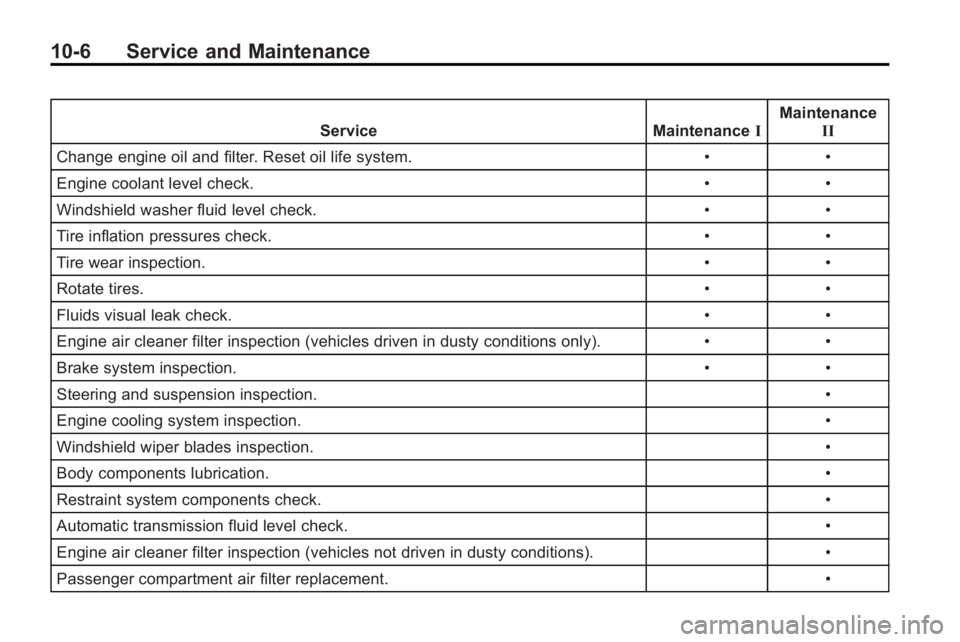
10-6 Service and Maintenance
ServiceMaintenanceIMaintenance
II
Change engine oil and filter. Reset oil life system. ••
Engine coolant level check. ••
Windshield washer fluid level check. ••
Tire inflation pressures check. ••
Tire wear inspection. ••
Rotate tires. ••
Fluids visual leak check. ••
Engine air cleaner filter inspection (vehicles driven in dusty conditions only). ••
Brake system inspection. ••
Steering and suspension inspection. •
Engine cooling system inspection. •
Windshield wiper blades inspection. •
Body components lubrication. •
Restraint system components check. •
Automatic transmission fluid level check. •
Engine air cleaner filter inspection (vehicles not driven in dusty conditions). •
Passenger compartment air filter replacement. •
Page 377 of 414

Service and Maintenance 10-7
Recommended Fluids, Lubricants, and Parts
Recommended Fluids and Lubricants
UsageFluid/Lubricant
Engine Oil Engine oil which meets GM Standard GM6094M and displays the
American Petroleum Institute Certified for Gasoline Engines starburst
symbol. To determine the proper viscosity for the vehicle's engine,
see
Engine Oil on page 9‑11.
Engine Coolant 50/50 mixture of clean, drinkable water and use only DEX-COOL
®Coolant.
See Engine Coolant on page 9‑18.
Hydraulic Brake System Hydraulic Brake Fluid (GM Part No. U.S. 88862806, in Canada 88862807). Windshield Washer Optikleen
®Washer Solvent.
Hydraulic Power Steering System GM Power Steering Fluid (GM Part No. U.S. 89021184,
in Canada 89021186).
Page 405 of 414
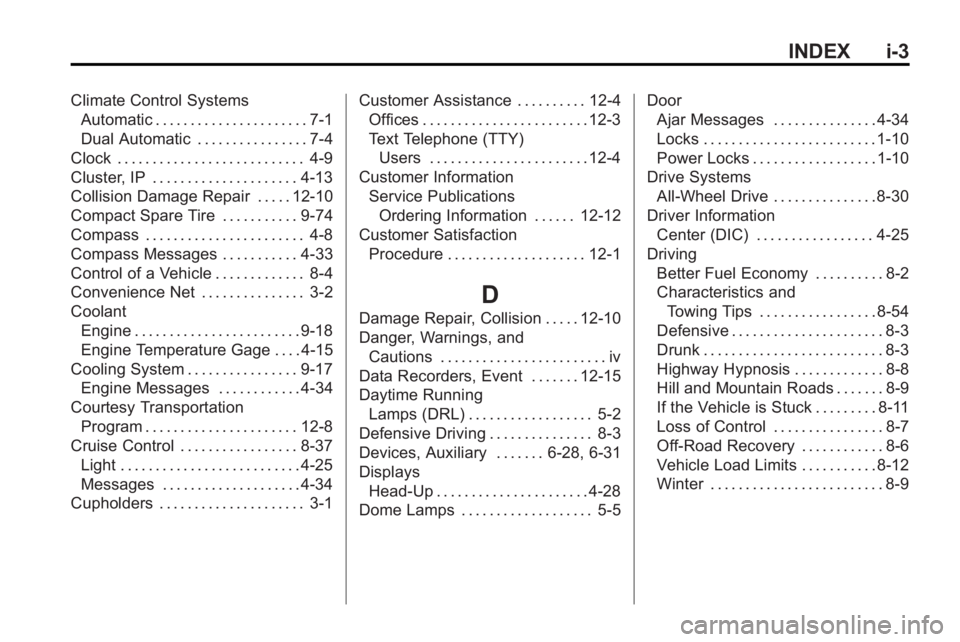
INDEX i-3
Climate Control SystemsAutomatic . . . . . . . . . . . . . . . . . . . . . . 7-1
Dual Automatic . . . . . . . . . . . . . . . . 7-4
Clock . . . . . . . . . . . . . . . . . . . . . . . . . . . 4-9
Cluster, IP . . . . . . . . . . . . . . . . . . . . . 4-13
Collision Damage Repair . . . . . 12-10
Compact Spare Tire . . . . . . . . . . . 9-74
Compass . . . . . . . . . . . . . . . . . . . . . . . 4-8
Compass Messages . . . . . . . . . . . 4-33
Control of a Vehicle . . . . . . . . . . . . . 8-4
Convenience Net . . . . . . . . . . . . . . . 3-2
Coolant Engine . . . . . . . . . . . . . . . . . . . . . . . . 9-18
Engine Temperature Gage . . . . 4-15
Cooling System . . . . . . . . . . . . . . . . 9-17 Engine Messages . . . . . . . . . . . . 4-34
Courtesy Transportation Program . . . . . . . . . . . . . . . . . . . . . . 12-8
Cruise Control . . . . . . . . . . . . . . . . . 8-37 Light . . . . . . . . . . . . . . . . . . . . . . . . . . 4-25
Messages . . . . . . . . . . . . . . . . . . . . 4-34
Cupholders . . . . . . . . . . . . . . . . . . . . . 3-1 Customer Assistance . . . . . . . . . . 12-4
Offices . . . . . . . . . . . . . . . . . . . . . . . . 12-3
Text Telephone (TTY)
Users . . . . . . . . . . . . . . . . . . . . . . . 12-4
Customer Information Service PublicationsOrdering Information . . . . . . 12-12
Customer Satisfaction Procedure . . . . . . . . . . . . . . . . . . . . 12-1
D
Damage Repair, Collision . . . . . 12-10
Danger, Warnings, andCautions . . . . . . . . . . . . . . . . . . . . . . . . iv
Data Recorders, Event . . . . . . . 12-15
Daytime Running Lamps (DRL) . . . . . . . . . . . . . . . . . . 5-2
Defensive Driving . . . . . . . . . . . . . . . 8-3
Devices, Auxiliary . . . . . . . 6-28, 6-31
Displays
Head-Up . . . . . . . . . . . . . . . . . . . . . . 4-28
Dome Lamps . . . . . . . . . . . . . . . . . . . 5-5 Door
Ajar Messages . . . . . . . . . . . . . . . 4-34
Locks . . . . . . . . . . . . . . . . . . . . . . . . . 1-10
Power Locks . . . . . . . . . . . . . . . . . . 1-10
Drive Systems All-Wheel Drive . . . . . . . . . . . . . . . 8-30
Driver Information
Center (DIC) . . . . . . . . . . . . . . . . . 4-25
Driving Better Fuel Economy . . . . . . . . . . 8-2
Characteristics andTowing Tips . . . . . . . . . . . . . . . . . 8-54
Defensive . . . . . . . . . . . . . . . . . . . . . . 8-3
Drunk . . . . . . . . . . . . . . . . . . . . . . . . . . 8-3
Highway Hypnosis . . . . . . . . . . . . . 8-8
Hill and Mountain Roads . . . . . . . 8-9
If the Vehicle is Stuck . . . . . . . . . 8-11
Loss of Control . . . . . . . . . . . . . . . . 8-7
Off-Road Recovery . . . . . . . . . . . . 8-6
Vehicle Load Limits . . . . . . . . . . . 8-12
Winter . . . . . . . . . . . . . . . . . . . . . . . . . 8-9