2010 AUDI S6 wheel
[x] Cancel search: wheelPage 303 of 368
__________________________________________________ T_i_ r _e _s_ a_ n_ d_ w_ h_e_ e _ l_s __ _
• Adjust the tire press ure to the load you are ca rry ing .
• Reins tall the valve s te m ca p on the v alve .
When should I check the tire pressure?
The cor rect tire p ress ure is especially importa nt a t hi gh s peeds . The
pressu re s ho ul d therefore be c hecked at least once a month and
always befor e sta rt ing a jou rney . Do not fo rget to ch eck the tire pr es
sure for the spare wheel=>
page 317.
When should I adjust the tire pressures?
Adjust t he tire pressure to the loa d you are ca rry ing . After chan ging a
w hee l or replac ing w heels yo u hav e to adjust the t ire press ures on all
w heels. I n add it io n, you m ust then store th e new t ire pressures in the
t ire press ure moni toring system *=>
page 31 4.
& WARNING
Incorrect tire pressures and /or underinflation can lead sudden tire
failure , loss of control , collision , serious personal injury or even
death .
• When the warning symbol appears in the instrument
cluster, stop and inspect the tires. • Incorrect tire pressure and/or underinflation can cause
increased tire
wear and can affect the handling of the vehicle and
stopping ability.
• Incorrect tire pressures and /or underinflation can also lead to
sudden tire failure , including a blowout and sudden deflation ,
causing loss of vehicle control.
• The driver is responsible for the correct tire pressures for all
tires on the vehicle. The applicable pressure values are located on
a sticker on the driver 's side 8-pillar.
• Only when all tires on the vehicle are filled to the correct pres
sure, the tire pressure monitoring system* can work correctly .
• The use of incorrect tire pressure values can lead to accidents or
other damage . Therefore it is e ssential that the driver observe the
Safety first
& WARNING (co ntinued )
specified tire pressure values for the tires and the correct pres
sures for the function of the tire pres sure monitoring system*.
• Always inflate tires to the recommended and correct tire pres
sure before driving off.
• Driving with underinflated tires bend more , letting them get
too hot re sulting in tread separation, sudden tire failure and loss
of control.
• Excessive speed and /overloading can cause heat build-up,
sudden tire failure and loss of control.
• If the tire pressure is too low or too high, the tires will wear
prematurely and the vehicle will not handle well.
• If the tire is not flat and you do not have to change a wheel
immediately, drive at reduced speed to the nearest service station
to check the tire pressure and add air as required .
0 Note
Driv ing witho ut valve stem caps can cause damage to the t ir e valves.
T o preven t this, a lways make sure th at fa ct o ry insta lled va lve stem
caps on all wheels are s ecure ly m ou nted on t he v alve .
<£> For the sake of the environment
Under infla ted ti res will also increase t he fue l cons umption .•
Tires and vehicle load limits
Th ere a re limits to the amo unt of load or weight that a ny vehicle and
any tire can ca rry . A veh icle t hat is overloaded w ill not handle well and
is mo re diffic ult to s top . Ove rloading can no t only lead to loss of
vehicle contro l, but can also damage important parts o f the ve hicle
a nd can le ad t o sud de n tir e fa ilure, incl uding a blowout and su dden
deflation t hat can cause the vehicle to crash . .,_
Vehicle care Technical data
Page 305 of 368
Steps for Determining Correct Load Limit
1.Locate the statement "THE COMBINED WEIGHT OF OCCUPANTS AND CARGO
SHOULD NEVER EXCEED XXX KG OR XXX LBS"on your vehicle's placard (tire infla
tion pressure label)=>
page 297,
fig. 216.
2. Determine the combined weight of the driver and passengers that will be riding in your vehicle.
3. Subtract the combined weight of the driver and passengers from
"XXX" kilo
grams or
"XXX" pounds shown on the
sticker =>
page 297, fig. 216.
4. The resulting figure equals the available amount of cargo and luggage load
capacity. For example, if the
"XXX"
amount equals 1400 lbs. and there will be five 150 lbs . passengers in your
vehicle, the amount of available cargo
and luggage load capacity is 650 lbs.
(1400-750 (5
X 150) = 650 lbs.)
Safety first
Tires and wheels -
5. Determine the combined weight of
luggage and cargo being loaded on the
vehicle. That weight may not safely exceed the available cargo and luggage
load capacity calculated in Step 4.
6. If your vehicle will be towing a trailer ,
load from your trailer will be transferred
to your vehicle. Consult this manual to
determine how this reduces the available cargo and luggage load capacity of your
vehicle.
- Check the tire sidewall(=>
page 305,
fig. 220) to determine the designated load rating for a specific tire . •
Vehicle care Technical data
Page 306 of 368
lffll __ T_ i_ r _e _s_ a_n_ d_ w_ h_ e_e_ l_ s _______________________________________________ _
Tire service Life
The servi ce life of tires depends on a lot of different
things including proper installation and balancing,
correct tir e pressure and driving style.
l 1.. ______ Jj
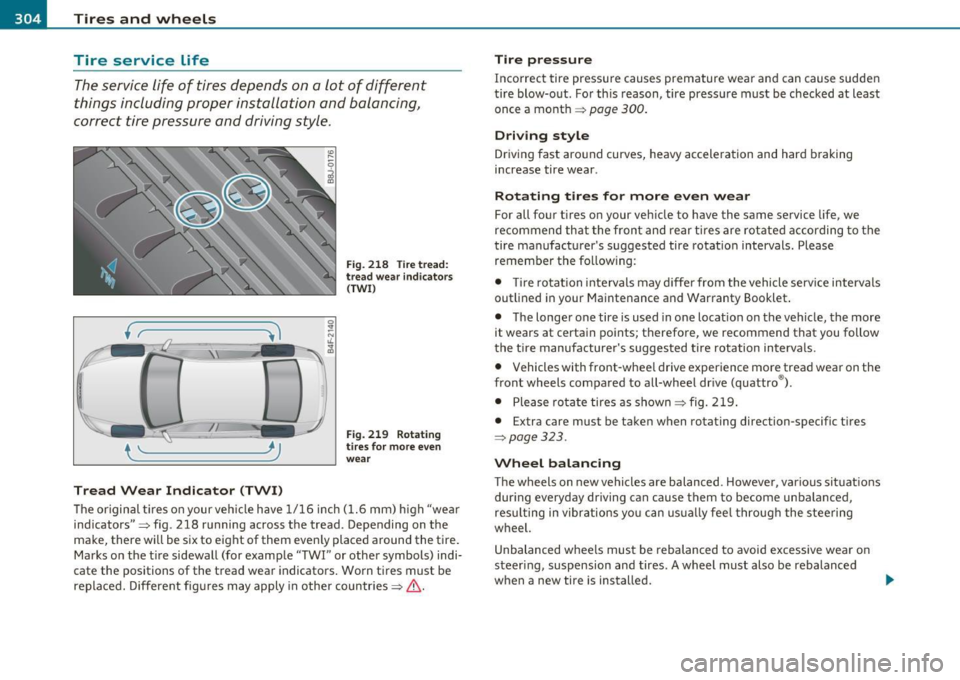
Tread Wear Indicator (TWI)
Fig. 2 18 Tire tread:
t rea d w ear in di cato rs
(TW I)
Fig . 21 9 R otati ng
tires f or m ore e ven
w ea r
The original t ires o n your veh icle have 1/16 inch ( 1.6 mm) h igh "wear
ind icators"~ fig. 218 running across the tread . Depending on the
ma ke, there w ill be six to eight of them even Ly placed around the ti re.
Marks on the t ire sidewall (for examp le "TWI " or other symbols) indi
cate the positions of the tread wea r indicators . Worn t ires must be
replaced. Differe nt figu res may apply in other countries ~ & .
Tire pressure
Incorrect tire pressure causes premature wea r and can cause sudden
tire blow-o ut. Fo r th is reason, tire pressu re must be checked at least
once a month~
page 300.
Driv ing style
Driving fast aro und curves, heavy acceleration and hard b raking
increase tire wear .
Rotating tires for more even wear
For all four tires o n your ve hicle to have the same se rvice life, we
recommend that the fron t and rear t ires are rot ated according to the
tire manufact urer's suggested tire rotat ion intervals . Please
remember the fo llow ing :
• Tir e ro tat ion inte rvals may d iffe r from the vehicle serv ice intervals
out lined in your Maintenance and Warranty Booklet .
• The longer one tire is used in one locat ion on the vehicle, the more
it wears at certain points; therefore, we recommend that you follow
the t ire manufacture r's sugges ted tire rotation interva ls .
• Vehicles with front-whee l drive experience more tread wea r on the
front wheels compa red to a ll-wheel dr ive (quattro ®).
• Please ro ta te tires as shown~ fig. 219 .
• Extra care must be taken when rotating direction -specific t ires
~ page 323 .
Wheel balancing
The wheels on new vehicles are balanced. However, var ious si tuatio ns
dur ing everyday driving can cause them to become unbalanced,
resu lting in v ibr ations yo u can us ua lly fee l throug h the stee rin g
w heel.
Unbalanced whee ls mus t be rebalanced to avoid excessive wea r on
steeri ng, suspension and tires . A wheel must also be rebalanced
when a new tire is installed.
~
Page 307 of 368

________________________________________________ T_ i_ re _ s_ a_ n_d_ w_ h_ e_ e_l _s _ ........
Incorrect wheel alignment
In correct whee l al ignme nt can ca use excessive tir e wea r, impairing
th e sa fety o f the vehicl e. If t ires show excessive w ear, hav e the w heel
alignment checked by a n authorized A udi dea ler or qualifie d work
shop.
All Wheel Drive
Vehicles wi th quattro® must always have tires of the same size ,
con st ruct ion an d tread type . For details see~
page 246.
& WARNING
Sudden tire failure can lead to los s of control, a cra sh and serious
personal injury!
• Never drive a vehicle when the tread on any tire is worn down
to the wear indicators.
• Worn tires are a safety hazard, they do not grip well on wet
roads and increase your risk of "hydroplaning" and loss of control.
• Always keep chemicals that can cause t ire damage, such as
grease , oil, gasoline and brake fluid away from tires.
• Tires age even if they are not being used and can fail suddenly,
especially at high speeds. Tires that are more than 6 years old can
only be used in an emergency and then with special care and at
lower speeds.
• Never mount used tires on your vehicle if you are not sure of
their "previous history. " Old used tires may have been damaged
even though the damage cannot be seen that can lead to sudden
tire failu re and loss of vehicle control. •
Vehicle OP-eration
New tires and replacing tires and whee ls
N ew t ires an d w hee ls have to be brok en in .
Fig. 220 Tire specificat ion codes on th e sidewall of a tire
No.
©
®
®
©
©
©
Description
Passenger car tire (where applicable)
Nom inal wid th of ti re in mil limeters
Ratio of hei9ht to width (aspect ratio)
Radial
jj Rim diameter code
L oa d index and speed rating
Vehicle care Do-it-yourselt service iTechnical data
Page 308 of 368

-~_T_ i_ re _ s_ a_n _ d_ w_ h _e_ e_ ls _________________________________________________ _
(j)
®
®
@
@
U.S . DOT tire identification number
Audi Original tire
Sever snow conditions
Tire ply composition and materials used Ma ximum load rating
Treadwear, traction and temperature grades M axi mum pe rmissib le inflation pressure
The tires and rims are essential parts of the vehicle's design . The tires
and rims approved by Audi are specially matched to the characteris
tics of the vehicle and can make a major contribution to good road holding and safe handling when in good condition and properly
inflated
~ & .
We recommend that all work on tires and wheels be performed by an
authorized Audi dealer . They are familiar with recommended proce
dures and have the necessary special tools and spare parts as well as
the proper facilities for disposing of the old tires.
Authorized Audi dealers have the necessary information about tech
nical requirements for installing or changing tires and rims.
Replacing tires and wheels
Tires should be replaced at least in pairs and not individually (for
example both front tires or both rear tires together) .
Be sure to read and heed the information to the tire pressure moni
toring system* ~
page 312.
Always buy replacement radial tires that have the same specifications
as the tires approved for your vehicle by Audi. Replacement tires must
always have the same load rating specification as the original equip
ment or approved optional tires listed in the table~
page 297.
Audi-approved specification tires are specially matched to your
vehicle and its load limits, and can contribute to the important road- holding, driving characteristics, and safety of the vehicle
. The table
(~ page 297) lists specifications of the tires approved for the Audi
models covered by your Owner's Literature.
The tire pressure label located on driver's side B-pillar (~
page 297,
fig. 217) lists the specifications of the original equipment tires installed on your vehicle at the time it was manufactured.
Federal law requires tire manufacturers to place standardized infor
mation on the sidewall of all tires~
page 305, fig. 220 . This infor
mation identifies and describes the fundamental characteristics, the
quality grade of the tire and also provides a tire identification number
for safety standard certification and in case of a recall.
Tire specifications
Knowledge of tire specifications makes it easier to choose the correct
tires . Radial tires have the tire specifications marked on the sidewall,
for example:
P245 / 45 R 17 99 H XL
This contains the following information:
P Indicates the tire is for passenger cars (where applicable)
245 Nominal tire width in mm of the tire from sidewall edge to side-
wall edge. In general, the larger the number, the wider the tire
45 Height/width ratio in percent (aspect ratio)
R Tire construction : Radial
17 Rim diameter code (in inches)
99 Load rating code
H Speed rating letter code
XL (or "xl", "EXTRA LOAD", or "RF") indicates that the tire is a"Rein
forced" or an "Extra Load" tire
M+S (or "M/S") Indicates that the tire has some mud and snow capa
bility
The tires could also have the information of direction of rotation
~page 293.
Page 309 of 368

________________________________________________ T_i_re _ s_ a _ n_d_ w_ h_ e_ e_l_s __ l!'II
Tire manufacturing date
Th e manufacturing date is also indicated on the tire sidewall
(possibly on ly on the
inner s ide of the wheel):
"DOT ... 2209 ... " means, for example, that the tire was produced in
the 22nd week of 2009.
Speed rating (letter code)
The speed rat ing letter code on the wheels ind icates the maximum
permissible road speeds =>
& in "Winter tires" on page 309.
P up to 93 mph (150 km/h)
Q up to 99 mph (158 km/h)
R up to 106 mph (170 km/h)
S up to 110 mph (180 km/h)
T up to 1 18 mp h (190 km/h)
U up to 124 mph (200 km/h)
H up to 130 mph (210 km/h)
V up to 149 mph (240 km/h)3>
Z over 149 mph (240 km/h)3>
W up to 168 mph (270 km/h)3>
Y up to 186 mph (298 km/h)3>
Your vehicle is normally factory equipped with t ires, which possess
excellent driving characterist ics and give you r A udi optimum driv ing
comfort. An electronic speed limiter=>
page 23 will normally prevent
your vehicle from going faster than the tire speed rating =>
&-
U.S. DOT Tire Identification Number (TIN) and tire
manufacture date
This is the tire's "serial number". It begins with the letters "DOT" and
indicates that the tire mee ts all federal standa rds. The next two
numbers or letters indicate the plant where it was manufactured, and
the last four numbers represent the week and year of manufacture .
For example, the numbers 2209 mean that the tire was produced in
3
l For tires w ith a maxim um speed capabi lity ove r 149 mph (240 km/h), tire
manufacture rs sometimes use the letters "ZR."
Safety first
the 22nd week of 2009 . The other numbers are marketing codes that
may or may not be used by the tire manufacturer . This i nformation is
used to contact consumers if a tire defect requires a recall.
Audi Original tire
Tires with the identification "AO" or "RO" have been specially
matched w ith your Audi. We recommend using only these tires
because they meet the highest standards regard ing safety and
driv ing characteristics when used correct ly. Your authorized Audi
dealer will gladly provide you with more information .
Tire ply composition and materials used
The number of plies indicates the number of layers of rubber-coated
fabric in the tire. In general, the greater the number of plies, the
more weight a tire can support . Tire manufacturers also must indi
cate the materials in the tire, which include steel, nylon, polyester,
and others .
Maximum Load Rating
This number indicates the maximum load in kilograms and pounds
that can be carried by the tire.
Tire quality grading for treadwear, traction, and
temperature resistance
Tread wear, traction and temperature grades=> page 308.
Maximum Permissible Inflation Pressure
Th is number is the greatest amount of air pressure that should ever
be put in the tire under normal driving conditions.
& WARNING
• Using incorrect or unmatched tires and/ or wheels or improper
tire and wheel combinations can lead to loss of control, collision
and serious personal injury. _,.
Vehicle care Technical data
Page 310 of 368
-~_T_ i_ re _ s_ a_n _ d_ w_ h _e_ e_ ls _________________________________________________ _
& WARNING (conti nu ed )
• Alway s use tire s, rim s and wheel bolts that meet the specifica
tions of original factory-installed tires or other combinat ions that
have been specifically approved by the vehicle manufacturer .
• Tires age even if they are not being used and can fail suddenly,
especially at high speed s. Tires that are more than 6 years old can
only be used in an emergency and then with special care and at
lower speeds.
• Never mount used tir es on your vehicle if you are not sure of
their "previous history. " Old used t ires m ay have been damaged
even though the damage cannot be seen that can lead to sudden
tire failure and loss of vehicle control.
• All four wheels must be fitted with radial tires of the same
type , size (rolling circumference) and the same tread pattern .
Driving with different tire s reduces vehicle handling and can lead
to a loss of control.
• If the spare tire is not the same as the tires that are mounted
on the vehicle - for example w ith winter tires - only use the spare
tire for a short period of time and drive with extra care. Refit the
normal road wheel as soon as safely possible.
• Never drive fa ster than the maximum speed for which the tires
on your vehicle are rated because ti re s that are driven faster than
their rated speed can fail suddenly.
• Overloading tire s cause heat build-up, sudden tire failure,
including a blowout and sudden deflation and loss of control.
• Temperature grades apply to tires that are properl y inflated
and not over or underinflated.
• For technical reasons it is not always possible to u se wheels
from other veh icles- in some cases not even wheels from the same
vehicle model.
• If you install wheel tr im discs on the vehicle wheels , make sure
that the air flow to the brakes i s not blocked . Reduced airflow to
the brakes can them to overheat, increasing stopping distances
and cau sing a collision.
& W ARNING (continued )
• Run flat ti res may only be used on vehicles that were equipped
with them at the factory. The vehicle must have a chassi s designed
fo r run flat tires. Inco rrect use of run flat tires can lead to vehicle
damage or accidents. Che ck with an author ized Audi dealer or tire
specialist to see if your vehicle can be equipped with run flat tires .
If run flat tire s are u sed, they must be installed on all four wheels.
M ixing t ire types is not permitted.
0 Note
• For tech nica l reasons, it is not generally poss ible to use the wheel
r ims from o ther veh icles . T his ca n hold t rue for w heels of the same
veh icle type.
• If the sp are tire is different fr om the tires t hat yo u have mo unted
on your vehicle (for example w inter t ires or wide profile tires), then
use the s pare tire for a shor t perio d of tim e on ly and drive wi th ext ra
care. Replace t he flat tire w ith the tire matching the others on your
vehicle as soon as possible.
• Never dr ive witho ut the valve stem cap . The valves could get
damage d.
~ For the sake of the environment
Dispose of old t ires in accor dance with the loca l req uiremen ts .•
Uniform tire quality grading
• Tr ead we ar
• Tract ion AA A B C
• T emperat ure A B C
Quality g rades can be fo und where applicable on the tire s ide wall
between t re ad sho ulder and m aximum se ct io n w idth =>
page 305,
fig.220 . ~
Page 311 of 368
________________________________________________ T_i_re _ s_ a _ n_d_ w_ h_ e_ e_l_s __ _
For example: Tread wear 200, Traction AA, Temperature A.
All passenger car tires must conform to Federal Safety Requirements
in addition to these grades.
Tread wear
The tread wear grade is a comparative rating based on the wear rate
of the tire when tested under controlled conditions on a specified
government test course .
For example, a tire graded 150 would wear one and one half (1 1/2)
times as well on the government course as a tire graded 100.
The relative performance of tires depends upon the actual conditions
of their use, however, and may depart significantly from the norm
due to variations in driving habits, service practices and differences in
road characteristics and climate.
Traction
The traction grades, from highest to lowest, are AA, A, Band C. Those
grades represent the tire's ability to stop on wet pavement as
measured under controlled conditions on specified government test
surfaces of asphalt and concrete . A tire marked C may have poor trac
tion performance ~& .
Temperature
The temperature grades are A (the highest), B, and C, representing
the tire's resistance to the generation of heat and its ability to dissi
pate heat when tested under controlled conditions on a specified
indoor laboratory test wheel.
Sustained high temperature can cause the material of the tire to
degenerate and reduce tire life, and excessive temperature can lead
to sudden tire failure~&.
The grade C corresponds to a level of performance which all
passenger car tires must meet under the Federal Motor Vehicle
Safety Standard No. 109 . Grades Band A represent higher levels of
performance on the laboratory test wheel than the minimum
required by law .
Safety first
& WARNING
The traction grade assigned to this tire is based on straight-ahead
braking traction tests, and does not include acceleration,
cornering, hydroplaning or peak traction characteristics.
& WARNING
The temperature grade for this tire is established for a tire that is
properly inflated and not overloaded. Excessive speed, underinfla
tion, or excessive loading, either separately or in combination, can
cause heat buildup and possible tire failure. •
Winter tires
Winter tires can improve vehicle handling on snow and
ice . At temperatures below 45 °F (7 °C) we recommend
changing to winter tires.
In some heavy snow areas, local governments may require true
winter or "snow" tires, those with
very deeply cut tread. These tires
should only be used in pairs and be installed on all four wheels. Make
sure you purchase snow tires that are the same size and construction
type as the other tires on your vehicle.
If your vehicle is equipped with all-wheel drive*, this will improve
traction during winter driving,
even with the standard tires. However,
we strongly recommend that you always equip all four wheels on your
vehicle with correctly fitted winter tires or all-season tires, when
winter road conditions are expected. This also improves the vehicle's
braking performance and reduces stopping distances.
Summer tires provide less grip on ice and snow .
Winter tires (snow tires) must always be fitted on all four wheels .
Ask your authorized Audi dealer or qualified workshop for permitted
winter tire sizes. Use only radial winter tires. ..,_
Vehicle care Technical data