2010 AUDI S6 battery
[x] Cancel search: batteryPage 290 of 368

-L~C~ h~ e~c ~k :..!_i ~ n ~g ~ a~n ~d~ f~il ~l~in ~ g[_ ________________________________________ _
0 Note
Brake fluid will damage the paint of your vehicle.
the special tools required and the necessary expertise, we recom
mend that you have the brake fluid changed by your authorized Audi
dealer. •
Battery
General information
Under normal operating condit ions, the battery in your Aud i does not
need any maintenance. With
high outside temperatures or long daily
drives we recommend that you have the electrolyte level checked by
a service facility. The electrolyte level should also be checked each
time the battery is charged~
page 290.
Have the battery checked when you take your vehicle in for service.
You are well advised to replace a battery that is older than 5 years.
With certain types of a irbag deployment, the battery is disconnected
from the vehicle electrical system for safety reasons=>
& in "Repair,
care and disposal of the airbags" on
page 209.
Disconnecting the battery terminals
Some vehicle functions (power window regulators, for example) are
lost if the battery terminals are disconnected. These functions have
to be relearned after the battery terminals are connected aga in. To
prevent this, the battery should only be disconnected from the
vehicle electrical system when absolutely necessary for repairs.
Vehicles not driven for long periods
If you do not drive your veh icle over a period of severa l days or weeks,
electrical components are gradually cut back or switched off. This
reduces energy consumption and maintains starting capability over a
longer period~
page 247.
Take into consideration that when you unlock your vehicle, some
convenience functions, such as the master key remote function or
power seat adjustment, may not be available. The convenience func
tions will be available again when you turn on the ign ition and start
the engine.
Winter operation
During the winter months, battery capacity tends to decrease as
temperatures drop. This is because more power is also consumed
while starting, and the headlights, rear window defogger, etc., are used more often .
Avoid unnecessary power consumpt ion, particu larly in city traffic or
when traveling only short distances. Let your authorized Audi dealer
check the capacity of the vehicle battery before w inter sets in
=> page 290. A well charged battery will not only prevent starting
problems when the weather is cold, but will also last longe r.
(I] Tips
If your veh icle is left standing for several weeks at extreme ly low
temperatures, the vehicle battery should be removed and stored
where it will not freeze. This will prevent it from being damaged and
having to be replaced.•
Page 291 of 368
___________________________________________ C_ h _ e_c _k _ i_n -=g .._ a_n _ d_ f_i _ll _i _ n -=g '-- ........
Working on the battery
Be es peciall y careful when wor kin g on or near the
ba ttery .
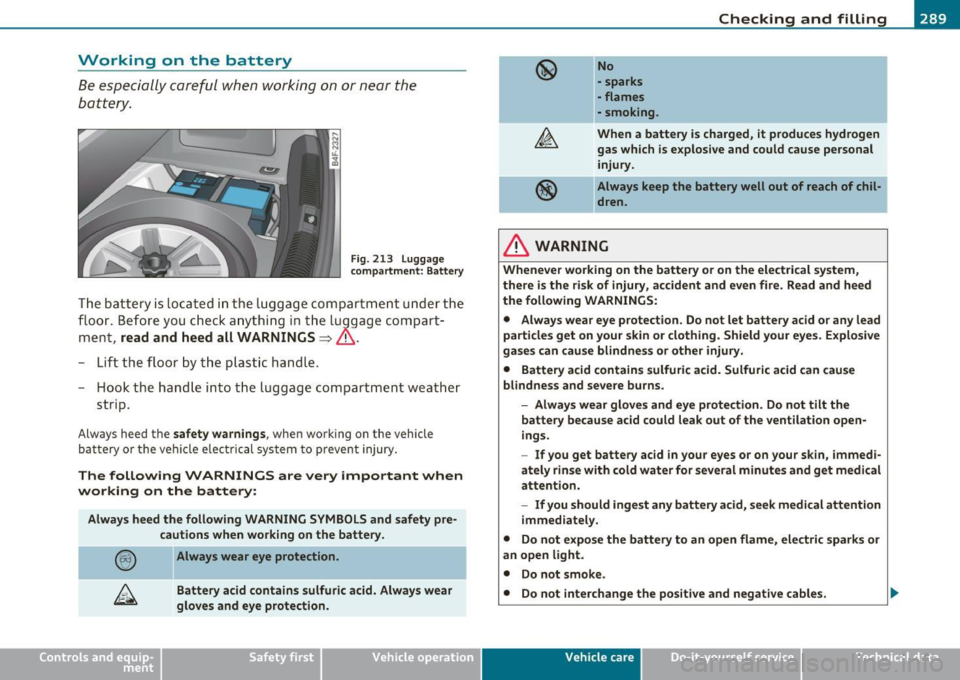
Fig. 213 Luggage
compartment : Battery
T he b atte ry is loc ated in th e lugg age co mpartmen t under the
flo or. Before you check an ything i n the lu~ga ge compart
m ent , read and heed all WARNINGS~
&-
- Li ft the fl oor by the plastic handle .
- Hook the ha nd le i nto the lugga ge com partm ent weat her
s tri p.
Always heed the safety warnings, when working on the veh icle
b att ery o r the vehi cle elec trical sys te m t o pr even t injury .
The following WARNINGS are very important when
working on the battery:
Always heed the following WARNING SYMBOLS and safety pre cautions when working on the battery.
®
Always wear eye protection.
Battery acid contains sulfuric acid. Always wear
gloves and eye protection. I
Vehicle OP-eration
No
- sparks
- flames
- smoking .
When a battery is charged, it produces hydrogen
gas which is explosive and could cause personal
injury.
Always keep the battery well out of reach of chil
dren.
& WARNING
Whenever working on the battery or on the electrical system,
there is the risk of injury, accident and even fire . Read and heed
the following WARNINGS:
• Always wear eye protection. Do not let battery acid or any lead
particle s get on your skin or clothing. Shield your eyes. Explosive
gases can cause blindness or other injury.
• Battery acid contains sulfuric acid . Sulfuric acid can cause
blindness and severe burns .
- Always wear gloves and eye protection. Do not tilt the battery because acid could leak out of the ventilation open
ings.
- If you get battery acid in your eyes or on your skin, immedi
ately rinse with cold water for several minutes and get medical
attent ion.
- If you should ingest any battery acid, seek medical attention
immediately.
• Do not expose the battery to an open flame, electric sparks or
an open light. • Do not smoke.
• Do not interchange the positive and negative cable s.
Vehicle care Do-it-yourselt service iTechnical data
Page 292 of 368
--~C:!h ~e~ c~ k~ i~ n ~g~ a~n~ d~ f~il ~l~in ~ g ~ ----------------------------------------
& WARN ING (con tinu ed)
• When working on the batter y, be su re not to short-ci rcuit the
terminal s with tools or other metal object s. This would cau se the
battery to heat up very quickly , which could lead to damage or
e xplo sion and per sonal injury .
• When a battery is charged , it produces hydrogen gas which i s
explo sive and could cau se p ersonal injury .
• Alway s keep the battery well out of the reach of children .
• Before work is done on the electric al system, di sconnect the
negative ground cable.
• Before perfo rming any work on the electrical system , switch
off the engine and ignition a s well as any electrical equipment .
The negative cable on the battery mu st be disconnected. If you are
just g oing to replace a light bulb, then it is enough to switch off
the l ights.
• Before dis conne cting the battery, swit ch off the anti -theft
ala rm system! Otherwise you w ill set off the alarm .
• When d is connecting the battery, first di sconnect the negative
cable and then the positive cable .
• Before reconnecting the battery, make sure all electrical
consumers are switched off . Reconnect the positive cable first and
then the negative cabl e. Never interchange th e cables· this could
start a fire!
• Never charge a frozen or a thawed-out battery . It could
e xplode! If a battery has frozen , then it must be replaced. A
dis charged battery can freeze over at 32 °F (0 °C ).
• Make sure the vent ho se is always atta ched to the opening on
the side of the battery .
• Never use batteries which are damaged. There is the danger of
an e xplosion! Always replace a damaged battery.
& WARNING
California Proposition 65 Warning:
• Battery posts , terminal s and r elated ac cessorie s cont ain lead
and lead compounds, chemi cals known to the State of Cal ifornia
to cause cancer and reproductive problem s. Wash hands after
handling.
0 Note
• Do not disco nnect the vehicle battery when the ign ition is
switched on or whe n the engine is runni ng, otherwise, you wi ll
damage electronic compone nts in the electr ical system .
• If you r ve hicl e is go ing to s ta nd for a long pe riod of time wit ho ut
being driven, protect the battery from "freezi ng", ot herwise it w ill be
damaged and will then have to be replaced .•
Battery charging
Starting the engine requires a well charged battery.
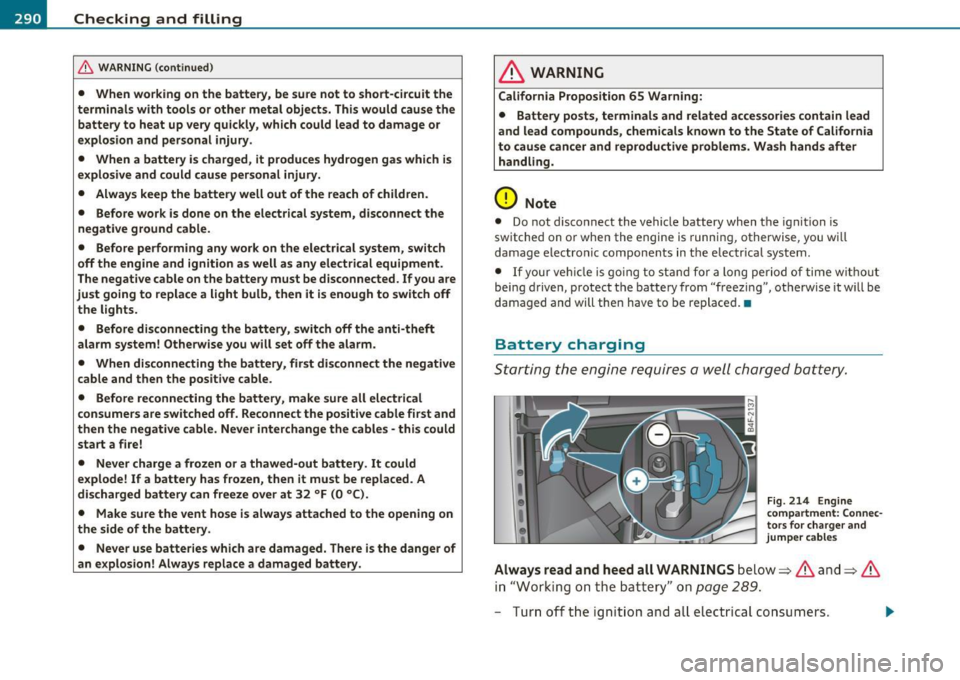
Fi g. 2 14 Engin e
c omp artm ent : Connec
to rs for charger an d
jumper cables
Always read and heed all WARNINGS be lo w => & and => &
in "Work ing o n the bat tery" on pag e 289.
-Turn o ff the ign it ion and all electrical consumers. ~
Page 293 of 368
___________________________________________ C_ h_e _c _k_ i_n ~g_ a_n_ d_ f_ i_ll _i_n _g __ _
- Mak e su re the a rea is w ell ventilated when you charge the
battery .
- Open the hood
~ page 2 76 .
- Open the red cover on the positive pole~ fig. 214.
- Connect the charger connectors according to the instruc- tions to the
jump start bolts . (Bolts under the red cover =
"positive", Bolts wit h hex head = "negative").
- Only now p lug the ma ins lead for the charging equipment
into the wall outlet and turn it on
~ &,. .
- Make sure the charging rate is not over 30 amps /14.8
Volt.
- When the batte ry is fully charged : Turn the charging
equipment off and remov e the ma ins lead from the wall
ou tlet.
- Now remove the clamps for the charging equipment .
- Close the red cover on the posit ive pole .
- Clos e the hood ~
page 277.
A discharged battery can freeze at tempe rat ures of only O 0C. Allow a
frozen battery to thaw completely before attemp ting to charge it
~ ,&. . However, we recommend not using a thawed battery again
because the battery casing can be cracked due to ice formation and
can leak battery acid.
B atter y charging (Ma ximum charging rate of 30
amps /14.8 Volt )
When charging at low voltages (e.g. w ith a trickle charger ), the
ba ttery cab les do not have to be disconnec ted first. The battery caps
should
not be opened when charging a battery .
It is not necessary to remove the battery from the luggage compart
ment.
Safety first
Fa st charging the b atter y (charging rat e above 14 .8
Volts)
For technical reasons do not use a batte ry c ha rger that uses voltage
greater t han 14.8 Volts to charge your veh icle's battery .
& WARNING
Charging a batter y can be dange rou s.
• Always follow the ope rating instruct ions p ro vi ded by the
batt ery c harger manufa cturer when charging your battery .
• Never cha rge a frozen battery. It ma y explode be cause of gas
trapped in the i ce. Allow a frozen battery to thaw out first.
• Do not reu se batter ies which were frozen. The battery housing
may have cracked and weakened when the batt ery froze.
• Charge the battery in a well ventilated are a. Keep a way from
open flame or el ectr ica l spark. Do not sm oke. Hydrogen gas gener
ated by the battery i s ex plosive.
• To r educ e th e danger of e xplosion , nev er conn ect or dis conne ct
c harger cable s while the charger i s operating.
• Batt ery acid that may spill during charging should b e washed
off with a solution of warm water and bakin g soda to neutralize
the acid .
0 Note
Never use a fast charger as a booster to start the engine . This will seri
ous ly damage sensitive electronic components , such as control units,
re lays, rad io, etc., as well as the battery charger. •
Vehicle care Technical data
Page 294 of 368
___ C_h_ e_c _k _i_n -=g :a,__ a_n_ d_ f_ i_ l _li _n _,g;._ __________________________________________ _
Battery replacement
The new battery must have the same specifications and
dimensions as the original equipment battery.
Inte lligent energy management in your veh icle is responsible for
dis trib uti ng the elect ric al ene rgy throughout yo ur vehi cle
::} page 247 . The intelligent energy management system will keep
t he e ngine battery charged be tter then vehicles withou t this system.
To make sure the additional e lectrical energy is available once again
after you have changed the ba tte ry, we recom mend that you in sta ll
batter ies of the same type and manufacture only (the same as those
installed at the t ime your vehicle was delivered). Specifications are
listed on the battery hous ing. Your author ized Audi dealer will then
code the battery management control unit .
If it is no t poss ible to use a ba tte ry of this type, the new battery m ust
have the same capacity, vo ltage (12 volts), amperage, construction
and plug sea ling.
When install ing the battery, make sure the ign it ion and a ll electrica l
cons umers are turned off .
0 Note
Make sure the venti lation hose on the side of the battery is
connec ted, othe rwise fumes or battery acid ca n leak out .
W For the sake of the environment
Because of the problem of proper disposal of a bat tery, w e recom
mend your authorized Audi dealer change the battery for you.
Batte ries contain sulfu ric acid and lead and mus t alway s be d ispose d
of properly in compliance with all environmental regulat ions.
Di sposing of vehicle b atteries imprope rly is very dange ro us to t he
environme nt.•
Windshield/headlight washer
container
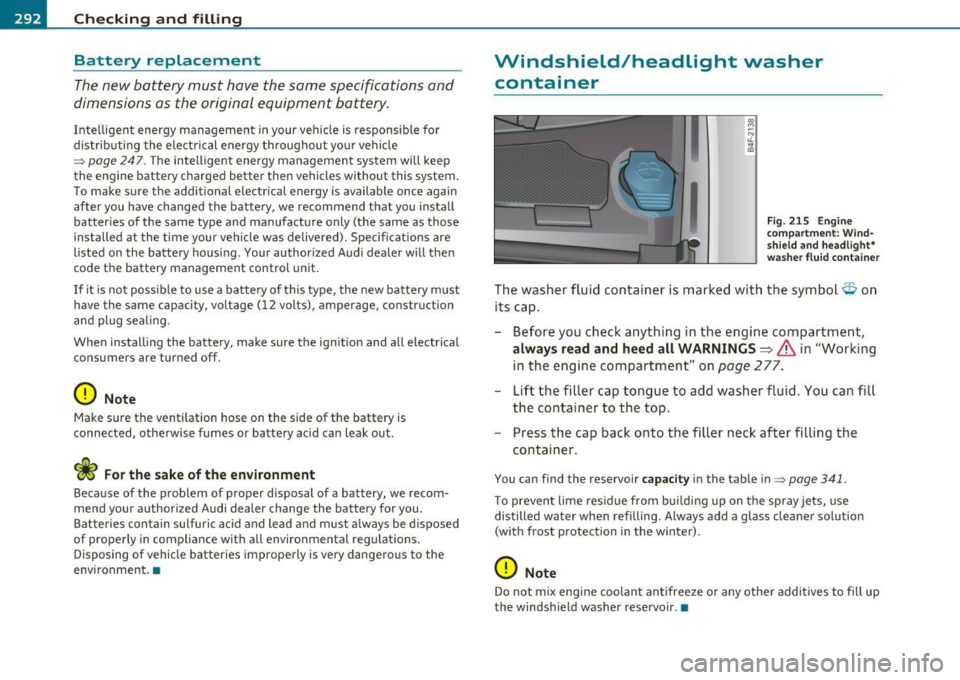
Fi g. 215 En gine
compartm ent: Wind·
s hie ld and head light*
w as her flu id co ntainer
Th e washe r fluid contain er is mark ed with the symbol O on
its cap .
- Bef ore you check anything i n the engin e compartm ent,
always read and heed all WARNINGS~ & in "Working
in th e e ngine com partme nt" on
page 277 .
- Lift t he filler cap tongue to add washe r fluid. You can fill
the conta iner to the top.
- Press the cap bac k onto the filler neck af ter filling the
container .
You can find the reservoir capacity in the table in::} page 341 .
To preven t lime res idue from bui ldi ng up on t he spray jets, use
distilled water when refilling. Always add a glass cleane r so lution
(with frost protection in t he winter).
0 Note
Do not mix engine coo lant antifreeze or any othe r additives to fi ll up
the windsh ield washe r rese rvo ir .•
Page 297 of 368

________________________________________________ T_i_re _ s_ a _ n_d_ w_ h_ e_ e_l_s __ _
Groove
means the spa ce between two ad jacen t tread ribs .
Load rating (code)
mea ns the max imu m load th at a tir e is ra te d to c arry fo r a give n infla
tion pressure. You may not find this information on all t ires beca use
i t is no t required by law .
Maximum load rat ing
me ans the load r ati ng for a t ire at th e maxi mum p ermis sib le in flation
pressure for that tire.
Maximum loaded vehicle weight
means the sum of:
(a) Curb weight
(b) Accessory weig ht
(c) Vehicle ca pacity we ight, and
(d) Pro duct ion op tions weigh t
Maximum (permissible) inflation pressure
means the m aximu m cold infla tio n pr essur e to whi ch a t ire may be
inflated . Also called "maximum inflat ion press ure."
Normal occupant weight
means 150 lbs. (68 k ilog rams) times t he num ber of occupants seate d
in t he vehi cle up to the total sea ting cap aci ty of yo ur vehicl e.
Occupant distribution
means d is tribut ion of occ upan ts i n a vehicle.
Outer diameter
means the ove rall d iameter of an inflated new tire.
Overall width
means the linear distance betwee n the exter iors of the s idewalls of
a n in flated tire, in cludi ng eleva tions due to la beling, dec ora tions, o r
protective bands or ribs.
Safety first
Ply
means a layer o f rubbe r-coate d para llel co rds.
Production options we ight
me ans the co m bine d we ight of tho se in stalled regu lar pr oduction
options weighi ng over 5 lbs. (2.3 kg) in excess of t hose standard
i t ems w hic h they replace, not previously considere d in c urb we igh t o r
accessory weight, includ ing heavy duty brakes , ride levelers, roof
rack, heavy duty battery, and s pecial tr im.
Radial ply tire
me ans a pneuma tic tir e in wh ich the pl y cords that extend to t he
beads are laid at substantially 90 degrees to the centerline of the
t rea d.
Recommended inflation pressure
see => page 294, "C old tire in fla tion pr essu re".
Reinforced tire
mea ns a t ire designe d to ope rate at hig her loads an d at higher infla
tion pressures than the co rresponding standard ti re. Reinforced t ires
my be i de ntified as "X L" , "xi", "EX TRA LOA D", o r "RF " on the sidewall.
Rim
mea ns a metal suppo rt fo r a tire or a tire and tube assemb ly up on
wh ic h the t ire beads are seated.
Rim diameter
means nom inal d iameter of the bead seat . If you change yo ur whee l
si ze, yo u w ill have to purchase new tires to ma tc h the new r im diam
eter .
Rim size designation
means r im diamete r and width.
Rim width
mea ns nom inal dis tance be twee n rim flanges.
Vehicle care Technical data
Page 330 of 368
.,.,___F_ u_ s_e _ s_ a_n_ d_ b_u _ l_ b_ s _______________________________________________ _
No. Equipment Amps
9 Heated seats, front 30
10 MMI
7,5
11 Seat adjustment (passenger) 10
12 Communication 5
Fuse holder (brown)
1 Electric fuel pump 20/30
2 Adaptive Air Suspension
15
3 Lane assist 10
4 Audi side assist
5
5 Adaptive Air Suspension 5
6 Shift gate automatic transmission/clutch switch 5
7 Parking System 5
8 Control module Gateway 5
9
Automatic headlight range control (auxiliary 5
driving lights), headlight electronics, right-side
10 Airbag 5
11 Heated rear seats 5
12 Telephone
5 •
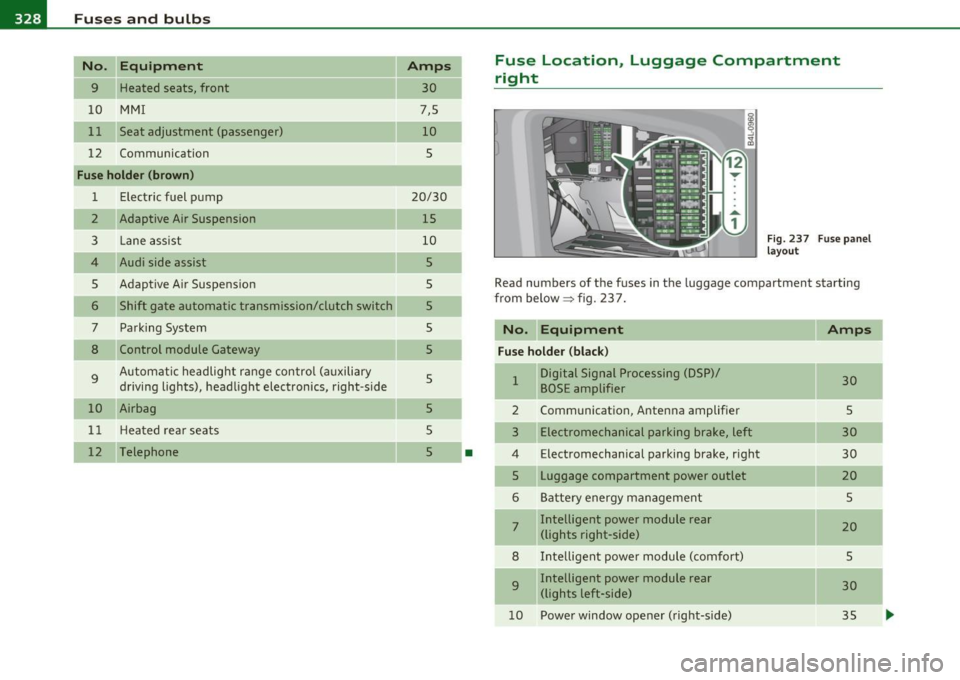
Fuse Location, Luggage Compartment
right
Fig. 237 Fuse panel
layout
Read numbers of the fuses in the luggage compartment starting
from below :::::> fig. 23 7.
No. Equipment
Amps
Fuse holder (black)
1 Digital Signal Processing (DSP)/ 30 BOSE amplifier
2 Communication, Antenna amplifier 5
3 Electromechanical parking brake, left 30
4 Electromechanical parking brake, right
30
5 Luggage compartment power outlet
20
6 Battery energy management 5
7 Intelligent power module rear
20 (lights right-side)
8 Intelligent power module (comfort)
5
9 Intelligent power module rear
30
(lights left-side)
10 Power window opener (right-side)
35
-
-
-
...
Page 333 of 368
Emergency situations --------------=----EWI
Emergency situations
General
This chapter is intended for trained emergency crew s and working
personnel who ha ve the necessar y tools and equipment to perform
the se operations . •
Starting by pushing or towing
(D Note
Your vehicle is equipped with an a utomat ic transmission. Conse
que ntly, the eng ine can not be started by pushing or towing. •
Starting with jumper cables
If necess ary, the engine can be started by connecting it to
the battery of an other vehicle .
If the engine shou ld fai l to start because of a discharged or weak
battery, the battery can be co nnecte d to the battery of
another
vehicle, using a pair of jumper cable s to start the engine .
Jumper cables
Use only jumper cables of suffic ient ly large cross section to carry the
sta rter cur ren t safely . Refe r to the manufacture r's specifications.
Use on ly j umper cab les with
insulated te rm ina l clamps w hich are
distinct ly marked :
plus(+) cable in most cases colo red red
minus (-) cable i n most cases colored black.
Safety first
& WARNING
Batterie s contain electricity, acid, and gas . Any of these can cause
very serious or fatal injury . Follow the inst ructions below for safe
handling of your vehicle 's battery .
• Always shield your eyes and avoid leaning over the battery
whenever possible.
• A discharged battery can freeze at temperatures just below
32 °F (0 °C). Before connecting a jumper cable, you must thaw the
frozen battery completely , otherwise it could explode.
• Do not allow battery acid to contact eyes or skin . Flush any
contacted area with water immediately .
• Improper use of a booster battery to start a vehicle may cause
an explosion.
• Vehicle batteries generate e xplos ive gases. Keep spa rks, flame
and lighted cigarettes away from batteries.
• Do not try to jump start any vehicle with a low acid level in the
battery.
• The voltage of the booster battery must also h ave a 12 -Volt
rating. The capacity (Ah) of the booster battery should not be
lower than that of the discharged battery. Use of batter ies of
different voltage or sub stantially different "Ah " rating may cau se
an explosion and personal injury.
• Never charge a frozen battery . Ga s trapped in the ice may cause
an e xplosion.
• Never charge or use a battery that has been frozen. The battery
case may have be weakened.
• Use of batteries of different voltage or substantially different
capacity (Ah ) rating may cause an explosion and injury . The
capacity (Ah ) of the booster battery should not be lower than that
of the discharged battery. _..
Vehicle care Do-it-yourself service Technical data