2010 AUDI S6 warning
[x] Cancel search: warningPage 271 of 368
____________________________________________ C_l_e _a_ n_ i n--= g=--- a_n_ d----' p,__ r_o _t_ e_ c_ t_ i _o_ n __ _
0 Note
• N ev er use che mical s olvents (e.g. lig hte r fl uid , turpen tine), waxe s,
sho e polish or sim ila r pr oducts on A lcantara ® surfaces.
• T o avo id damage, have s tubbor n sta ins removed by a co mmerc ia l
cleaning s pecialist .
• Do not use brushes, stiff spo nges or sim ilarly ab rasive cl ea ni ng
aids. •
Safety belts
Only well- maintain ed safe ty b elts wo rk re liably when
n ee ded.
- Kee p belts cle an.
- F or clea nin g, use a mil d soap and w ate r solution. Let belts
dry thor oug hly and aw ay fro m direct s unlig ht.
- D o not a llow i nertia re el sa fety b elt s t o re trac t bef ore the y
are c ompl ete ly dry .
- Che ck th e condi tio n of you r sa fety belts
regu larly.
H eav ily so iled safe ty be lts may not ret rac t proper ly.
& WARNING
Damaged safety belts can break in a crash.
• Anything that might damage your safety belts could mean
that you and your passengers would not be adequately protected
in an accident.
• Safety belt performance depends on correct installation. Never
remove belts from the vehicle to clean them .
• Do not use chemical cleaning agents , bleach or dyes. They have
corrosive properties which weaken the webbing.
Safety first
& WARNING (co ntinued )
• When cleaning your safety belts , inspect them for damage . If
you discover damage, see your Audi dealer .
• Always read and heed all WARNINGS and other information
~page 258. •
Engine compartment
Be es pec ially care ful w hen clean ing th e engine co mp art
m en t.
Always switch off the ign ition before cleaning the engine~,&. .
Plenum panel
Remove leaves from the plenum pane l in front of the win dshi eld
under the eng ine hoo d. Thi s preven ts the wa ter d rain holes fro m
becoming blocked , and it prevents debris from enter ing t he veh icle
in ter ior thro ugh t he heat ing a nd ve ntilation ducts.
Corrosion protection
The e ng in e co mp artm ent a nd trans missio n have bee n co rros io n
protected at the facto ry .
G ood ant i- corro sion t rea tmen t is very i mporta nt, pa rt icul arly in t he
wi nte r. If the ve hicle is freq uently d riven on sa lt treated roads, the
entire eng ine compartment and plenum pane l sho uld be tho rough ly
clea ned at the end of winter and retreated to preve nt salt damage. At
the same time, t he un derside of the vehi cle should be washed as well.
If the eng ine co mpartme nt is clean ed at any t ime wi th gre ase
remov ing so lutions
2
), or if you have the engine was hed, the anti
cor rosion treat men t is almo st alw ays rem oved as well.
It is the refore
essential to have a long-last ing corrosion protection reapplied to all
s u rfaces, seams, jo ints and com ponents in the engine compartmen t.~
2> Us e on ly the co rrect clean ing so lut ions . Neve r use gaso line or diese l fue l.
Vehicle care Technical data
Page 272 of 368
-~_C_ le_ a_n_ i_ n_ g=- a_ n_d___. p_ ro_ t_e _c_ t_ i_o _n ___________________________________________ _
in. WARNING
Be aware: The engine compartment of any motor vehicle is a
potentially hazardous area.
• Before working in the engine compartment, be sure to read the information =>
page 269.
• Before reaching into the front plenum panel, always remove
the ignition key. Otherwise, the windshield wiper system could
unintentionally be switched on, possibly causing personal injury
from the moving wiper linkage.
• Never reach into the area around or touch the radiator fan. The
auxiliary fan is temperature controlled and can switch on suddenly
- even when the ignition is off.
• Do not wash, wax or dry the engine with the engine running.
Moving or hot parts could injure you.
• Do not clean the underside of the chassis, fenders, wheel
covers, or other hard to reach parts without protecting your hands
and arms. You may cut yourself on sharp-edged metal parts.
• Always read and heed all WARNINGS and other information
=:> page 258. •
Page 275 of 368
In order to fill the tank properly while protecting the environment,
please follow this refueling procedure carefully.
& WARNING
Under normal operating conditions, never carry additional fuel
containers in your car. Gas canisters and other containers used to
transport fuel can be dangerous. Such containers, full or empty,
may leak and could cause a fire in a collision. If you must transport
fuel to use for your lawn mower, snow blower, etc., be very careful
and always observe local and state laws regarding the use, trans
portation and storage of such fuel containers. Make certain the
container meets industry standards (ANSI /ASTM F852 -86).
0 Note
Never drive your vehicle until the fuel tank is completely empty . The
irregular supply of fuel can cause misfiring. Gasoline could enter the
exhaust system and damage the catalytic converter. •
Refuelling
The fuel filler flap is unlocked from a button in the
driver's door.
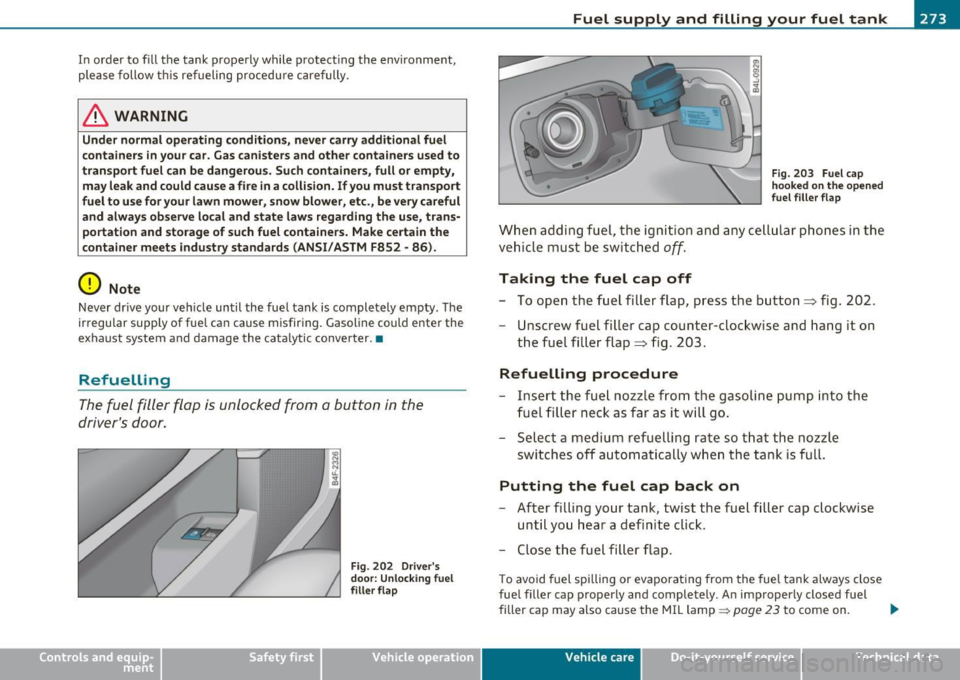
Fig . 202 Driver's
door: Unlock ing fuel
filler flap
Vehicle OP-eration
Fuel supply and filling your fuel tank
Fig. 203 Fuel cap
hooked on the opened
f uel filler flap
When adding fuel , the ignition and any cellular phones in the
vehicle must be switched
off.
Taking the fuel cap off
- To open the fuel filler flap, press the button~ fig. 202.
- Unscrew fuel filler cap counter-clockwise and hang it on
the fuel filler flap~ fig . 203.
Refuelling procedure
- Insert the fue l nozzle from the gasoline pump into the
fuel filler neck as far as it will go.
- Select a medium refuelling rate so that the nozzle
switches off automatically when the tank is full.
Putting the fuel cap back on
- After filling your tank, twist the fuel filler cap clockwise
until you hear a definite click .
- Close the fuel filler flap.
To avo id fuel spi lling or evaporating from the fuel tank always close
fuel filler cap properly and completely . An improperly closed fuel
filler cap may also cause the MIL lamp~
page 23 to come on. ._.
Vehicle care Do-it-yourselt service iTechnical data
Page 276 of 368
Fuel supply and filling your fuel tank
in. WARNING
Improper refu eling or handling of fuel can cause fire , explosion
and sev ere burns .
• Fuel is highly flammable and can cause seve re burns and other
injuries .
• Failure to shut the engine off while refueling and /or to inse rt
the pump nozzle fully into the fuel fill er n eck could cau se fuel to
spray out of filler neck or to overflow. Fuel sp ray and overflowing
fue l can cau se a fire.
• Never u se a cellula r telephone while refueling. The electromag
netic radiation can cau se spark s that can ign ite fuel vapor s and
cause a fire.
• Never get back into your vehicle while refue ling . If in ex cep
tional circumstances you must get back in your veh icle while refu
eling , make certain that you clo se th e door and touch metal to
discharge static electricity before touching the filler nozzle again .
Static electricity can cause sparks that can ignite fuel vapors
released during refueling.
• N ever smoke or have an open flame anywhere in or near your
vehicle when refueling or filling a portable fuel containe r.
• For your safety, we strongly recommend that you do not travel
with a portable fuel container in your vehicle. The containe r, full
or empty may leak and could cau se a fire, especially in a crash .
• If, under except ional circumstances , you must t ranspo rt a
portable fuel container, please ob serve the following:
- Never fill a portable fuel container while it is anywhere in or
on the vehicle (for example, in the luggage compartment, or
on the trunk ). Static electricity can bu ild up while filling and
can ignite fuel vapors causing a fire .
- Alway s place a portable fuel container on the ground before
fill ing.
- Alway s keep the filler nozzle completely inside the portable
container before and during fill ing.
& WARNING (c on tinued )
-If filling a portable container made of metal , the filler nozzle
must alway s be in contact with the container. This will help
prevent static electricity from dis charging and cause a fire .
- Never spill fuel inside the vehicle or luggage compartment .
Fuel vapor s are highly flammable.
- Always observe local and state /provincial laws regarding the
use , storage and transportation of fuel containers .
-Make certain the fuel container meets industry standards
(ANSI / ASTM F852-86).
0 Note
If any fuel has spilled onto the ca r, it should be remove d immed iate ly
t o prevent damage to t he pa int.
For the sake of the environment
As soo n as t he correct ly operated nozz le switches off automatically
for the first time, the tank is full. Do not try to add more fue l because
fue l may spill out . In addition, the expansion s pace in the fuel tank
w ill b e filled -causing the fue l to overflow when it becomes warm an d
poll ute the e nvironment .
(I] Tips
• Runn ing your e ngine while ref uellin g may cause vapo rs to escape
or even cause fuel to spill out of the tank . This wou ld then shut off the
fue l nozzle before the tank is f ull.
• Do not refuel your vehicle with the ignition turned on. The fuel
gauge may o therwise not ind icate the correc t fu el leve l after
refuell ing .•
Page 278 of 368

lffll __ C_h_ e_c _k _i_n -=g :a,__ a_n_ d_ f_ i_ l _li _n _,g;._ __________________________________________ _
Checking and filling
Engine hood
Releasing the engine hood
The engine hood is released from inside the vehicle.
-Open the driver's door.
Fig. 205 Driver's side
footwell: engine hood
release lever
- Pull the release lever on the left under the instrument
panel => fig. 205 in the direction of the arrow.
The hood pops up slightly under spring pressure. •
Opening the engine hood
Fig. 206 Release lever
under the engine hood
Before opening the engine hood, make sure that the wind
shield wipers are flat against the windshield. Otherwise, they
could damage the paint on the hood.
Pull up on the release under the hood=> fig. 206. This
releases the catch =>
&.
- Open the hood all the way.
& WARNING
Hot engine coolant can burn you.
• To reduce the risk of being burned, never open the hood if you
see or hear steam or coolant escaping from the engine compart
ment. Wait until no steam or coolant can be seen or heard before
carefully opening the hood. •
Page 279 of 368

___________________________________________ C..:...._ h:....:e :....:c:..:. k.::..: i..:.. n .:..:g:!:....:: a....:. n..:.. d~ f:....:. i.:..ll :.:.i:....:n :.:g !....- _,n
Closing the engine hood
- Pull the hood down until the pressure from the struts is
reduced.
- Let the hood
drop down and latch in place. Do not try to
push it shut;
it may fail to engage=:> &.
& WARNING
A hood that is not completely latched could fly up and block your
view while driving.
• When you close the engine hood, check it to make sure the
safety catch has properly engaged. The hood should be flush with
the surrounding vehicle body parts.
• If you notice while driving that the hood is not secured prop
erly, stop at once and close it. •
Working in the engine compartment
Be especially careful whenever you work in the engine
compartment.
Whenever you must perform any work in the engine compartment,
for example checking and filling different fluids, there is a risk of injury, burns and accidents. To prevent personal injury always
observe the following WARNINGS. The engine compartment of any
vehicle is a hazardous area=>& .
& WARNING
To help avoid injury, before you check anything under the hood:
• Turn off the engine.
• Remove the ignition key.
• Apply the parking brake.
Safety first
& WARNING (continued)
• Move selector lever to "P" (Park).
• Always let the engine cool down. Hot components will burn
skin on contact.
• To reduce the risk of being burned, never open the hood if you
see or hear steam or coolant escaping from the engine compart
ment. Wait until no steam or coolant can be seen or heard before
carefully opening the hood.
• Keep children away from the engine compartment.
• Never spill fluids on hot engine components. They can cause a
fire. • Never touch the radiator fan. The auxiliary electric fan is
temperature controlled and can switch on suddenly.
• Never open the coolant reservoir cap when the engine is still
warm. The coolant system is pressurized and hot coolant could
spray out.
• Protect your face, hands and arm from steam or hot engine
coolant by placing a thick rag over the cap when you open the
coolant reservoir.
• If work on the fuel system or the electrical system is necessary:
- Always disconnect the battery.
- Never smoke or work near heaters or open flames. Fluids in
the engine compartment could start a fire.
- Keep an approved fire extinguisher immediately available.
• To avoid electrical shock and personal injury while the engine is
running or being started, never touch:
-Ignition cables
- Other components of the high voltage electronic ignition
system.
• If you must perform a check or repair with the engine running:
- First, fully apply the parking brake, move selector lever to
"P" (Park). .,
Vehicle care Technical data
Page 280 of 368
ffl __ C_h_ e_c _k _i_n -=g :a,__ a_n_ d_ f_ i_ l _li _n _,g;._ __________________________________________ _
& WARNING (continued )
-Always use extreme caution to prevent clothing, jewelry, or
long hair from getting caught in the radiator fan, V-belts or
other moving parts, or from contacting hot parts. Tie back hair
before starting, and do not wear clothing that will hang or
droop into the engine.
• Minimize exposure to emission and chemical hazards=:>
/1::..
& WARNING
California Proposition 65 Warning:
• Engine exhaust, some of its constituents, and certain vehicle
components contain or emit chemicals known to the State of Cali
fornia to cause cancer and birth defects and reproductive harm. In addition, certain fluids contained in vehicles and certain products
of component wear contain or emit chemicals known to the State
of California to cause cancer and birth defects or other reproduc
tive harm.
• Battery posts, terminals and related accessories contain lead
and lead compounds, chemicals known to the State of California
to cause cancer and reproductive harms. Wash hands after
handling.
0 Note
W hen a dding fluids, a lways make sure that t hey are poured into the
pro per conta in er or filler op ening, oth erwise serious damag e to
vehicle systems w ill occur.
ci> For the sake of the environment
To detect lea ks i n time, ins pect t he vehicle floor pan from un derneath
re gu lar ly. If yo u s ee spots from oil or o ther vehicle f luids, have your
vehicle inspected by an authorized Aud i dea ler. •
Engine compartment
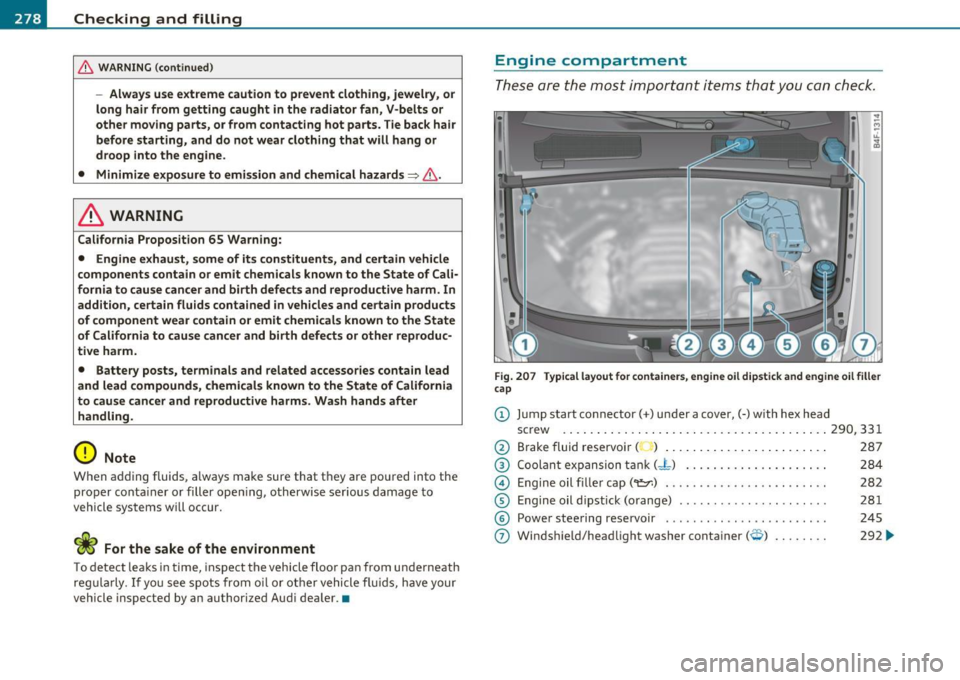
These are th e most importa nt it ems that you can ch eck .
Fig. 207 Typic al layout for container s, engine oil dip st ic k an d eng ine o il fill er
cap
©
@
®
©
®
J u mp start co nnector( +) u nder a cover,(-) w ith hex head
screw . .... . .. .... .. .. .. . ...... ......... . .. .. 290, 331
B rake fluid reservoi r ( ) . . . . . . . . . . . . . . . . . . . . . . . . 287
C oolant expa nsion tank
(J -) . . . . . . . . . . . . . . . . . . . . . 284
E ngin e oil fi ller cap
('1::r. ) . .... ....... ...... .... . .
Engine oil dipstick (o range) .................. ... .
© Power steering reservoir .................... ... . 282
2 8 1
2 4 5
292 _,.
(j) Winds hiel d/head light washer conta iner ( O ) ....... .
Page 281 of 368
___________________________________________ C_ h_e _c _k_ i_n ~g_ a_n_ d_ f_ i_ll _i_n _g __ _
& WARNING
Before you check anything in the engine compartment , always
read and heed all WARNINGS~
& in "Working in the engine
compartment " on
page 277. •
Engine oil
Engine oil specifications
The engin e oil used in your Audi needs the right kind of oil.
Th e e ng ine in your Aud i is a sophis ticated powerplant that was bui lt
to exacting spec ificat ions. This engine needs the r ight kind of engine
oil t hat meets spec ifi cat ions regarding qu ality a nd viscosity so t hat it
can run smooth ly and re liably. Choosing the right o il and changing oil
with in the time and mileage intervals pr in ted in your veh icle 's
Warranty
& Maintena nce book let matters a lot more today than it did
years ago . Audi has developed a specia l quality standard for engine oil
that w ill help assure that your veh icle's engine will get t he lubr ication
it needs fo r prope r operation.
M ode rn engine lubr ication has taken a quan tum leap in the last few
years. Many synthet ic oils available today provide better engine lubri
c at ion th at c an outlast tradit ional petro le u m-based o ils, making
them a smart choice for use throughout the life of your Aud i.
Whethe r you use synthetic or petroleum -based engine oi l, the o il th at
yo u use mus t confo rm to Aud i's oi l quality standa rd VW 502 00 to
help keep your ve hicle's engine runn ing smooth ly and help prevent
the format ion of ha rmfu l deposits, somet imes called "sludge," t hat
over time can lead to expens ive repairs.
A t the time o f pr int ing , engine o ils avai lab le in the U.S . and Can ad a
that meet the exact ing spec ificat io ns of A udi o il standard VW 502 00
are syn the tic engine o ils . Thi s does not mean, however, that every
syn the tic engine o il will meet Aud i o il sta ndard VW 502 00. So a lways
be s ure that you use an app roved o il.
Safety first
To help prevent the format io n of harmfu l deposits use only oi l with
t he follow ing s peci ficati ons p rin ted on the oil con tainer:
Audi oil standard VW 502 00
Oil container labe ls may carry the specification s ingly or in comb ina
t ion wi th o ther d esigna tions and o il quali ty stand ards.
Viscosity
Engine oils are g raded acco rdi ng to the ir viscosity . The proper
viscos ity grade oi l for your eng ine depends o n climac tic or seasona l
conditions where you drive. Yo u can use oi l with a v iscosity grade o f
SA E SW 40 acros s all t empe rature range s fo r no rma l dr iving con di
tions.
However, if engine oil v iscosity grade SAE SW 40 is not ava ilab le, yo u
can a lso use viscos ity grade SAE SW -30 or SAE OW -40 as long as it
meets Audi oi l quality stan dard VW 502 00 specifications .
Be ca use e ngine o il th at mee ts the Aud i oil st andar d m ay not be avail
able everywhere when you need it, we strongly recommend that you
alw ays car ry w it h you an ex tra quart (lite r) o f oil that expressly
conforms to the VW 502 00 specification, in case you have to top off
t he o il w hil e on the road.
Only if t he level of the oil is at o r below t he min imum mark on the o il
dipstic k -and no oil that exp ress ly conforms to A udi oi l standar d
VW 50 2 00 sp ec ificat ions i s available -may you top off w it h a high
quality engine o il, preferably synthetic-based, that meets ACEA A3,
ACEA AS or AC EA BS or A PI SL sp eci fi cations, but even t he n, only in
viscos ity grades SAE SW-40, SAE SW-30, or SAE OW-40 . However,
dur ing t he enti re time between o il change intervals, neve r top o ff
with more than a tota l of 0.5 qt/liter engine oil that does not
c on form to A udi o il specif ic a tion VW 5 02 00.
For mo re informa tion about eng ine o il that has been approved fo r
your vehicle, p lease contact either your author ized A ud i deale r or
Audi Cus tomer Relat io ns at 1 (800) 822-2834 or v is it our w eb si te a t
www.audiusa.com or www.audicanada.ca. Here you w ill also f ind a
cu rrent list of oil s (m anu fact ur ers, brand na mes e tc.) tha t co nform to
Audi oil standard VW 502 00. ..,.
Vehicle care Technical data