2010 AUDI S6 height adjustment
[x] Cancel search: height adjustmentPage 194 of 368
alll!II Safety belts Pffl _______________ _
& WARNING
Improperly positioned safety belts can cause serious personal
injury in an accident.
• Expectant mothers must always wear the lap portion of the
safety belt as low as possible across the pelvis and below the
rounding of the abdomen.
• Always read and heed all WARNINGS and other important
information ~
& in "Fastening safety belts" on page 189. •
Unfastening safety belts
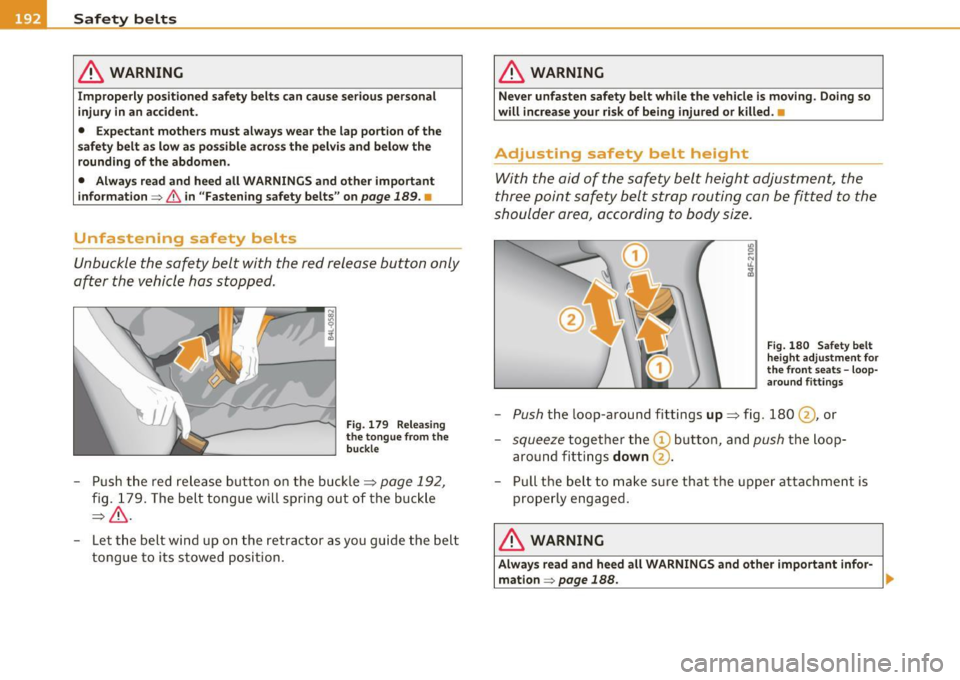
Unbuckle the safety belt with the red release button only
after the vehicle has stopped.
Fig. 179 Releasing
the tongue from the
buckle
- Push the red release button on the buckle ~ page 192 ,
fig. 179. The belt tongue will spr ing out of the buckle
~& -
- Let the belt wind up on the retractor as you guide the belt
tongue to its stowed position.
& WARNING
Never unfasten safety belt while the vehicle is moving. Doing so
will increase your risk of being injured or killed. •
Adjusting safety belt height
With the aid of the safety belt height adjustment , the
three point safety belt strap routing can be fitted to the
shoulder area, according to body size.
Fig. 180 Safety belt
height adjustment for
the front seats -loop
around fittings
-Push the loop-around fittings up~ fig. 180 @, or
- squeeze together the (D button, and push the loop-
around fittings
down @.
- Pull the belt to make sure that the upper attachment is
properly engaged.
& WARNING
Always read and heed all WARNINGS and other important infor-
mation ~
page 188. .,
Page 195 of 368

_____________________________________________ S_a _f _e _t _y _b_ e_lt _ s __ _
[I) Tips
• T he shoulder belt part shou ld route approximate ly over the
middle of your shoulder -under no circumstances should it route over
you r neck a nd throat area~
& in "Safety belt position" on page 190.
• With the front seats, the height adjustment of the seat can also
be used to adjust the position of the safety belts. •
Improperly worn safety belts
Incorrectly positioned safety belts can cause severe inju
nes.
Wearing safety belts improperly can cause serious injury or
death. Safety belts can only work when they are correctly
positioned on the body . Improper seating positions reduce
the effectiveness of safety belts and will even increase the
ris k of injury and death by moving the safety belt to critical
areas of the body. Improper seating positions also increase
the risk of serious injury and death when an airbag deploys
and str ikes an occupant who is not in the correct seating posi
tion. A driver is responsible for the safety of all vehicle occu
pants and especially for children. Therefore:
- Never permit anyone to assume an incorrect sitting posi
tion in the vehicle while traveling
~ & .
& WARNING
Impr ope rly w orn safet y belts inc re a se the ris k of se rious pe rsonal
injury and de ath whenever a vehi cle i s be ing u sed .
• Alway s mak e sure th at all vehicle occupants are corre ctl y
r es trained an d stay in a correct seating po sition wh enever the
v eh icle is being used.
Controls and equip ment Safety first Vehicle operation
& WA
RNING (continu ed)
• Alw ays re ad and heed all WARNINGS and o ther imp ort ant
information ~
page 188. •
Safety belt pretensioners
How safety belt pretensioners work
In front, side and rear -end collisions above a particular
severity, safety belts are tensioned automatically.
Th e safety belts are equipped with safety belt p retensioners. The
system is activated by sensors in front, side and rear-end collisions of
great sever ity. This tightens th e be lt and ta kes up belt slack~
& in
"Service and disposal of safety belt pretens ioner". Taking up the slack
helps to reduce forward occ upan t movement during a coll is io n.
0 Note
Never let the bel t remain over a rear seat back that has been folded
forward.
[I) Tips
The safety belt pretensioner can only be act ivated once.
• In minor fronta l, side and rear -end collis ions, in a rollove r and in
acc idents involving very little impact force, the safety belt preten
sioner are not activated .
• When the safety belt pretensioners are activated, a fine dust is
re leased. This is norma l and is not ca used by a fire in the vehicle.
• The relevant safety requirements must be observed when the
vehicle o r components of the system a re scrapped. A q ual ified deal
ersh ip is familiar with these regulat ions and will be pleased to pass on
the information to you .
~
Vehicle care Do-it-yourself service Technical data
Page 227 of 368
& WARNING (continued)
• Make sure the forward-facing seat has been designed and certi·
fied by its manufacturer for use
on a front seat with a passenger
front and side airbag.
• Always follow the manufacturer's instructions provided with
the child safety seat or infant carrier.
• Always move the front passenger seat into the rearmost posi
tion of the passenger seat's fore and aft adjustment range, and as
far away from the airbag as possible before installing the child
restraint.
• Always make sure that nothing prevents the front passenger's
seat from being moved to the rearmost position in its fore and aft
adjustment range.
• Always make sure the backrest is in an
upright position.
• Make sure that the PASSENGER AIR BAG
OFF light comes on
and stays on all the time whenever the ignition is switched
on.
• If the light does not stay on, perform the checks => page 206,
"Monitoring the Advanced Airbag System".
• Take the child restraint off the front passenger seat and install
it properly at one of the rear seat positions if the PASSENGER AIR
BAG
OFF light does not stay on whenever the ignition is switched
on. a
Safety first Vehicle OP-eration
Child Safety
Booster seats and safety belts
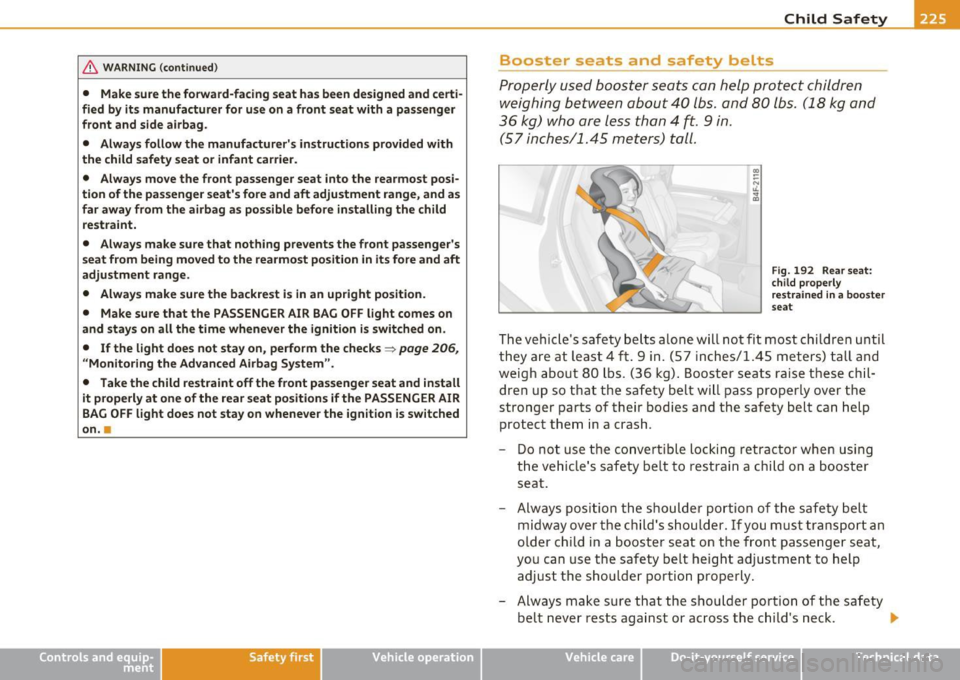
Properly used booster seats can help protect children
weighing between about 40 lbs. and 80 lbs. (18 kg and
36 kg) who are less than 4 ft.
9 in.
(57 inches/1.45 meters) tall .
Fig. 192 Rear seat:
child properly
restrained in a booster
seat
The vehicle's safety belts alone will not fit most children until
they are at least 4 ft. 9 in. (57 inches/1.45 meters) tall and
weigh about 80 lbs. (36 kg). Booster seats raise these chil
dren up so that the safety belt will pass properly over the
stronger parts of their bodies and the safety belt can help
protect them in a crash.
- Do not use the convertible locking retractor when using
the vehicle's safety belt to restrain a child on a booster
seat.
- Always position the shoulder portion of the safety belt
midway over the child's shoulder. If you must transport an
older child in a booster seat on the front passenger seat,
you can use the safety belt height adjustment to help
adjust the shoulder portion properly.
- Always make sure that the shoulder portion of the safety
belt never rests against or across the child's neck.
9'>
Vehicle care Do-it-yourselt service iTechnical data
Page 361 of 368

___________________________________________ A_ l::.. p _h _a_ b_ e_t _ic _a_ l_ in_ d _ e_x __ _
R
Radiator fan ................... .... 286
Rain sensor . ................... ... .. 66
Rain sensor defect ive ............... .. 30
Reading lights
Front ................... ... .. .. ..
63
Rear .. ......... ... ... ...... ..... 64
Rear ashtray ........................ 91
Rear fog lights ......... ...... .. .. .. .. 60
Rear lid
Escape handle ..... ..............
316
Open ing and closing .. .. ..... ..... . 46
Valet key function ...... ..... .. .. .. 40
Rear light
Defective .............. .. .... .. ..
21
Rear seat bench .......... .. .. .. .. .. .. 83
Rear view camera Park ing mode
2 ... ... .... .... .... 163
Park ing mode 1 .............. ... . 162
Rear view mirror
Inside rear view mirror . . . . . . . . .
69, 70
Rear window defogger ........ .... .. . 101
Rear window shelf . .. .. ... ....... ..... 80
Rear window sun shade ............... 65
Red symbols ... ... ........ .... .... .. 25
Refuelling . ................... .. .. . 273
Release lever for hood ............... 276
Remote control garage door opener
(Homelink ®) ........... .... ... .
169
Remote control key ................. .. 38
Unlocking and locking ..... ......... 42
Controls and equip
ment Safety first
Remote rear lid release
... .. ...... .. .. 46
Repair manua ls . ... .... ............. 344
Repairs
Airbag system ...................
209
Replacing a fuse . .... ............... 325
Replacing light bulbs . .. .. .. .. ....... 329
Replacing tires and wheels .... ... .. .. . 306
Reporting Safety Defects ........ 183, 184
Reset button .. ...... .. .. .. .......... 10
Residual heat . .. .. ............... ... 98
Retractor .......................... 189
Rims
Cast alloy ...... .... .. ... ... .....
263
Roof rack ... ................ ... .. .. . 87
Loading ................ .. .. .. .. . 88
Mounting locations .... ............ 88
Roof weight ................. ... .. ... 88
s
Safe driving habits ..... .. ..... ... ... 17 4
Safety belt position .... ....... ......
190
Safety belt height adjustment .. .. .. 192
Safety belts worn by pregnant women ...
191
Safety belt pretens ioner
Service and disposal ..............
194
Safety belt pretensioners .. .. .. .. .. ... 193
Safety belt warning light .. ...... . 15,185
Safety belts . .. .. .... ............. .. 189
cleaning . ............... .. .... .. 269
Danger to passengers who do not wear a
safety belt .. ........... ...... ..
187
Fastening . .... ............. .... . 189
height adjustment ........ ... .. ... 192
Improperly worn . .. .............. 193
Not worn . .... ..... ...... ... ... . 187
Safety belt position ............ .. . 190
Safety instructions .. .. .. .. .... .. . 188
Securing child safety seats ...... .. . 227
Special considerations for pregnant
women .... . .... ... . .. .. .. .. .. .
191
Unfastening . .... ... .. .. .. .. .. .. . 192
Warning/indicator light ........... 185
Why YOU MUST wear them ....... .. 185
Worn properly ...... ...... .. .. .. . 188
Safety compliance sticker . .. .. .. .. .... 338
Safety equipment ................ .. . 17 4
Safety features for occupant restraint and protection .... . .. ..............
17 4
Safety guidelines Seat adjustment ... .... ...........
75
Safety instructions
Engine compartment ........ .. ...
277
for side curtain airbags .. ... ..... .. 216
for using child safety seats .. .. .. .. . 220
for using safety belts ...... .... .. . 188
Monitor ing the Advanced Airbag System .
208
Safety lock
Ignition key, automatic transmission
109
Seat adjustment Adjusting the seatback .. ...........
77
Adjusting upper thigh support ....... 78
Driver's seat . ................. .. .. 75
Driver's seat memory ........... ... 79
Front passenger's seat .... .. ....... 76
Vehicle operation Vehicle care Do-it-yourself service Technical data