2010 AUDI Q7 wipers
[x] Cancel search: wipersPage 257 of 390

Intelligent technology
--------------------------------------------------' '----'----
The ASR works in conjunction with the ABS. If a malfunction should
occur in the ABS, the ASR w ill also be out of action.
& WARNING
The increased safety afforded by ASR does not mean that you can
take safety risks. Always adapt your driving style to the road
conditions and traffic situation.
[ i] Tips
To ensure that the ASR works properly, all four whee ls must be fitted
with ident ical tires. Any differences in rolling radius of the tires can
cause the system to reduce engine power when th is is not desired.
See also=>
page 326, "New tires and replacing tires and whee ls" .•
Braking
General information
What affects braking efficiency?
Operating conditions and driving habits
The brakes on today's automobiles are still subject to wear,
depending large ly on operating conditions and driving habits=>& .
On vehicles that are either driven mostly in stop -and -go city traffic or
are driven hard, the brake pads should be checked by your authorized
Audi dealer more often than specified in the
Warranty & Mainte
nance booklet.
Failure to have your brake pads inspected can result
in reduced brake pe rformance .
On steep slopes, you should use the brak ing effect of the engine . This
way, you prevent unnecessary wear on the brake system. If you must
use your brakes, do not hold the brakes down continuously. Pump the
brakes at intervals.
Noises may occur when braking depending on the speed , braking
force and outside conditions such as temperature and humidity.
Safety first
Moisture or road salt
If you are driving faster than 31 mph (SO km/h) and the windshield
wipers are on, the brake pads wi ll briefly touch the brake discs in
regular interva ls so as to improve reaction time when braking on wet
surfaces . You, the driver, will not not ice anything.
Under certain cond itions, for example, when driving through wa ter or
very heavy rain, or even after washing yo ur vehicle , the braking effect
can be reduced due to moisture (or in free zing conditions ice) on the
brake pads. A few careful brake applications should dry off the brake
pads or remove any ice coatings .
The effect iveness of the brakes can be reduced when the vehicle is
dr iven on a sa lt-covered road and the brakes are not used. Here too,
you should clean off accumu lated salt coating from brake discs and
pads with a few careful applications of the brake=> & -
Corrosion
There may be a tendency for dirt to build up o n the brake pads and
corrosion to form on the dis cs if the car is no t driven regularly or only
for short trips with little use of the brakes.
If the brakes are not used frequently, or if corrosion has formed on
the discs, it is advisable to clean off the pads and discs by braking
firmly a few times from a moderately high speed=> &.
Faults in the brake system
If you should notice a sudden increase in brake pedal travel, then one
o f the two brake circuits may have failed==>& .
Low brake fluid level
Malfunctions can occur in the brake system if the brake fluid level is
too low. The brake fluid level is monitored e lectron ically .
Brake lining wear status
Brake lining wear may be checked by visual inspection of the condi
tion of the brake pads through the openings in the wheel. If neces
sary, the wheel may be removed for this inspection =>
page 339,
"Changing a wheel". ._.
Vehicle care Technical data
Page 298 of 390

___ C_h_ e_c _k _i_n -=g :a,__ a_n_ d_ f_ i_ l _li _n _,g;._ __________________________________________ _
Checking and filling
Engine hood
Releasing the engine hood
The engine hood is released from inside the vehicle.
-Open the driver's door.
Fig. 229 Driver's side
footwell: engine hood
release lever
-Pull the release lever on the left under the instrument
panel => fig . 229 in the direction of the arrow .
The hood pops up slightly under spring pressure .•
Opening the engine hood
Fig. 230 Release lever
under the engine hood
Before opening the engine hood, make sure that the wind
shield wipers are flat against the windshield. Otherwise, they
could damage the paint on the hood.
- Lift the hood slightly =>& .
- Pull up on the release under the hood => fig. 230. This
releases the catch.
- Open the hood all the way.
& WARNING
Hot engine coolant can burn you.
• To reduce the risk of being burned, never open the hood if you
see or hear steam or coolant escaping from the engine compart
ment. Wait until no steam or coolant can be seen or heard before
carefully opening the hood. •
Page 384 of 390

___ A_ l_. p_ h _ a_b_ e_ t_ic _a_ l_ in_ d_e _ x ____________________________________________ _
Retractor ... .. .. ....... ... ... ... . .. 203
Rims
Cast alloy .......................
280
Roof rack . .. .................... ... 100
Loading ..... ................. .. 101
Mounting locations . .. .. .. .. .. .. . .
Roof weight ....... ... ............ . 101
101
266
Rule of behavior offroad
s
Safe driving habits ... .. .. .. ......... 188
Safety belt height adjustment .. .. ..... 206
Safety belt position .. .. .... ......... 204
Safety belt height adjustment ...... 206
Safety belts worn by pregnant women ...
205
Safety belt pretensioner ............. 207
Service and disposal ........ .... .. 208
Safety belt warning light .... .. .. .. 18, 199
Safety belts ... ................... .. 203
cleaning ...................... .. 285
Danger to passengers who do not wear a
safety belt ............ ... ... ...
201
Fastening ......... .............. 203
Improperly worn .. .... .. ......... 207
Not worn .... ................. .. 201
Safety belt position ....... .. .. .. .. 204
Safety instructions ............ ... 202
Securing child sa fety seats ......... 241
Special considerations for pregnant Why YOU MUST wear them .
.. .. .. .
199 Seating capacity . ....... .. .. .. .. .. .. 199
Worn properly ............... ... . 202 Seating position
Safety compliance sticker ............
360 Driver ... ....................... 190
Safety equipment ................... 188 Front passenger . . . . . . . . . . . . . . . . . 191
Safety features for occupant restraint and How to adjust the
front seats ...... 191
protection . .. .. ........ ....... . 188 Incorrect seat position ... ......... 193
Safety guidelines Occupants .
.. .. .... ............. 190
Seat adjustment ................ .. 83 Rear passengers 192
Safety instructions Seats
Engine compartme nrt ...... .. .. .. .
297 Number of seats . ... ............ . 199
for side curtain airbags ........... . 230 Selective unlock feature .. .. ..... .. ... 47
for using child safety seats .. .. .... . 234 Selector lever ... .... .. ........... .. 162
for using safety bel ts ... .. ... .. .. . 202 Service and disposal
Monitoring the Advanced Airbag System Safety belt pretensioner .......... .
208
222
Safety lock
Ignition key, automatic transmission
125
Seat adjustment
Adjusting the seat height manually ...
86
Adjusting the seatback manually . .. .. 86
Driver's seat .............. ....... 83
Driver 's seat memory ............ .. 87
Front passenger's seat .. .. .. ..... .. 84
Front seats . . . . . . . . . . . . . . . . . . . . . . 83
Head restraints ......... .. .. .. 90, 193
Manual controls . ................. 86
Moving the seat forward or backward
manually ............ ........ ...
86
Power .. .. .. ... .... ...... .. ... ... 84
Seat be lts
See Safety be lts ................ . 199
Service interval display . ........... .. . 25
Service position
Windshield wipers .. .... .......... 75
Servotron ic
Power steering ....... ... .. .... ..
257
Shift buttons ..................... . 166
Side airbags
Description ........ .............
225
How they work ............ .... .. 226
Side ass ist
Activating and deactivating ........
152
Description . ... ................. 152
Informational and alert stage signals 154
Messages in instrument cluster display ..
159
MMI settings ........ .. .... .... .. 158
women .. ..... ........ ...... .. 205 Seat memory ................ ..... . . 87
Operation ..... ................ . 154
Safety tips ..... ... ............. . 160
Unfastening · · · · · · · · · · · · · · · · · · · · · 206 Seat vent ilation .. ..... ........ .. .. . 119
Warning/ind icator light .. ......... 199 Sensor detection area ............ . 154
Page 387 of 390
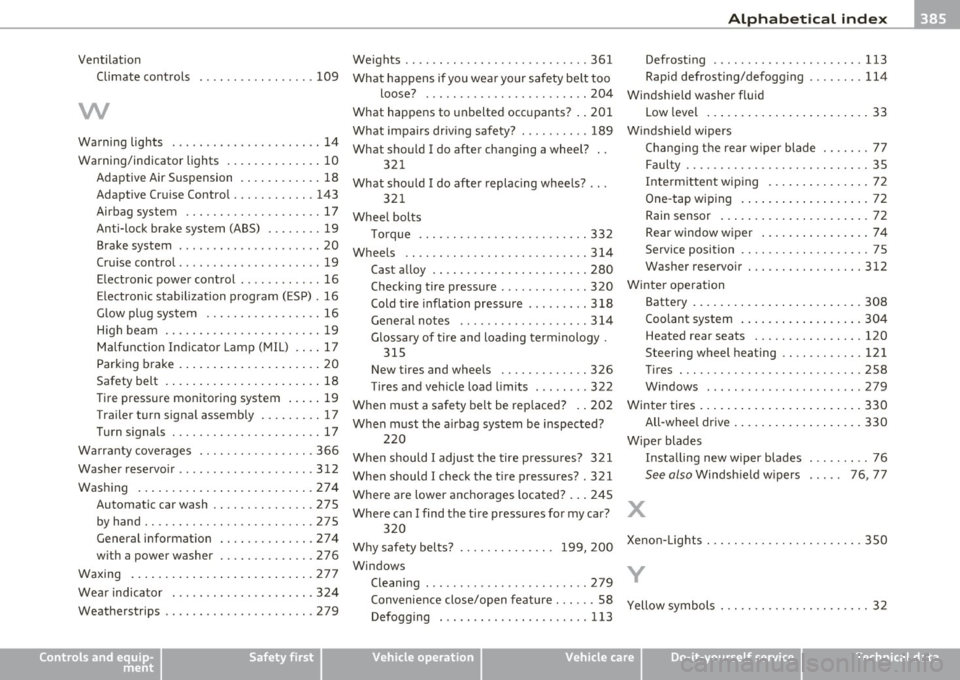
Alphabetical index -___________________________________ ____._ _______ _
Ventilatio n Weights .. .. .. .. .. .... .. .. .... .. ... 361
Climate controls ................. 109 What happens if you wear your safety be lt too
w
Warning lights ............. .... .... . 14
Warning/indicator lights ... ... ... ... .. 10
Adaptive Air Suspension . .. . .... .. .. 18
Adaptive C ru ise Contro l ............ 143
Airbag system .................... 17
An ti-lock brake system (ABS) ........ 19
Brake system ............ ... ...... 20
Cru ise control ............ .... .... . 19
E lectronic power cont rol ... .. .. ... .. 16
E lectro nic stabil ization p rogram ( ESP) . 16
Glow pl ug sys tem ................. 16
H igh beam ....................... 19
Mal fu nction Indicator Lamp ( MIL) .... 17
Park ing brake ..... ....... ... . ... .. 20
Safety belt . ....... .. .. ... .. .. .. .. 18
T ir e pressure monito ring system ... .. 19
Trailer turn signa l assembly ......... 17
Turn signals ............ .. .. .. .. .. 17
Wa rran ty cover ages . ......... .... .. . 3 66
Washer reservo ir ............ ........ 312
Washing . ....... ... .. .. .. .. .. .. .. . 274
Automatic car wash ............... 275
by hand ...... ...... .. .. .. ... ... . 275
General informat ion .............. 274
w ith a power washer .............. 276
Waxing .... ..... ... .. .. .... .. .. .. . 27 7
Wea r indicator . .. .... ...... .... ... . 324
Weatherstrips ...................... 279 loose?
....................... . 204
What happe ns to unbelted occupants? . . 201
W hat impairs driv ing safety? . ........ . 189
What should I do after changing a wheel? ..
32 1
What should I do after replac ing whee ls? ...
32 1
Wheel bolts To rque .... .. ..... ...... ...... .. 332
W heels .. .. .. .. ... ................ 314
Cast alloy ...... .... .... ......... 280
Checking tire pressure ............. 320
Cold tire infla tion pressure ......... 318
General notes ............ .... ... 314
Glossa ry of tire and loading terminology .
315
New tires and whee ls ........... .. 326
Ti res and vehicle load limits ........ 322
W hen m ust a safe ty be lt be rep laced? . . 202
When m ust the a irbag system be inspected?
220
When should I adjus t th e tire press ures? 321
When should I check t he t ire pressures? . 321
Where are lower anchorages loca ted? .. . 24 5
Where can I find the tire pressures for my car? 320
W hy safety belts? ........... .. . 199, 200
Windows Clean ing .... ...... ....... .... .. . 279
Convenience close/open feature . ..... 58
Defogging ......... ... .......... 113 Defrost
ing ... .... ... .... ... ... .. 113
Rapid defrosting/defogg ing ........ 114
Win dshield washer fluid
Low level ... .. .. .. ..... ....... ... 33
W indshield wipers
Changi ng the rear w ipe r blade ....... 77
F aul ty ........................... 3S
I nte rm ittent wi ping .. .. ... .. . ... .. 72
One -tap wip ing . ... .. .. ... .. ... ... 72
Rain sensor ... .. .. ... ... ..... .... 72
Rear window wiper ...... ..... ... .. 74
Service position .. .. ............... 75
Washer reservo ir . .. ............. . 312
Winter ope ration
Battery ... .. ... .... . ..... .. .. .. . 308
Coolant system ...... .. ... .. .. .. . 30 4
Heated rear seats .......... ... .. . 120
Steering wheel heating .. .......... 121
Tires . ......................... . 258
Windows ... .. .................. 279
Winter ti res .... ... .. .. .. .. .. .. .. .. . 33 0
All-whee l drive ....... ... ...... .. . 330
W iper blades
I nsta lling new wiper b lades ....... .. 76
See also Windsh ie ld wipers . . . . . 76 , 7 7
X
Xeno n-Lig hts . .. ...... ...... ....... . 3 50
y
Yellow symbols . .. .. .. ...... ... .. .. .. 32
Controls and equip
ment Safety first Vehicle operation
Vehicle care Do-it-yourself service Technical data