2010 AUDI Q7 Ami
[x] Cancel search: AmiPage 62 of 390

Opening and closing
C ,
. ,, . . ,,
~~~
~ 80 ~- OB
. ' . ,.:, . :,
Tilting front roof segment
...
"' ...
;
Fig. 46 Section of
headliner in rear:
Switch for Panoramic
sliding sunroof
- Press switch==> page 59, fig. 45 @in the initial position
@ briefly to open the roof segment completely . Press it
longer to set an intermediate position manually.
Tilting rear roof segment
-Tap the rocker switch==> page 59, fig. 45 ®or==> fig. 46
© in the rear area~ briefly, the roof segment tilts up
automatically.
- To set an intermediate position manually, press the rocker
switch @ or© in the rear area~ until the roof segment
has reached the desired tilted position .
Opening front roof segment to comfort
setting
-Turn the rotary switch:::;, page 59, fig. 45 @to position
(D, you will feel the switch engage. The roof segment is
slid open only to a comfort position with low wind noise.
This is the recommended standard setting for normal
driving conditions.
Sliding front roof segment fully open
-Rotate and hold the switch @in position @until the roof
segment has reached the desired position. There may be
increased wind noise in this position.
[I) Tips
• In position @, the switch jumps back to posit ion (D again as soon
as the switch is released .
• When driving w ith the Panoramic sliding sunroof open, open the
front roof segment to the comfort set ting to minimize wind noise .•
A pp lies to veh icles: w ith Panoramic sliding sunroof
Closing Panoramic sliding sunroof
Closing tilted front roof segment
-Pull the switch==> page 59, fig. 45 @and hold it until the
roof segment has reached the desired position.
- Pull the switch briefly to close the roof segment automat
ically . By activating the switch briefly again , the roof
segment can be stopped in any position ==>& .
Closing front roof segment when slid open
-Rotate switch:::;, page 59, fig. 45 @to position @ to
close the roof segment==>& . To move to an intermediate
position , rotate the switch to the corresponding cl ick
stop.
Closing tilted rear roof segment
- Tap the rocker switch==> page 59, fig. 45@ or:::;, fig . 46
© in the front area~ briefly to close the roof segment
completely :::;,& .
1))-
Page 63 of 390

-To set an intermediate position manually, press the rocker
switch in the front area
e:> until the roof segment has
reached the desired tilt position==>& .
& WARNING
Improper use of the Panoramic sliding sunroof can cause serious
personal injury.
• Be careful when closing the Panoramic sliding sunroof. Not
paying attention could cause you or others to be trapped and
injured as the Panoramic sliding sunroof closes.
• Always take the key with you when you leave the vehicle to
prevent injuries caused by the Panoramic sliding sunroof closing
• Never leave children or persons requiring assistance alone in
the vehicle, especially when they could access the vehicle keys.
Unsupervised use of the keys can result in the engine being started
or use of vehicle systems such as the power windows, etc. which
could result in serious injury. The doors could be locked with the
remote key, delaying help in an emergency.
• The Panoramic sliding sunroof will continue to operate until
the ignition key has been removed a nd one of the front doors has
been opened. •
Applies to vehicles : w ith Panoram ic sliding sunroof
Convenience closing feature
The Panoramic sliding sunroof can be closed from outside
with the key in the driver's door lock .
-Insert the key into the driver's door lock.
- Turn and hold the key in the lock position ®==>
page 46,
fig. 29 until the Panoramic sliding sunroof is completely
closed ==> & in "Closing Panoramic sliding sunroof" on
page 60. The power sun blind is also closed.
Con tro ls a nd e quip
m en t Vehicle
OP-eration
Opening and closing
& WARNING
Be careful when closing the Panoramic sliding sunroof. Not paying
attention could cause you or others to be trapped and injured as
the Panoramic sliding sunroof closes. •
Applies to v ehicl es: w ith Panoramic slid in g sunroof
Opening and closing sunshade
I .~ "'
r~ 1~· I
0 g
"I ..!J
"' a,
' ~
G
{(e)
B
0
0 ..
~ ~ ffl ""'
[f 'd 11 -I
t _, $
b l•,:,,,;; =·:::"' == ;'·== ··.••,:::-= ·•,::: ::::= ·•=·· = ·=· ======· •=··•·•-,· =,~=·,., .. c":::'• .. ·= '·"•' :::· ,=••,•s ::::::::: j ~
Fig. 47 Section of
front headliner: Switch
for sunshade
Fig. 48 Section of
headliner in rear:
I>· .. ,.:._::;::-_·;r .,;:;, :::;>:,: -:-·. _::: ;:::'·;-}.- .::,.:.-: ::::: :~ ,.:.·-:- -":-· Switch for sunshade
The two segments of the Panoramic sliding sunroof are each
equipped with a sunshade for protection against the sun's
rays. The front shade is power operated, the rear shade is
opened and closed manually . To prevent the vehicle interior _.,
Vehicle care Do-it-yourselt service iTechnical data
Page 64 of 390

Opening and closing
from heating up, you should close both sunshades when you
park your vehicle in the sun.
Opening and closing front sunshade
Tap the rear -:c;"J" of the rocker switch~ page 61, fig. 47 or
the rocker switch for rear-seat passengers~
page 61,
fig. 48 briefly to open the sunshade fully.
- Tap the front
·'J.rT of the rocker switch briefly to close the
sunshade fully~& .
- To set an intermediate position manually, press the front or rear of the rocker switch (depending on the position of
the shade)
until the desired position is reached ~ & .
Opening and closing rear sunshade
-Hold the sunshade by the grip and push it to the desired
position.
& WARNING
Never close the sunshade without paying attention or checking -
danger of injury! •
Applies to veh icles : w ith Panoram ic sliding sunroof
Emergency closing
In an emergency, the Panoramic sliding sunroof can be
closed electrically.
If the Panoramic sliding sunroof detects an object in its path
when it is closing, it will open again automatically. In this
case, you can close the roof with the power emergency
closing function .
Emergency closing of front roof segment
- Turn the switch~ page 59, fig . 45 @ to the normal posi
tion @.
- Within five seconds after the sunroof opens automati
cally, pull the switch until the roof segment closes.~&.
The driver's and front passenger's doors must be closed.
- If the power emergency closing function is not possible, you must close the roof manually~
page 63.
Emergency closing of rear roof segment
-Within five seconds after the sunroof opens automati
cally, press the front
e:> of the rocker switch~ page 59,
fig. 45 ® until the roof segment closes~&. The driver's
and front passenger's doors must be closed.
- If the power emergency closing function is not possible,
you must close the roof manually ~
page 64.
& WARNING
Improper use of the Panoramic sliding sunroof can cause serious
personal injury.
• Be careful when closing the Panoramic sliding sunroof. Not
paying attention could cause you or others to be trapped and
injured as the Panoramic sliding sunroof closes.
• Always take the key with you when you leave the vehicle to
prevent injuries caused by the Panoramic sliding sunroof closing
• Never leave children or persons requiring assistance alone in
the vehicle, especially when they could access the vehicle keys.
Unsupervised use of the keys can result in the engine being started
or use of vehicle systems such as the power windows, etc. which
could result in serious injury. The doors could be locked with the
remote key, delaying help in an emergency. .,,.
Page 65 of 390

& WARNING (continued)
• The Panoramic sliding sunroof will continue to operate until
the ignition key has been removed and one of the front doors has
been opened .•
A pp lies to vehicles : w ith Panoram ic sl iding sunroof
Mechanical emergency closing for front
roof segment (Step 1)
The Panoramic sliding sunroof can be closed manually in
an emergency.
Fig. 49 Section of
front headliner: Removing cover
Fig. 50 Section of
front headliner:
Removing the cover for
the light unit
Removal of the light unit requires some dexterity.
Contro ls a nd e quip
m en t Vehicle
OP-eration
Opening and closing
-Open the compartment.
- Pull the chrome strip down carefully, along with the
center cover~ fig. 49 -Arrow-.
- Pull the cover for the light unit down carefully~ fig. 50
-Arrows-. •
Applies to v ehicles: w ith Pano ramic slid ing sun roof
Mechanical emergency closing for front
roof segment (Step 2)
I 0
'-:'~
-~ •-- 1 I • • •
( -
I
I I
Fig. 51 Section of
front headliner:
Removing light unit
Fig. 52 Section of
front headliner: Crank
for emergency opera
tion
- Take the screwdriver from the vehicle tool kit~ page 336 . .,_
Vehicle care Do-it-yourselt service iTechnical data
Page 66 of 390

Open ing and closing
- R emove the two screws=> fig . 5 1 - Arrows- from the light
unit.
- Carefully remove the light unit .
- Remove the crank from the bracket on the fuse cover on
the left front of the instrument panel=>
page 346,
fig . 258 ® ·
- Push the crank into the hexagonal hole as far as it can go
=>
page 63, fig. 52.
- Hold the crank down and turn it to close the roof .
- Re-install the light unit . For installation, reverse the
removal sequence.
- Return the crank to its location in the fuse box cover
=>
page 346, fig. 258 and install the cover.
- Have the problem corrected.
[I] Tips
To turn the crank for emergency closing more easily, you should use
the screwdriver handle as an aid~
page 63, fig. 52. First, remove the
screwdriver from the handle, then push the handle onto the crank. •
Applies to v ehic les: with P anor amic s lidin g sunroof
Mechanical emergency closing for rear roof
segment
- Carefully remove the cover for the rear roof segment drive
in the rear area of the headliner .
- Remove the crank from the bracket on the fuse cover on the left front of the instrument panel=>
page 346,
fig. 258 ® ·
- Press the crank into the hexagona l hole in the drive as far
as it wi ll go (bas ica lly, as shown in=>
page 63, fig . 52) .
- Ho ld the crank down and turn it to close the roof.
- Re-install the cover.
- Return the crank to its locat ion in the fuse box cover
=> page 346, fig. 258 and install the cover .
- Have the problem co rrected .
[I] Tips
To turn the crank for emergency closing more easily, you should use
the screwdriver handle from the tool kit~
page 336 as an aid. First,
remove the screwdriver from the handle, then push the handl e onto
the c rank .•
Page 70 of 390
Clear vision
Applies to vehicles : with Adaptive Light
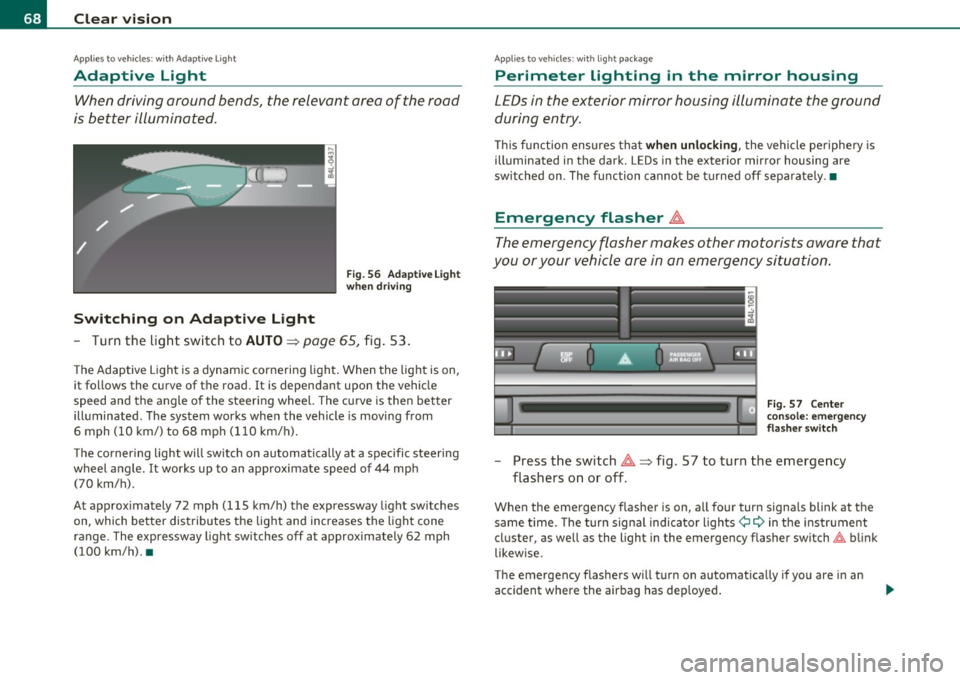
Adaptive Light
When driving around bends, the relevant area of the road
is better illuminated.
Switching on Adaptive Light
Fig . 56 Adaptive Light
when driving
- Turn the light switch to AUTO~ page 65, fig. 53.
The Adaptive Light is a dynamic cornering light. When the light is on,
it follows the curve of the road. It is dependant upon the vehicle
speed and the angle of the steering wheel. The curve is then better
illuminated. The system works when the vehicle is moving from
6 mph (10 km/) to 68 mph (110 km/h).
The cornering light will switch on automatically at a specific steering
wheel angle. It works up to an approximate speed of 44 mph
(70 km/h).
At approximately 72 mph (115 km/h) the expressway light switches
on, which better distributes the light and increases the light cone
range . The expressway light switches off at approximately 62 mph
(100 km/h). •
Applies to vehicles : w ith light package
Perimeter lighting in the mirror housing
LEDs in the exterior mirror housing illuminate the ground
during entry.
This function ensures that when unlocking, the vehicle periphery is
illuminated in the dark. LEDs in the exterior mirror housing are
switched on. The function cannot be turned off separately .•
Emergency flasher ~
The emergency flasher makes other motorists aware that
you or your vehicle are in an emergency situation.
Fig. 57 Center
console: emergency
flasher switch
-Press the switch~~ fig. 57 to turn the emergency
flashers on or off .
When the emergency flasher is on, all fou r turn signals blink at the
same time. The turn signal indicator lights¢
9 in the instrument
cluster, as well as the light in the emergency flasher switch~ blink
likewise.
The emergency flashers will turn on automatically if you are in an
accident where the airbag has deployed.
Page 102 of 390

llffl!I.___S_ e_a _t_ s_ a_ n_ d_ s_t _o _r_ a...: g,,._ e ______________________________________________ _
Roof rack
First things first
A roof rack can be fitted to carry additional luggage on
the roof.
- A lways read and follow the instruct io ns prov ided by the
roof rack manufacturer when the roof rack system m ust
be installed .
If you are tra nspo rting l uggage or other objects on the roof, please
note the following:
• Your vehicle has specially designed aerodynamic roof rails. Only
install a roof rack specifica lly designed fo r you r model. Contact the
nearest authorized Audi dea ler for information on approved mod ular
roof rac ks for your vehicle .
• T hese approved roof racks a re the basis for a complete roof rack
system. Add itiona l attachments for the basic roof rack are necessary
to safe ly transport luggage, bicycles, surf boa rds, skis or sma ll boats .
All necessary hardwa re for these systems is ava ilable at yo ur a utho
r ized Audi dealer .
• We recommend that you keep t he installat ion inst ruct ions for
your roof rack system together with your Owner's literature in the
vehicle.
When should the roof rack be remo ved?
• Before going through an automat ic car wash (it is best to ask the
car wash operator for advice) .
• When not in use, to reduce fuel consumption, wind noise and to
guard against theft .
& WARNING
• Use of an unapproved roof rack or incorrect mounting of an
approved roof r ack can cau se the roof rack or the items atta ched
to it to fall off the roof onto the road.
• Object s falling from the roof of a v ehicle can cau se a crash and
personal injury .
• Only mount the system b etween the markings shown in
=> page 101, fig. 96.
• The roof rack sy stem must be in stall ed e xactly ac cording to the
instructions provided.
0 Note
• Your vehicle warranty does not cover any damages to the vehicle
caused by using roof ra ck s or mounting s truc tures not appr oved by
Audi for your veh icle . The same applies to damage result ing from
incor re ct roof rac k ins tallat io n.
• Always check the roof rack mountings and hardware before each
t rip and dur ing a trip to ma ke sure everyth ing is sec urely tig htened. If
necessary, ret ighten the mountings and check the entire system from
t ime to time.
• After mounting a roof rack system, or when yo u transport objects
on the roof of your veh icle, t he heigh t of the vehicle is natura lly
increased . Be careful whe n driving under low br idges or in park ing
g ar ages for ex ample . This could ca use damage to the lo ad and even
the vehicle itself .•
Page 103 of 390

_______________________________________________ S_ e_ a_t _s_ a_n_ d_ s_ t_ o _ r_a """g::;. e _ __._
Roof rack mounting locations
Roof racks must be installed only at the locations marked
on the roof rails .
Fig. 96 Roof ra ils :
fr ont and rear
m ounting l ocations
Mount the front and rear cross bars betwee n the punched markings
on the inside of the roof railings :::> fig. 96. The marki ngs are lo cate d
on t he inside of the railings .•
Loading the roof rack
Always dist ribu te loads evenly . Make sure anything on
the roof rack is securely tied down.
- A lways distr ibu te the loads o n the roof rack even ly.
- A lways attach items to the roof rack secure ly before you
drive o ff.
The maximum permiss ible roof weight is 220 lb (100 kg ). The roof
we ight is made up o f the weight of the roof rack system and the
we ight of the object being transported .
When using a roof rack system which has a lower load carry ing
capacity, you must not use up th e total max imum permiss ible load
carrying capac ity specified above. Instead, you should load the roof
Con tro ls a nd e quip
m en t Vehicle
OP-eration
rack system only to the max imum capacity specified by the manufac
tu rer of the roof ra ck system.
& WARNING
Weak, damaged or improper straps u sed to secure item s to the
roof rack can fail during hard braking or in a colli sion and cause
s e riou s personal injury .
• Make sure the roof rack is i nstalled e xactly as spe cified abo ve
~ page 101 .
• Always u se suitable mounting strap s fo r se curing items to the
roof rack to help pre vent items from shifting or fl ying forward .
• Item s on the roof rack mu st alwa ys be secu rel y mounted.
• The use of a roof rac k can negati vely affect the way a vehicle
handle s. Cargo that i s large , he avy , bulky, long or flat will have a
greater negative influence on the vehicle 's a erodynami cs, center
of gr avit y and overall h andling . Alway s drive slowl y, avoid sudden
braking and maneuvers when tran sporting cargo on the roof of
your veh icle .
• Never e xceed the maximum permi ssible load carr ying capacity
of the r oof of your vehicle , the permi ssible a xle weight s and the
permis sible tot al weight of your v ehicl e=>
page 361, "W eights ".
• Alway s drive slowly , avoid sudden braking and maneuver s
when t ran sport ing cargo on th e ro of of y our veh icle.
0 Note
Make sure that the opened rear lid does not come in contact with the
cargo on the roof .
c£> For the sake of the environment
Sometimes it may be easier to leave a roof rack installed even tho ugh
you a re not using i t. Due to the inc reased air res istance your vehicle
will unnecessarily use more fuel. Remove the roof rack if you are not
going to use it. •
Vehicle care Do-it-yourselt service iTechnical data