2010 AUDI A5 COUPE cooling
[x] Cancel search: coolingPage 279 of 360

___________________________________________ C_ h_e _c_ k_ i_n _g _ a_n _d_ f_il _li _n _g __ fflllll
•
& WARNING (continued)
• When removing the oil drain plug with your fingers, stay as far
away as possible. Always keep your forearm parallel to the ground
to help prevent hot oil from running down your arm.
• Drain the oil into a container designed for this purpose, one
large enough to hold at least the total amount of oil
in your engine.
• Engine oil is poisonous. Keep it well out of the reach of children.
• Continuous contact with used engine oil is harmful to your
skin. Always protect your skin by washing oil off thoroughly with
soap and water.
0 Note
Never mix oil additives with your engine oil. These additives can
damage your engine and adversely affect your Audi Limited New
Vehicle Warranty.
<£> For the sake of the environment
• Before changing your oil, first make sure you know where you
can properly dispose of the used oil.
• Always dispose of used engine oil properly. Do not dump it on
garden soil, wooded areas, into open streams or down sewage
drains.
• Recycle used engine oil by taking it to a used engine oil collec
tion facility in your area, or contact a service station. •
Engine cooling system
Coolant
The engine coolant performs two functions: it keeps the
engine from overheating and it protects the engine from
freezing in the winter.
The cooling system is sealed and generally requires little attention.
The cooling system has been filled at the factory with a permanent
coolant which does not need to be changed. The coolant consists of
a mixture of water and the manufacturer's glycol -basedcoolant
additive G12++ antifreeze with anti corrosion additives (50% for USA
models; 60% for Canadian models). This mixture both assures the
necessary frost protection and protects metal components in the
engine's cooling system from corrosion and scaling. It also raises
the boiling point of the coolant.
Do not reduce the concentration of the coolant in the summer by
adding plain water.
The proportion of coolant additive must be at
least 50% but not more than 60%
to maintain antifree ze protection
and cooling efficiency. If the coolant frost protection is too low, the
coolant could freeze and damage the vehicle heating and engine
cooling system.
For year-round driving, antifreeze is added at the factory for temper
atures down to:
• -31 °F
! -35 °ci usA
• - 40°F ( - 40°CJ Canada.
You can mix the G12++ coolant additive with other additives (G12 +
or G12) . Always check with your authorized Audi dealer .
& WARNING
Before you check anything in the engine compartment, always
read and heed all WARNINGS
~ & in "Working in the engine
compartment" on
page 271.
Vehicle care I t •
Page 280 of 360
___ C_h_ e_ c_k _in --== g'-- a_n _d_ f_il _li _n ..:::g:::..- ___________________________________________ _
0 Note
• Before winter sets in, have the coolant checked to see if the
coolant additive in your vehicle is sufficient to meet the climate
conditions. This is especia lly important if you live in a region where
the winter is extremely cold. If necessary, increase the proportion of
coo lant additive to 60%.
• When adding coolant additive to your coo ling system,
reme mber:
- We recommend using only coolant additive G12+ + (check the
label) for your vehicle. This coolant addit ive is ava ilable at autho
rized Audi dealers . Other types of antifreeze can significantly
reduce corrosion protection . The resulting corrosion can cause a
loss of coolant and serious engine damage.
• Do not add any type of radiator leak sealant to your vehicle's
engine coolant . Adding radiator repair fluid may adverse ly affect the
function and performance o f your cooling system and cou ld result
in damage not covered by your New Vehicle Limited Warranty. •
Checking the engine coolant level
The engine coolant level can be checke d with a quick
glance.
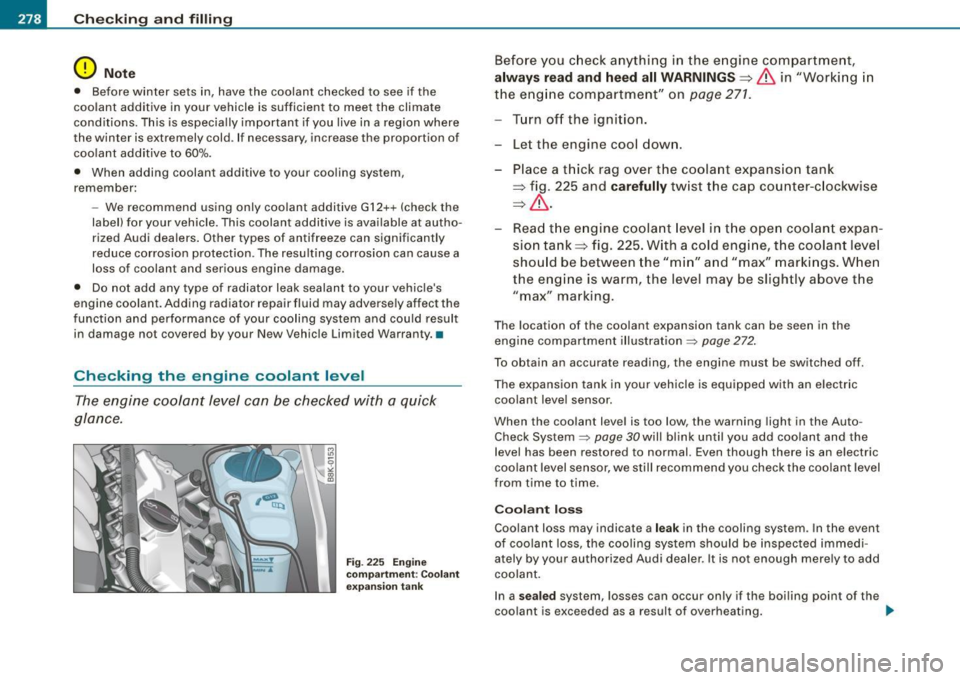
Fig . 2 25 Engine
c omp artmen t: Coo la n t
e xpan sion tank
Be fo re y ou c heck anything in the e ngine compar tm en t,
always read and heed all WARNINGS==> & in "Working in
the eng ine compartment" on
page 271.
Tur n off the ignitio n.
- Let the engine coo l down.
P lace a th ick rag ove r the coola nt expans io n tank
==> fig. 225 and carefully twist th e cap counter-c lockwise
==> & .
Read t he e ngin e coola nt level i n the open coo la nt expan
sion tank==> fig. 225. W ith a cold eng ine, the coolant leve l
sho uld be bet ween the "m in" and "max" markings. W hen
t h e eng ine is warm, the level may be slightly above the
"max" marking .
The location of the coolant expansion tank can be seen in the
engine compartment illustration=>
page 272.
To obtain an accurate read ing, the engine must be switched off .
The expansion tank in your vehicle is equipped with an e lectric
coo lant leve l sensor.
When the coolant leve l is too low, the warning light in the Auto
Check System =>
page 30will blink until you add coolant and the
level has been restored to normal. Even though there is an electric
coo lant level sensor, we still recommend you check the co olant level
from t ime to time.
C oolant loss
Coolant loss may indicate a le ak in the cooling system . In the event
of coo lant loss, the co oling system should be inspec ted i mmedi
ately by your authorized Audi dealer. It is not enough mere ly to add
coo lant.
In a
s ealed system, losses can occur on ly if the boi ling point of the
coo lant is exceeded as a result of overheating. ...
Page 281 of 360

___________________________________________ C_ h_e _c_ k_ i_n _g _ a_n _d_ f_il _li _n _g __ ll'I
•
& WARNING
The cooling sy stem i s under pre ssure and can get very hot . Redu ce
the risk of scalding from hot coolant by following these steps.
• Turn off the engine and allow it to cool down .
• Protect your face, hands and arms from escaping fluid and
ste am by cover ing the cap with a large , thick rag .
• Turn the cap slowly and very carefully
in a counter -clockwise
dire ction while applying light , downward pressure on the top of
the cap .
• To avoid being burned, do not spill antifreeze or coolant on the
e x haust system or hot engine parts . Under certain conditions, the
ethylene glycol in engine coolant can catch fire .
0 Note
Do not add any type of radiator leak sea lant to your vehicle's engine
coolant. Adding radia to r repa ir flu id may advers ely affect the fu nc
tion and performance of your coo ling system and could res ult in
damage not covered by y our New Vehic le Lim ited War ra nty .•
Adding coolant
B e very care ful when ad ding e ngine cool ant.
Be for e you check a nything in the engine com partmen t,
always read and heed all WARNINGS~ & in "Work ing in
t h e eng ine compa rtment" on
page 271 .
-Tur n o ff th e en gine.
- Let the e ng in e cool d own.
- Plac e a thi ck rag over the coo la nt expansion tank
~ page 2 78 , fig. 2 25 and carefully tur n t he cap coun te r
cl ockwi se
~ &.
Add coo lan t.
- Twist the cap on aga in
tightly.
Replacement engine coolant must conform to exact specifications
~ page 2 77, "C oolant". Even in an eme rgency, if co olant addi tive
G12+ +, G12 + or G12 is not availab le, do not use a different additive.
U se pla in water ins tead until you can ge t the c orrect add itive and
can res tore the correc t rat io. Th is shou ld be done as soon as
p os sible.
I f y ou hav e los t a co ns ide rab le amou nt of coo la nt, then y ou should
add cold antifreeze and cold water only when the engine is cold .
A lways use
new e ngine c oolant w he n r efil ling .
D o not fill coolant a bove the " MAX" mark. Excess coola nt w il l be
forced out through the pressure relief va lve in the cap when the
eng ine becomes hot.
& WARNING
• The cooling system is under pressure and can get very hot .
Reduce the risk of scalding from hot coolant by following these
steps.
-Turn off the engine and allow it to cool down .
- Protect your face , hands and arms from escaping fluid and
steam by covering the cap with a large , thick rag .
- Turn the cap slowly and very carefully in a counter -clockwise
direction while applying light, downward pressure on the top
of the cap.
- To avoid being burned, do not spill antifreeze or coolant on
the exhau st system or hot engine parts. Under certain condi
tions, the ethylene glycol in eng ine coolant can catch fire .
• Antifreeze is poisonous. Always store antifreeze in its original
container and well out of the reach of children .
• If you dra in the coolant , it must be caught and safely stored in
a proper container clearly marked "poison ".
~
Vehicle care I t •
Page 348 of 360

llffl __ A_l.:. p _h_ a_ b_e _t _ic _ a_l _in _ d_e _x ____________________________________________ _
Care of exterior ... .. ... ... ... ... ... . 252
Cargo area
See Loading the luggage compartment ..
175
Cargo net .... .... ................... 79
Catalytic converter . . . . . . . . . . . . . . . . . . 244
Center armrest Adjusting ........................ 78
Storage compartment ........ .... . 78
Certification . . . . . . . . . . . . . . . . . . . . . . . 342
Changing a flat tire .. .... .... ....... 312
Changing a wheel ................... 312
Changing engine oi l ...... .... .... ... 276
Chassis Undercoating . . . . . . . . . . . . . . . . . . . . 258
Checking Engine coolant level .. ...... ...... 278
Checking tire pressure .... .... .... ... 293
Child restraint system anchors ........ 227
Child restraints Danger of using child restraints in the
front seat . . . . . . . . . . . . . . . . . . . . . . 190
Where can I get additional information
about child restraints and their use? ...
232
Child safety ................... .... . 213
Convertible locking retractor . . . . . . . 223
Important safety instructions for using
child safety seats .... .... ... .... 216
Important things to know when driving with chi ldren ................... 213
Installing a child restraint using the
LATCH system .................. 229 Lower
anchorages ... ...... ...... . 228
Mounting and releasing the anchorage hook .. .............. ....... ... 229
Tether anchors .. ...... .... .... .. 230
Tether straps ........ ....... ..... 230
Child safety seats ... ........... ..... 218
Booster seats .. ... .... ........ ... 221
Convertible chi ld seats ............ 219
Convertible locking retractor . ...... 223
Danger of using child restraints in the
front seat . . . . . . . . . . . . . . . . . . . . . . 190
How do I properly install a child safety
seat in my vehicle? ........ ...... 216
Infant seats ...... ........ ....... 218
Installing ....................... 223
LATCH system . . . . . . . . . . . . . . . . . . . 229
Safety instructions .... ...... ..... 216
Cigarette lighter ........ ....... ...... 87
Cleaning Alcantara® (synthetic suede) . ..... 262
Engine compartment ....... ... ... 263
Fabrics and fabric coverings ..... .. 259
Instrument panel ................. 260
Interior .. .... .... ... .. .... .... .. 259
Leather ......................... 261
MMI display ..................... 259
MM I termina l .. ... .... .... .... ... 259
Plastic and vinyl .. .. ......... ... . 256
Plastic parts . . . . . . . . . . . . . . . . . . . . . 260
Safety be lts ...... ....... ........ 263
Trim strips . ........... .... ...... 255
trim strips ... .. ........ .... ... ... 256
Cleaning and protection .. ........ ... 252
Clock ........ .... ...... ....... ...... 10 Coat hooks
. . . . . . . . . . . . . . . . . . . . . . . . . . 89
Co ld tire inflation pressure .... ....... 291
Compact spare tire .................. 311
See also Spare tire ........ ...... .. 311
Compass mirror . ...... .. .... .... .... 67
Comp liance ...... .... ....... .... ... 342
Consumer Information .... ... ... . 177, 339
Contacting NHTSA ... .... .... .... ... 177
Convenience closed ... ....... ........ 49
Convenience key ..................... 44
START ENGINE STOP button ... 110, 111
Starting engine .... ....... .... ... 110
Switching engine off .............. 111
Switching on ignition ............. 11
O
Unlocking and locking vehicle ... ... . 44
Convenience opening ...... ........... 49
Convertible child safety seats ...... ... 219
Convertible locking retractor Activating .. ....... .... ...... .... 225
Deactivating ..................... 226
Using to secure a child safety seat .. 223,
225
Coolant system ..................... 277
Cooling System Expansion tank .... ........... ... 278
Cornering light ...................... 57
Cruise contro l
Changing speed . ...... .... .... .. 116
Preselect speed .. ...... ..... .. ... 116
Switching off ... .. .... .... .... ... 116
Switching on ...... ........... ... 115
Warning/indicator lights ... .. ...... . 15
Cruising range ................... .... 23