2010 AUDI A5 COUPE roof
[x] Cancel search: roofPage 91 of 360
Glove compartment
The glove compa rtmen t is illumin ated an d can be Jocke d.
To open glove compartment
Fig . 97 Glov e comp art
m ent
- Pull t he handle i n th e direc tion o f the arrow =:> fig. 97 and
swing t he cover down to open .
To close glove compartment
-Push the glove compartment lid upward unt il the loc k
engages.
T here are holders for a pen and a pad of paper in the glove compart
ment l id .
On the right side in the glove compartment is a holder with the key
b ody into which the emergency key must be clipped to be a ble to
start the vehicle .
& WARNING
To reduce the risk of personal inju ry in an a ccident or sudde n stop ,
alway s keep the glove compartment closed while driving . •
Con tro ls and eq uip
ment
Seats and storag e
Storage compartment in the roof
,.,,,O;E\ 11111
fl([]') G)
o .. o
!.---~\.;;;;;;;;. ] Fig. 98 Storage p ocket
in th e roof
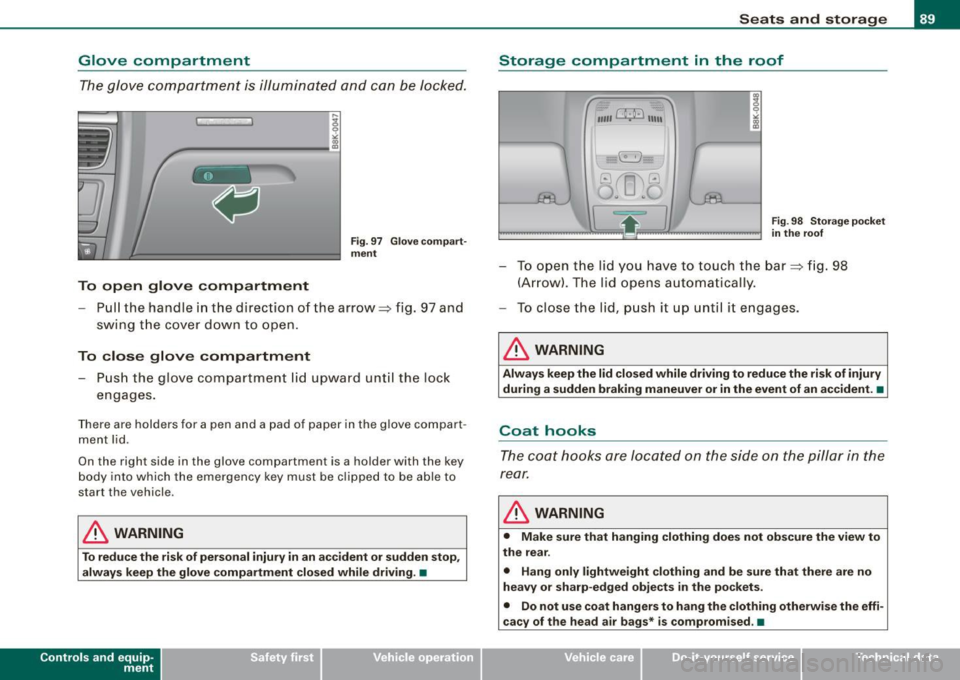
- T o open t he li d yo u have to tou ch the bar =:> fig. 98
(Ar row). T he lid opens a utom atic ally.
- To close the lid, push i t up un til it enga ges.
& WARNING
Alway s keep the lid closed while driving to reduce the risk of injury
during a sudden braking maneuver or in the event of an a ccident. •
Coat hooks
The coat hooks are lo cated on the side on t he pillar in the
rear.
& WARNING
• Make sure that hanging clothing doe s not obscure the view to
the rear .
• Hang only lightweight clothing and be sure that there are no
heavy or sharp -edged object s in the po cket s.
• Do not u se co at hanger s to han g the clothing otherwi se the effi
c a cy of the head a ir b ags* is compromi sed. •
Vehicle care
I I irechnical data
Page 93 of 360

& WARNING !continued)
control system as well as the proper procedure for defog
ging/defrosting the windows.
0 Note
• If you suspect that the automatic climate control system has
been damaged, switch the system off to avoid further damage and
have it inspected by a qualified dealership.
• Repairs to the Audi automatic climate control system require
specialized knowledge and special tools. Therefore, contact an
authorized dealer in the event of malfunctions.
[ i) Tips
• To avoid adversely affecting heating and cooling performance
and to prevent condensation on the windows, the air intake in front
of the windshield must be free of ice, snow and leaves .
• The air flowing out of the vents and throughout the vehicle's
entire interior is discharged at the rear of the vehicle. Make sure that
the outlet slots are not covered by clothing, etc.
• Th e automatic climate control system works most effectively if
the windows and the panorama/tilting sunroof* are closed.
However, if the interior of a parked vehicle is extremely hot from the
sun, briefly opening the windows can speed up the cooling
process. •
Contro ls and eq uip
ment
Warm and cold
Ap plies to veh icles: with deluxe automat ic climate contro l
Controls
This overview is to assist you in familiarizing yourself with
the controls of the automatic climate control system.
Fig. 99 Controls of the deluxe automatic climate control
Functions are set by rotating the regulator or are switched on and
off by tapping the buttons . The LED in the buttons illuminates when
the function is active .
Button(s) Meaning Page
!OFF] Switching on and off => page 92
(AUTO] Automatic operation => page 92
Regu latoral T
emperature selection => page 93
@ Fan => page 93
1~1 Recirculation mode => page 94
Vehicle care
I I irechnical data
Page 98 of 360

Warm and cold
tioning component. Please cons ult an authori zed dealersh ip if there
is an operating problem. •
Applies t o ve hicles: w it h d elu xe au to m ati c clim ate con tro l
Rear air vents
The rear air vents are located in the center console.
- Rotate the thumbwheel to open and close the vents.
- To ad just the direction of the airflow from the outlet,
move the tab in the center of the outlet in the desired
direction. The direction of the air delivered from the
vents can be adjusted horizontally and vertically.
The air vents are actuated either automatically or manually d e pending on the op erating mode selec ted . H eated or unh eated
fresh air, or cooled air flows from the vents.
i he ai r ven ts to heat the rear footwell are located under the front
seats.
[ i J Tips
If the climate control is operating in cooling mode, air flows prima
rily from the vents in the center console. To achieve adequate
cooling, you should never close these v ents completely. •
Applies to ve hicles: with delu xe au to m atic c limate con tro l
Economical use of the climate control system
Economical use of the climate control system helps save
fuel.
When the climate control system is working in cooling mode, engine performance is reduced and fuel consump- tion is affected. To keep the time
the climate control system
is on as short as possible, you should do the following:
- To save fuel, turn off cooling mode by pressing the
[AC )
button (ind icator light goes out).
- In addition, if you open the window or the
panorama/tilting sunroof* while driving, turn off cooling
mode by pressing the
[AC) button (indicator light goes
out).
- If the vehicle is extremely hot due to the heat of the sun,
briefly open doors and windows .
c£> For the sake of the environment
When you save fuel, you reduce emissions from the vehicle. •
Deluxe automatic climate control
plus
Applies to vehicle s: with D elu xe a utoma tic cl ima te co ntrol p lus
Description
The air conditioner is fully automatic and is designed to
maintain a comfortable and uniform climate inside the
vehicle.
We recommend the following settings :
- Set the temperature to 75 °F (+23 °Cl.
- Press the [AUTO
I button.
With this setting, you attain maximum comfort in the least amount
of time . Change th is s etting, as des ired, to meet your personal
needs .
~
Page 100 of 360

Warm and cold
• Repairs to the Audi ai r conditioner require special technical
know ledge and special tools. Contact an authorized Audi dea ler for
assistance.
[ i ) Tips
• To avoid adversely affecting hea ting and cooling performance
and to preven t condensation on the windows, the air intake in front
of the windshield must be free of ice , snow and leaves.
• The air flowing out of the ven ts and throughout the vehicle 's
entire interior is d ischarged at the rear of the vehicle . Make sure tha t
the outle t slots are not cover ed by clothing, etc .
• Climate control works mos t effectively if the windows and the
panoramic s liding /ti lting sunroof * are closed. Howeve r, if the in te
rior of a parked vehicle is extremely hot from the sun, briefly
opening the windows can speed up the cooling process. •
App lies to ve hicles : w it h D elux e auto matic cli mate co ntrol plu s
Controls
This overview will help you to familiarize yourself with the
climate controls.
F ig . 106 Climate control s
The display shows the selected temperature for the driver's side on
the left and the selected temperature for the front pas senger's side
on the right.
Functions are set by rotating th e control or are switched on and off
b y tapping the buttons . The LED in the bu ttons illum inates when the
function is active . ..,_
Page 106 of 360

• .___w __ a _r _m _ a _n_d_ c_ o _ ld __________________________________________________ _
Applies to vehic les: with Deluxe automatic c limate con tro l plu s
Economical use of the climate control system
Economical use of the climate control system helps save
fuel.
When the climate control system is working in cooling
mode, engine performance is reduced and fuel consump
tion is affected. To keep the time the climate control system
is on as short as possible, you should do the following:
- To save fuel, turn off cooling mode by pressing the AC
button (indicator light goes out).
- In addition, if you open the window or the panoramic
sliding/tilting sunroof * while driving, turn off cooling
mode by pressing the AC button (indicator light goes
outl.
- If the vehicle is extremely hot due to the heat of the sun,
briefly open doors and windows.
c£> For the sake of the environment
When you save fuel, you reduce emissions from the vehicle. •
Deluxe automatic climate control
plus - basic settings
Applies to vehic les : with Deluxe automatic climate contro l plus
General information
The basic climate control settings can be adjusted in the
radio or
MM/* .
Fig . 114 MMI display:
Setup climate control
- Select: Function button [CAR]> Control button AC.
The following functions can be selected:
• Automatic recirculat. =>
page 104
• Synchronization=> page 105 •
Applies to veh icles: w ith Deluxe automatic clima te co ntrol p lus
Automatic recirculation
An air quality sensor detects increased concentrations of
pollutants in the outside air and automatically switches
to recirculation mode.
We recommend that you always keep automatic recirculati on ON to
prevent polluted outside air from entering the vehicle interior. .,_
Page 178 of 360

___ o_ r_iv _ i _n....; g::;_ S_ a_f _e _ly=-- -------------------------------------------------
Loose items in the luggage compartment can shift
suddenly, changing vehicle handling characteristics. Loose
items can also increase the risk of serious personal injury in
a sudden vehicle maneuver or in a collision.
- Distribute the load evenly in the luggage compartment.
- Always place and properly secure heavy items in the
luggage compartment as low and as far forward as
possible
~ fig. 183.
Secure luggage using the tie-downs provided~
page 79.
- Make sure that the rear seat back is securely latched in
place.
& WARNING
Improperly stored luggage or other items can fly through the
vehicle causing serious personal injury in the event of hard braking or an accident. To help reduce the risk of serious personal injury:
• Always put objects , for example, luggage or other heavy items
in the luggage compartment.
• Always secure objects in the luggage compartment using the
tie-down eyelets and suitable straps.
& WARNING
Heavy loads will influence the way your vehicle handles. To help
reduce the risk of a loss of control leading to serious personal
injury:
• Always keep in mind when transporting heavy objects, that a
change in the center of gravity can also cause changes in vehicle
handling:
-Always distribute the load as evenly as possible.
& WARNING (continued)
-Place heavy objects as far forward in the luggage compart
ment as possible.
• Never exceed the Gross Axle Weight Rating or the Gross
Vehicle Weight Rating specified on the safety compliance sticker on the left door jamb. Exceeding permissible weight standards
can cause the vehicle to slide and handle differently.
• Please observe information on safe driving~
page 168.
& WARNING
To help prevent poisonous exhaust gas from being drawn into the
vehicle, always keep the rear lid closed while driving.
• Never transport objects larger than those fitting completely
into the luggage area because the rear lid cannot be fully closed.
• If you absolutely must drive with the rear lid open, observe the
following notes to reduce the risk of poisoning:
-Close all windows,
- Close the panoramic tilting sunroof*,
- Open all air outlets in the instrument panel,
- Switch off the air recirculation,
- Set the fresh air fan to the highest speed.
& WARNING
Always make sure that the doors, all windows, the panoramic
tilting sunroof* and the rear lid are securely closed and locked to
reduce the risk of injury when the vehicle is not being used.
• After closing the rear lid, always make sure that it is properly
closed and locked.
• Never leave your vehicle unattended especially with the rear lid
left open. A child could crawl into the vehicle through the luggage
compartment and close the rear lid becoming trapped and unable .,_
Page 193 of 360

__________________________________________________ A_ i_ r _b _a...; g::- s_ y=--- s_t _e _m __ _
as defined in the electronic control unit~ page 200, "PASSENGER
AIRBAG OFF lig ht" .
A lways remember, a chi ld safety seat or infant carrier insta lled on
the front seat may be struck and knocked out of position by the
rap id ly i nfla ting pass enger 's airbag in a frontal c olli sion . The airba g
co uld greatly reduce the effectiveness of the chi ld re straint and
e ven s eriously in ju re the chi ld dur ing infla tion.
F or this reason, and because the bac k seat is the safest place for
chi ldr en -when prop erly res traine d acc ordi ng to th eir age an d size
- w e stro ngly recom mend that c hildren a lwa ys s it in th e bac k seat
~ page 213, "Chil d Safe ty ".
& WARNING
A child in a rearward-facing child safety seat installed on the front
passenger seat will be seriously injured and can be killed if the
front airbag inflates - even with an Advanced Airbag System.
• The inflating airbag will hit the child safety seat o r infant
carrier with great force and will smash the child safety seat and
child against the backrest , center armrest , door or roof.
• Always install rear-facing child safety seats on the rear seat.
• If you must install a rearward facing child safety seat on the
front passenger seat because of exceptional circumstances and
the PASSENGER AIR BAG OFF light does not come on and stay on,
immediately install the rear-facing child safety seat in a rear
seating position and have the airbag system inspected by your
authorized Audi dealer.
• Forward-facing child safety seats installed on the front
pa ssenger's seat may interfere with the deployment of the airbag
and cause serious personal injury to the child .
& WARNING
If, in exceptional circumstances , you must install a forward-facing
child restraint on the front passenger's seat:
Controls and equip ment Safety first
Vehicle operation
& WARNING (continued)
• Always make sure the forward-facing seat has been designed
and certified by its manufacturer for use on a front seat with a
passenger front and side airbag .
• Never put the forward-facing child restraint up against or very
near the instrument panel .
• Always move the passenger seat into its rearmost position in
the seat's fore and aft adjustment range, as far away from the
airbag as possible before installing the forward-facing child
restraint. The backrest must be adjusted to an upright position .
• Make sure that the PASSENGER AIR BAG OFF light comes on
and stays on all the time whenever the ignition is switched on.
& WARNING
To reduce the risk of serious injury, make sure that the PASSENGER
AIR BAG OFF light will be displayed whenever a child restraint is
installed on the front passenger seat and the ignition is switched
on.
• If the PASSENGER AIR BAG OFF light does not stay on , perform
the checks described
~ page 199 , "Monitoring the Advanced
Airbag System" .
• Take the child restraint off the front passenger seat and install
it properly at one of the rear seat positions if the PASSENGER AIR
BAG OFF light does not stay on .
• Have the airbag system inspected by your authorized Audi
dealer immediately .
• Always carefully follow instructions from child restraint manu
facturers when installing child restraints .
& WARNING
If, in exceptional circumstances, you must install a forward or
rearward-facing child restraint on the front passenger's seat :
Vehicle care Do-it-yourself service Technical data
Page 197 of 360

__________________________________________________ A_ i_ r _b _a...; g::- s_ y=--- s_t _e _m __ lffllll
& WA RN ING (co ntinued)
• Th e inflating airb ag will hit th e child safety sea t o r inf ant
ca rrier with g re at f orc e and will sm ash th e child safety sea t a nd
c hild again st t he backre st, c enter armre st, doo r, or roof .
• Alway s in sta ll re arwa rd-f acing child re str aints i n the ba ck seat.
• If you mu st in stall a rearw ard facing child safety seat on the
fro nt pa ssenger seat be cau se of e xceptional cir cumstance s and
the PASSENGER AIR BAG OFF light doe s not come on and stay on ,
imm edi ately in sta ll the re ar- fa cing child safe ty s eat in a rea r
seating p osition and h ave th e airbag system in spected by your
autho riz e d Audi de aler.
& WARNING
If, in e xceptional circum sta n ce s, y ou mu st in stall a forw ard -f aci ng
c hild restraint on the front pa ssenger' s seat:
• Alway s make sure the forw ard -fa cing seat has b een de signed
and cert ified by it s manufa cturer for use on a front seat with a
pa ssenge r fr ont and side airb ag .
• Never put the forward -facing child re straint up again st or very
near the instrum ent p anel .
• Alway s move the p assenger seat into it s rearmo st po sition in
the seat's fore and aft adju stme nt r ange , as far aw ay from the
a irb ag as pos sible , before in stalling the forward -fac ing child
r e stra int . The b ackrest must be adjusted to an upright po sition .
• Make sure that the PASSEN GER AIR BAG OFF light come s on
a nd stay s on all the time whe never the ign it ion i s sw itch ed on . •
Advanced Airbag System components
The front passenger seat in your vehicle has a lot of very important
parts of the Advanced A irbag System in it. These parts inc lude the
weight -sensing mat, sensors, wiring, brackets, and more. The func -
Controls and equip ment Safety first Vehicle operation tion of the system in the front passenger seat is checked by
the elec
tronic contro l unit when the ignition is on . The control unit monitors
the Advanced Airbag System and turns the a irbag indicator light on
when a malfunction in the system components is detected . The
function of the airbag indicator light is described in greater detail below. Because the front passenger seat conta ins important parts
of the Advanced Airbag System, you must take care to prevent it
from being damaged. Damage to the seat may prevent the
Advanced Airbag for the front passenger seat from doing its job in
a crash.
T he front Ad van ced Airbag System consi sts of th e
following:
• Crash sensors in the front of the vehicle that measure vehicle
acce leration/deceleration to provide information to the Advanced
A irbag System about the sever ity of the crash .
• An electronic control unit, with integrated crash sensors for front
and side impac ts. The control unit "decides" whether to fire the
front airbags based on the information received from the crash sensors . The control unit also "decides" whether the safety belt
pretensioners should be activated.
• An Advanced Airbag w ith gas generator and contro l valve for the
driver inside the steering wheel hub.
• An Advanced Airbag with gas generator and contro l valve inside
the instrument panel for the front passenger .
• A weight -sensing mat under the upholstery padding of the front
passenger seat cushion that measures the total weight on the seat .
The information registered is sent continuously to the e lectronic
control unit to regu late dep loyment of the front Advanced Airbag on
the passenger s ide.
• An airbag monito ring system and indicator light in the instru
ment cluster=> page
199.
• A sensor in each front sea t registers t he distance between the
respective seat and the steering wheel or instrument panel. The
information registered is sen t continuously to the electronic control
unit to regulate dep loyment of the front Advanced Airbags. ._
Vehicle care Do-it-yourself service Technical data