2010 AUDI A5 COUPE belt
[x] Cancel search: beltPage 79 of 360
- Grasp the sides of the head restraint with both hands
und stellen Sie die gewunschte Position ein.
Electric height adjustment*
- Push the switch up or down
~ page 76, fig. 78 to adjust
the height of the head restraint.
- Adjust the headrests so the upper edge is as even as
possible with the top of your head
~ page 76, fig. 77
~ page 173, "Proper adjustment of head restraints".
Refer to~ page 173, "Proper adjustment of head restraints" for
guidelines on how to adjust the height of the front head restraints
to suit the occupant's body size.
& WARNING
• Driving without head restraints or with head restraints that are
not properly adjusted increases the risk of serious or fatal neck
injury dramatically .
• Read and heed all WARNINGS~
page 173.
[ i J Tips
Correctly adjusted head restraints and safety belts are an extremely
effective combination of safety features.•
Con tro ls and eq uip
ment
Seats and storage
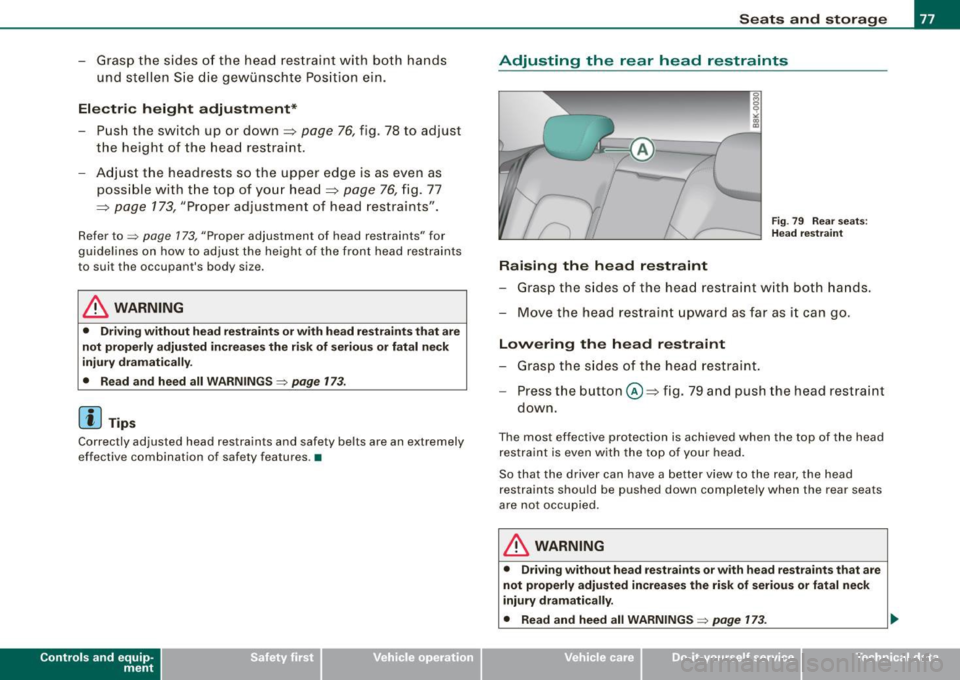
Adjusting the rear head restraints
Fig . 79 Rear seats:
Head restraint
Raising the head restraint
- Grasp the sides of the head restraint with both hands.
- Move the head restraint upward as far as it can go.
Lowering the head restraint
- Grasp the sides of the head restraint.
- Press the button@~ fig. 79 and push the head restraint
down.
The most effective protection is achieved when the top of the head
restraint is even with the top of your head.
So that the driver can have a better view to the rear, the head
restraints should be pushed down completely when the rear seats
are not occupied.
& WARNING
• Driving without head restraints or with head restraints that are
not properly adjusted increases the risk of serious or fatal neck
injury dramatically.
• Read and heed all WARNINGS =>
page 173. _.,
Vehicle care I I irechnical data
Page 80 of 360

Seats and storage
[ i J Tips
Correctly adjusted head restraints and safety belts are an extremely
effective combination of safety features. •
Center armrest
The center armrest can be adjusted to several levels.
Adjusting the center armrest
Fig. 80 Armrest
between the
driver's /front
passenger's seats .
To adjust the angle, raise the armrest from the starting
position detent by detent => fig. 80.
To bring the armrest back into the starting position, raise
it out of the top detent and fold it back down.
The armrest can slide forward and back.•
Luggage compartment
Loading luggage compartment
Items of luggage must be stowed securely.
Fig. 81 Place heavy
objects as far forward
as possible.
Note the following to preserve the vehicle's good handling
characteristics.
- Distribute the load as evenly as possible.
- Place heavy objects as far forward as possible => fig. 81.
- Secure the items of luggage with the cargo net* or with
non -elastic retaining straps to the tie-down rings*
=> page 79.
& WARNING
• Loose objects in the luggage compartment can slide about
suddenly and alter the vehicle's handling characteristics.
• Loose objects in the passenger compartment can fly forward
during abrupt maneuvers or accidents and injure occupants.
• Always store objects in the luggage compartment and use suit-
able straps, particularly with heavy objects. •
Page 82 of 360

Seats and stor ag e
St orage n et
- Engage the hooks on the cargo net in the fastening
eyelets in the f loor at the rear of the l uggage compart
me nt
~ page 79, fig . 84 .
Fo ld down the attaching hooks in t he upper area of the
luggage compartment, pull the net up and hang the
eyelets on the net into the hooks .
You can use the attaching hooks~ page 79, fig. 84 to hang bags,
sacks, etc.
If nothing is attached to the hooks , they fold back by themselves.
& WARNING
Fo r rea sons of str ength , only o bjects wit h a m axim um weight of
5 kg should b e carri ed in the sto rag e net . H ea vier obje cts a re not
a d equ atel y s ecur ed . T here is risk of p ers onal inj ury. •
Ap plies to vehicle s: with fo lding s ea t b ack
Enlarging cargo capacity of the vehicle
interior
The seat backs can be folded forward to enlarge the cargo
capacity.
Fi g. 85 Release handle
on the seat bac k
Folding th e se atback forward
- When you pull the release lever@~ fig. 85 in the direc
tion of the a rrow, the safety knob© pops out far enough
for the red mar king on knob to be vis ible .
- Fo ld the seatback forward .
Raising the seatback
- Ra ise t he seatback un til it is securely latched~& .
When yo u can no longer se e the red ma rk o n the safety
knob @, the seat is latched.
& WARNING
The sea t ba ck mu st be securely l atc h ed so that obje cts c annot
s lide for ward out of the luggage compartm ent during sudd en
br ak ing.
0 Note
Make sure when raising the seatback that the rear safety belts are in
the guide so that a re not pinched in the seatback lock and
damaged. •
Page 84 of 360

Seats and storage
Applies to vehicles: wi th fo lding seat back
Locking the seatback
Fig. 88 Locking seat
back
- Turn the mechanical key~ fig . 88 to the right to lock the
seatback.
- Turn the mechanical key to the left to
unlock the seat
back.
The correctly latched seat back (basic position) can locked and
unlocked with the mechanical key next to the release handle . This
prevents any entry from the vehicle interior into the luggage
compartment.
0 Note
Make sure when raising the seatback that the rear safety belts are in
the guide so that are not pinched in the seatback lock and
damaged. •
Parcel shelf
The parcel shelf behind the rear seat bock con be used to
carry light items of clothing.
& WARNING
No heavy or hard objects should be placed on the parcel shelf.
They are a hazard to the vehicle occupants during sudden braking.
The is a risk of injury.
0 Note
Please make sure that the heating wires for the rear window
defogger are not damage by abrasive objects.
[ i ] Tips
To ensure problem -free ventilation, the ventilation slots between
the rear window and the parcel shelf must not be covered. •
Applies to vehicles: with ski sack
Ski sack
The ski sock con be carried in the interior with the help of
the poss-through.
e
Fig. 89 In the rear seat
bench: Opening the
pass-through
~
Page 85 of 360

Opening the trunk pass-through
-Fold the center armrest in the rear forward and out .
- Pull the release handle=:> page
82, fig. 89 -Arrow- and
fold down the cover of the pass-through in the vehicle interior.
- Open the rear lid.
- Push the ski sack through the opening from the luggage
compartment.
- Secure the ski sack => page
83.
Closing the trunk pass-through
- Open the rear lid.
- Remove the ski sack from the trunk pass-through.
- Push the pass-through cover up inside the vehicle until it
latches.
- Raise the center armrest in the vehicle again .
- Close the rear lid .
& WARNING
Objects must only be transported in the ski sack since the ski sack
can be secured. Individual objects cannot be secured. There is a
risk of injury.
[ i] Tips
• You can open the pass -through from the luggage compartment.
Push the release button down and push the cover forward.
• The pass -through can be locked and unlocked with the vehicle
mechanical key:::::, page
82, fig. 89 . •
Con tro ls and eq uip
ment
A pp lies to vehicles: wit h ski sa ck
Securing the ski sack
Seats and storage
The ski sack must be secured in the luggage compart
ment.
Fig . 90 Luggage
compartment :
Securing the bag
Fig . 91 Securing the
objects in the ski sack
Securing the ski sack in the luggage
compartment
- The ski sack has two belts with hooks on the underside.
Hang the hooks to the rear fastening eyelets in the
luggage compartment => fig. 90.
Vehicle care I I irechnical data
Page 116 of 360

• .___O_ n_ t_h _e_ r_o _a_ d __________________________________________________ _
When stopping at a traffic signal or stopping in city traffic on vehi
cles with an automatic transmission, the parking brake can be
applied. The vehicle does not have to be held with the footbrake . The
parking brake eliminates the tendency to creep with a drive range
engaged . As soon as you drive off as usual , the parking brake is
released automatically and the vehicle starts to move.
Starting on slopes
When starting on inclines, the starting assist prevents the vehicle
from unintentionally rolling back . The braking force of the parking
brake is not released until sufficient driving force has been built up
at the wheels .
[ i] Tips
For safety reasons , the parking brake is released automatically only
when the driver's safety belt is engaged in the buckle .•
Starting off with a trailer
To prevent rolling back unintentionally on an incline, do
the following:
- Keep the switch pulled and depress the accelerator . The
parking brake stays applied and prevents the vehicle
from rolling backward.
- You can release the switch once you are sure that you are
developing enough driving force at the wheels by
depressing the accelerator.
Depending on the weight of the rig (vehicle and trailer) and the
severity of the incline, you may roll backwards as you start. You can
prevent rolling backwards by holding the parking brake switch
pulled out and accelerating -just as you would when starting on a
hill with a conventional hand brake. •
Emergency braking
In the event that the conventional brake system fails or
locks.
- In an emergency, pull the switch and continue to pull it to
slow your vehicle down with the parking brake.
- As soon as you release the switch or accelerate, the
braking process stops.
If you pull the switch and hold it above a sp eed of about 5 mph (8
km/h), the emergency braking function is initiated. The vehicle is
braked at all four wheels by activating the hydraulic brake system .
The brake performance is similar to making an emergency stop
=>& .
In order not to activate the emergency braking by mistake, an
audible warning tone (buzzer) sounds when the switch is pulled. As
soon as the switch is released, or the accelerator pedal is depressed,
emergency braking stops.
& WARNING
Emergency braking should only be used in an emergency, when
the normal foot brake has failed or the brake pedal is obstructed .
Using the parking brake to perform emergency braking will slow
your vehicle down as if you had made a full brake application. The
laws of physics cannot be suspended even with ESP and its asso
ciated components (ABS, ASR, EDS) .
In corners and when road or
weather conditions are bad, a full brake application can cause the
vehicle to skid or the rear end to break away -risking an
accident. •
Page 117 of 360

On th e road 1111
-------------------'
Driver messages in the instrument cluster
Warning Vehicl e in cline is e xce ssive
This message appears when the parking brake is applied on an
incline that exceeds about 30%.
In this case the braking power of the park ing brake may
n ot be
adequ ate
to prevent the vehicle from rol ling unintentionally.
Pl ease release parking brake
Please note that for safety reasons the parking brake is re leased
automatically only if the driver's seat belt is fully engaged in the
buckle.
To relea se the parking brake pre ss the br ake pedal
This driver message appears when the switch to release the parking
brake was pressed. The parking brake can only be released if you
step on the brake pedal and at the same time press the switch or
you automatically release the parking brake wi th the starting assist
=> page 113.
Parking brake!
This driver message appears together with the yellow symbol
when there is a parking b rake ma lfunction.
M alfun ction sta rt ing a ssist
This driver message appears if the re is a starting assist ma lfunction .
The automatic release of the parking brake when starting is
malfunctioning. You have to release the parking brake manua lly by
pressing the switch. Have the problem corrected by an authorized
Audi dea ler .•
Con tro ls and eq uip
ment
Cruise control
Switching on
The cruise control system m akes it possible to drive at a
constan t speed starting at 20 mph (30 km/h) .
A--
Fig. 120 Con tro l l ever
w ith pu sh -butt on
Fig . 12 1 D ispla y:
Se lec te d sp ee d
Pull the lever to pos ition (D => fig. 120 to switc h the
system on.
Drive a t th e speed to be controlled .
Press button
© to set that speed.
The stored speed and the green symbol ( CRU ISE (US mode l)/ c,f'
(Canadian model) are shown in the display=> fig. 121. The display _.,
Vehicle care I I irechnical data
Page 170 of 360
___ o_ r_iv _ i _n....; g::;_ S_ a_f _e _ly=-- -------------------------------------------------
Driving Safely
General notes
Safe driving habits
Please remember -safety first!
This chapter contains important information, tips, instructions and
warnings that you need to read and observe for your own safety, the
safety of your passengers and others. We have summarized here
what you need to know about safety belts, airbags, child restraints
as well as child safety. Your safety is for us
priority number 1. Always
observe the information and warnings in this section -for your own
safety as well as that of your passengers.
The information in this section applies to all model versions of your
vehicle. Some of the features described in this sections may be
standard equipment on some models, or may be optional equip
ment on others. If you are not sure, ask your authorized Audi dealer.
& WARNING
• Always make sure that you follow the instructions and heed
the WARNINGS in this Manual. It is in your interest and in the
interest of your passengers.
• Always keep the complete Owner's Literature in your Audi
when you lend or sell your vehicle so that this important informa
tion will always be available to the driver and passengers.
• Always keep the Owner's literature handy so that you can find
it easily if you have questions .•
Safety equipment
The safety features are part of the occupant restraint
system and work together to help reduce the risk of injury
in a wide variety of accident situations.
Your safety and the safety of your passengers should not be left to
chance. Advances in technology have made a variety of features
available to help reduce the risk of injury in an accident. The
following is a list of just a few of the safety features in your Audi:
• sophisticated safety belts for driver and all passenger seating
positions,
• belt force limiters for the seats,
• belt pretensioners for the seats,
• head restraints for each seating position,
• front airbags,
• side airbags in the front seats,
• side curtain airbags,
• special LATCH anchorages for child restraints,
• adjustable steering column.
These individual safety features, can work together as a system to
help protect you and your passengers in a wide range of accidents.
These features cannot work as a system if they are not always
correctly adjusted and correctly used.
Safety is everybody's responsibility! •