Page 5 of 130
EBU17170
INTRODUCTION
EBU17290
Congratulations on your purchase of the Yamaha YFM125GY. This ATV represents the result of many
years of Yamaha experience in the production of fine sporting, touring, and pacesetting racing machines.
With the purchase of this Yamaha, you can now appreciate the high degree of craftsmanship and reliability
that have made Yamaha a leader in these fields.
This manual will provide you with a good basic understanding of the features and operation of this ATV.
This manual includes important safety information. It provides information about special tech-
niques and skills necessary to ride the ATV.
It also includes basic maintenance and inspection proce-
dures. If you have any questions regarding the operation or maintenance of your ATV, please consult a
Yamaha dealer.
AN IMPORTANT SAFETY MESSAGE:
�
READ THIS MANUAL COMPLETELY BEFORE OPERATING YOUR ATV. MAKE SURE YOU UNDER-
STAND ALL INSTRUCTIONS.
�
PAY CLOSE ATTENTION TO THE WARNING AND CAUTION LABELS ON THE ATV.
�
THIS ATV, AND ANY OTHER ATV OVER 90 cc, SHOULD NOT BE RIDDEN BY ANYONE UNDER 16
YEARS OF AGE.
Page 6 of 130
EBU17330
IMPORTANT MANUAL INFORMATION
EBU17342
FAILURE TO FOLLOW THE WARNINGS CONTAINED IN THIS MANUAL CAN RESULT IN SERIOUS IN-
JURY OR DEATH.
Particularly important information is distinguished in this manual by the following notations:
* Product and specifications are subject to change without notice.
This is the safety alert symbol. It is used to alert you to potential per-
sonal injury hazards. Obey all safety messages that follow this sym-
bol to avoid possible injury or death.
A WARNING indicates a hazardous situation which, if not avoided,
could result in death or serious injury.
A NOTICE indicates special precautions that must be taken to avoid
damage to the vehicle or other property.
A TIP provides key information to make procedures easier or clearer.
WARNING
NOTICETIP
Page 8 of 130

EBU17420
TABLE OF CONTENTS
SAFETY INFORMATION .............................. 1-1
LOCATION OF THE WARNING AND
SPECIFICATION LABELS ............................ 2-1
DESCRIPTION .............................................. 3-1
Left view ..................................................... 3-1
Right view................................................... 3-1
Controls and instruments ........................... 3-2
INSTRUMENT AND CONTROL
FUNCTIONS .................................................. 4-1
Main switch ............................................... 4-1
Indicator lights ........................................... 4-1
Handlebar switches ................................... 4-2
Throttle lever ............................................. 4-3
Speed limiter ............................................. 4-3
Front brake lever ....................................... 4-4
Rear brake lever ........................................ 4-4
Parking brake ............................................ 4-5
Drive select lever ....................................... 4-6
Fuel tank cap ............................................. 4-6
Fuel ........................................................... 4-6
Fuel cock ................................................... 4-7
Starter (choke) .......................................... 4-9Seat ........................................................... 4-9
Front carrier ............................................. 4-10
Rear carrier .............................................. 4-10
PRE-OPERATION CHECKS ..........................5-1
Pre-operation check list ............................. 5-1
Fuel ............................................................ 5-3
Engine oil ................................................... 5-3
Transmission oil ......................................... 5-3
Front and rear brakes ................................ 5-3
Throttle lever .............................................. 5-4
Drive chain ................................................. 5-4
Tires ........................................................... 5-4
Measuring the tire pressure ....................... 5-5
Tire wear limit ............................................ 5-6
Chassis fasteners ...................................... 5-6
Instruments, lights and switches ................ 5-6
Battery ....................................................... 5-6
OPERATION...................................................6-1
Starting a cold engine ................................ 6-1
Starting a warm engine .............................. 6-3
Operating the drive select lever and
driving in reverse ..................................... 6-3
Engine break-in .......................................... 6-4
Parking ....................................................... 6-5
Page 13 of 130

1-3
1
2
3
4
5
6
7
8
9
10
11
backwards when climbing a hill. To avoid stall-
ing, use the proper gear and maintain a steady
speed when climbing a hill. If you stall or roll
backwards, follow the special procedure for
braking described in this manual. Dismount on
the uphill side or to a side if pointed straight up-
hill. Turn the ATV around and remount, following
the procedure described in this manual.
�
Always check for obstacles before operating in a
new area.
�
Never attempt to operate over large obstacles,
such as large rocks or fallen trees. Always follow
proper procedures when operating over obsta-
cles as described in this manual.
�
Always be careful when skidding or sliding.
Learn to safely control skidding or sliding by
practicing at low speeds and on level, smooth
terrain. On extremely slippery surfaces, such as
ice, go slowly and be very cautious in order to re-
duce the chance of skidding or sliding out of con-
trol.
�
Never operate an ATV in fast flowing water or in
water deeper than that recommended in this
manual. Remember that wet brakes may have
reduced stopping ability. Test your brakes after
leaving water. If necessary, apply them severaltimes to let friction dry out the linings.
�
Always be sure there are no obstacles or people
behind you when you operate in reverse. When
it is safe to proceed in reverse, go slowly.
�
Always use the size and type of tires specified in
this manual.
�
Always maintain proper tire pressure as de-
scribed in this manual.
�
Never modify an ATV through improper installa-
tion or use of accessories.
�
Never exceed the stated load capacity for an
ATV. Cargo should be properly distributed and
securely attached. Reduce speed and follow in-
structions in this manual for carrying cargo or
pulling a trailer. Allow greater distance for brak-
ing.WARNING
EWB00061
�
Always turn off the engine when refueling.
�
Do not refuel right after the engine has been
running and is still very hot.
�
Do not spill gasoline on the engine or ex-
haust pipe/muffler when refueling. Never re-
fuel while smoking, or in the vicinity of
sparks, open flames, or other sources of ig-
nition such as the pilot lights of water heat-
Page 14 of 130
1-4
1
2
3
4
5
6
7
8
9
10
11
ers and clothes dryers. Gasoline can catch
fire and you could be burned.
�
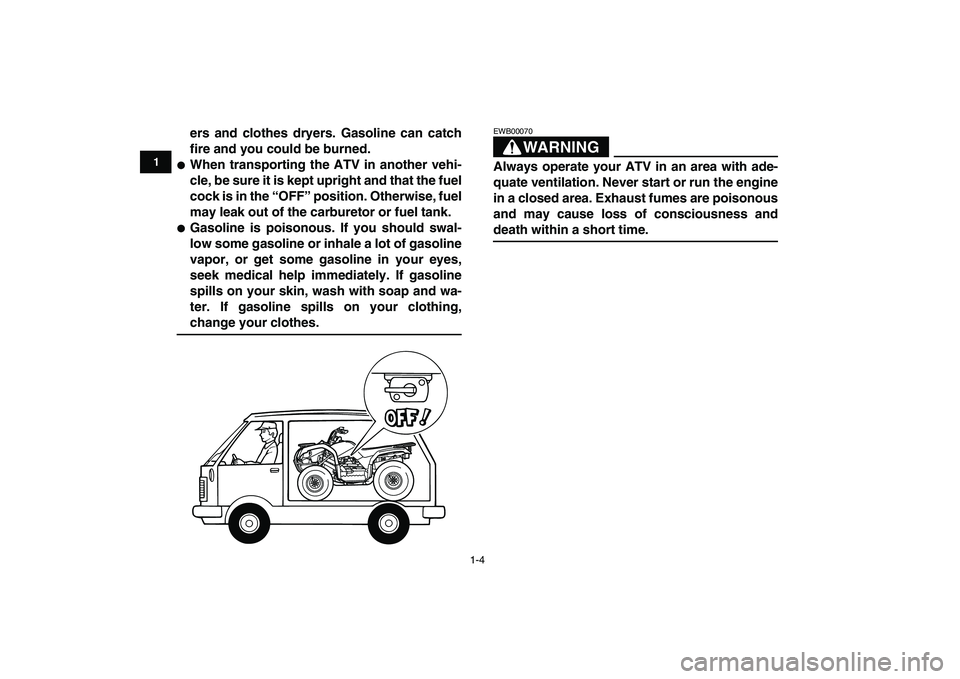
When transporting the ATV in another vehi-
cle, be sure it is kept upright and that the fuel
cock is in the “OFF” position. Otherwise, fuel
may leak out of the carburetor or fuel tank.
�
Gasoline is poisonous. If you should swal-
low some gasoline or inhale a lot of gasoline
vapor, or get some gasoline in your eyes,
seek medical help immediately. If gasoline
spills on your skin, wash with soap and wa-
ter. If gasoline spills on your clothing,
change your clothes.
WARNING
EWB00070
Always operate your ATV in an area with ade-
quate ventilation. Never start or run the engine
in a closed area. Exhaust fumes are poisonous
and may cause loss of consciousness and
death within a short time.
Page 15 of 130
2-1
12
3
4
5
6
7
8
9
10
11
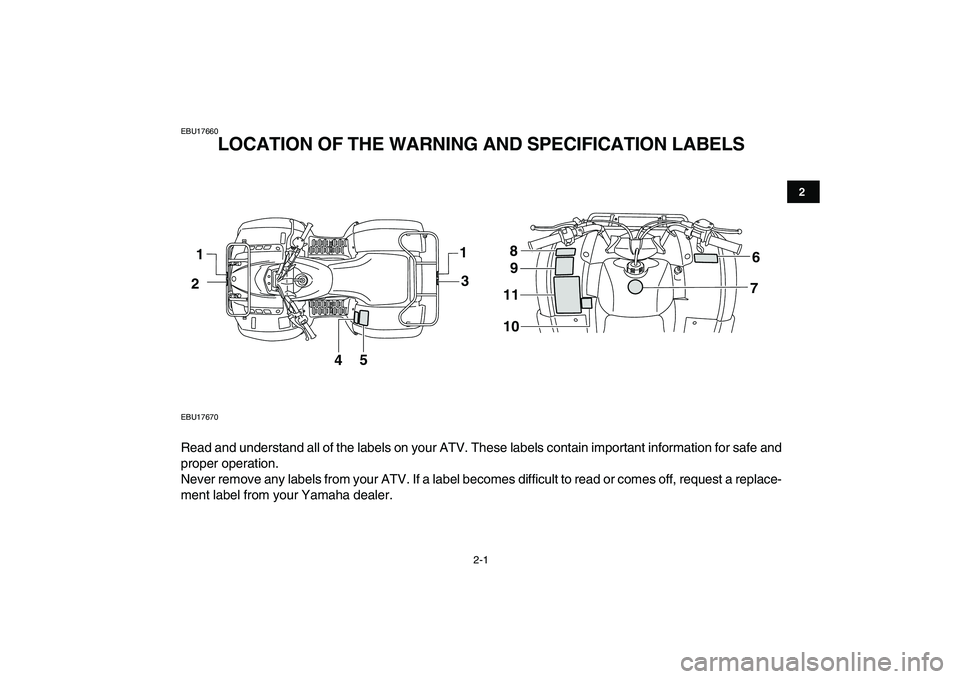
EBU17660
LOCATION OF THE WARNING AND SPECIFICATION LABELS
EBU17670
Read and understand all of the labels on your ATV. These labels contain important information for safe and
proper operation.
Never remove any labels from your ATV. If a label becomes difficult to read or comes off, request a replace-
ment label from your Yamaha dealer.
1
3
5
4 1
2
8
9
11
106
7
Page 16 of 130
2-2
12
3
4
5
6
7
8
9
10
11
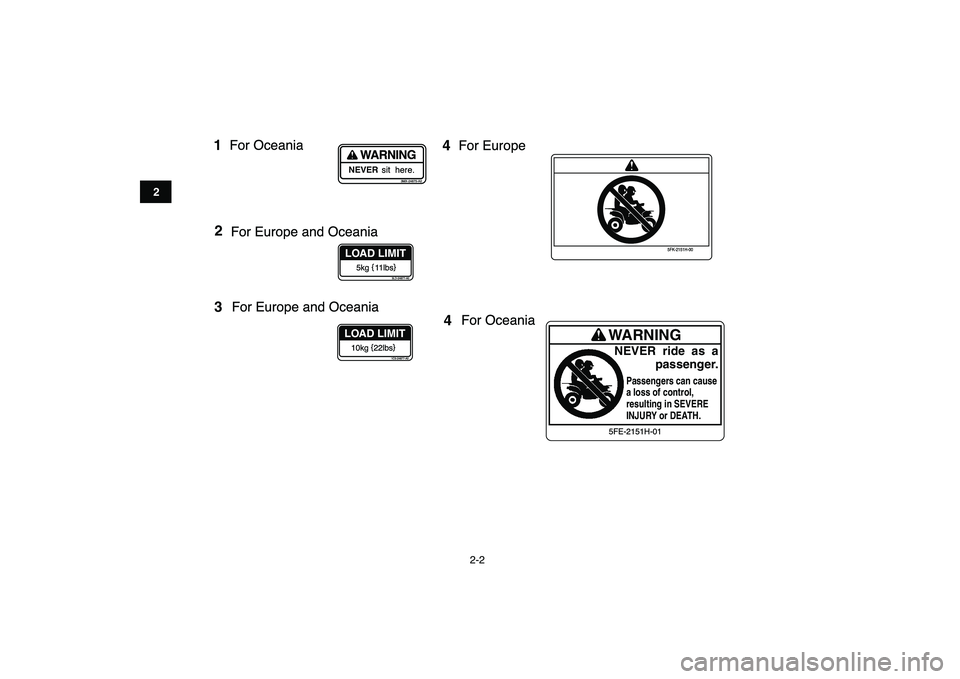
For Europe
For Oceania
5FK-2151H-00
For Oceania
sit here. NEVER
3MX-24875-A0
5kg
11lbs
3LD-24877-A0
10kg
22lbs
1C5-24877-A0
1
2
34
4
WARNINGNEVER ride as a
passenger.Passengers can cause
a loss of control,
resulting in SEVERE
INJURY or DEATH.
5FE-2151H-01
For Europe and Oceania
For Europe and Oceania
Page 17 of 130
2-3
12
3
4
5
6
7
8
9
10
11
GB
D
E
FI
NL
P
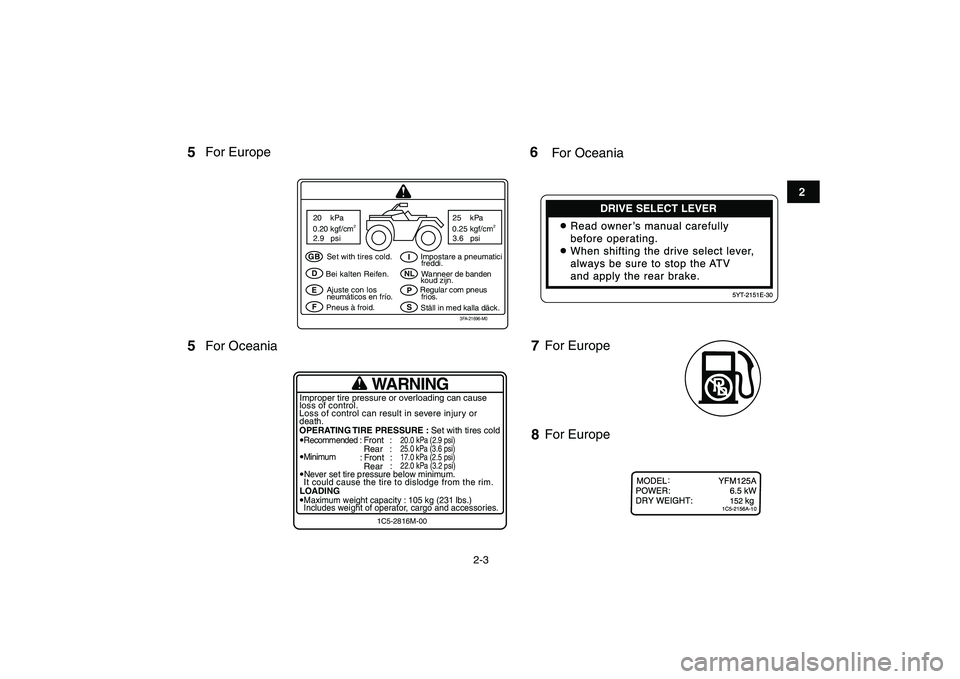
S Set with tires cold.
Bei kalten Reifen.
Ajuste con los
neumáticos en frío.
Pneus à froid.Impostare a pneumatici
freddi.
Wanneer de banden
koud zijn.
Regular com pneus
frios.
Ställ in med kalla däck. 20 kPa
0.20 kgf/cm
2
2.9 psi25 kPa
0.25 kgf/cm
2
3.6 psi3FA-21696-M0
For Europe
For Oceania
5
5
For Oceania
For Europe For Europe
7
8 6
WARNING
Improper tire pressure or overloading can cause
loss of control.
Loss of control can result in severe injury or
death.
OPERATING TIRE PRESSURE : Set with tires coldRecommended
: Front :
20.0 kPa (2.9 psi)
Rear:
25.0 kPa (3.6 psi)
Minimum
: Front :
17.0 kPa (2.5 psi)
Rear:
22.0 kPa (3.2 psi)
Never set tire pressure below minimum.
It could cause the tire to dislodge from the rim.LOADINGMaximum weight capacity : 105 kg (231 lbs.)
Includes weight of operator, cargo and accessories.
1C5-2816M-00