2009 VOLVO XC90 ECU
[x] Cancel search: ECUPage 150 of 282

06 Starting and drivingTowing
06150
CAUTION
Vehicles with AWD (All Wheel Drive) with the
front wheels off the ground should not be
towed at speeds about 50 mph (70 km/h) or
for distances longer than 30 miles (50 km).
CAUTION
•
Please check with state and local
authorities before attempting this type
of towing, as vehicles being towed are
subject to regulations regarding maxi-
mum towing speed, length and type of
towing device, lighting, etc.
•
If the vehicle's battery is dead, do not
attempt to start the vehicle by pushing
or pulling it as this will damage the
three-way catalytic converter(s). The
engine must be jump started using an
auxiliary battery (see page 141).
•
If the vehicle is being towed on a flat bed
truck, the towing eyelets must not be
used to secure the vehicle on the flat
bed. Consult the tow truck operator.
WARNING
•
Remember that the power brakes and
power steering will not function when
engine is not running. The braking and
steering systems will function but the
brake pedal pressure required is
3 – 4 times above normal and greater
steering effort must be exerted.
•
The towing eyelets must not be used for
pulling another vehicle out of a ditch or
for any similar purpose involving severe
strain.
•
Do not use the towing eyelets to pull the
vehicle up onto a flat bed tow truck.
G030862
Towing vehicles with front wheel drive/
All Wheel DriveVolvo recommends the use of flat bed equip-
ment.
If wheel lift equipment must be used, please
use extreme caution to help avoid damage to
the vehicle. In this case, the vehicle should
be towed with the rear wheels on the ground
if at all possible.
If it is absolutely necessary to tow the vehicle
with the front wheels on the ground, please
refer to the towing information on the previous
page.
CAUTION
•
Sling-type equipment applied at the
front will damage radiator and air con-
ditioning lines.
•
It is equally important not to use sling-
type equipment at the rear or apply lift-
ing equipment inside the rear wheels;
serious damage to the rear axle may
result.
•
If the vehicle is being towed on a flat bed
truck, the towing eyelets must not be
used to secure the vehicle on the flat
bed. Consult the tow truck operator.
Page 156 of 282
06 Starting and drivingLoad carriers (accessory)
06156
Positioning load carriersIf wing-shaped load carriers are used, make
sure that they are installed on the roof rails with
the rounded edge forward. Load carriers of this
type are identical and can be placed anywhere
along the roof rails.
When not in use, we recommend that the front
load carrier be placed approximately 2 inches
(5 cm) in front of the center roof rail anchorage
point and the rear load carrier approximately
1.5 inches (3.5 cm) in front of the rear rail
anchorage. This will help to reduce wind noise.Installing load carriersMake sure that the load carriers are pressed
firmly out against the roof rail and securely
tightened place. Check regularly that any load
carriers are securely in place.
WARNING
Loads carried on the vehicle's roof should
not exceed 220 lbs (100 kg), including the
weight of the load carriers and any other
load carrying equipment (ski boxes, bicycle
racks, etc.). Excessive loads on the roof can
adversely affect the handling and roadhold-
ing characteristics of the vehicle.
Page 182 of 282

07 Wheels and tiresChanging wheels
07182
5. Continue to raise the wheel by turning the
crank clockwise. Raise the wheel a little bit
at a time and guide it around the rear axle
until it is securely seated in the storage
area.
6. When it is no longer possible to turn the
crank any further, check that the spare
wheel is securely in position in the storage
compartment.
G026997
Jack attachment pointsJack attachmentsThere are two attachment points for the jack on
each side of the vehicle. These attachment
points are under the center of each door.
WARNING
There is an attachment point on each side
of the vehicle located under the pillars
between the front and rear doors. This point
is used during the production process only,
and is NOT intended for attaching the jack.
G020332
WARNING
The undersides of accessory running
boards are not intended for attaching the
jack.
Changing a wheel•
Park the vehicle on a firm, level, non-slip-
pery surface.
•
Engage the parking brake and put the gear
selector in the Park position.
•
Loosen the wheel bolts by exerting down-
ward pressure on the lug wrench.
•
Remove the wheel cap (where applicable)
using the lug wrench in the tool bag.
•
With the wheels still on the ground, use the
lug wrench to loosen the wheel bolts
1/2 – 1 turn. Turn the bolts counterclock-
wise to loosen the bolts.CAUTION
•
The vehicle must not be driven with
wheels of different dimensions or with a
spare tire other than the one that came
with the vehicle. The use of different size
wheels can seriously damage your vehi-
cle's transmission.
•
Correct tightening torque on wheel
bolts must be observed.
•
The wheel bolts should never be
greased or lubricated.
•
Extended, chromed wheel bolts must
not be used with steel rims, as they
make it impossible to fit the hub caps.
Page 187 of 282

07 Wheels and tires
Tire Sealing System
07``187
3. Ensure that the on/off switch is in position
0 (the 0 side of the switch should be
pressed down).
4. Put on the gloves included in the tire seal-
ing system.
WARNING
Contact with the sealing compound may
cause skin irritation. If contact occurs, wash
the affected area immediately with soap and
water.5. Unscrew the orange cover over the bottle
holder and unscrew the cap on the bottle
of sealing compound.
NOTE
Do not break the seal on the bottle. This
occurs automatically when the bottle is
screwed into the holder.6. Screw the bottle into the bottle holder.
WARNING
The bottle is equipped with a catch to keep
it securely in place and help prevent sealing
compound leakage. Once in place, the bot-
tle cannot be unscrewed. This must be done
by a trained and qualified Volvo service
technician.7. Remove the valve cap from the tire’s infla-
tion valve and screw the tire sealing sys-
tem’s hose connector onto the valve as
tightly as possible by hand.
8. Connect the electrical wire to the nearest
12-volt socket in the vehicle.
9. Start the vehicle’s engine.
10. Start the tire sealing system’s compressor
by pressing the on/off switch to position I.
WARNING
•Never stand next to the tire being inflated
when the compressor is in operation.•If cracks, bubbles, etc. form on the tire,
switch off the compressor immediately.•If there is visible damage to the sidewall
or the rim, the tire cannot be repaired.
The vehicle should not be driven if this
occurs. Contact a towing service or
Volvo On Call Roadside Assistance if
applicable.NOTE
The air pressure gauge will temporarily
show an increase in pressure to approxi-
mately 88 psi (6 bar) while the sealing com-
pound is being pumped into the tire. The
pressure should return to a normal level
after approximately 30 seconds.11. Within seven minutes, inflate the tire to
between 22—44 psi (1.8—3.0 bar). Switch
off the compressor briefly to get a clear
reading from the pressure gauge. The
compressor should not be used for more
than 10 minutes at a time to avoid over-
heating.
Page 195 of 282

08 Car care
Washing and cleaning the vehicle
08``195
fully. Solvents or stain removers should not be
used.
CAUTION
•
Avoid waxing or polishing plastic or rub-
ber components
•
Polishing chromed strips can wear
away or damage the surface
•
Polishes containing abrasive sub-
stances should not be usedNOTE
When washing the vehicle, remember to
remove dirt from the drain holes in the doors
and sills.
WARNING
•
When the vehicle is driven immediately
after being washed, apply the brakes
several times in order to remove any
moisture from the brake linings.
•
Engine cleaning agents should not be
used when the engine is warm. This
constitutes a fire risk.
Automatic washing – simple and quick•
We do NOT recommend washing your
vehicle in an automatic wash during thefirst six months (because the paint will not
have hardened sufficiently).
•
An automatic wash is a simple and quick
way to clean your vehicle, but it is worth
remembering that it may not be as thor-
ough as when you yourself go over the
vehicle with sponge and water. Keeping
the underbody clean is most important,
especially in the winter. Some automatic
washers do not have facilities for washing
the underbody.
•
Before driving into an automatic car wash,
make sure that side view mirrors, auxiliary
lamps, etc, are secure, and that any
antenna(s) are retracted or removed. Oth-
erwise there is risk of the machine dislodg-
ing them.
Exterior lightingCondensation may form temporarily on the
inside of the lenses of exterior lights such as
headlights, fog lights, or tail lights. This is nor-
mal and the lights are designed to withstand
moisture. Normally, condensation will dissi-
pate after the lights have been on for a short
time.
Polishing and waxing•
Normally, polishing is not required during
the first year after delivery, however, wax-
ing may be beneficial.
•
Before applying polish or wax the vehicle
must be washed and dried. Tar spots can
be removed with kerosene or tar remover.
Difficult spots may require a fine rubbing
compound.
•
After polishing use liquid or paste wax.
•
Several commercially available products
contain both polish and wax.
•
Waxing alone does not substitute for pol-
ishing a dull surface.
•
A wide range of polymer-based car waxes
can be purchased today. These waxes are
easy to use and produce a long-lasting,
high-gloss finish that protects the body-
work against oxidation, road dirt and fad-
ing.
•
Do not polish or wax your vehicle in direct
sunlight (the surface of the vehicle should
not be warmer than 113° F (45° C).
Page 213 of 282
09 Maintenance and servicing
Wiper blades
09
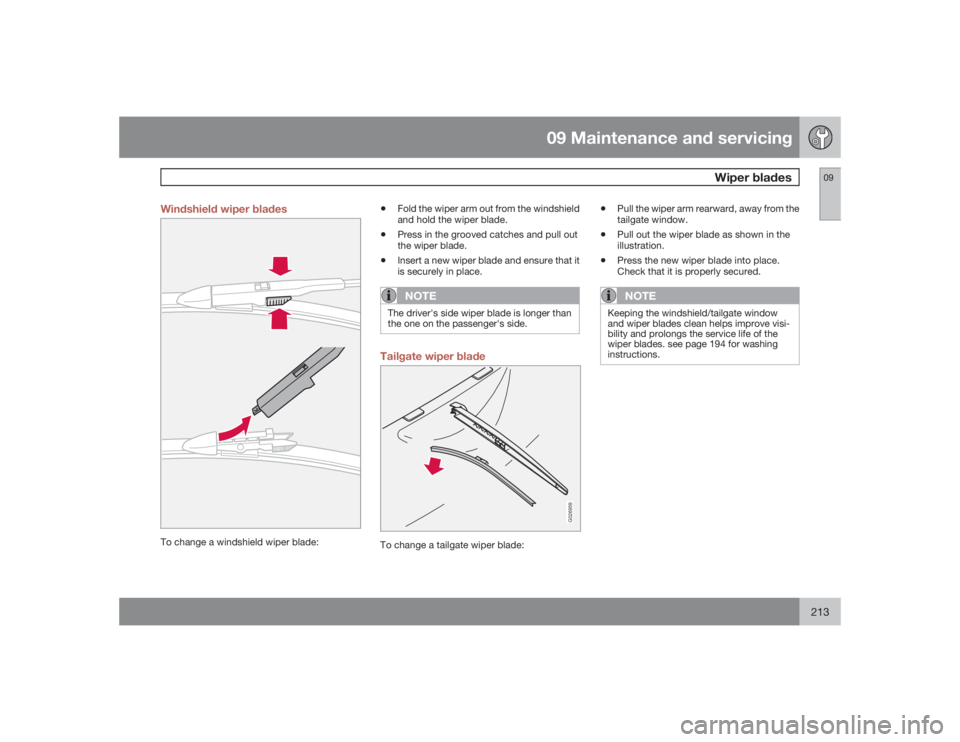
213 Windshield wiper blades
To change a windshield wiper blade:
•
Fold the wiper arm out from the windshield
and hold the wiper blade.
•
Press in the grooved catches and pull out
the wiper blade.
•
Insert a new wiper blade and ensure that it
is securely in place.NOTE
The driver's side wiper blade is longer than
the one on the passenger's side.Tailgate wiper blade
G026959
To change a tailgate wiper blade:
•
Pull the wiper arm rearward, away from the
tailgate window.
•
Pull out the wiper blade as shown in the
illustration.
•
Press the new wiper blade into place.
Check that it is properly secured.NOTE
Keeping the windshield/tailgate window
and wiper blades clean helps improve visi-
bility and prolongs the service life of the
wiper blades. see page 194 for washing
instructions.
Page 214 of 282

09 Maintenance and servicingBattery
09214
Battery maintenance
A
G030882
Two types of battery may be used and are fully
interchangeableThe battery in your vehicle is located under the
floor of the cargo compartment.
Driving habits and conditions, climate, the
number of starts, etc. all affect the service life
and function of the battery. In order for your
battery to perform satisfactorily, keep the fol-
lowing in mind:
G030883
•
Check the fluid level in each cell in the bat-
tery every 24 months or every 15,000
1
miles (24,000 km), whichever is sooner.
The fluid should be at the level shown in the
illustration above (A)
2. Do not overfill.
•
Use a screw driver to open the caps or
cover and a flashlight to inspect the level.
•
If necessary, add distilled water. The level
should never be above the indicator (A)
2.
•
The fluid level should be checked if the
battery has been recharged.
•
After inspection, be sure the cap over each
battery cell or cover is securely in place.
•
Check that the battery cables are correctly
connected and properly tightened. Route
ventilation hose through opening in floor
(see one of the illustrations in "Replacing
the battery" on page 215).
•
Never disconnect the battery when the
engine is running, for example when
changing the battery.
•
The battery should be disconnected from
the vehicle when a battery charger is used
directly on the battery.
•
However, if the battery is being charged via
the connecting points in the engine com-
partment (see page 141), the battery must
be connected.WARNING
PROPOSITION 65 WARNING!
Battery posts, terminals, and related acces-
sories contain lead and lead compounds,
chemicals known to the state of California
to cause cancer and reproductive harm.
Wash hands after handling.
1More frequently in warm climates.2The level indicator inside the battery could be designed in various ways. See illustrations.
Page 216 of 282

09 Maintenance and servicingBattery
09216
1. Switch off the ignition.
2.
Wait at least 5 minutes after switching
off the ignition before disconnecting the
battery so that all information in the vehi-
cle's electrical system can be stored in the
control modules.
3. Remove the retaining bracket and unscrew
the cover over the battery. Wait at least
5 minutes after switching off the ignition
before disconnecting the battery so that all
information in the vehicle's electrical sys-
tem can be stored in the control modules.
4. Disconnect the negative (ground) cable
first.
G027075
5. Disconnect the positive cable and pull the
ventilation hose from the battery.
6. Lift out the old battery and put a new bat-
tery into place.
7. Connect the positive cable first.
8. Connect the negative (ground) cable.
9. Be sure that the ventilation hose (see right
column) is securely connected to the bat-
tery and that the other end of the hose is
properly routed through the ventilation
opening in the floor of the battery compart-
ment.
G030884
Ventilation hose
10. Reinstall the cover and retaining bracket
and screw it securely in place.
NOTE
After the battery has been disconnected or
replaced, lock and unlock the vehicle with
the central locking system's remote control
to reactivate such features as the power
windows, moonroof, courtesy lighting, etc.
WARNING
•
The battery generates hydrogen gas,
which is flammable and explosive. The
battery is fitted with a ventilation hose
which vents hydrogen gas out of the
battery compartment through a ventila-
tion opening in the bottom of this com-
partment. If the battery must be
replaced, it is essential that the ventila-
tion hose is properly connected to the
battery and that it is routed through the
ventilation opening provided (see illus-
tration).
•
Be sure the ventilation hose is free of
debris.
•
Only use replacement batteries equip-
ped with a ventilation hose. Consult a
trained and qualified Volvo service tech-
nician.