2009 VOLVO XC90 ECO mode
[x] Cancel search: ECO modePage 171 of 282

07 Wheels and tires
Tire inflation pressure tables – Canadian models
07
171
The following tire pressures are recommended
by Volvo for your vehicle. Refer to the tire infla-tion placard for information specific to the tires
installed on your vehicle at the factory.Cold tire pressures up to five personsTire size
Cold tire pressures up to five persons psi (kPa)
Optional pressure up to three persons psi (kPa)
Front
Rear
Front
Rear
225/70R16
235/65R17
235/60R18
39 (270)
39 (270)
32 (220)
32 (220)
255/50R19
255/45R20
39 (270)
39 (270)
35 (240)
35 (240)
Temporary spare tire
T155/85R18
61 (420)
61 (420)
61 (420)
61 (420)
Page 174 of 282

07 Wheels and tiresGlossary of tire terminology
07174
•
Tire information placard: A placard
showing the OE (Original Equipment) tire
sizes, recommended inflation pressure,
and the maximum weight the vehicle can
carry.
•
Tire Identification Number (TIN): A num-
ber on the sidewall of each tire providing
information about the tire brand and man-
ufacturing plant, tire size and date of man-
ufacturer.
•
Inflation pressure: A measure of the
amount of air in a tire.
•
Standard load: A class of P-metric or Met-
ric tires designed to carry a maximum load
at 35 psi [37 psi (2.5 bar) for Metric tires].
Increasing the inflation pressure beyond
this pressure will not increase the tires load
carrying capability.
•
Extra load: A class of P-metric or Metric
tires designed to carry a heavier maximum
load at 41 psi [43 psi (2.9 bar) for Metric
tires]. Increasing the inflation pressure
beyond this pressure will not increase the
tires load carrying capability.
•
kPa: Kilopascal, a metric unit of air pres-
sure.
•
PSI: Pounds per square inch, a standard
unit of air pressure.
•
B-pillar: The structural member at the side
of the vehicle behind the front door.
•
Bead area of the tire: Area of the tire next
to the rim.
•
Sidewall of the tire: Area between the
bead area and the tread.
•
Tread area of the tire: Area of the perim-
eter of the tire that contacts the road when
mounted on the vehicle.
•
Rim: The metal support (wheel) for a tire or
a tire and tube assembly upon which the
tire beads are seated.
•
Maximum load rating: a figure indicating
the maximum load in pounds and kilo-
grams that can be carried by the tire. This
rating is established by the tire manufac-
turer.
•
Maximum permissible inflation pres-
sure: the greatest amount of air pressure
that should ever be put in the tire. This limit
is set by the tire manufacturer.
•
Recommended tire inflation pressure:
inflation pressure, established by Volvo,
which is based on the type of tires that are
mounted on a vehicle at the factory. This
inflation pressure is affected by the number
of occupants in the vehicle, the amount of
cargo, and the speed at which the vehicle
will be driven for a prolonged period. This
information can be found on the tire infla-
tion placard(s) located on the driver's side
B-pillar or on the inside of the fuel filler dooron Canadian models, and in the tire infla-
tion table in this chapter.
•
Cold tires: The tires are considered to be
cold when they have the same temperature
as the surrounding (ambient) air. This tem-
perature is normally reached after the vehi-
cle has been parked for at least 3 hours.
Page 180 of 282
07 Wheels and tiresChanging wheels
07180
G030879
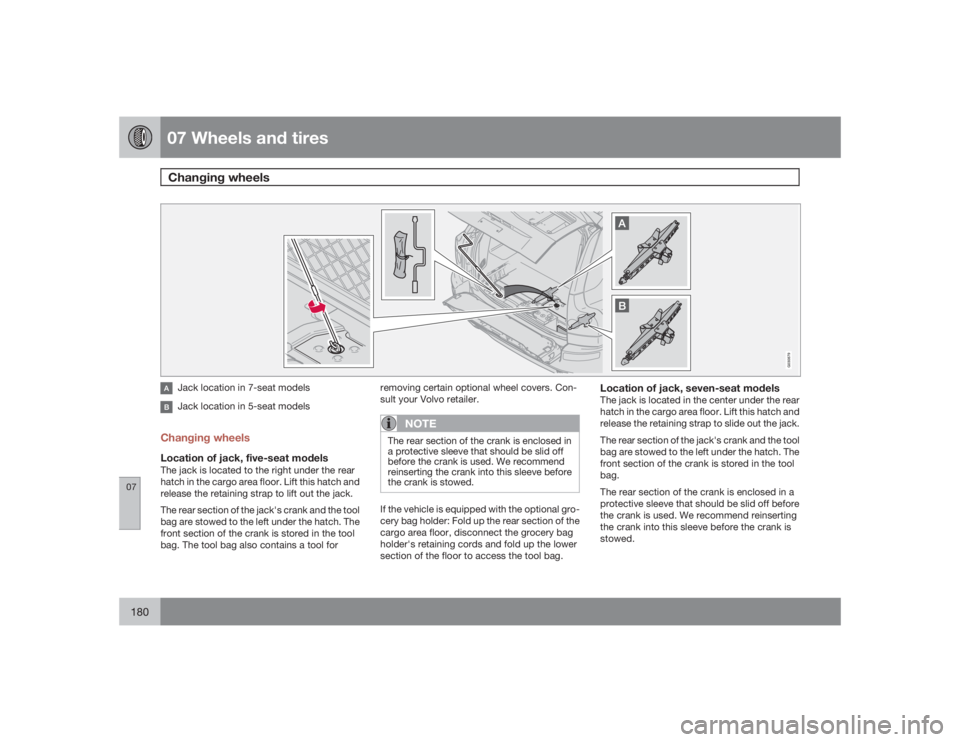
Jack location in 7-seat modelsJack location in 5-seat models
Changing wheelsLocation of jack, five-seat modelsThe jack is located to the right under the rear
hatch in the cargo area floor. Lift this hatch and
release the retaining strap to lift out the jack.
The rear section of the jack's crank and the tool
bag are stowed to the left under the hatch. The
front section of the crank is stored in the tool
bag. The tool bag also contains a tool forremoving certain optional wheel covers. Con-
sult your Volvo retailer.
NOTE
The rear section of the crank is enclosed in
a protective sleeve that should be slid off
before the crank is used. We recommend
reinserting the crank into this sleeve before
the crank is stowed.If the vehicle is equipped with the optional gro-
cery bag holder: Fold up the rear section of the
cargo area floor, disconnect the grocery bag
holder's retaining cords and fold up the lower
section of the floor to access the tool bag.
Location of jack, seven-seat modelsThe jack is located in the center under the rear
hatch in the cargo area floor. Lift this hatch and
release the retaining strap to slide out the jack.
The rear section of the jack's crank and the tool
bag are stowed to the left under the hatch. The
front section of the crank is stored in the tool
bag.
The rear section of the crank is enclosed in a
protective sleeve that should be slid off before
the crank is used. We recommend reinserting
the crank into this sleeve before the crank is
stowed.
Page 190 of 282

07 Wheels and tiresTire Pressure Monitoring System (TPMS) – U.S. models only
07190
The tire pressure monitoring system uses sen-
sors mounted in the tire valves to check infla-
tion pressure levels. When the vehicle is
moving at a speed of approximately 20 mph
(30 km/h) or faster, these sensors transmit
inflation pressure data to a receiver located in
the vehicle.USA – FCC ID: MRXG403MA4
A
This device complies with part 15 of the FCC
rules. Operation is subject to the following
conditions: (1) This device may not cause
harmful interference, and (2) this device
must accept any interference received,
including interference that may cause unde-
sired operation.
When low inflation pressure is detected,
TPMS will light up the tire pressure warning
light (also referred to as a telltale) in the
instrument panel (see page 57), and will dis-
play a message in the text window. The
wording of this message is determined by
the degree of inflation pressure loss.AOn certain models, the FCC code is MRXTG315AM04
NOTE
If a fault occurs in TPMS, the tire pressure
warning light will flash for approximately
1 minute and
TIRE PRESS SYST
SERVICE REQUIRED
will be displayed.
Each tire, including the spare (if provided),
should be checked monthly when cold and
inflated to the inflation pressure recommended
by the vehicle manufacturer on the vehicle
placard or tire inflation pressure label. (If your
vehicle has tires of a different size than the size
indicated on the vehicle placard or tire inflation
pressure label, you should determine the
proper tire inflation pressure for those tires.)
As an added safety feature, your vehicle has
been equipped with a tire pressure monitoring
system (TPMS) that illuminates a low tire pres-
sure telltale when one or more of your tires is
significantly under-inflated. Accordingly, when
the low tire pressure telltale illuminates, you
should stop and check your tires as soon as
possible, and inflate them to the proper pres-
sure. Driving on a significantly under-inflated
tire causes the tire to overheat and can lead to
tire failure. Under-inflation also reduces fuel
efficiency and tire tread life, and may affect the
vehicle's handling and stopping ability.
Please note that the TPMS is not a substitute
for proper tire maintenance, and it is the driv-er's responsibility to maintain correct tire pres-
sure, even if under-inflation has not reached
the level to trigger illumination of the TPMS low
tire pressure telltale.
Your vehicle has also been equipped with a
TPMS malfunction indicator to indicate when
the system is not operating properly. The
TPMS malfunction indicator is combined with
the low tire pressure telltale. When the system
detects a malfunction, the telltale will flash for
approximately one minute and then remain
continuously illuminated. This sequence will
continue upon subsequent vehicle start-ups as
long as the malfunction exists. When the mal-
function indicator is illuminated, the system
may not be able to detect or signal low tire
pressure as intended. TPMS malfunctions may
occur for a variety of reasons, including the
installation of replacement or alternate tires or
wheels on the vehicle that prevent the TPMS
from functioning properly. Always check the
TPMS malfunction telltale after replacing one
or more tires or wheels on your vehicle to
ensure that the replacement or alternate tires
and wheels allow the TPMS to continue to
function properly.
Page 191 of 282
07 Wheels and tires
Tire Pressure Monitoring System (TPMS) – U.S. models only
07
191
NOTE
TPMS indicates low tire pressure but does
not replace normal tire maintenance. For
information on correct tire pressure, please
refer to the tables on pages 170 and 171, or
consult your Volvo retailer.Erasing warning messagesWhen a low tire pressure warning message has
been displayed, and the tire pressure warning
light has come on:•
Use a tire pressure gauge to check the
inflation pressure of all four tires.
•
Re-inflate the tire(s) to the correct pressure
(consult the tire pressure placard or the
table see page 170).
•
Drive the vehicle for several minutes at a
speed of 20 mph (30 km/h) or faster.
This will erase the warning text and the warning
light will go out.WARNING
Incorrect inflation pressure could lead to tire
failure, resulting in a loss of control of the
vehicle.
Changing wheels with TPMSPlease note the following when changing or
replacing the factory installed TPMS wheels/
tires on the vehicle:•
Only the factory-mounted wheels are
equipped with TPMS sensors in the valves.
•
If the vehicle is equipped with a temporary
spare tire, this tire does not have a TPMS
sensor.
•
If wheels without TPMS sensors are moun-
ted on the vehicle,
TIRE PRESS SYST
SERVICE REQUIRED
will be displayed
each time the vehicle is driven above
25 mph (40 km/h) for 10 minutes or more.
•
Once TPMS sensors are properly installed,
the warning message should not reappear.
•
Volvo recommends that TPMS sensors be
fitted on all wheels used on the vehicle.
Volvo does not recommend moving sen-
sors back and forth between sets of
wheels.NOTE
If a tire is changed or if the TPMS sensor is
moved to another wheel, the sensor’s seal,
nut and valve core should be replaced.
CAUTION
When inflating tires with TPMS valves, press
the pump's mouthpiece straight onto the
valve to help avoid bending or otherwise
damaging the valve.
Page 209 of 282

09 Maintenance and servicing
Engine oil
09``209
NOTE
Volvo uses different systems to indicate a
low oil level or pressure. Some models have
an oil pressure sensor, in which case a
warning symbol (see page 56) is used to
indicate low oil pressure. Other models have
an oil level sensor, in which case the driver
is alerted by the warning symbol in the cen-
ter of the instrument panel and a text in the
information display. Some models use both
systems. Contact a trained and qualified
Volvo service technician for more informa-
tion.Changing engine oil and oil filterSee page 208 for oil specifications and page
268 for oil volumes. Refer to the Warranty and
Service Records Information booklet for infor-
mation on the oil change intervals.
NOTE
Volvo does not recommend the use of oil
additives.
Synthetic oil is not used when the oil is
changed at the normal maintenance inter-
vals except at owner request and at addi-
tional charge. Please consult a trained and
qualified Volvo service technician.
Checking and adding oil
G030880
Location of dipstick (1) and oil filler cap (2)The oil level should be checked every time the
vehicle is refueled. This is especially important
during the period up to the first scheduled
maintenance service.•
The vehicle should be parked on a level
surface when the oil is checked.
•
If the engine is warm, wait for at least
10-15 minutes after the engine has been
switched off before checking the oil.
Checking the oil•
Pull out the dipstick and wipe it with a lint-
free rag.
•
Reinsert the dipstick, pull it out, and check
the oil level.
•
Add oil if necessary. If the level is close to
theMIN mark, add approximately
1 US quart (1 liter) of oil.
•
Run the engine until it reaches normal
operating temperature.
•
Switch off the engine and wait for at least
10-15 minutes and recheck the oil level. If
necessary, add oil until the level is near the
mark.
•
Oil level should be between the MIN and
MAX marks on the dipstick.
Page 237 of 282

10 Audio
Audio system controls
10``237 Steering wheel keypad
G027135
The four buttons on the steering wheel keypad
can be used to control the audio system. The
steering wheel keypad can be used to adjust
volume, shift between preset stations and
change CD tracks.•
Press the
or
buttons briefly
to search for a radio station, or to go to the
next/previous track on a CD.
•
Press and hold down these buttons to
search within a track.
Accessing and using menus
G027112
In menu mode, you can change settings and
program new functions in the audio system.
The various menu alternatives are shown in the
display, and the current level in the menu struc-
ture is shown at the upper right corner of the
display.
Press the MENU button to enter menu mode.
Use the menus as follows:•
Use the menu arrow keys
to navigate
up or down in the menus. Dots in the dis-
play indicate that there are more menu
selections from which to choose.
•
PressENTER to confirm or cancel a menu
selection.
•
One long press on EXIT/CLEAR exits
menu mode.
•
A short press on the EXIT/CLEAR enables
you to cancel, undo, or answer no to a
menu selection, or to go back in the menu
structure.
ShortcutThe menu alternatives are numbered and can
be accessed directly by pressing the respec-
tive keys on the numbered keypad on the left
side of the audio panel.MY KEY – programming a shortcutUse the MY KEY button to program a favorite
function from the menu, such as RANDOM,
etc.
1.
Use the MENU buttons to scroll among the
functions.
2. Select the desired function from the menu
by pressing the MY KEY button for more
than two seconds.
3.
When
MY KEY STORED
is shown in the
display, the function has been stored.
4. Activate the function by briefly pressing the
MY KEY button.
Repeat steps 1 – 4 to store new functions on
theMY KEY buttons.
Page 240 of 282

10 AudioAudio system controls
10240
NOTE
Sound level for the center speaker can only
be set if Dolby Pro Logic II (
DPL II
) or three-
channel stereo (
3-CH
) is selected in the
menu.
Sound level for the subwoofer can only be set
ifSUBWOOFER
is selected in the menu (acti-
vated).
Setting
Shown in the dis-
play
Bass
BASS
Treble
TREBLE
Balance between
the right and left
speakers
BALANCE
Balance between
the front and rear
speakers
FADER
Bass speaker level
SUBWOOFER(option)
Setting
Shown in the dis-
play
Center speaker level
CENTER
(Premium
Sound system only)
Surround sound
level
SURROUND
(Pre-
mium Sound system
only)
SURROUND MODESurround sound settings are used to balance
sound levels throughout the vehicle. Surround
settings for the various sound sources are
made separately.
There are three settings for surround sound.•
PRO LOGIC II
•
3-CHANNEL
•
OFF (2-channel stereo)
The
symbol in the display indicates that
Dolby Surround Pro Logic II is activated.
•
Dolby Surround Pro Logic II functions in
CD mode only.
•
2-channel stereo is recommended for AM/
FM radio broadcasts.
•
Dolby Surround Pro Logic II is only availa-
ble on the highest level audio system –
Premium Sound.Use the following instructions to select PRO
LOGIC II, 3-CHANNEL, or to turn these func-
tions off. See also the menu structure on page
252.
1.
Select
AUDIO SETTINGS
in the menu and
pressENTER.
2.
Select
CD SURROUND
and press
ENTER.
3.
Select
PRO LOGIC II, 3-CHANNEL
, or
OFF
and press ENTER.
4.
The symbol
PL II
is displayed when
Pro Logic II is selected.
5.
3-CH
is displayed when 3-channel stereo
is selected.
6.
OFF
indicates normal stereo mode.
Dolby noise reduction is manufactured under
license from Dolby Laboratories Licensing Cor-
poration.
"Dolby Surround Pro Logic II", and the double-
D symbol are trademarks of Dolby Laborato-
ries Licensing Corporation. Dolby Surround
Pro Logic II is manufactured under licence from
Dolby Laboratories Licensing Corporation.