2009 VOLVO XC60 weight
[x] Cancel search: weightPage 26 of 297

01 SafetyOccupant Weight Sensor 01
24 In the USA
Volvo Cars of North America, LLC
Customer Care Center
P.O. Box 914 Rockleigh, New Jersey
07647-0914
1-800-458-1552
In Canada
Volvo Cars of Canada Corp.
National Customer Service
175 Gordon Baker Road North York, Ontario
M2H 2N7
1-800-663-8255
WARNING
\b
No objects that add to the total weight
on the seat should be placed on the
front passenger\fs seat. If a child is
seated in the front passenger\fs seat
with any additional weight, this extra
weight could cause the OWS system to
enable the airbag, which might cause it
to deploy in the event of a collision,
thereby injuring the child.
\b The seat belt should never be wrapped
around an object on the front passeng-
er\fs seat. This could interfere with the
OWS system\fs function.
\b The front passenger\fs seat belt should
never be used in a way that exerts more
pressure on the passenger than normal.
This could increase the pressure exer-
ted on the weight sensor by a child, and
could result in the airbag being enabled,
which might cause it to deploy in the
event of a collision, thereby injuring the
child.WARNING \b
Keep the following points in mind with
respect to the OWS system. Failure to
follow these instructions could
adversely affect the system\fs function
and result in serious injury to the occu-
pant of the front passenger\fs seat:
\b The full weight of the front seat passen-
ger should always be on the seat cush-
ion. The passenger should never lift
him/herself off the seat cushion using
the armrest in the door or the center
console, by pressing the feet on the
floor, by sitting on the edge of the seat
cushion, or by pressing against the
backrest in a way that reduces pressure
on the seat cushion. This could cause
OWS to disable the front, passenger\fs
side airbag.
Page 27 of 297

01 Safety
Occupant Weight Sensor01
25
WARNING\b
Do not place any type of object on the
front passenger\fs seat in such a way
that jamming, pressing, or squeezing
occurs between the object and the front
seat, other than as a direct result of the
correct use of the Automatic Locking
Retractor/Emergency Locking Retrac-
tor (ALR/ELR) seat belt (see page 34).
\b No objects should be placed under the
front passenger\fs seat. This could inter-
fere with the OWS system\fs function.
Page 35 of 297
01 Safety
Child safety01
}}
33
Children should be seated safely
Volvo recommends the proper use of restraint
systems for all occupants including children.
Remember that, regardless of age and size, a
child should always be properly restrained in a
vehicle.
Your vehicle is also equipped with ISOFIX/
LATCH attachments, which make it more con-
venient to install child seats.
Some restraint systems for children are
designed to be secured in the vehicle by lap
belts or the lap portion of a lap-shoulder belt.
Such child restraint systems can help protect
children in vehicles in the event of an accident
only if they are used properly. However, chil-
dren could be endangered in a crash if the child
restraints are not properly secured in the vehi-
cle. Failure to follow the installation instructions
for your child restraint can result in your child
striking the vehicle\fs interior in a sudden stop.
Holding a child in your arms is NOT a suitable
substitute for a child restraint system. In an
accident, a child held in a person\fs arms can
be crushed between the vehicle\fs interior and
an unrestrained person. The child could also be
injured by striking the interior, or by being ejec-
ted from the vehicle during a sudden maneuver
or impact. The same can also happen if the
infant or child rides unrestrained on the seat.
Other occupants should also be properly
restrained to help reduce the chance of injuring
or increasing the injury of a child.
All states and provinces have legislation gov-
erning how and where children should be car-
ried in a vehicle. Find out the regulations exist-
ing in your state or province. Recent accident
statistics have shown that children are safer in
rear seating positions than front seating posi-
tions when properly restrained. A child restraint
system can help protect a child in a vehicle.
Here\fs what to look for when selecting a child
restraint system:
It should have a label certifying that it meets
applicable Federal Motor Vehicle Safety
Standards (FMVSS 213) – or in Canada,
CMVSS 213.
Make sure the child restraint system is
approved for the child\fs height, weight and
development – the label required by the stand-
ard or regulation, or instructions for infant
restraints, typically provide this information.
In using any child restraint system, we urge you
to carefully look over the instructions that are
provided with the restraint. Be sure you under-
stand them and can use the device properly
and safely in this vehicle. A misused child
restraint system can result in increased injuries
for both the infant or child and other occupants
in the vehicle.
When a child has outgrown the child safety
seat, you should use the rear seat with the
standard seat belt fastened. The best way to
help protect the child here is to place the child
on a cushion so that the seat belt is properly
located on the hips (see the illustration
on page
35). Legislation in your state or province may
mandate the use of a child seat or cushion in
combination with the seat belt, depending on
the child\fs age and/or size. Please check local
regulations.
A specially designed and tested booster cush-
ion can be obtained from your Volvo retailer.
USA: for children weighing 33 – 80 lbs.
(15 – 36 kg) and 38 – 54 inches (97 – 137 cm)
in height
Canada: for children weighing 40 – 80 lbs.
(18 – 36 kg) and 40 – 54 inches (102 – 137 cm)
in height
Page 37 of 297

01 Safety
Child restraint systems01
}}
35
Child restraints
Infant seat
There are three main types of child restraint
systems: infant seats, convertible seats, and
booster cushions. They are classified accord-
ing to the child\fs age and size.
The following section provides
general infor-
mation on securing a child restraint using a
three-point seat belt. Refer to pages 42 and
43 for information on securing a child restraint
using ISOFIX lower anchors and/or top tether
anchorages. Convertible seat
WARNING
A child seat should never be used in the
front passenger seat of any vehicle with a
front passenger airbag – not even if the
"Passenger airbag off" symbol near the
rear-view mirror is illuminated (on vehicles
equipped with Occupant Weight Sensor). If
the severity of an accident were to cause the
airbag to inflate, this could lead to serious
injury or death to a child seated in this posi-
tion. Booster cushionWARNING
Always refer to the child restraint manufac-
turer\fs instructions for detailed information
on securing the restraint. G022840 G022847 G023269
Page 38 of 297
01 SafetyChild restraint systems 01
36
WARNING \b
When not in use, keep the child restraint
system secured or remove it from the
passenger compartment to help pre-
vent it from injuring passengers in the
event of a sudden stop or collision.
\b A small child\fs head represents a con-
siderable part of its total weight and its
neck is still very weak. Volvo recom-
mends that children up to age 4 travel,
properly restrained, facing rearward. In
addition, Volvo recommends that chil-
dren should ride rearward facing, prop-
erly restrained, as long as possible.
Page 39 of 297

01 Safety
Infant seats01
}}
37
Securing an infant seat with a seat belt
Do not place the infant seat in the front passeng-
er's seat
NOTE
Refer to pages 42 and 43 for information
on securing a child restraint using ISOFIX
lower anchors and/or top tether ancho-
rages.
1.
Place the infant seat in the rear seat of the
vehicle.
2. Attach the seat belt to the infant seat according to the manufacturer\fs instruc-
tions. Positioning the seat belt through the infant seat
WARNING
\b
An infant seat must be in the rear-facing
position only.
\b The infant seat should not be positioned
behind the driver\fs seat unless there is
adequate space for safe installation.
WARNING A child seat should never be used in the
front passenger seat of any vehicle with a
front passenger airbag – not even if the
"Passenger airbag off" symbol near the
rear-view mirror is illuminated (on vehicles
equipped with Occupant Weight Sensor). If
the severity of an accident were to cause the
airbag to inflate, this could lead to serious
injury or death to a child seated in this posi-
tion.
3. Fasten the seat belt by inserting the latch
plate into the buckle (lock) until a distinct
click is audible. Fasten the seat belt G022844 G023270 G023271
Page 41 of 297
01 Safety
Convertible seats01
}}
39
Securing a convertible seat with a seat
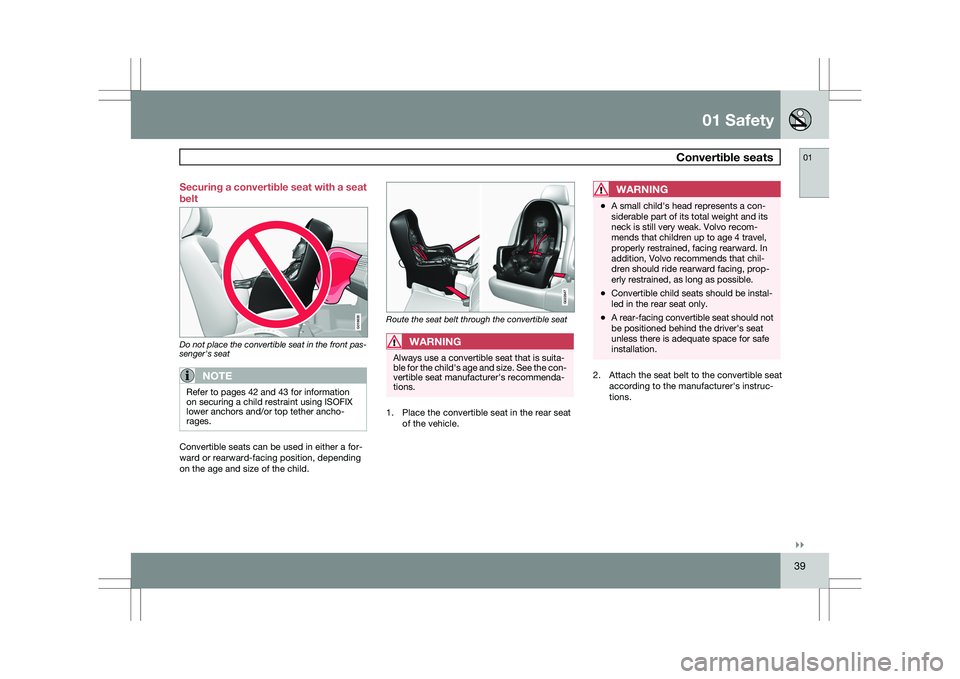
belt
Do not place the convertible seat in the front pas-
senger's seat
NOTE
Refer to pages 42 and 43 for information
on securing a child restraint using ISOFIX
lower anchors and/or top tether ancho-
rages.
Convertible seats can be used in either a for-
ward or rearward-facing position, depending
on the age and size of the child. Route the seat belt through the convertible seat
WARNING
Always use a convertible seat that is suita-
ble for the child\fs age and size. See the con-
vertible seat manufacturer\fs recommenda-
tions.
1. Place the convertible seat in the rear seat
of the vehicle.
WARNING \b
A small child\fs head represents a con-
siderable part of its total weight and its
neck is still very weak. Volvo recom-
mends that children up to age 4 travel,
properly restrained, facing rearward. In
addition, Volvo recommends that chil-
dren should ride rearward facing, prop-
erly restrained, as long as possible.
\b Convertible child seats should be instal-
led in the rear seat only.
\b A rear-facing convertible seat should not
be positioned behind the driver\fs seat
unless there is adequate space for safe
installation. 2. Attach the seat belt to the convertible seat
according to the manufacturer\fs instruc-
tions. G018630 G022847
Page 42 of 297

01 SafetyConvertible seats 01
40 Fasten the seat belt
3. Fasten the seat belt by inserting the latch
plate into the buckle (lock) until a distinct
click is audible.
4. Pull the shoulder section of the seat belt out as far as possible to activate the belt\fs
automatic locking function.
NOTE The locking retractor will automatically
release when the seat belt is unbuckled and
allowed to retract fully.
5. Press the convertible seat firmly in place,
let the seat belt retract and pull it taut. A
sound from the seat belt retractor\fs auto-
matic locking function will be audible at this time and is normal. The seat belt should
now be locked in place.
Pull out the shoulder section of the seat belt
6. Push and pull the convertible seat to
ensure that it is held securely in place by
the seat belt.WARNING It should not be possible to move the child
restraint more than 1 in. (2.5 cm) in any
direction.
The convertible seat can be removed by
unbuckling the seat belt and letting it retract
completely. Ensure that the seat is securely in place
WARNING
A child seat should never be used in the
front passenger seat of any vehicle with a
front passenger airbag – not even if the
"Passenger airbag off" symbol near the
rear-view mirror is illuminated (on vehicles
equipped with Occupant Weight Sensor). If
the severity of an accident were to cause the
airbag to inflate, this could lead to serious
injury or death to a child seated in this posi-
tion. G022848 G022849 G022850