2009 VOLVO XC60 flat tire
[x] Cancel search: flat tirePage 259 of 297
06 Maintenance and specifications
Wheels and tires06
}}
257
To check inflation pressure:1.
Remove the cap from the valve on one tire,
then firmly press the tire gauge onto the
valve.
2. Add air to reach the recommended air pressure.
3. Replace the valve cap.
4. Repeat this procedure for each tire, includ-
ing the spare.
5. Visually inspect the tires to make sure there
are no nails or other objects embedded
that could puncture the tire and cause an
air leak.
6. Check the sidewalls to make sure there are
no gouges, cuts, bulges or other irregular-
ities.
NOTE \b
If you overfill the tire, release air by
pushing on the metal stem in the center
of the valve. Then recheck the pressure
with your tire gauge.
\b Some spare tires require higher inflation
pressure than the other tires. Consult
the tire inflation tables or see the infla-
tion pressure placard. Tire specifications
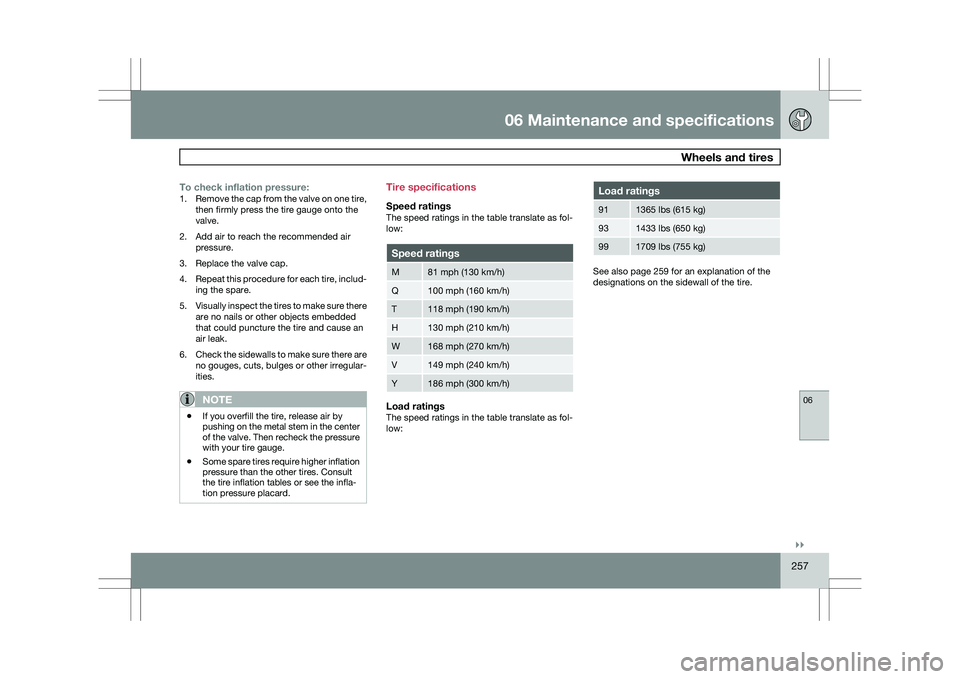
Speed ratingsThe speed ratings in the table translate as fol-
low:
Speed ratings
M 81 mph (130 km/h)
Q 100 mph (160 km/h)
T 118 mph (190 km/h)
H 130 mph (210 km/h)
W 168 mph (270 km/h)
V 149 mph (240 km/h)
Y 186 mph (300 km/h)
Load ratingsThe speed ratings in the table translate as fol-
low: Load ratings
91 1365 lbs (615 kg)
93 1433 lbs (650 kg)
99 1709 lbs (755 kg)
See also page 259 for an explanation of the
designations on the sidewall of the tire.
Page 260 of 297

06 Maintenance and specificationsWheels and tires 06
258 Tire inflation pressure table – U.S. models
The following tire pressures are recommended by Volvo for your vehicle. \
Refer to the tire inflation placard for information specific to the tire\
s installed
on your vehicle at the factory.
Tire size Cold tire pressure for up to 5 persons
Front
psi/kPa Rear
psi/kPa
235/65R17
235/60R18
235/55R19 35/240 35/240
T125/80R17 61/420 61/420
Tire inflation pressure table – Canadian models
The following tire pressures are recommended by Volvo for your vehicle. \
Refer to the tire inflation placard for information specific to the tire\
s installed
on your vehicle at the factory.
Tire size Cold tire pressure for up to 5 persons Optional tire pressure for up to 3 persons
Front
psi/kPa Rear
psi/kPa Front
psi/kPa Rear
psi/kPa
235/65R17
235/60R18
235/55R19 39/267 39/267 35/240 35/240
T 125/80 R 17 61/420 61/420 61/420 61/420
Page 261 of 297
06 Maintenance and specifications
Wheels and tires06
}}
259
Tire designations
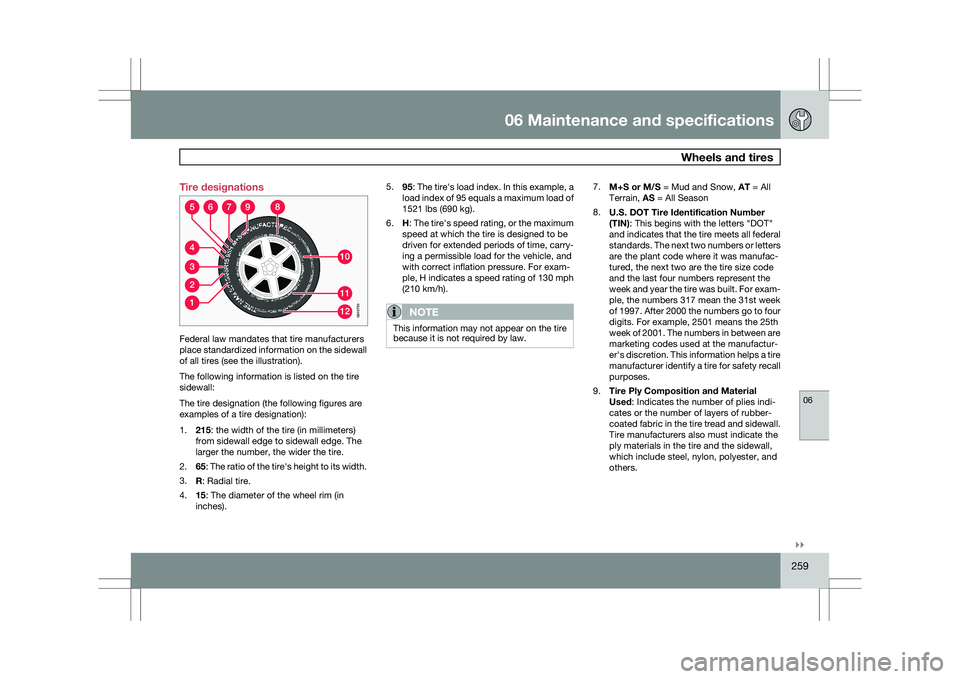
Federal law mandates that tire manufacturers
place standardized information on the sidewall
of all tires (see the illustration).
The following information is listed on the tire
sidewall:
The tire designation (the following figures are
examples of a tire designation):
1.
215: the width of the tire (in millimeters)
from sidewall edge to sidewall edge. The
larger the number, the wider the tire.
2. 65: The ratio of the tire\fs height to its width.
3. R: Radial tire.
4. 15: The diameter of the wheel rim (in
inches). 5.
95: The tire\fs load index. In this example, a
load index of 95 equals a maximum load of
1521 lbs (690 kg).
6. H: The tire\fs speed rating, or the maximum
speed at which the tire is designed to be
driven for extended periods of time, carry-
ing a permissible load for the vehicle, and
with correct inflation pressure. For exam-
ple, H indicates a speed rating of 130 mph
(210 km/h).
NOTE This information may not appear on the tire
because it is not required by law. 7.
M+S or M/S = Mud and Snow, AT = All
Terrain, AS = All Season
8. U.S. DOT Tire Identification Number
(TIN): This begins with the letters "DOT"
and indicates that the tire meets all federal
standards. The next two numbers or letters
are the plant code where it was manufac-
tured, the next two are the tire size code
and the last four numbers represent the
week and year the tire was built. For exam-
ple, the numbers 317 mean the 31st week
of 1997. After 2000 the numbers go to four
digits. For example, 2501 means the 25th
week of 2001. The numbers in between are
marketing codes used at the manufactur-
er\fs discretion. This information helps a tire
manufacturer identify a tire for safety recall
purposes.
9. Tire Ply Composition and Material
Used: Indicates the number of plies indi-
cates or the number of layers of rubber-
coated fabric in the tire tread and sidewall.
Tire manufacturers also must indicate the
ply materials in the tire and the sidewall,
which include steel, nylon, polyester, and
others.
310
11
12
4
56789
2
1
G010753
Page 262 of 297
06 Maintenance and specificationsWheels and tires 06
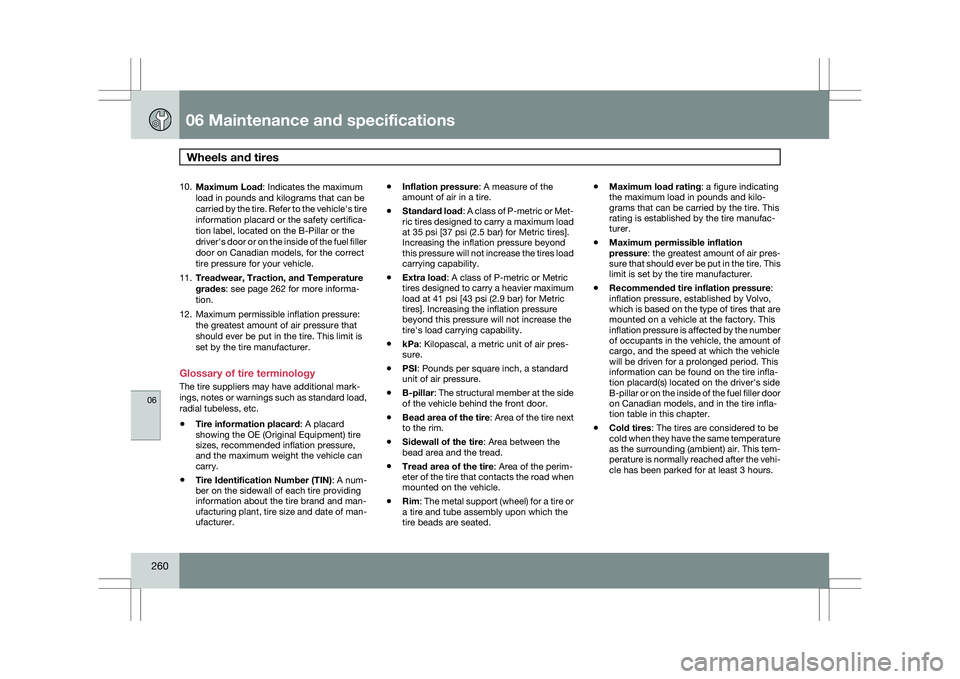
260 10.
Maximum Load: Indicates the maximum
load in pounds and kilograms that can be
carried by the tire. Refer to the vehicle\fs tire
information placard or the safety certifica-
tion label, located on the B-Pillar or the
driver\fs door or on the inside of the fuel filler
door on Canadian models, for the correct
tire pressure for your vehicle.
11. Treadwear, Traction, and Temperature
grades: see page 262 for more informa-
tion.
12. Maximum permissible inflation pressure: the greatest amount of air pressure that
should ever be put in the tire. This limit is
set by the tire manufacturer.
Glossary of tire terminology
The tire suppliers may have additional mark-
ings, notes or warnings such as standard load,
radial tubeless, etc.
\b Tire information placard: A placard
showing the OE (Original Equipment) tire
sizes, recommended inflation pressure,
and the maximum weight the vehicle can
carry.
\b Tire Identification Number (TIN)
: A num-
ber on the sidewall of each tire providing
information about the tire brand and man-
ufacturing plant, tire size and date of man-
ufacturer. \b
Inflation pressure: A measure of the
amount of air in a tire.
\b Standard load: A class of P-metric or Met-
ric tires designed to carry a maximum load
at 35 psi [37 psi (2.5 bar) for Metric tires].
Increasing the inflation pressure beyond
this pressure will not increase the tires load
carrying capability.
\b Extra load: A class of P-metric or Metric
tires designed to carry a heavier maximum
load at 41 psi [43 psi (2.9 bar) for Metric
tires]. Increasing the inflation pressure
beyond this pressure will not increase the
tire\fs load carrying capability.
\b kPa: Kilopascal, a metric unit of air pres-
sure.
\b PSI: Pounds per square inch, a standard
unit of air pressure.
\b B-pillar: The structural member at the side
of the vehicle behind the front door.
\b Bead area of the tire: Area of the tire next
to the rim.
\b Sidewall of the tire: Area between the
bead area and the tread.
\b Tread area of the tire: Area of the perim-
eter of the tire that contacts the road when
mounted on the vehicle.
\b Rim: The metal support (wheel) for a tire or
a tire and tube assembly upon which the
tire beads are seated. \b
Maximum load rating: a figure indicating
the maximum load in pounds and kilo-
grams that can be carried by the tire. This
rating is established by the tire manufac-
turer.
\b Maximum permissible inflation
pressure: the greatest amount of air pres-
sure that should ever be put in the tire. This
limit is set by the tire manufacturer.
\b Recommended tire inflation pressure:
inflation pressure, established by Volvo,
which is based on the type of tires that are
mounted on a vehicle at the factory. This
inflation pressure is affected by the number
of occupants in the vehicle, the amount of
cargo, and the speed at which the vehicle
will be driven for a prolonged period. This
information can be found on the tire infla-
tion placard(s) located on the driver\fs side
B-pillar or on the inside of the fuel filler door
on Canadian models, and in the tire infla-
tion table in this chapter.
\b Cold tires: The tires are considered to be
cold when they have the same temperature
as the surrounding (ambient) air. This tem-
perature is normally reached after the vehi-
cle has been parked for at least 3 hours.
Page 264 of 297
06 Maintenance and specificationsWheels and tires 06
262
WARNING \b
Exceeding the permissible axle weight,
gross vehicle weight, or any other
weight rating limits can cause tire over-
heating resulting in permanent defor-
mation or catastrophic failure.
\b Do not use replacement tires with lower
load carrying capacities than the tires
that were original equipment on the
vehicle because this will lower the vehi-
cle\fs GVW rating. Replacement tires
with a higher limit than the originals do
not increase the vehicle\fs GVW rating
limitations. Uniform Tire Quality Grading
ALL PASSENGER VEHICLE TIRES MUST
CONFORM TO FEDERAL SAFETY
REQUIREMENTS IN ADDITION TO THESE
GRADES
Quality grades can be found, where appli-
cable, on the tire sidewall between the tread
shoulder and maximum section width. For
example:
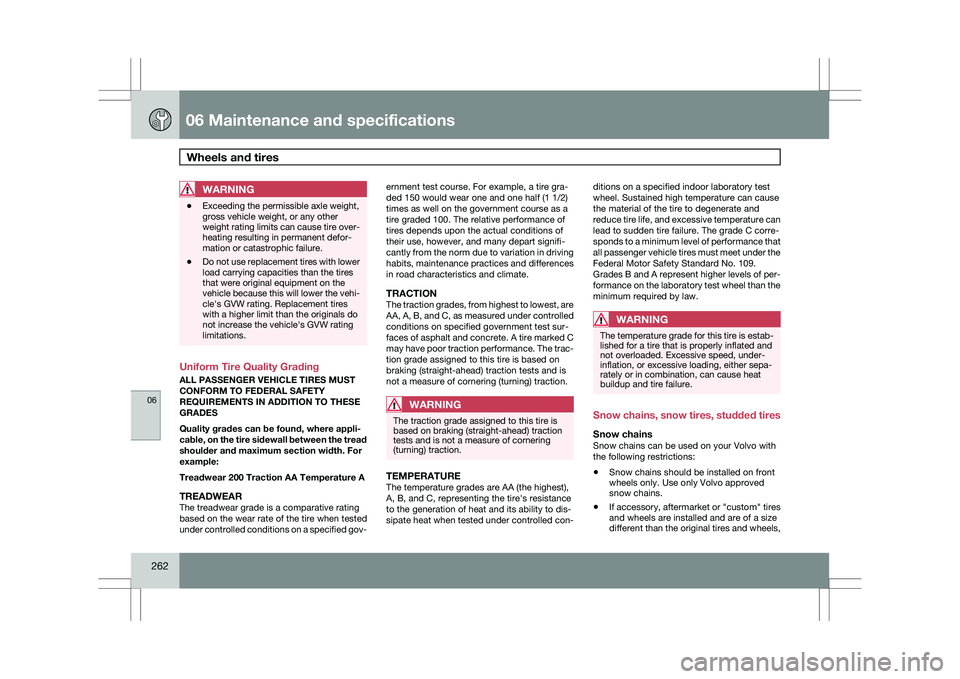
Treadwear 200 Traction AA Temperature A
TREADWEARThe treadwear grade is a comparative rating
based on the wear rate of the tire when tested
under controlled conditions on a specified gov- ernment test course. For example, a tire gra-
ded 150 would wear one and one half (1 1/2)
times as well on the government course as a
tire graded 100. The relative performance of
tires depends upon the actual conditions of
their use, however, and many depart signifi-
cantly from the norm due to variation in driving
habits, maintenance practices and differences
in road characteristics and climate.
TRACTIONThe traction grades, from highest to lowest, are
AA, A, B, and C, as measured under controlled
conditions on specified government test sur-
faces of asphalt and concrete. A tire marked C
may have poor traction performance. The trac-
tion grade assigned to this tire is based on
braking (straight-ahead) traction tests and is
not a measure of cornering (turning) traction.
WARNING
The traction grade assigned to this tire is
based on braking (straight-ahead) traction
tests and is not a measure of cornering
(turning) traction.
TEMPERATUREThe temperature grades are AA (the highest),
A, B, and C, representing the tire\fs resistance
to the generation of heat and its ability to dis-
sipate heat when tested under controlled con-ditions on a specified indoor laboratory test
wheel. Sustained high temperature can cause
the material of the tire to degenerate and
reduce tire life, and excessive temperature can
lead to sudden tire failure. The grade C corre-
sponds to a minimum level of performance that
all passenger vehicle tires must meet under the
Federal Motor Safety Standard No. 109.
Grades B and A represent higher levels of per-
formance on the laboratory test wheel than the
minimum required by law.
WARNING
The temperature grade for this tire is estab-
lished for a tire that is properly inflated and
not overloaded. Excessive speed, under-
inflation, or excessive loading, either sepa-
rately or in combination, can cause heat
buildup and tire failure.
Snow chains, snow tires, studded tires
Snow chainsSnow chains can be used on your Volvo with
the following restrictions:
\b
Snow chains should be installed on front
wheels only. Use only Volvo approved
snow chains.
\b If accessory, aftermarket or "custom" tires
and wheels are installed and are of a size
different than the original tires and wheels,
Page 267 of 297

06 Maintenance and specifications
Wheels and tires06
}}
265
After useThe foam block and spare wheel must be
replaced in the reverse order. Note the arrow
on the upper foam block. It should point for-
ward.Removing the wheel cover
Changing a tire:1. Apply the parking brake.
2.
Put the gear selector in P.
3. Block the wheels that are on the ground with wooden blocks or large stones.
4. Remove the wheel cover (where applica- ble) using the lug wrench in the tool
bag.With the vehicle still on the ground,
use the lug wrench to loosen the wheel nuts 1/2 – 1 turns by exerting downward
pressure.
5. Turn the nuts counterclockwise to loosen. Jack attachment points
6. There are two jack attachment points on
each side of the vehicle. Position the jack
correctly in the attachment (see illustration)
and crank while simultaneously guiding the
base of the jack to the ground. The base of
the jack must be flat on a level, firm, non-
slippery surface. Before raising the vehicle,
check that the jack is still correctly posi-
tioned in the attachment.
WARNING There are two attachment points near the
rear of the vehicle. Only the rear-most
attachment point is intended for the jack
(see the illustration).
7. Raise the vehicle until the wheel to be
changed is lifted off the ground.
8. Unscrew the wheel nuts completely and carefully remove the wheel so as not to
damage the threads on the studs.
9. Raise the vehicle until the wheel to be changed is lifted off the ground.
10. Unscrew the wheel nuts completely and carefully remove the wheel so as not to
damage the threads on the studs. G031901 G032149
Page 268 of 297
06 Maintenance and specificationsWheels and tires 06
266
* Option/accessory, for more information, see Introduction.
WARNING \b
The jack must correctly engage the jack
attachment.
\b Be sure the jack is on a firm, level, non-
slippery surface.
\b Never allow any part of your body to be
extended under a vehicle supported by
a jack.
\b Use the jack intended for the vehicle
when changing a tire. For any other job,
use stands to support the vehicle.
\b Apply the parking brake and put the
gear selector in the Park (
P) position.
\b Block the wheels standing on the
ground, use rigid wooden blocks or
large stones.
\b The jack should be kept well-greased
and clean, and should not be damaged.
\b No objects should be placed between
the base of jack and the ground, or
between the jack and the attachment
bar on the vehicle.
Re-installing the wheel1. Clean the contact surfaces on the wheel
and hub.
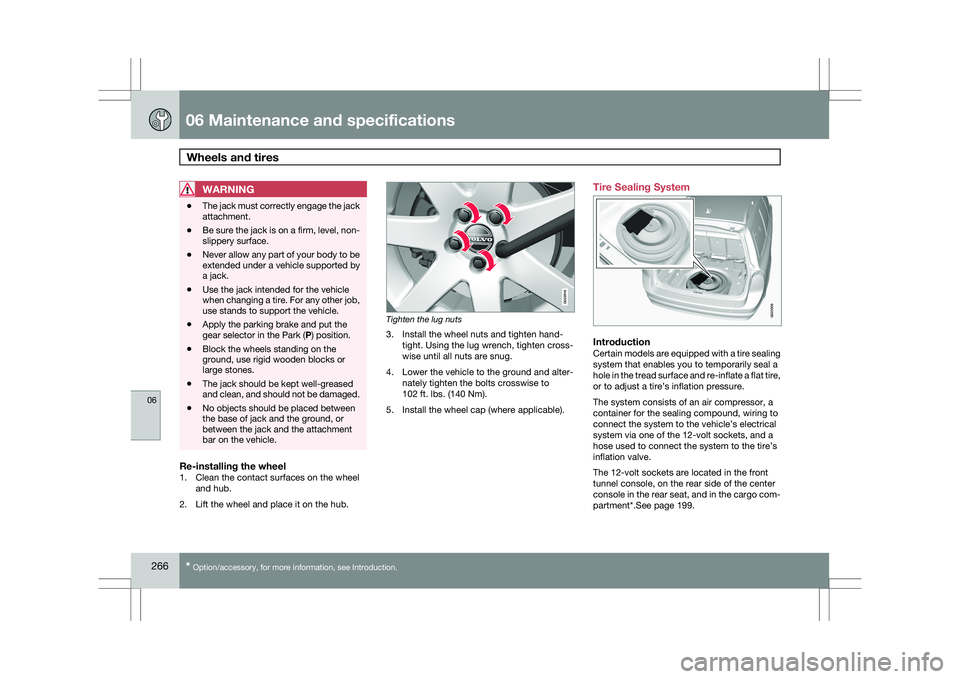
2. Lift the wheel and place it on the hub. Tighten the lug nuts
3. Install the wheel nuts and tighten hand-
tight. Using the lug wrench, tighten cross-
wise until all nuts are snug.
4. Lower the vehicle to the ground and alter- nately tighten the bolts crosswise to
102 ft. lbs. (140 Nm).
5. Install the wheel cap (where applicable). Tire Sealing System
IntroductionCertain models are equipped with a tire sealing
system that enables you to temporarily seal a
hole in the tread surface and re-inflate a flat tire,
or to adjust a tire’s inflation pressure.
The system consists of an air compressor, a
container for the sealing compound, wiring to
connect the system to the vehicle’s electrical
system via one of the 12-volt sockets, and a
hose used to connect the system to the tire’s
inflation valve.
The 12-volt sockets are located in the front
tunnel console, on the rear side of the center
console in the rear seat, and in the cargo com-
partment*.See page 199. G022916 G023309
Page 270 of 297
06 Maintenance and specificationsWheels and tires 06
268
WARNING Please keep the following points in mind
when using the tire sealing system:
\b
The sealing compound bottle (no. 8 in
the illustration) contains 1.2-Ethanol
and natural rubber-latex. These sub-
stances are harmful if swallowed.
\b The contents of this bottle may cause
allergic skin reactions or otherwise be
potentially harmful to the skin, the cen-
tral nervous system, and the eyes.
Precautions:
\b Keep out of reach of children.
\b Do not ingest the contents.
\b Avoid prolonged or repeated contact
with the skin.
\b Hands should be washed thoroughly
after handling.
First aid:
\b Skin: Wash affected areas of skin with
soap and water. Get medical attention
if symptoms occur.
\b Eyes: Flush with plenty of water for least
15 minutes, occasionally lifting the
upper and lower eyelids. Get medical
attention if symptoms occur. \b
Inhalation: Move the person to fresh air.
If irritation persists, get medical atten-
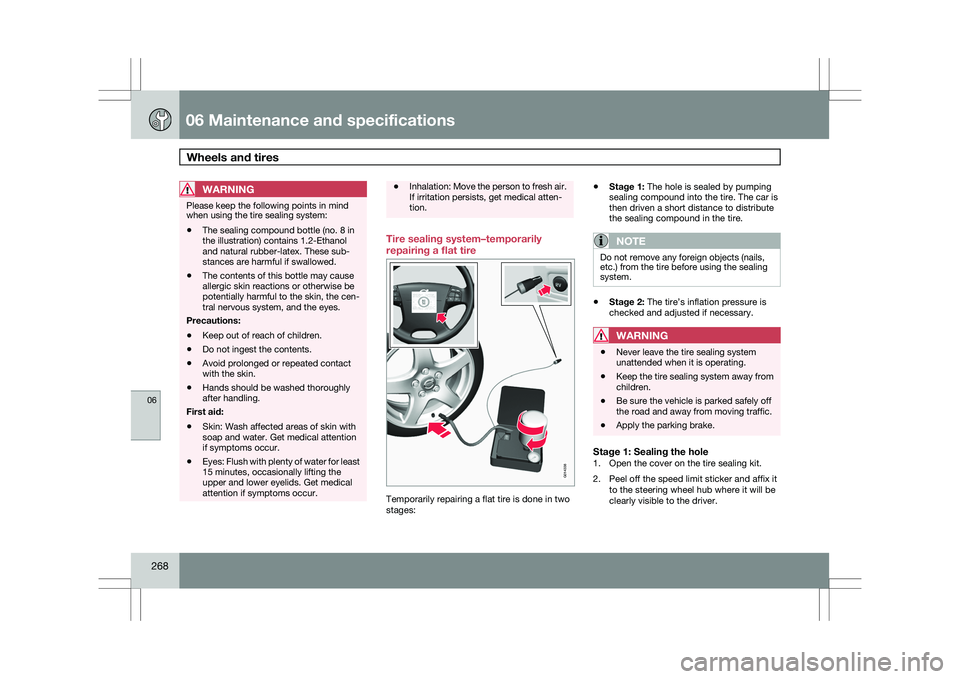
tion. Tire sealing system–temporarily
repairing a flat tire
Temporarily repairing a flat tire is done in two
stages:\b
Stage 1: The hole is sealed by pumping
sealing compound into the tire. The car is
then driven a short distance to distribute
the sealing compound in the tire.
NOTE Do not remove any foreign objects (nails,
etc.) from the tire before using the sealing
system.
\b
Stage 2: The tire’s inflation pressure is
checked and adjusted if necessary.
WARNING \b
Never leave the tire sealing system
unattended when it is operating.
\b Keep the tire sealing system away from
children.
\b Be sure the vehicle is parked safely off
the road and away from moving traffic.
\b Apply the parking brake.
Stage 1: Sealing the hole1. Open the cover on the tire sealing kit.
2. Peel off the speed limit sticker and affix it
to the steering wheel hub where it will be
clearly visible to the driver. G01433
8