2009 TOYOTA YARIS Indicator
[x] Cancel search: IndicatorPage 94 of 392
94 1-7. Safety information
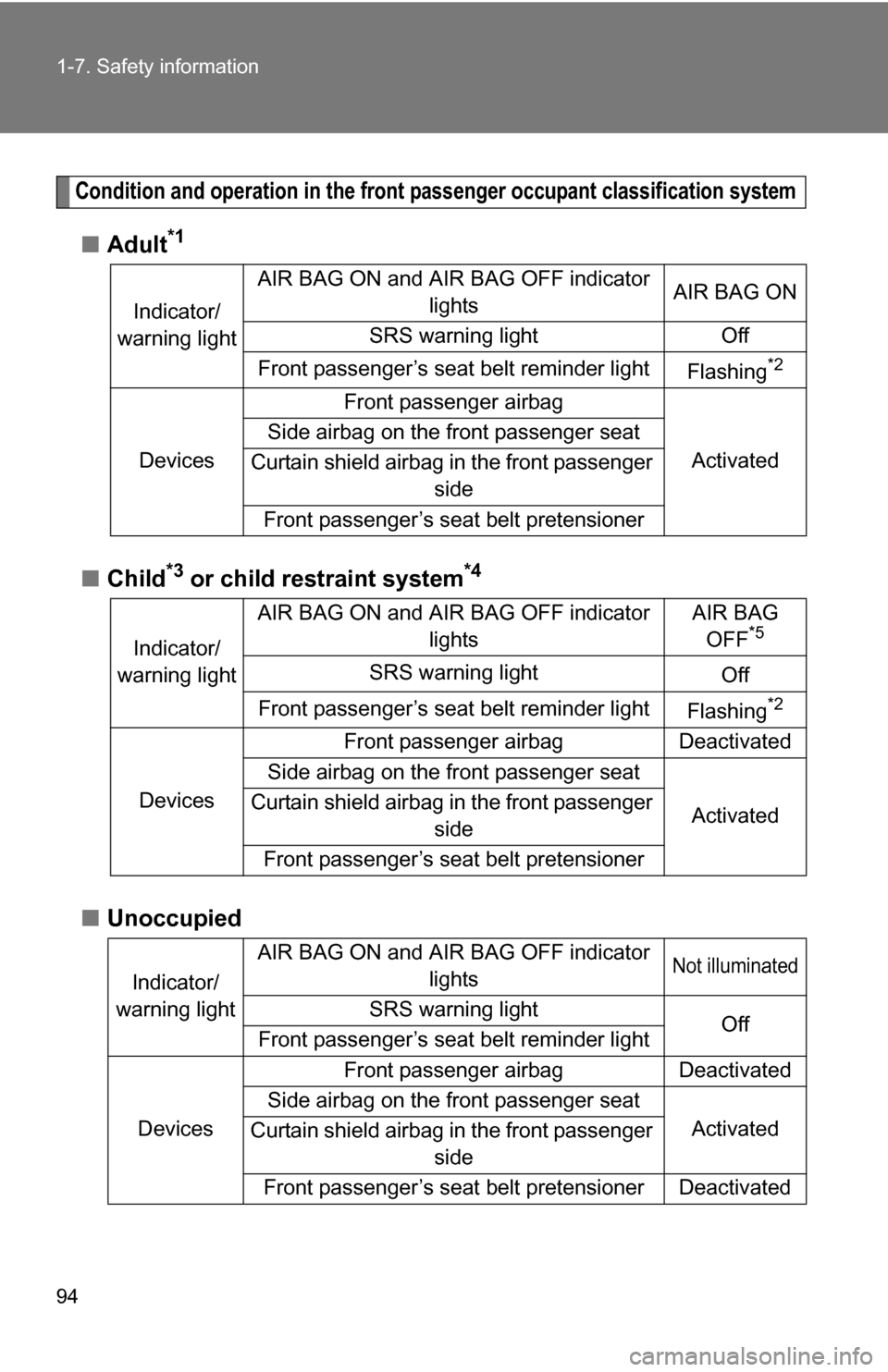
Condition and operation in the front passenger occupant classification system
■Adult*1
■Child*3 or child restraint system*4
■Unoccupied
Indicator/
warning light AIR BAG ON and AIR BAG OFF indicator
lights AIR BAG ON
SRS warning light Off
Front passenger’s seat belt reminder light Flashing
*2
DevicesFront passenger airbag
Activated
Side airbag on the front passenger seat
Curtain shield airbag in the front passenger side
Front passenger’s seat belt pretensioner
Indicator/
warning light AIR BAG ON and AIR BAG OFF indicator
lights AIR BAG
OFF
*5
SRS warning light Off
Front passenger’s seat belt reminder light Flashing
*2
DevicesFront passenger airbag
Deactivated
Side airbag on the front passenger seat
Activated
Curtain shield airbag in the front passenger
side
Front passenger’s seat belt pretensioner
Indicator/
warning light AIR BAG ON and AIR BAG OFF indicator
lights
Not illuminated
SRS warning light Off
Front passenger’s seat belt reminder light
Devices Front passenger airbag Deactivated
Side airbag on the front passenger seat Activated
Curtain shield airbag in the front passenger
side
Front passenger’s seat belt pretensioner Deactivated
Page 95 of 392
95
1-7. Safety information
1
Before driving
■
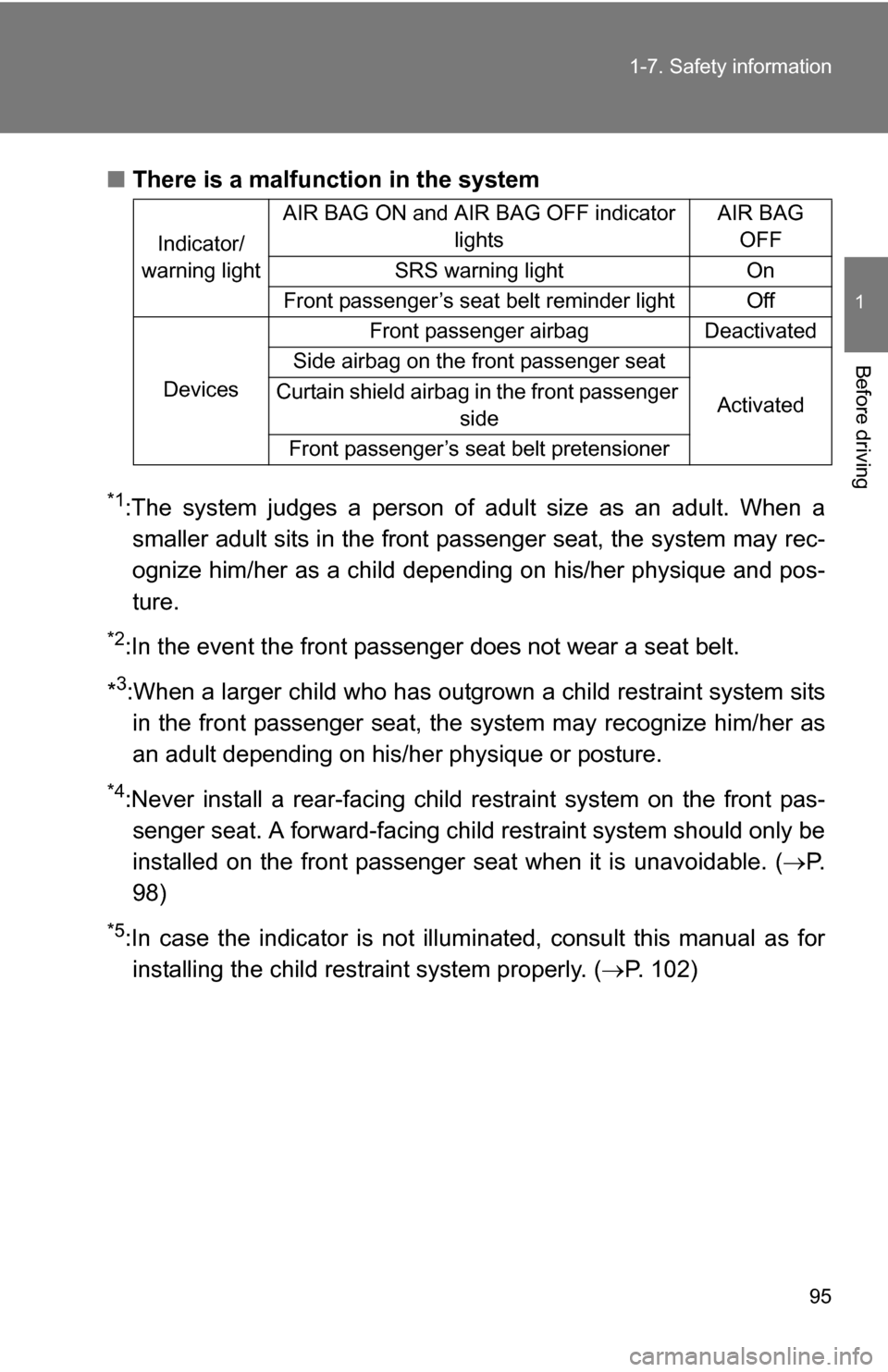
There is a malfunction in the system
*1:The system judges a person of adult size as an adult. When a
smaller adult sits in the front pa ssenger seat, the system may rec-
ognize him/her as a child dependi ng on his/her physique and pos-
ture.
*2:In the event the front passenge r does not wear a seat belt.
*
3:When a larger child who has outgrow n a child restraint system sits
in the front passenger seat, the system may recognize him/her as
an adult depending on his/her physique or posture.
*4:Never install a rear-facing child restraint system on the front pas-
senger seat. A forward-facing child restraint system should only be
installed on the front passenger seat when it is unavoidable. ( P.
98)
*5:In case the indicator is not illum inated, consult this manual as for
installing the child restraint system properly. ( P. 102)
Indicator/
warning light AIR BAG ON and AIR BAG OFF indicator
lights AIR BAG
OFF
SRS warning light On
Front passenger’s seat belt reminder light Off
Devices Front passenger airbag
Deactivated
Side airbag on the front passenger seat
Activated
Curtain shield airbag in the front passenger
side
Front passenger’s seat belt pretensioner
Page 96 of 392
96 1-7. Safety information
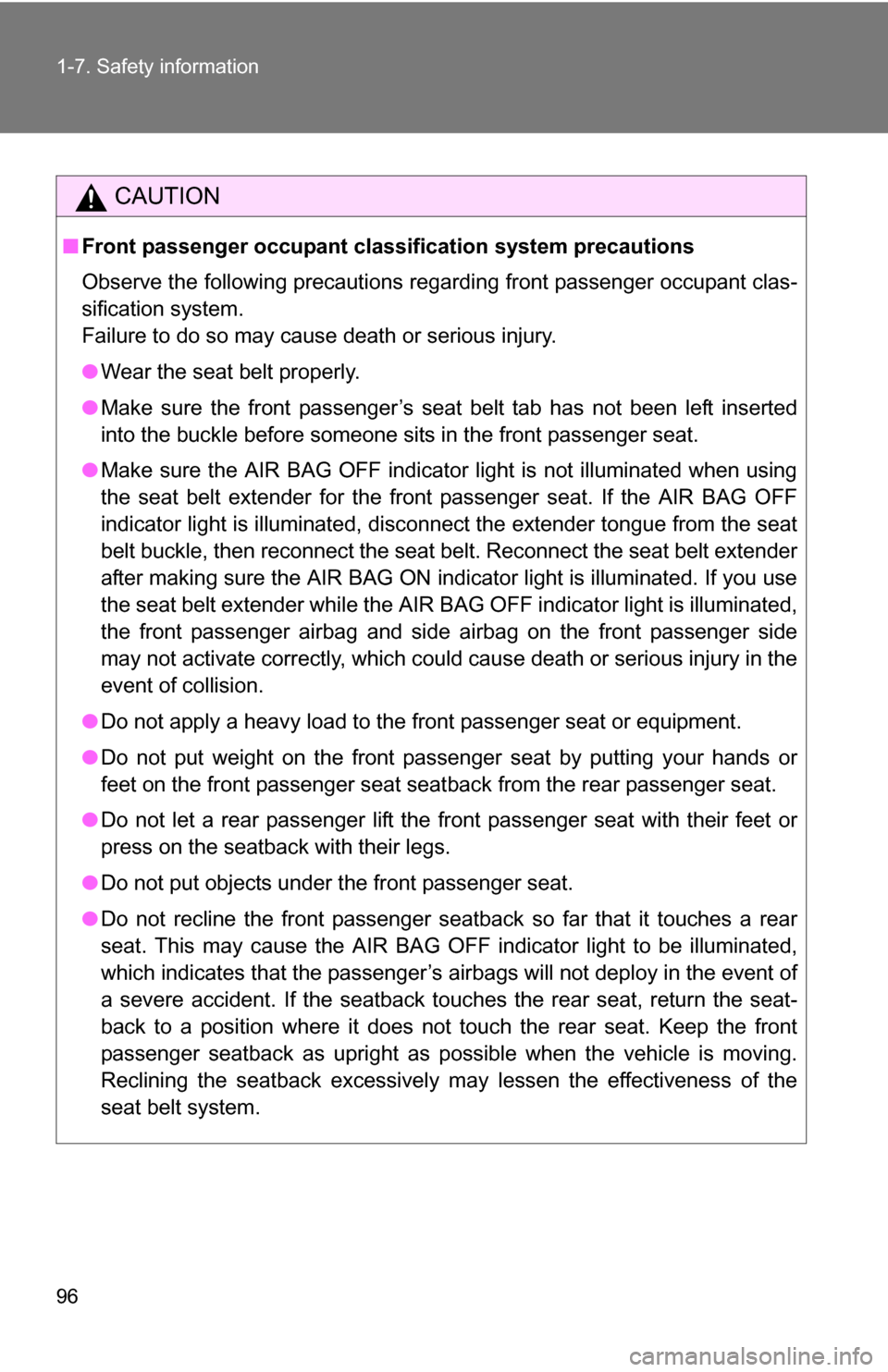
CAUTION
■Front passenger occupant cl assification system precautions
Observe the following precautions regarding front passenger occupant clas-
sification system.
Failure to do so may cause death or serious injury.
● Wear the seat belt properly.
● Make sure the front passenger’s seat belt tab has not been left inserted
into the buckle before someone sits in the front passenger seat.
● Make sure the AIR BAG OFF indicator light is not illuminated when using
the seat belt extender for the front passenger seat. If the AIR BAG OFF
indicator light is illuminated, disconnect the extender tongue from the seat
belt buckle, then reconnect the seat belt. Reconnect the seat belt extender
after making sure the AIR BAG ON indicator light is illuminated. If you use
the seat belt extender while the AIR BAG OFF indicator light is illuminated,
the front passenger airbag and side airbag on the front passenger side
may not activate correctly, which could cause death or serious injury in the
event of collision.
● Do not apply a heavy load to the front passenger seat or equipment.
● Do not put weight on the front passenger seat by putting your hands or
feet on the front passenger seat seatback from the rear passenger seat.
● Do not let a rear passenger lift the front passenger seat with their feet or
press on the seatback with their legs.
● Do not put objects under the front passenger seat.
● Do not recline the front passenger seatback so far that it touches a rear
seat. This may cause the AIR BAG OFF indicator light to be illuminated,
which indicates that the passenger’s airbags will not deploy in the event of
a severe accident. If the seatback touches the rear seat, return the seat-
back to a position where it does not touch the rear seat. Keep the front\
passenger seatback as upright as possible when the vehicle is moving.
Reclining the seatback excessively may lessen the effectiveness of the
seat belt system.
Page 97 of 392
97
1-7. Safety information
1
Before driving
CAUTION
■
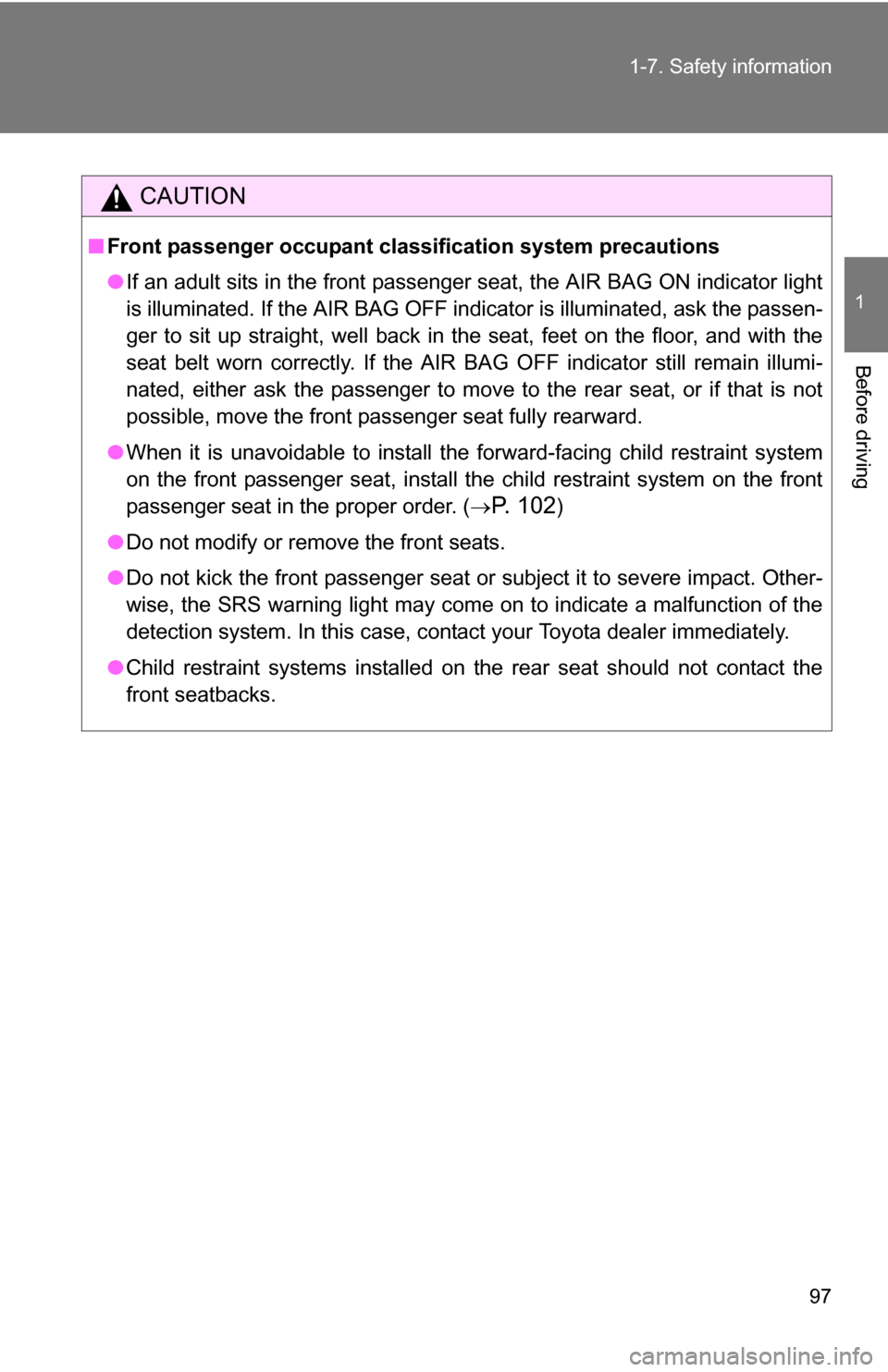
Front passenger occupant cl assification system precautions
● If an adult sits in the front passenger seat, the AIR BAG ON indicator light
is illuminated. If the AIR BAG OFF indicator is illuminated, ask the passen-
ger to sit up straight, well back in the seat, feet on the floor, and with the
seat belt worn correctly. If the AIR BAG OFF indicator still remain illumi-
nated, either ask the passenger to move to the rear seat, or if that is not
possible, move the front passenger seat fully rearward.
● When it is unavoidable to install the forward-facing child restraint system
on the front passenger seat, install the child restraint system on the front
passenger seat in the proper order. (
P. 102)
● Do not modify or remove the front seats.
● Do not kick the front passenger seat or subject it to severe impact. Other-
wise, the SRS warning light may come on to indicate a malfunction of the
detection system. In this case, contact your Toyota dealer immediately.
● Child restraint systems installed on the rear seat should not contact the
front seatbacks.
Page 100 of 392
100 1-7. Safety information
CAUTION
■Child restraint precautions
●For effective protection in automobile accidents and sudden stops, a child
must be properly restrained, using a seat belt or child restraint system
depending on the age and size of the child. Holding a child in your arms is
not a substitute for a child restraint system. In an accident, the child can be
crushed against the windshield, or between you and the vehicle's interior.
● Toyota strongly urges the use of a proper child restraint system that con-
forms to the size of the child, installed on the rear seat. According to acci-
dent statistics, the child is safer when properly restrained in the rear seat
than in the front seat.
● Never install a rear-facing child restraint system on the front passenger
seat even if AIR BAG OFF indicator light is illuminated. In the event of an
accident, the force of the rapid inflation of the front passenger airbag can
cause death or serious injury to the child if the rear-facing child restraint
system is installed on the front passenger seat.
● A forward-facing child restraint system may be installed on the front pas-
senger seat only when it is unavoidable. A child restraint system that
requires a top tether strap should not be used in the front passenger seat
since there is no top tether strap anchor for the front passenger seat.
Adjust the seatback as upright as possible and always move the seat as
far back as possible even if the AIR BA G OFF indicator light is illuminated,
because the front passenger airbag could inflate with considerable speed
and force. Otherwise, the child may be killed or seriously injured.
● Do not use the seat belt extender when installing a child restraint system
on the front or rear passenger seat. If installing a child restraint system
with the seat belt extender connected to the seat belt, the seat belt will not
securely hold the child restraint system, which could cause death or seri-
ous injury to the child or other passengers in the event of collision.
● Vehicles with side airbags and curtain shield airbags: Do not allow the
child to lean his/her head or any part of his/her body against the door or
the area of the seat, front and rear pill ars or roof side rail from which the
side airbags or curtain shield airbags deploy even if the child is seated in
the child restraint system. It is dangerous if the side airbags and curtain
shield airbags inflate, and the impact could cause death or serious injury to
the child.
Page 111 of 392
111
1-7. Safety information
1
Before driving
CAUTION
■
When installing a booster seat
Do not fully extend the shoulder belt to prevent the belt from going to ALR
lock mode. ( P. 57)
ALR mode causes the belt to tighten only which could cause injury or dis-
comfort to the child.
■ When installing a child restraint system
Follow the directions given in the child restraint system installation manual
and fix the child restraint system securely in place.
If the child restraint system is not correctly fixed in place, the child or other
passengers may be seriously injured or even killed in the event of sudden
braking or an accident.
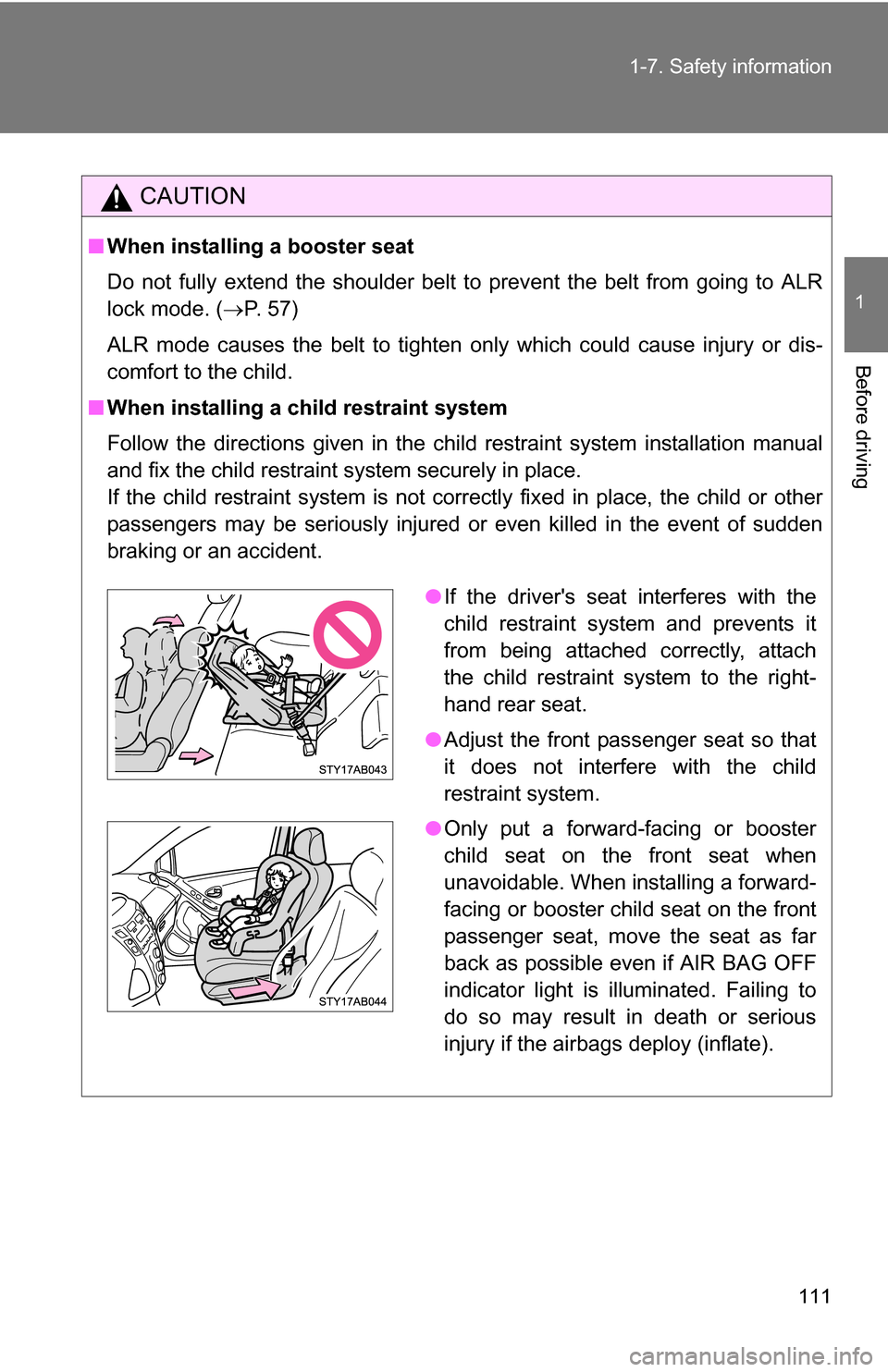
●If the driver's seat interferes with the
child restraint system and prevents it
from being attached correctly, attach
the child restraint system to the right-
hand rear seat.
● Adjust the front passenger seat so that
it does not interfere with the child
restraint system.
● Only put a forward-facing or booster
child seat on the front seat when
unavoidable. When installing a forward-
facing or booster child seat on the front
passenger seat, move the seat as far
back as possible even if AIR BAG OFF
indicator light is illuminated. Failing to
do so may result in death or serious
injury if the airbags deploy (inflate).
Page 115 of 392
When driving2
115
2-1. Driving proceduresDriving the vehicle............ 116
Engine (ignition) switch .... 125
Automatic
Transmission.... 128
Manual Transmission ....... 130
Turn signal lever .............. 131
Parking brake ................... 132
Horn ................................. 134
2-2. Instrument cluster Gauges and meters ......... 135
Indicators and warning lights .............................. 141
2-3. Operating the lights and wipers
Headlight switch ............... 145
Fog light switch ................ 147
Windshield wipers and washer ........................... 148
Rear window wiper and washer ........................... 151
2-4. Using other driving systems Cruise control ................... 152
Driving assist systems ..... 155 2-5. Driving information
Cargo and luggage .......... 157
Vehicle load limits ............ 160
Winter driving tips ............ 161
Trailer towing (except Canada) ............ 164
Trailer towing (Canada) ... 165
Dinghy towing (vehicles with an automatic
transmission) ................. 173
Dinghy towing (vehicles with a manual
transmission) ................. 174
Page 124 of 392
124 2-1. Driving procedures
NOTICE
■Avoiding damage to vehicle parts
●Do not turn the steering wheel fully in either direction and hold it there for a
long time.
Doing so may damage the power steering motor.
● When driving over bumps in the road, drive as slowly as possible to avoid
damaging the wheels, underside of the vehicle, etc.
■ If you hear a squealing or scrapin g noise while driving (brake pad wear
limit indicators)
Have the brake pads checked and replaced by your Toyota dealer as soon
as possible.
The rotor damage can result if the pads are not replaced when needed.
It is dangerous to drive the vehicle when the wear limits of the brake pads
and/or that of the brake discs are exceeded.
■ If you get a flat tire while driving
A flat or damaged tire may cause the following situations. Hold the steering
wheel firmly and gradually press the brake pedal to slow down the vehicle.
●It may be difficult to control your vehicle.
● The vehicle will make abnormal sounds.
● The vehicle will behave abnormally.
Replace a flat tire with a new one. ( P. 320)
■ When encountering flooded roads
Do not drive on a road that has flooded after heavy rain etc. Doing so may
cause the following serious damage to the vehicle.
●Engine stalling
● Short in electrical components
● Engine damage caused by water immersion
In the event that you drive on a flooded road and the vehicle is flooded, be
sure to have your Toyota dealer check the following.
● Brake function
● Changes in quantity and quality of eng ine oil, transaxle fluid, etc.
● Lubricant condition for the bearings and suspension joints (where possi-
ble) and the function of all joints, bearings, etc.