Page 2 of 402
17
OVERVIEW
FEATURES/OPERATIONS
SAFETY AND EMERGENCY FEATURES
2009
Yaris Liftback
!Awordaboutsafevehicleoperations
This
Quick Reference Guide is a summary of basic vehicle
operations. It contains brief descriptions of fundamental
operations so you can locate and use the vehicle’s main
equipment quickly and easily.
The Quick Reference Guide is not intended as a substitute for the
Owner’s Manual located in your vehicle’s glove box. We strongly
encourage you to review the Owner’s Manualand supplementary
manuals so you will have a better understanding of your vehicle’s
capabilities and limitations.
Your dealership and the entire staff of Toyota Motor Sales, U.S.A.,
Inc. wish you many years of satisfied driving in your new Yaris.
This Quick Reference Guide is not a full description of Yaris
operations. Every Yaris owner should review the Owner’s
Manual that accompanies this vehicle.
Pay special attention to the boxed information highlighted in
color throughout the Owner’s Manual. Each box contains safe
operatinginstructionstohelpyouavoidinjuryorequipment
malfunction.
All information in this Quick Reference Guide is current at
the time of printing. Toyota reserves the right to make
changes at any time without notice.
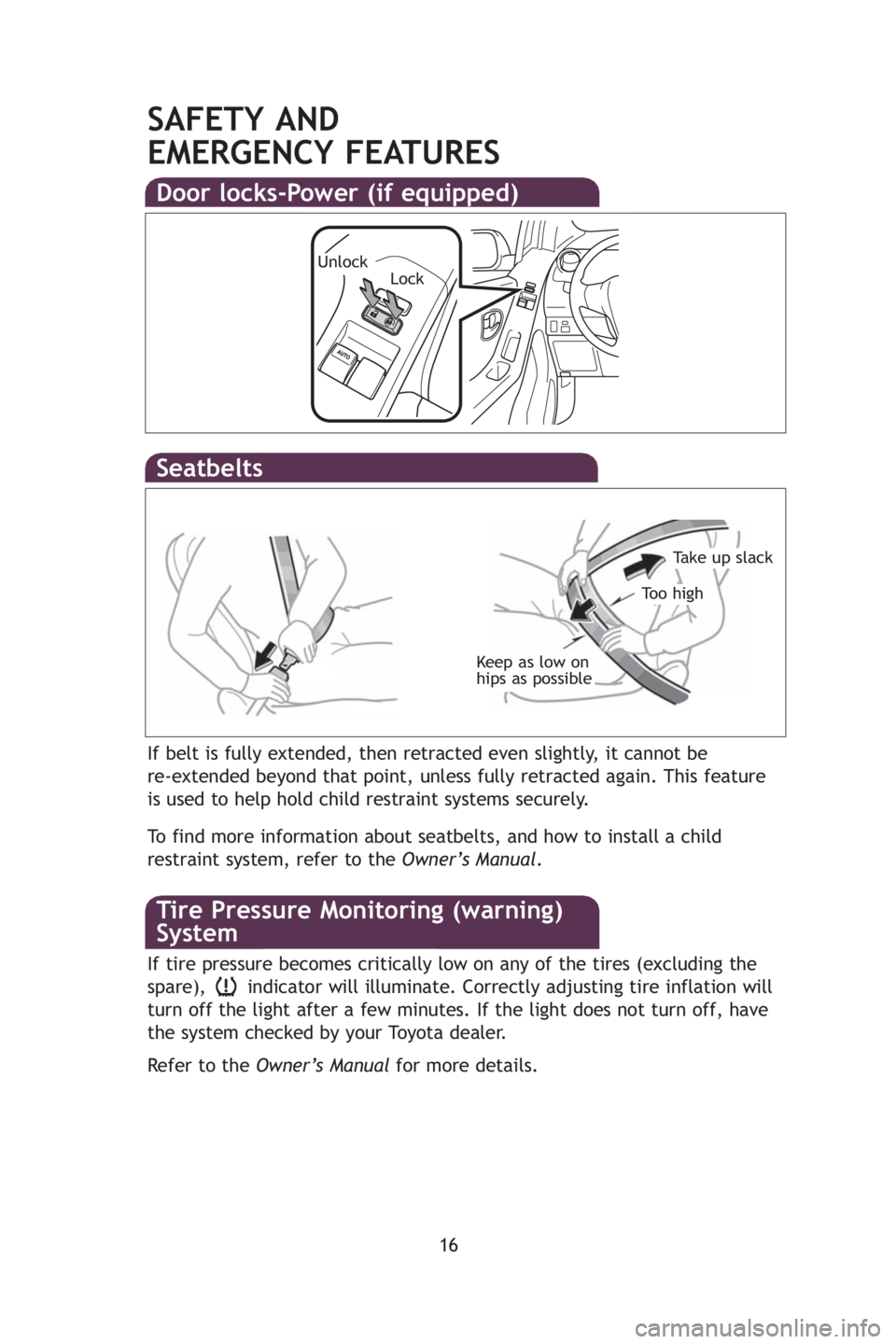
Spare tire & tools
Tool location
Removing the spare tire
Loosen and remove the bolt.
Refer to the Owner’s Manual for tire
changing and jack positioning
procedures.
Tool bag
Tie-down belt Jack handleSpare tire
Jack
Child comfort guide
Rear seat center position guides provide added comfort for children who
have outgrown child restraints.
Split seat
Non-split seat
412782M1.qxd:412782M1 8/18/08 1:55 PM Page 2
Page 3 of 402
1
OVERVIEW
FEATURES/OPERATIONS
SAFETY AND EMERGENCY FEATURES
Enginemaintenance7Fuel tank door release and cap6Hood release 7Indicator symbols4-5Instrument cluster 4Instrument panel2-3
Keyless entry* 6
Air Conditioning/Heating13Audio 14-15Automatic Transmission 8Clock15Cruise control14Door-Back 12Lightcontrol-Instrument panel9Lights& turn signals11Luggagestoragebox15Parkingbrake 8Power outlet 15Seat adjustments-Front9Seat adjustments-Rear9Seat-Foldingrear seat10-11Seats-Head restraints 12Tilt steeringwheel8Windows-Power 12
Windshield wipers & washers 13
Child comfort guide17Door locks-Power 16Seatbelts16Sparetire & tools17
Tire Pressure Monitoring (warning) System 16
OVERVIEW
FEATURES/OPERATIONS
SAFETY AND
EMERGENCY FEATURES
INDEX
* Visit your Toyota dealer for information on customizing this feature.
412782M2.qxd:_412782M2 8/18/08 2:02 PM Page 1
Page 18 of 402
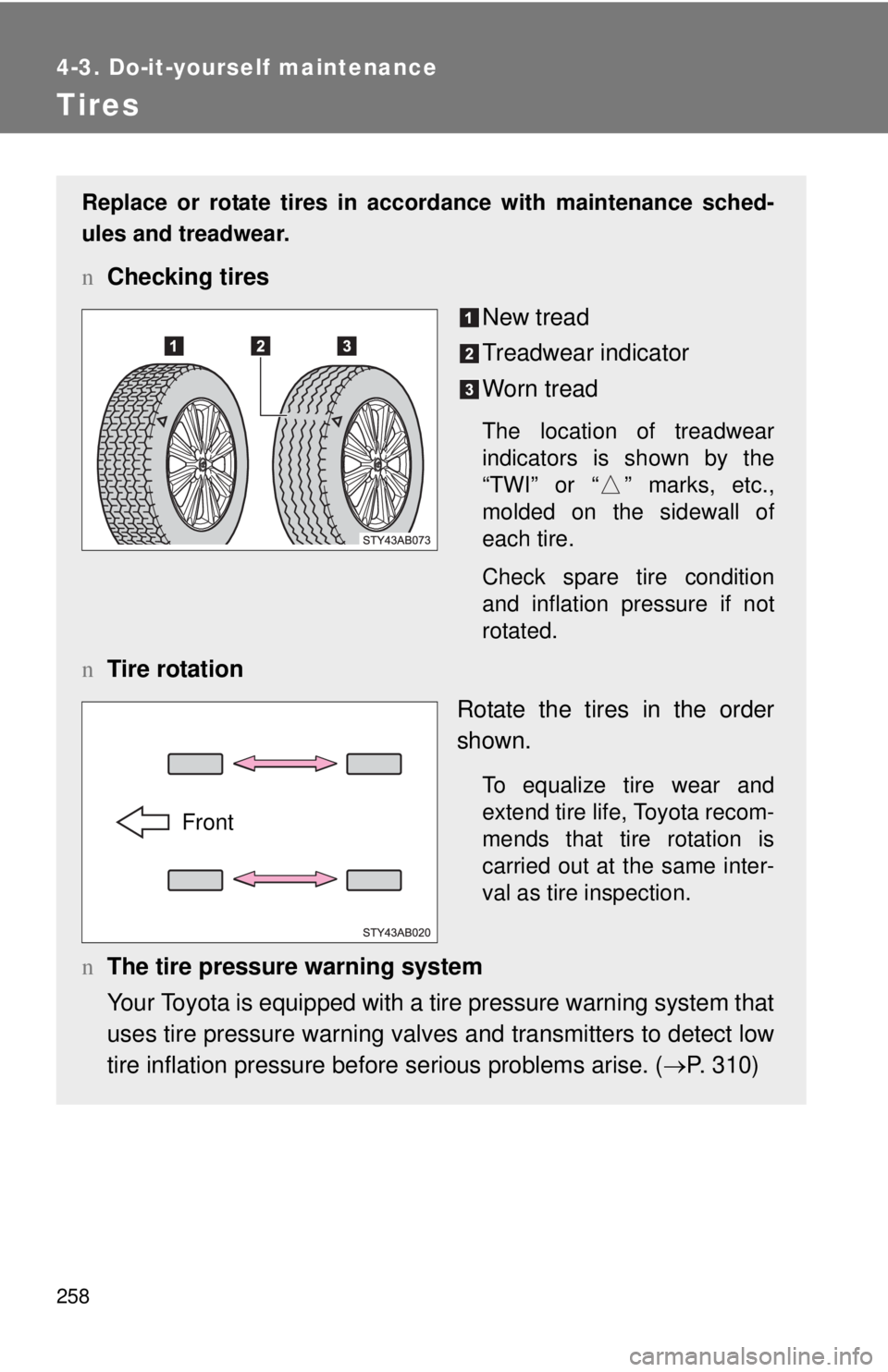
16
SAFETY AND
EMERGENCY FEATURES
Keep as low on
hips as possible
Take up slack
To o h i g h
Seatbelts
If belt is fully extended, then retracted even slightly, it cannot be
re-extended beyond that point, unless fully retracted again. This feature
is used to help hold child restraint systems securely.
To find more information about seatbelts, and how to install a child
restraint system, refer to theOwner’s Manual.
Door locks-Power (if equipped)
UnlockLock
If tire pressure becomes critically low on any of the tires (excluding the
spare), indicator will illuminate. Correctly adjusting tire inflation will
turn off the light after a few minutes. If the light does not turn off, have
the system checked by your Toyota dealer.
RefertotheOwner’s Manual for more details.
Tire Pressure Monitoring (warning)
System
412782M2.qxd:_412782M2 8/18/08 2:08 PM Page 16
Page 269 of 402
258
4-3. Do-it-yourself maintenance
Tires
Replace or rotate tires in accordance with maintenance sched-
ules and treadwear.
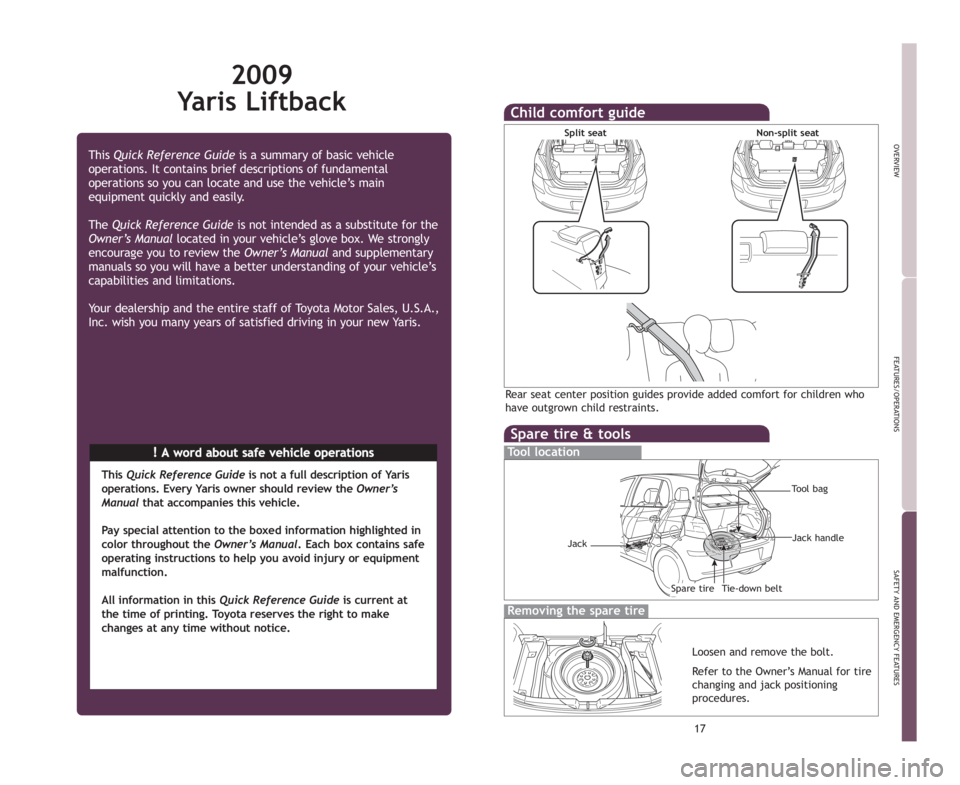
n Checking tires
New tread
Treadwear indicator
Worn tread
The location of treadwear
indicators is shown by the
“TWI” or “” marks, etc.,
molded on the sidewall of
ea
ch tire.
Check spare tire condition
an
d inflation pressure if not
rotated.
n Tire rotation
Rotate the tires in the order
show
n.
To equalize tire wear and
extend tire life, Toyota recom -
mends that tire rotation is
ca
rried out at the same inter -
val as tire inspection.
n The tire pressure warning system
Your Toyota is equipped with a tire pressure warning system that
use
s tire pressure warning valves and transmitters to detect low
tire inflation pressure before serious problems arise. (→P. 310 )
Front
Page 277 of 402

266 4-3. Do-it-yourself maintenance
nTire inflation pressure check interval
You should check tire pressure every two weeks, or at least once a
mo
nth.
Do not forget to check the spare tire.
nEffects of incorrect tire inflation pressure
Driving with incorrect ti re
inflation pressure may result in the following:
lReduced fuel efficiency
lReduced driving comfort and tire life
lReduced safety
lDamage to the drive train
If a tire needs frequent refilling, have it checked by your Toyota dealer.
n
Instructions for checking tire inflation pressure
When checking tire inflation pressure, observe the following:
lCheck only when the tires are cold.
If your vehicle has been parked for at least 3 hours and has not been
driven for
more than 1 mile or 1.5 km, you will get an accurate cold
tire inflation pressure reading.
lAlways use a tire pressure gauge.
The appearance of the tire can be mi slead
ing. In addition, tire infla-
tion pressures that are even just a few pounds off can degrade ride
a
nd handling.
lDo not bleed or reduce tire inflation pressure after driving. It is normal
for the tire inflation pressure to be higher after driving.
lNever exceed the vehicle capacity weight.
Passengers and luggage weight should be placed so that the vehicle
is bal
anced.
Page 322 of 402

312 5-2. Steps to take in an emergency
nKey reminder buzzer
The buzzer indicates that the key has not been removed (with the engine
switch in the ACC or LOCK position and the driver’s door opened).
n L
ight reminder buzzer
The buzzer indicates that the headlight switch is left on (with the key
removed and the driver
’s door opened).
n If the malfunction indic
ator lamp comes on while driving
First check the following:
l Is your vehicle low on gas?
If it is, refuel the vehicle immediately.
l Is the fue
l tank cap loose?
If it is, tighten it securely.
The light will go off after taking several driving trips.
If the light does not go off even after several trips, contact your Toyota dealer
as soon as possible.
n Front p
assenger detect ion sensor and passenger seat belt reminder
If luggage or other load is placed on the front passenger seat, depending on
it
s weight, the reminder light to flash and buzzer to sound.
n
When the tire pressure warning light comes on
Check the tire inflation pressure and adjust to the appropriate level.
nThe tire pressure warning light ma y turn on due to natural causes
The tire pressure warning light may turn on due to natural causes such
a
s natural air leaks or tire inflation pressure changes caused by temper -
ature. In this case, adjusting the ti re inflation pressure will turn of
f the
warning light (after a few minutes).
nWhen a tire is replaced with a spare tire
The compact spare tire is not equipped with the tire pressure warning
valve and trans
mitter. If a tire goes flat, the tire pressure warning light will
not turn off even though the flat tire is replaced with the spare tire.
Replace the spare tire with the repair ed tire and adjust the proper tire
inflation pressure. The ti re pressure warning light will turn off after a few
minutes.
Page 324 of 402

314 5-2. Steps to take in an emergency
nCustomization that can be co nfigured at Toyota dealer
l The vehicle speed linked seat belt reminder buzzer can be disabled.
(Customizable features →P. 369)
l The key reminder buzzer can be disabled.
(Customizable features →P. 369)
l The light reminder buzzer can be disabled.
(Customizable features →P. 369)
CAUTION
nIf the tire pressure warning light comes on
Be sure to observe the following precautions. Failure to do so could
cause loss of vehicle control and re sult in death or serious injury.
lStop your vehicle in a safe place as soon as possible. Adjust the tire
inflation pressure immediately.
lIf the tire pressure warning light comes on even after tire inflation pres-
sure adjustment, it is pr obable that you have a fl at tire. Check the tires.
If the tire is flat, change to the spare tire and have the flat tire repaired
by the nearest Toyota dealer.
lAvoid abrupt maneuvering and braking. If the vehicle tires deteriorate,
you could lose control of the steering wheel or the brakes.
nIf a blowout or sudden air leakage should occur
The tire pressure warning syste m may not activate immediately.
nMaintenance of the tire
Each tire, including the spare (if provided), should be checked monthly
when cold and inflated to the inflation pressure recommended by the
vehicle manufacturer on the vehicle pl acard or tire inflation pressure
label (tire and load information label). (If your vehicle has tires of a differ-
ent size than the size indicated on the vehicle placard or tire inflation
pressure label [tire and load information label], you should determine the
proper tire inflation pr essure for those tires.)
Page 327 of 402
5
When trouble arises
317
5-2. Steps to take in an emergency
If you have a flat tire
Remove the flat tire and replace it with the spare provided.
nBefore jacking up the vehicle
lS
top the vehicle on a hard, flat surface.
lSe
t the parking brake.
lSh
ift the shift lever to P (automatic transmission) or R (manual
transmission).
l S
top the engine.
lT
urn on the emergency flashers.
n Location of th
e spare tire, jack and tools
Spare tire
Jack
Jack handle
Tie-down belt
Tool bag
(including towing
eyelet)