Page 156 of 402
143
2-2. Instrument cluster
2
When driving
n
Indicators
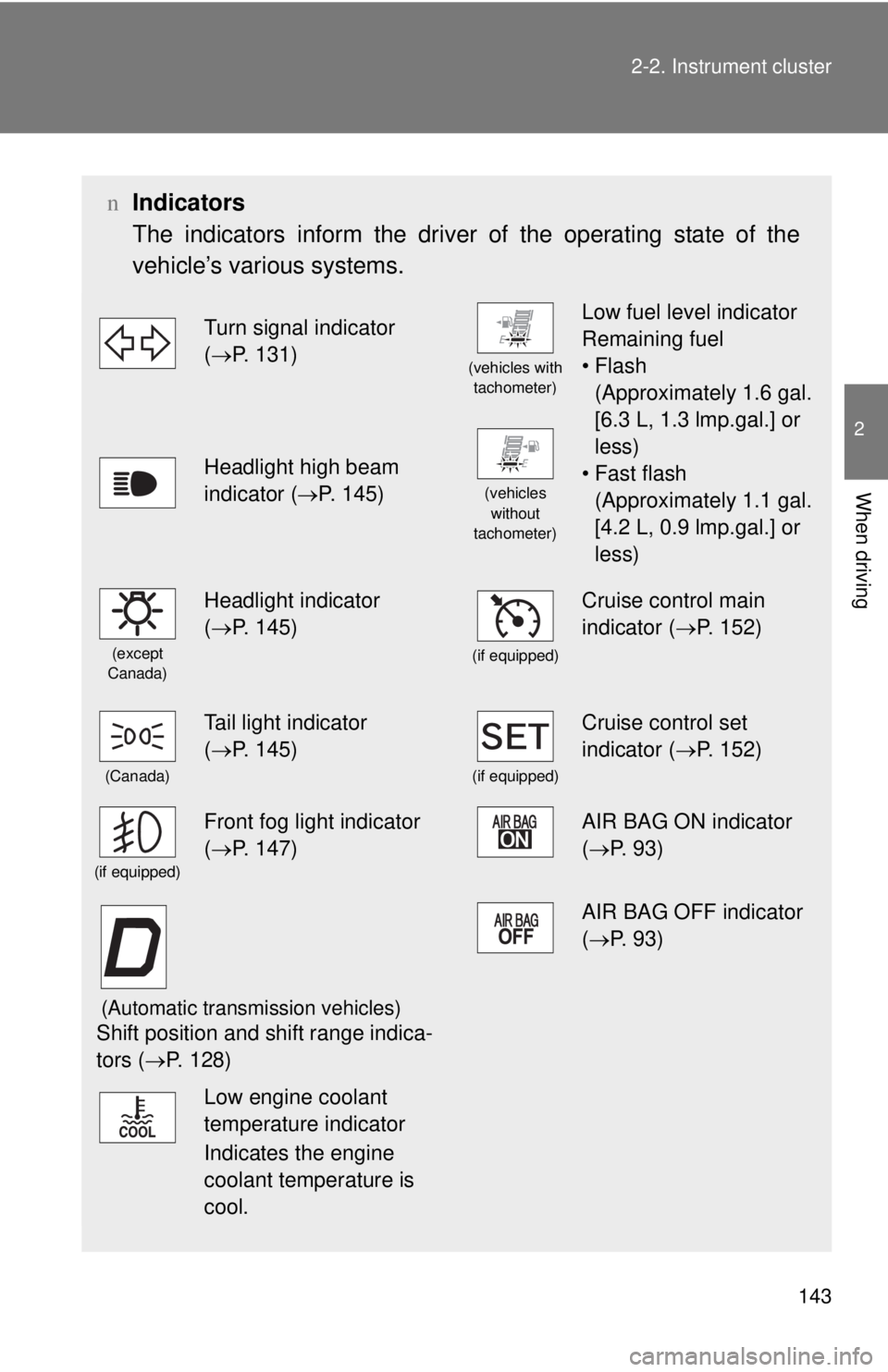
The indicators inform the driver of the operating state of the
vehicle’s various systems.
Turn signal indicator
( →P. 131)
(vehicles with
tachometer)
Low fuel level indicator
Remaining fuel
•Flash
(Approximately 1.6 gal.
[6.3 L, 1.3 lmp.gal.] or
less)
• Fast flash
(Approximately 1.1 gal.
[4.2 L, 0.9 lmp.gal.] or
less)
Headlight high beam
indicator ( →P. 145)
(vehicles
without
tachometer)
(except
Canada)
Headlight indicator
( →P. 145)
(if equipped)
Cruise control main
indicator ( →P. 152)
(Canada)
Tail light indicator
( →P. 145)
(if equipped)
Cruise control set
indicator ( →P. 152)
(if equipped)
Front fog light indicator
( →P. 147)AIR BAG ON indicator
( →P. 93)
(Automatic transmission vehicles)
Shift position and shift range indica-
tors ( →P. 128)
AIR BAG OFF indicator
(→P. 93)
Low engine coolant
temperature indicator
Indicates the engine
coolant temperature is
cool.
Page 158 of 402
145
2
When driving
2-3. Operating the lights and wipers
Headlight switch
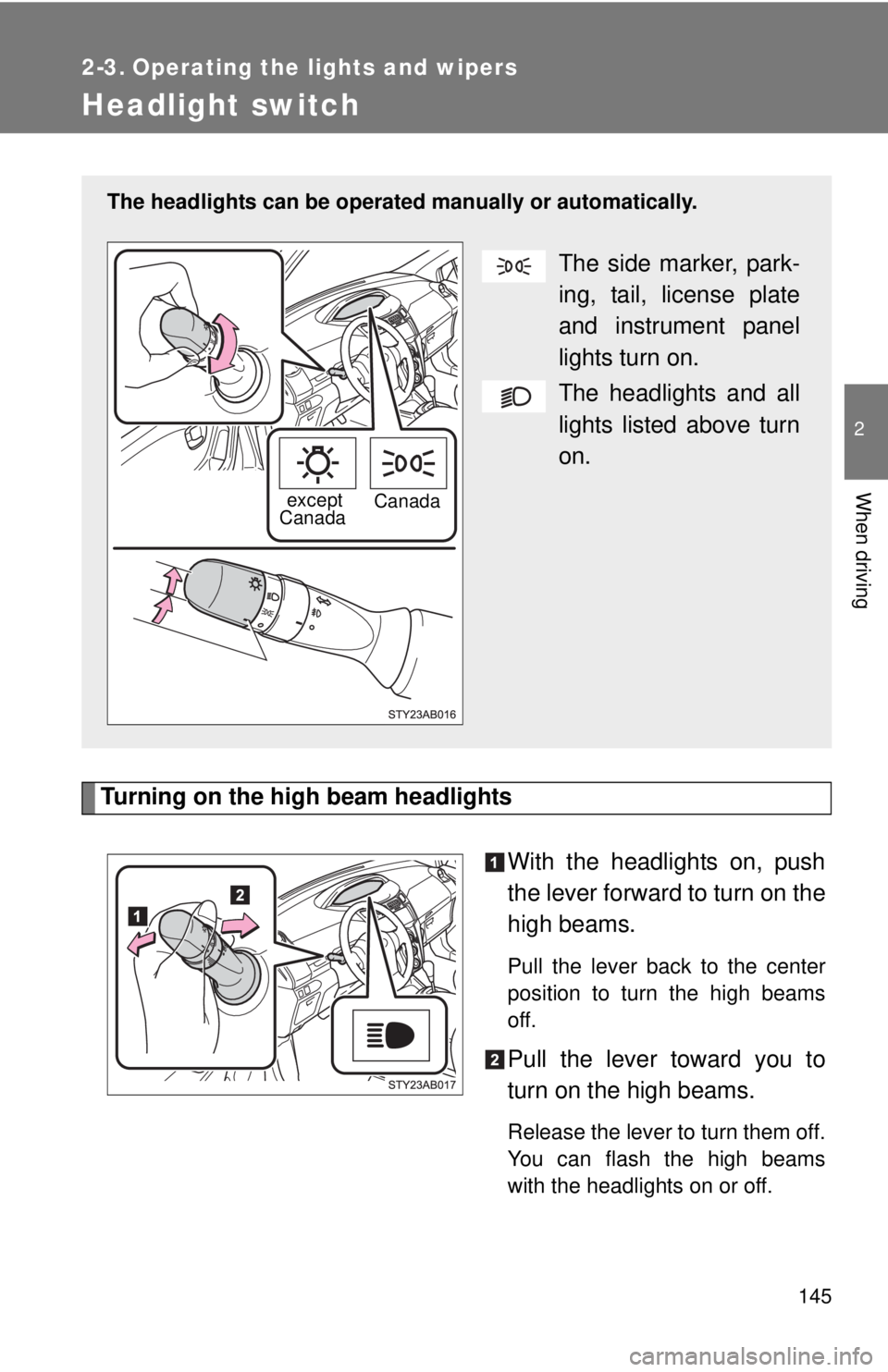
Turning on the high beam headlights
With the headlights on, push
the lever forward to turn on the
h
igh beams.
Pull the lever back to the center
position to turn the high beams
off.
Pull the lever toward you to
turn on the high beams.
Release the lever to turn them off.
You can flash the high beams
with the headlights on or off.
The headlights can be operated manually or automatically.
The side marker, park-
ing, tail, license plate
an
d instrument panel
lights turn on.
The headlights and all
lights listed above turn
on
.
except
Canada Canada
Page 159 of 402
146 2-3. Operating the lights and wipers
nDaytime running light system (if equipped)
To make your vehicle more visible to other drivers, the headlights turn on
automatically (at a reduced intensity) whenever the engine is started and the
parking brake is released. Daytime r unning lights are not designed for use at
night.
n L
ight reminder buzzer
A buzzer sounds when the key is removed and the driver's door is opened
while the light
s are turned on.
NOTICE
nTo prevent battery discharge
Do not leave the lights on longer than necessary when the engine is not run-
ning.
Page 160 of 402
147
2-3. Operating the lights and wipers
2
When driving
Fog light switch (if equipped)
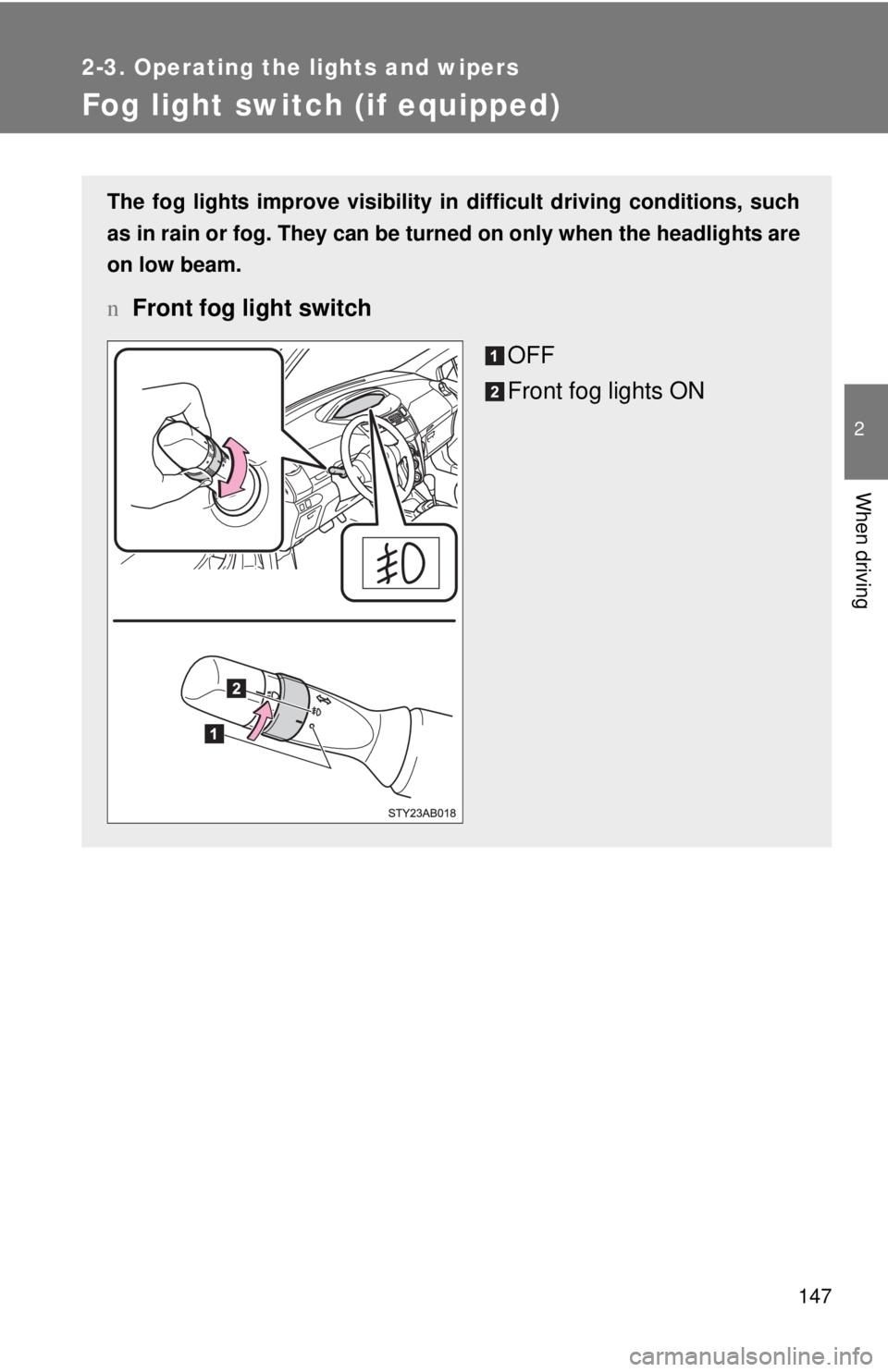
The fog lights improve visibility in difficult driving conditions, such
as in rain or fog. They can be turned on only when the headlights are
on low beam.
n Front fog light switch
OFF
Front fog lights ON
Page 247 of 402
236 4-2. Maintenance
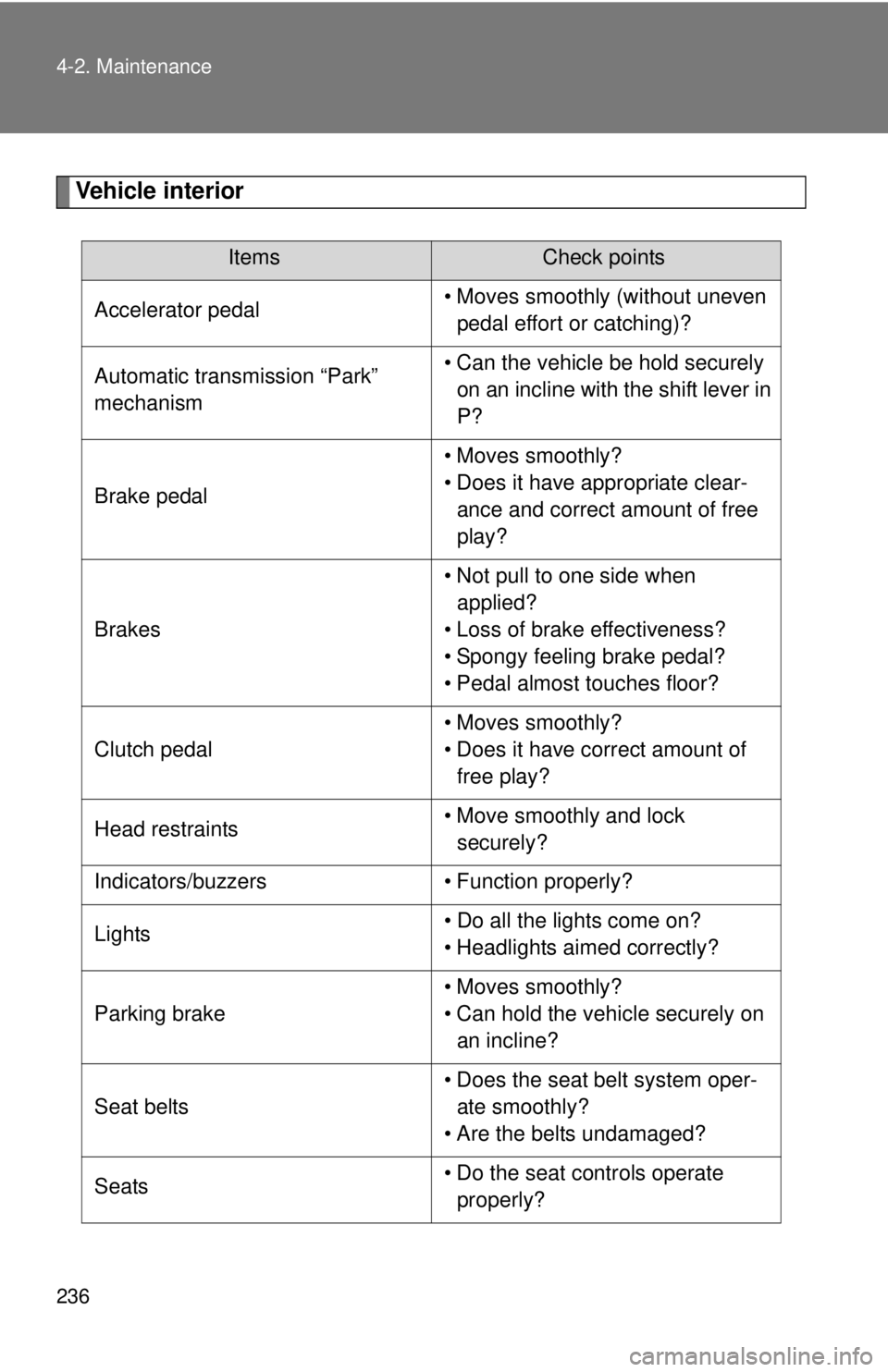
Vehicle interior
ItemsCheck points
Accelerator pedal • Moves smoothly (without uneven
pedal effort or catching)?
Automatic transmission “Park”
mechanism • Can the vehicle be hold securely
on an incline with the shift lever in
P?
Brake pedal • Moves smoothly?
• Does it have appropriate clear-
ance and correct amount of free
play?
Brakes • Not pull to one side when
applied?
• Loss of brake effectiveness?
• Spongy feeling brake pedal?
• Pedal almost touches floor?
Clutch pedal • Moves smoothly?
• Does it have correct amount of
free play?
Head restraints • Move smoothly and lock
securely?
Indicators/buzzers • Function properly?
Lights • Do all the lights come on?
• Headlights aimed correctly?
Parking brake • Moves smoothly?
• Can hold the vehicle securely on
an incline?
Seat belts • Does the seat belt system oper-
ate smoothly?
• Are the belts undamaged?
Seats • Do the seat controls operate
properly?
Page 292 of 402
281
4-3. Do-it-yourself maintenance
4
Maintenance and care
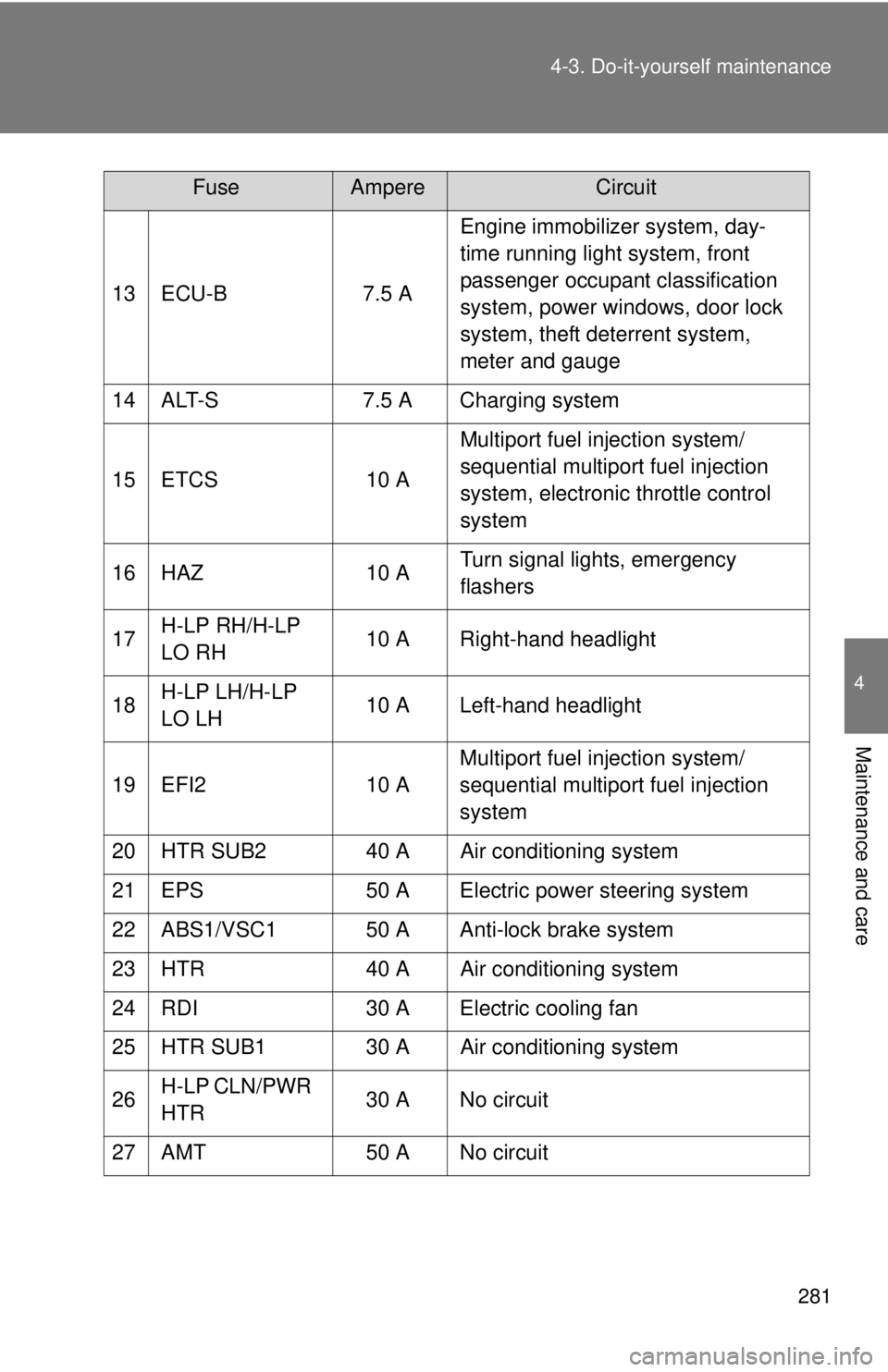
13 ECU-B
7.5 AEngine immobilizer system, day-
time running light system, front
passenger occupant classification
system, power windows, door lock
system, theft deterrent system,
meter and gauge
14 ALT-S 7.5 A Charging system
15 ETCS 10 AMultiport fuel injection system/
sequential multiport fuel injection
system, electronic throttle control
system
16 HAZ 10 ATurn signal lights, emergency
flashers
17 H-LP RH/H-LP
LO RH 10 A Right-hand headlight
18 H-LP LH/H-LP
LO LH 10 A Left-hand headlight
19 EFI2 10 AMultiport fuel injection system/
sequential multiport fuel injection
system
20 HTR SUB2 40 A Air conditioning system
21 EPS 50 A Electric power steering system
22 ABS1/VSC1 50 A Anti-lock brake system
23 HTR 40 A Air conditioning system
24 RDI 30 A Electric cooling fan
25 HTR SUB1 30 A Air conditioning system
26 H-LP CLN/PWR
HTR 30 A No circuit
27 AMT 50 A No circuit
FuseAmpereCircuit
Page 297 of 402
286
4-3. Do-it-yourself maintenance
Light bulbs
You may replace the following bulbs yourself. The difficulty level of
replacement varies depending on the bulb. If necessary bulb
replacement seems difficult to perfor m, contact your Toyota dealer.
For more information about replacing other light bulbs, contact your
Toyota dealer.
nPrepare a replacement light bulb.
Check the wattage of the light bulb being replaced. ( →P
. 352)
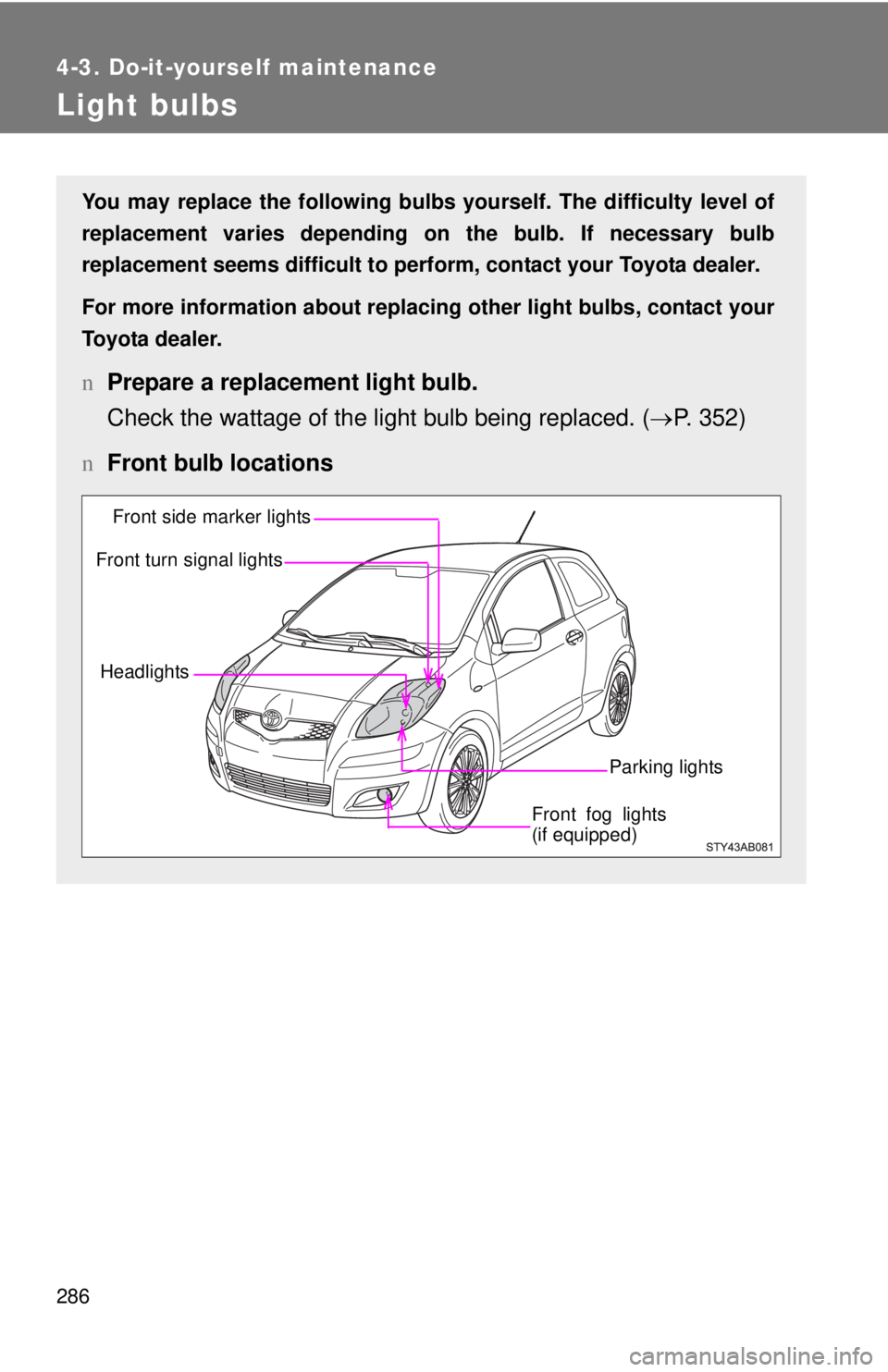
n Front bulb locations
Headlights
Front fog lights
(if equipped)
Front side marker lights
Front turn signal lights
Parking lights
Page 298 of 402
287
4-3. Do-it-yourself maintenance
4
Maintenance and care
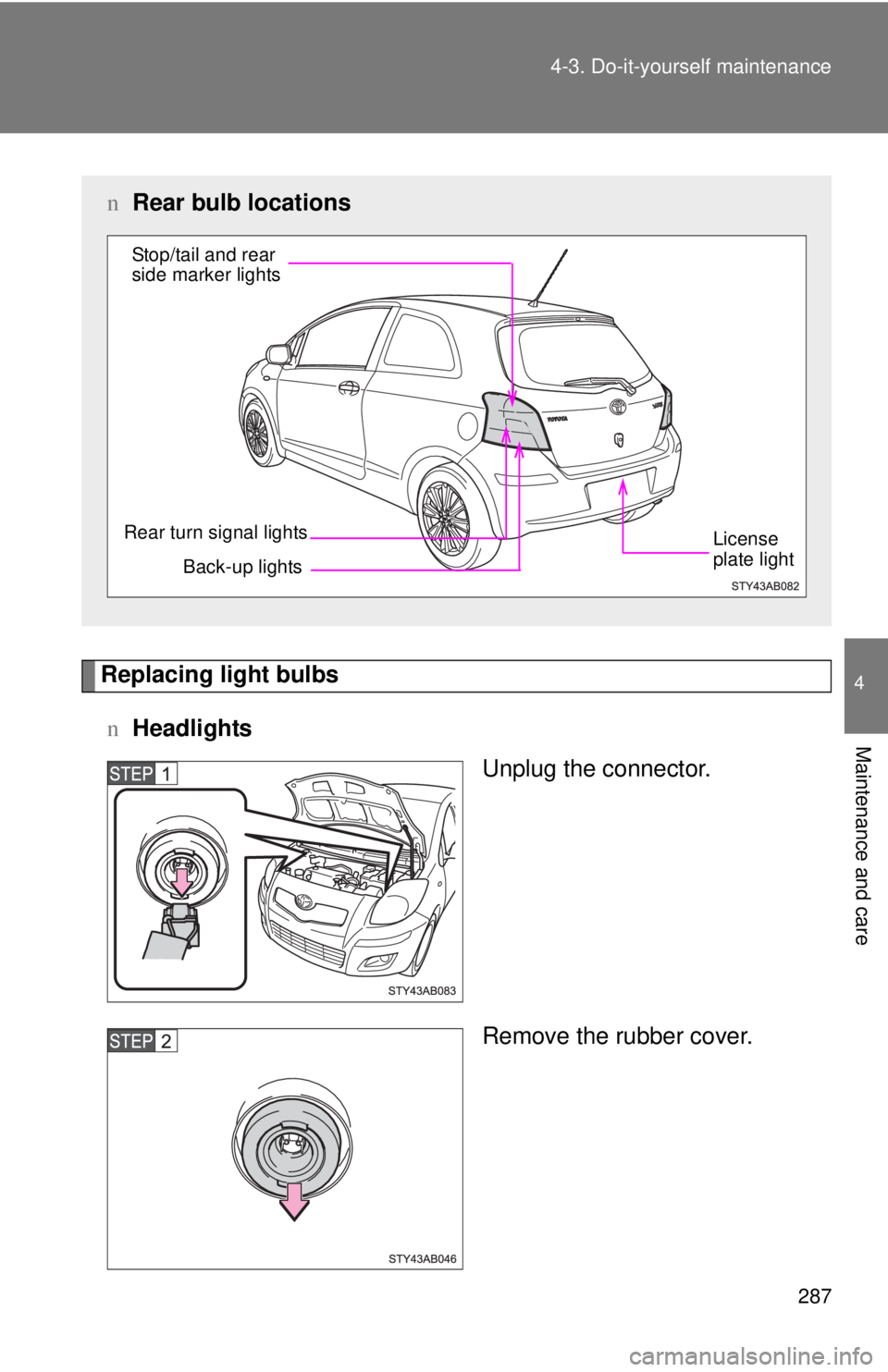
Replacing light bulbs
n
Headlights
Unplug the connector.
Remove the rubber cover.
nRear bulb locations
Back-up lights
Rear turn signal lights Stop/tail and rear
side marker lights
License
plate light