Page 188 of 672
188
2-2. Instrument cluster
Gauges and meters
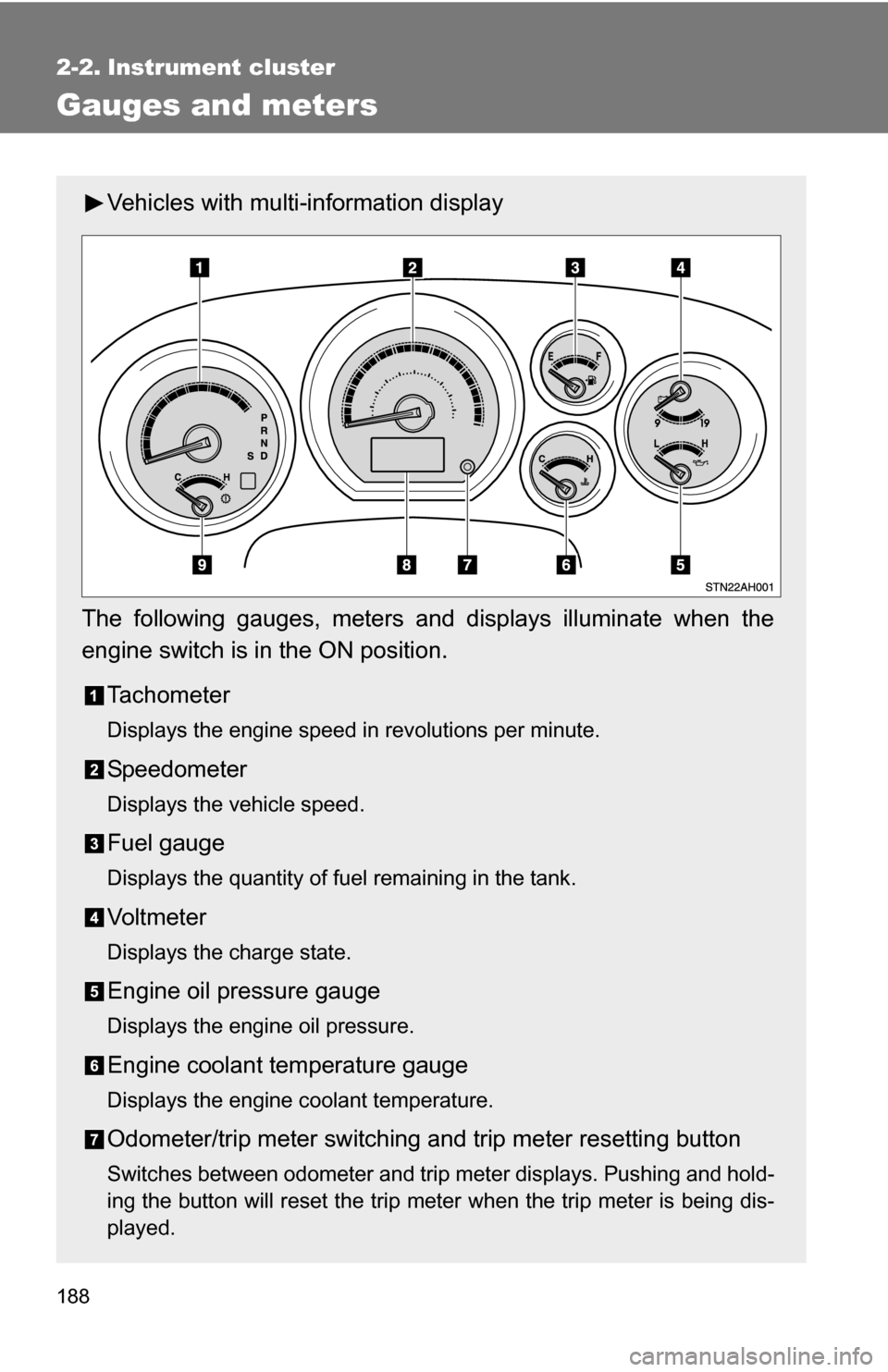
Vehicles with multi-information display
The following gauges, meters and displays illuminate when the
engine switch is in the ON position. Tachometer
Displays the engine speed in revolutions per minute.
Speedometer
Displays the vehicle speed.
Fuel gauge
Displays the quantity of fuel remaining in the tank.
Vo l t m e t e r
Displays the charge state.
Engine oil pressure gauge
Displays the engine oil pressure.
Engine coolant temperature gauge
Displays the engine coolant temperature.
Odometer/trip meter switching and trip meter resetting button
Switches between odometer and trip meter displays. Pushing and hold-
ing the button will reset the trip meter when the trip meter is being dis-
played.
Page 191 of 672
191
2-2. Instrument cluster
2
When driving
Fuel gauge
Displays the quantity of fuel remaining in the tank.
Voltmeter (if equipped)
Displays the charge state.
Engine oil pressure gauge (if equipped)
Displays the engine oil pressure.
Engine coolant temperature gauge
Displays the engine coolant temperature.
Odometer/trip meter switching and trip meter resetting button
Switches between odometer and trip meter displays. Pushing and hold-
ing the button will reset the trip meter when the trip meter is being dis-
played.
Odometer/trip meter
Odometer:
Displays the total distance the vehicle has been driven.
Trip meter:
Displays the distance the vehicle has been driven since the meter was
last reset. Trip meters A and B can be used to record and display differ-
ent distances independently.
Automatic transmission fluid temperature gauge (if equipped)
Displays the automatic transmission fluid temperature.
Page 193 of 672
193
2-2. Instrument cluster
2
When driving
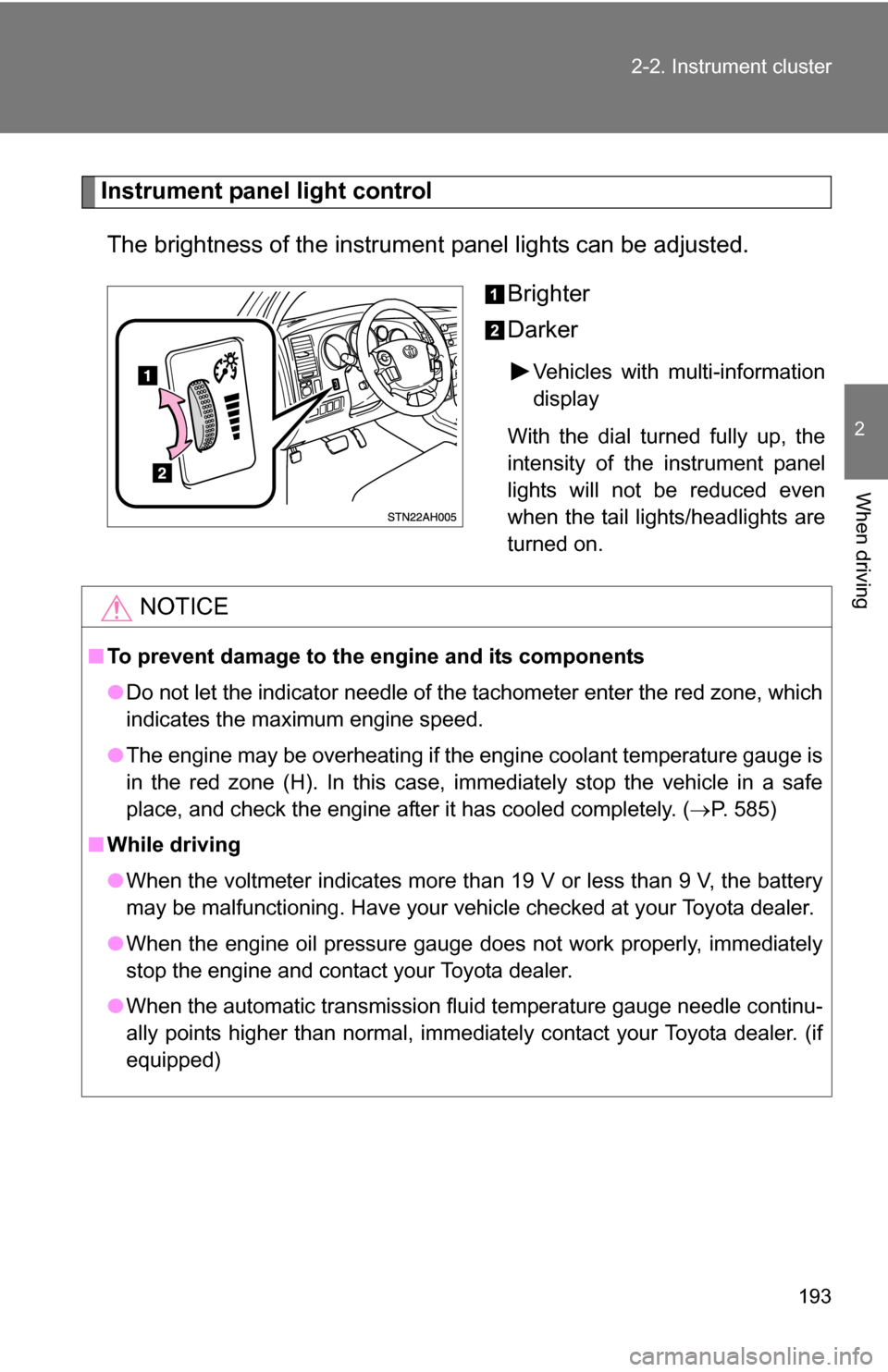
Instrument panel light control
The brightness of the instrument panel lights can be adjusted.
Brighter
Darker
Vehicles with multi-information
display
With the dial turned fully up, the
intensity of the instrument panel
lights will not be reduced even
when the tail lights/headlights are
turned on.
NOTICE
■ To prevent damage to the engine and its components
●Do not let the indicator needle of the tachometer enter the red zone, which
indicates the maximum engine speed.
● The engine may be overheating if the engine coolant temperature gauge is
in the red zone (H). In this case, immediately stop the vehicle in a safe
place, and check the engine after it has cooled completely. ( P. 585)
■ While driving
●When the voltmeter indicates more than 19 V or less than 9 V, the battery
may be malfunctioning. Have your vehicle checked at your Toyota dealer.
● When the engine oil pressure gauge does not work properly, immediately
stop the engine and contact your Toyota dealer.
● When the automatic transmission fluid temperature gauge needle continu-
ally points higher than normal, immediately contact your Toyota dealer. (if
equipped)
Page 473 of 672
473
4-3. Do-it-yourself maintenance
4
Maintenance and care
CAUTION
The engine compartment contains many mechanisms and fluids that may
move suddenly, become hot, or become electrically energized. To avoid death
or serious injury observe the following precautions.
■
When working on the engine compartment
●Keep hands, clothing, and tools away from the moving fan and engine
drive belt.
● Be careful not to touch the engine, radiator, exhaust manifold, etc. right
after driving as they may be hot. Oil and other fluids may also be hot.
● Do not leave anything that may burn easily, such as paper or rags, in the
engine compartment.
● Do not smoke, cause sparks or expose an open flame to fuel or the bat-
tery. Fuel and battery fumes are flammable.
● Be extremely cautious when working on the battery. It contains poisonous
and corrosive sulfuric acid.
● Take care because brake fluid can harm your hands or eyes and damage
painted surfaces.
If fluid gets on your hands or in your eyes, flush the affected area with
clean water immediately.
If you still experience discomfort, see a doctor.
■ When working near the cooling fan or radiator grille
Be sure the engine switch is off.
With the engine switch on, the cooling fan may automatically start to run if
the air conditioning is on and/or the coolant temperature is high.
■ Safety glasses
Wear safety glasses to prevent flying or falling material, fluid spray, etc. from
getting in the eyes.
Page 479 of 672
479
4-3. Do-it-yourself maintenance
4
Maintenance and care
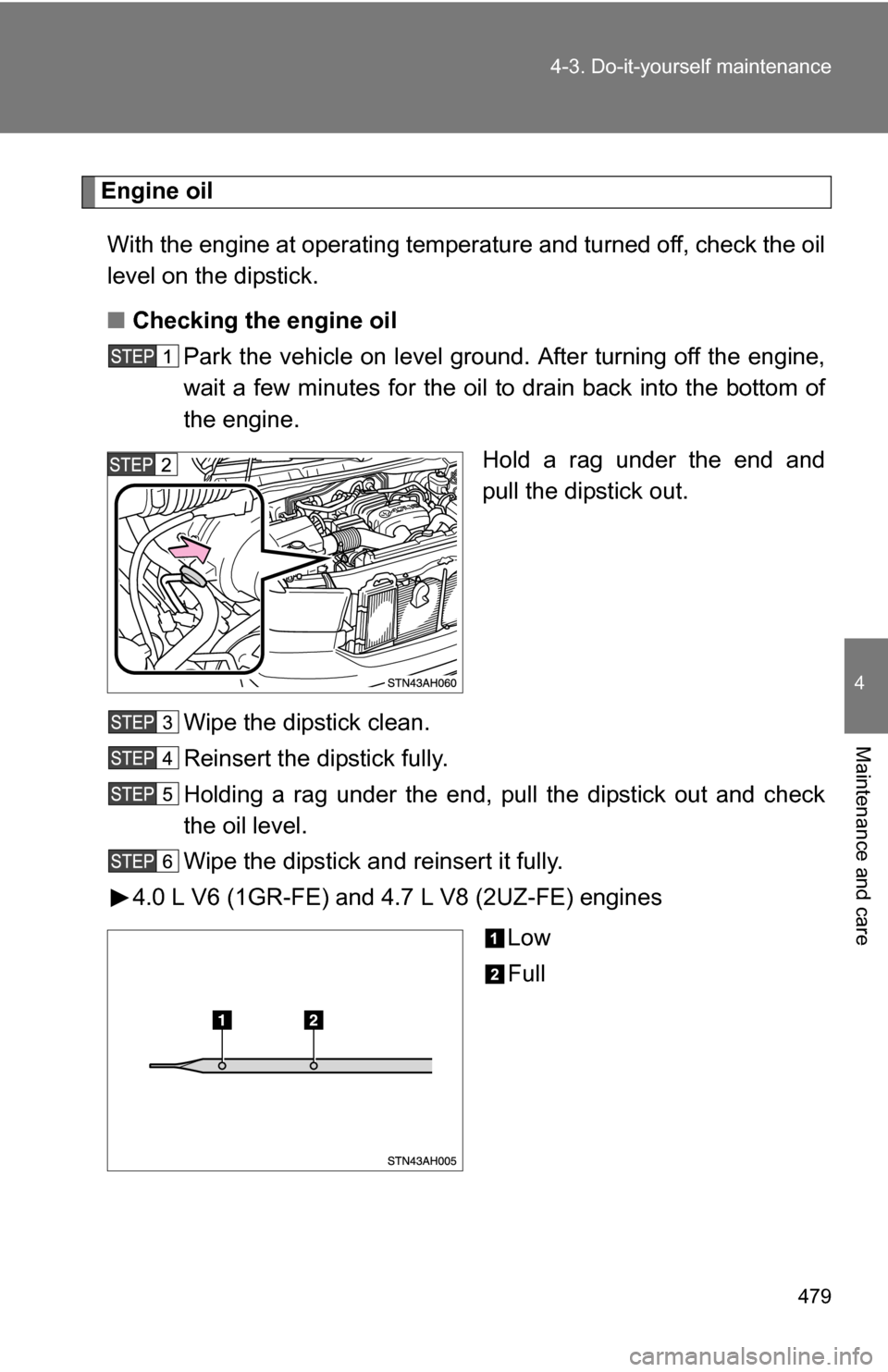
Engine oil
With the engine at operating temperature and turned off, check the oil
level on the dipstick.
■ Checking the engine oil
Park the vehicle on level gro und. After turning off the engine,
wait a few minutes for the oil to drain back into the bottom of
the engine.
Hold a rag under the end and
pull the dipstick out.
Wipe the dipstick clean.
Reinsert the dipstick fully.
Holding a rag under the end, pull the dipstick out and check
the oil level.
Wipe the dipstick and reinsert it fully.
4.0 L V6 (1GR-FE) and 4.7 L V8 (2UZ-FE) engines
Low
Full
Page 482 of 672
482 4-3. Do-it-yourself maintenance
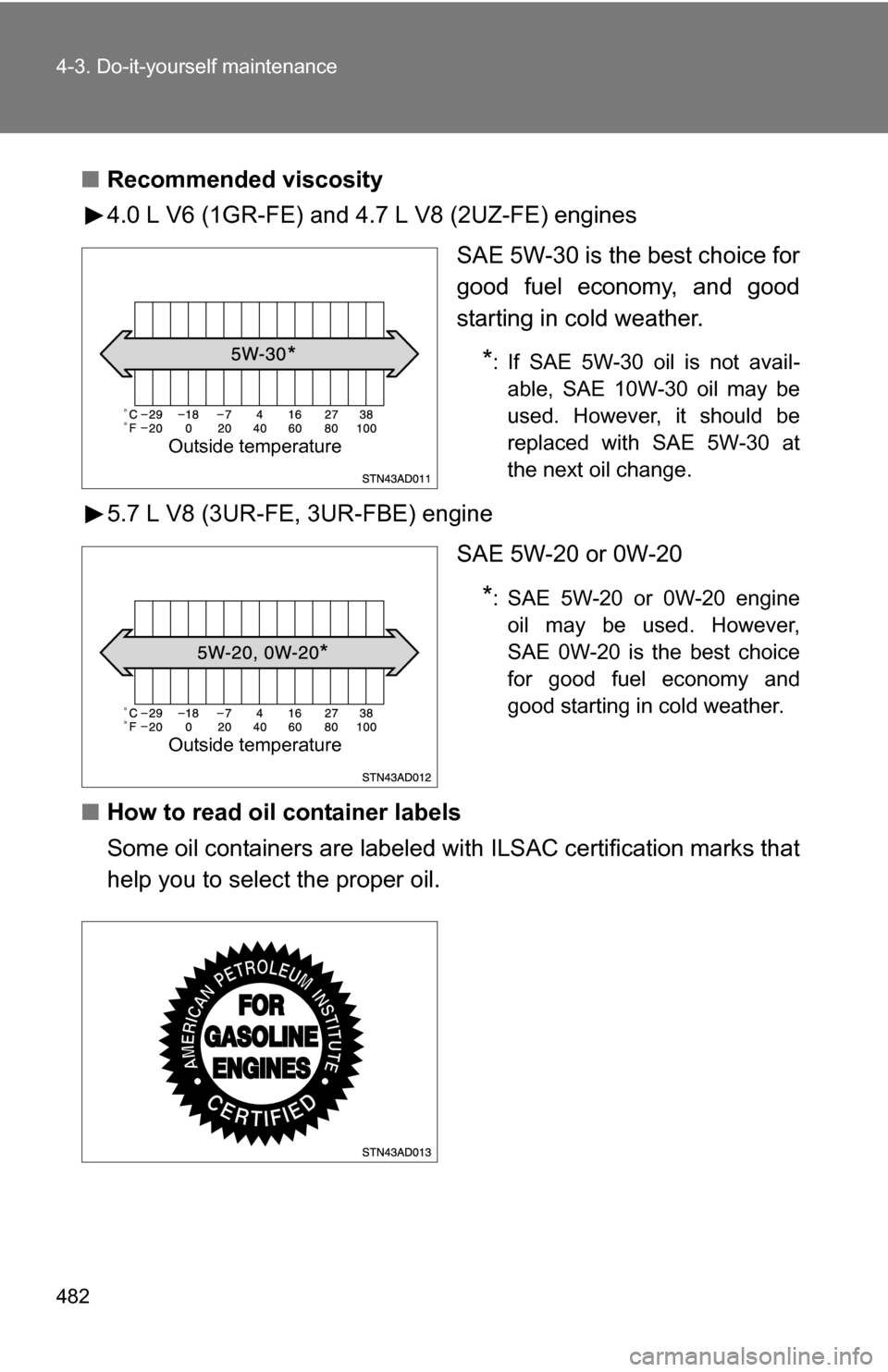
■Recommended viscosity
4.0 L V6 (1GR-FE) and 4.7 L V8 (2UZ-FE) engines
SAE 5W-30 is the best choice for
good fuel economy, and good
starting in cold weather.
*: If SAE 5W-30 oil is not avail-able, SAE 10W-30 oil may be
used. However, it should be
replaced with SAE 5W-30 at
the next oil change.
5.7 L V8 (3UR-FE, 3UR-FBE) engine
SAE 5W-20 or 0W-20
*: SAE 5W-20 or 0W-20 engineoil may be used. However,
SAE 0W-20 is the best choice
for good fuel economy and
good starting in cold weather.
■ How to read oil container labels
Some oil containers are labeled with ILSAC certification marks that
help you to select the proper oil.
Outside temperature
Outside temperature
Page 541 of 672
5
When trouble arises
541
5-1. Essential information
If you think something is wrong
If you notice any of the following symptoms, your vehicle probably
needs adjustment or repair. Contact your Toyota dealer as soon as
possible.
■ Visible symptoms
●Fluid leaks under the vehicle
(Water dripping from the air cond itioning after use is normal.)
● Flat-looking tires or uneven tire wear
● Engine coolant temperature g auge needle continually points
higher than normal
● Voltmeter continually points higher or lower than normal
(if equipped)
● Engine oil pressure gauge continually points lower than nor-
mal (if equipped)
● Automatic transmission fluid temperature gauge needle con-
tinually points higher than normal (if equipped)
■ Audible symptoms
●Changes in exhaust sound
● Excessive tire squeal when cornering
● Strange noises related to the suspension system
● Pinging or other noises related to the engine
■ Operational symptoms
●Engine missing, stumbling or running rough
● Appreciable loss of power
● Vehicle pulls heavily to one side when braking
● Vehicle pulls heavily to one side when driving on a level road
● Loss of brake effectiveness, s pongy feeling, pedal almost
touches the floor
Page 607 of 672
607
6-1. Specifications
6
Vehicle specifications
Lubrication system
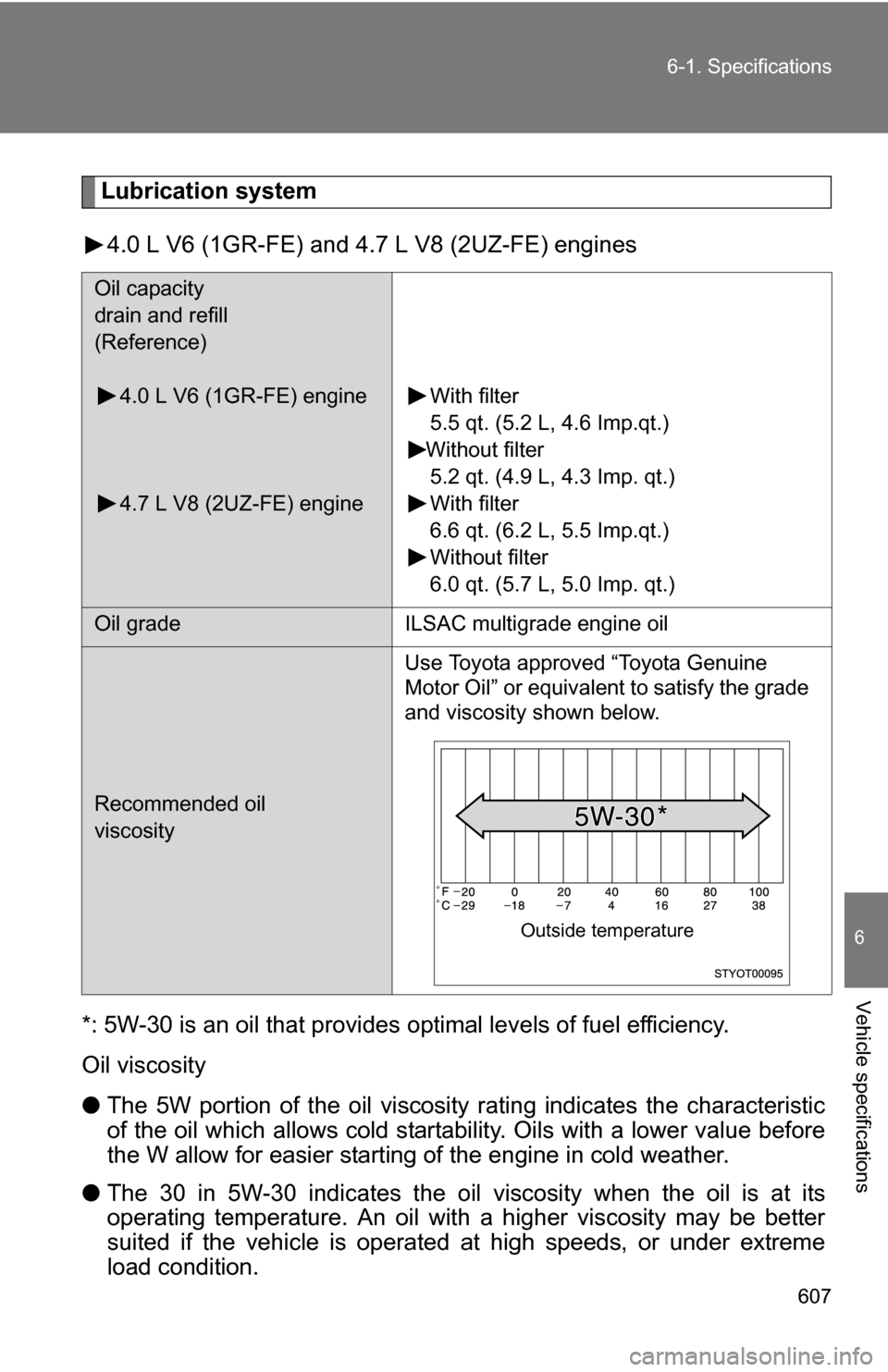
4.0 L V6 (1GR-FE) and 4.7 L V8 (2UZ-FE) engines
*: 5W-30 is an oil that provides optimal levels of fuel efficiency.
Oil viscosity
● The 5W portion of the oil viscosity rating indicates the characteristic
of the oil which allows cold startab ility. Oils with a lower value before
the W allow for easier starting of the engine in cold weather.
● The 30 in 5W-30 indicates the oil viscosity when the oil is at its
operating temperature. An oil with a higher viscosity may be better
suited if the vehicle is operated at high speeds, or under extreme
load condition.
Oil capacity
drain and refill
(Reference)
4.0 L V6 (1GR-FE) engine
4.7 L V8 (2UZ-FE) engine With filter
5.5 qt. (5.2 L, 4.6 Imp.qt.)
Without filter 5.2 qt. (4.9 L, 4.3 Imp. qt.)
With filter
6.6 qt. (6.2 L, 5.5 Imp.qt.)
Without filter
6.0 qt. (5.7 L, 5.0 Imp. qt.)
Oil grade ILSAC multigrade engine oil
Recommended oil
viscosityUse Toyota approved “Toyota Genuine
Motor Oil” or equivalent to satisfy the grade
and viscosity shown below.
Outside temperature