Page 111 of 556
111
1-7. Safety information
1
Before driving
L/C200_U (OM60D97U)
CAUTION
■
SRS airbag precautions
● The SRS front passenger airbag also deploys with considerable force, and
can cause death or serious injury especially if the front passenger is very
close to the airbag. The front passenger seat should be as far from the air-
bag as possible with the seatback adjusted, so the front passenger sits
upright.
● Improperly seated and/or restrained infants and children can be killed or
seriously injured by a deploying airbag. An infant or child who is too small
to use a seat belt should be properly secured using a child restraint sys-
tem. Toyota strongly recommends that all infants and children be placed in
the rear seats of the vehicle and properly restrained. The rear seats are
the safest for infants and children. (P. 123)
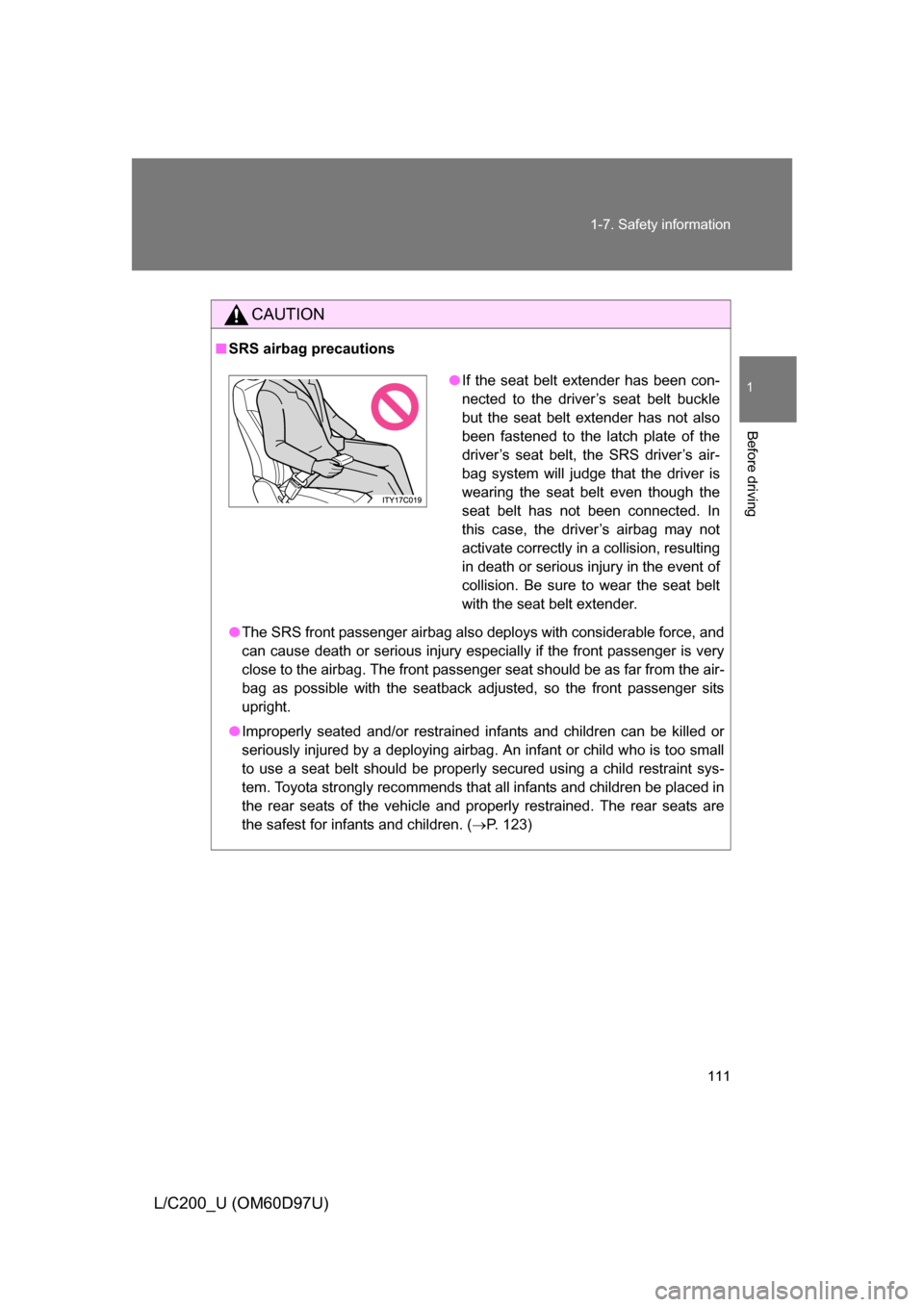
● If the seat belt extender has been con-
nected to the driver’s seat belt buckle
but the seat belt extender has not also
been fastened to the latch plate of the
driver’s seat belt, the SRS driver’s air-
bag system will judge that the driver is
wearing the seat belt even though the
seat belt has not been connected. In
this case, the driver’s airbag may not
activate correctly in a collision, resulting
in death or serious injury in the event of
collision. Be sure to wear the seat belt
with the seat belt extender.
Page 123 of 556
123
1
1-7. Safety information
Before driving
L/C200_U (OM60D97U)
Child restraint systems
Points to rememberStudies have shown that installing a child restraint on a rear seat is
much safer than installing one to the front passenger seat.
● Choose a child restraint system th at suits your vehicle and is
appropriate to the age and size of the child.
● For installation details, follow the instructions provided with the
child restraint system.
General installation instructions are provided in this manual.
( P. 127)
Types of child restraints
Child restraint systems are classi fied into the following 3 types
according to the age and size of the child.
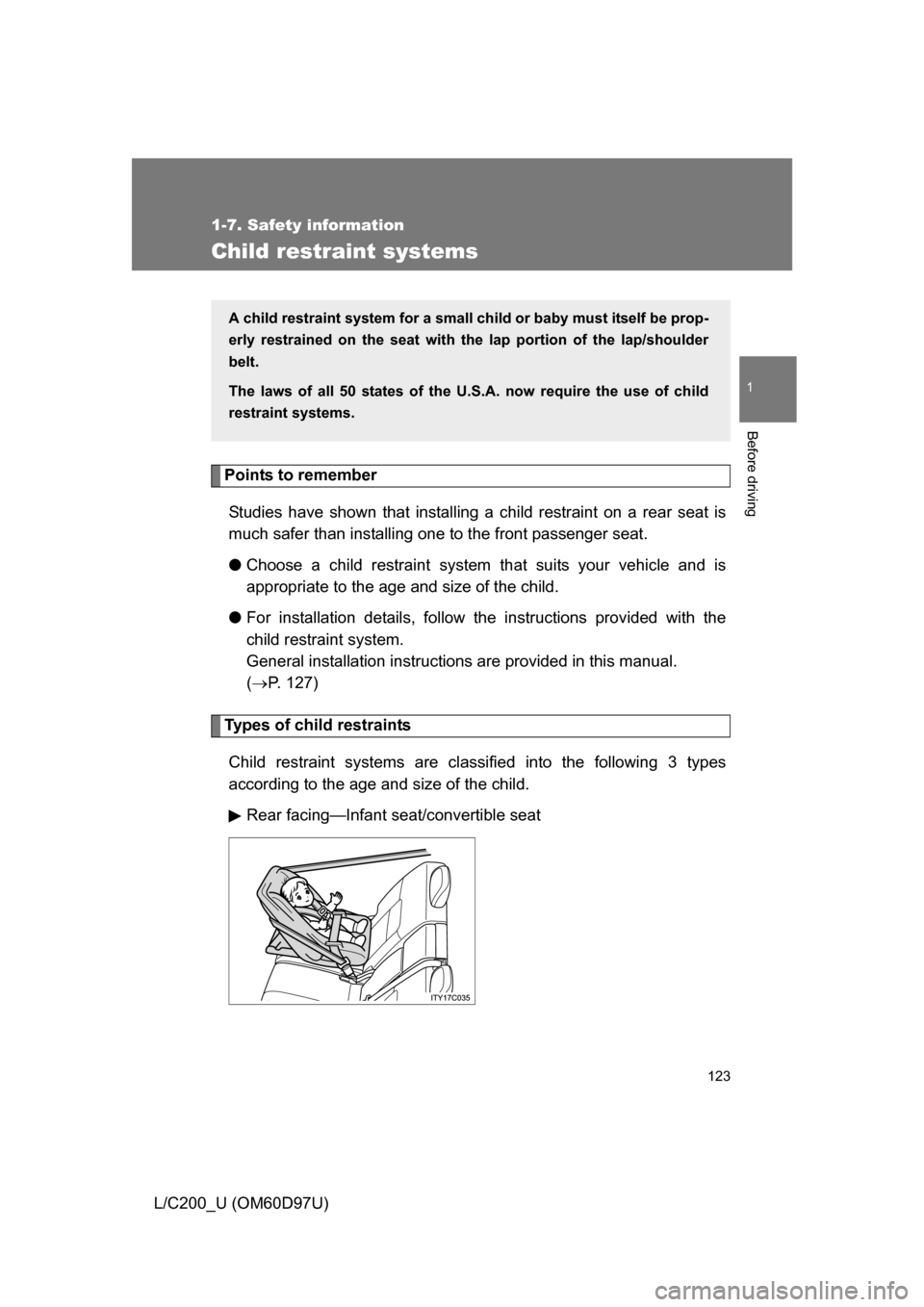
Rear facing—Infant seat/convertible seat
A child restraint system for a small ch ild or baby must itself be prop-
erly restrained on the seat with th e lap portion of the lap/shoulder
belt.
The laws of all 50 states of the U. S.A. now require the use of child
restraint systems.
Page 125 of 556
125
1-7. Safety information
1
Before driving
L/C200_U (OM60D97U)
■
Selecting an appropriat e child restraint system
● Use a child restraint system appropriate for the child until the child
becomes large enough to properly wear the vehicle’s seat belt.
● If a child is too large for a child restraint system, sit the child on a rear
seat and use the vehicle’s seat belt. ( P. 70)
CAUTION
■Using a child restraint system
The use of a child restraint system not suitable for the vehicle may not prop-
erly secure the infant or child, resulting in serious injury or even death.
■ Child restraint precautions
● For effective protection in automobile accidents and sudden stops, a child
must be properly restrained, using a seat belt or child restraint system
depending on the age and size of the child. Holding a child in your arms is
not a substitute for a child restraint system. In an accident, the child can be
crushed against the windshield, or between you and the vehicle’s interior.
● Toyota strongly urges the use of a proper child restraint system that con-
forms to the size of the child, installed on the rear seat. According to acci-
dent statistics, the child is safer when properly restrained in the rear seat
than in the front seat.
● Never install a rear-facing child restraint system on the front passenger
seat even if the AIR BAG OFF indicator light illuminates. In the event of an
accident, the force of the rapid inflation of the front passenger airbag can
cause death or serious injury to the child if the rear-facing child restraint
system is installed on the front passenger seat.
● A forward-facing child restraint system may be installed on the front pas-
senger seat only when it is unavoidable. A child restraint system that
requires a top tether strap should not be used in the front passenger seat
since there is no top tether strap anchor for the front passenger seat.
Adjust the seatback as upright as possible and always move the seat as
far back as possible even if the AIR BAG OFF indicator light illuminates,
because the front passenger airbag could inflate with considerable speed
and force. Otherwise, the child may be killed or seriously injured.
Page 130 of 556
130 1-7. Safety information
L/C200_U (OM60D97U)
Installing child restraints using a seat belt (child restraint lock
function belt)
■ Rear-facing Infant seat/convertible seat
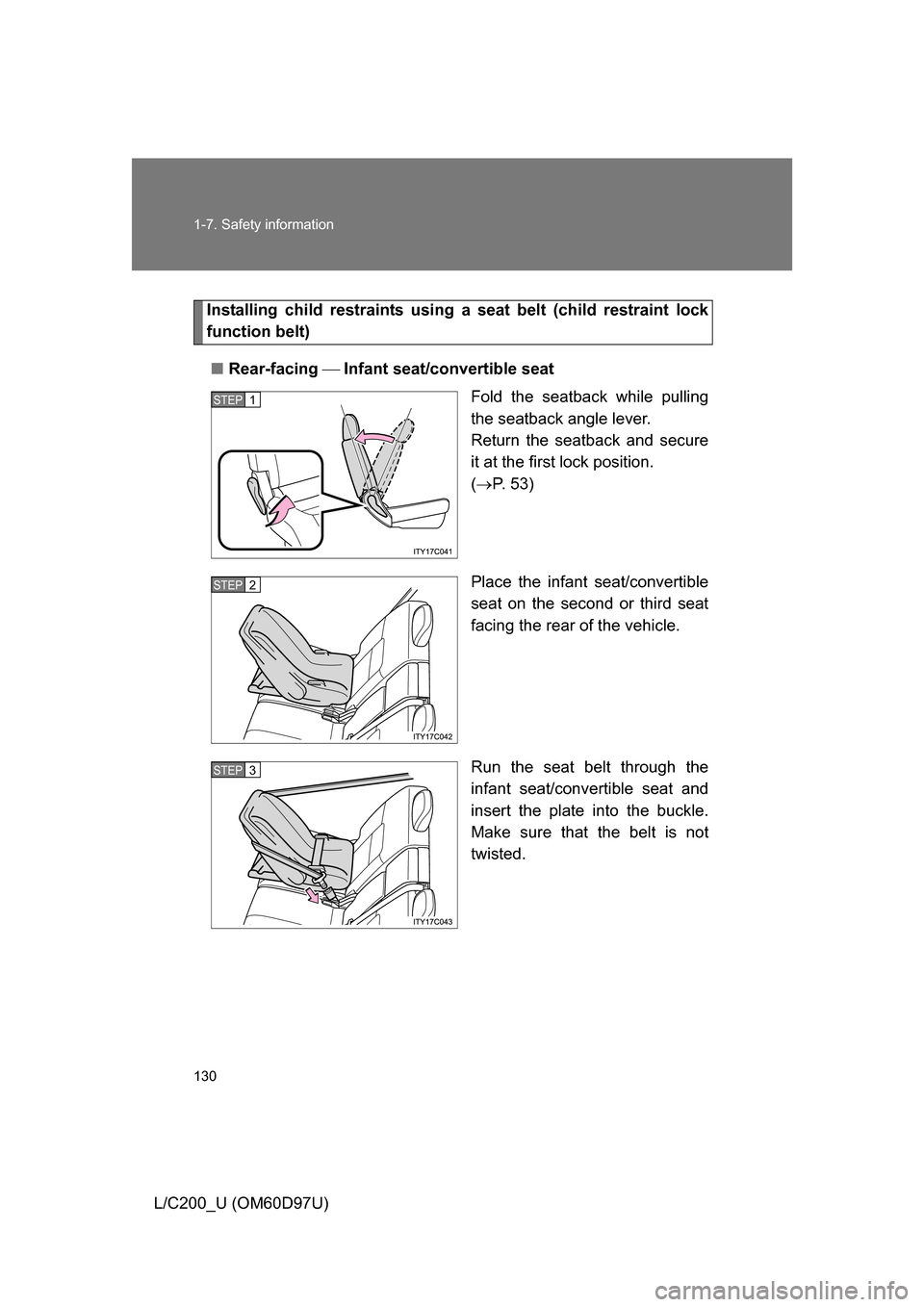
Fold the seatback while pulling
the seatback angle lever.
Return the seatback and secure
it at the first lock position.
( P. 53)
Place the infant seat/convertible
seat on the second or third seat
facing the rear of the vehicle.
Run the seat belt through the
infant seat/convertible seat and
insert the plate into the buckle.
Make sure that the belt is not
twisted.
STEP1
STEP2
STEP3
Page 131 of 556
131
1-7. Safety information
1
Before driving
L/C200_U (OM60D97U)
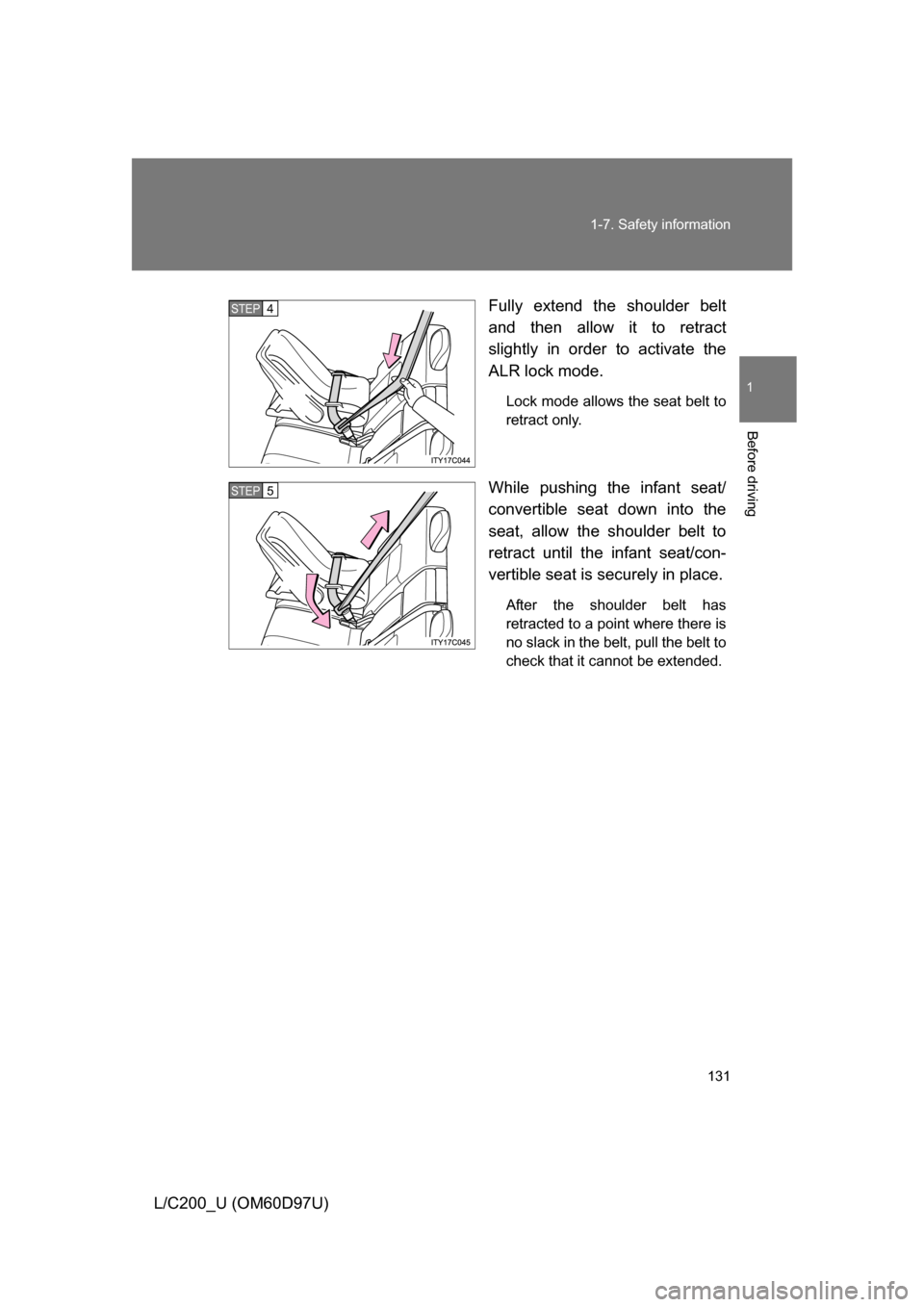
Fully extend the shoulder belt
and then allow it to retract
slightly in order to activate the
ALR lock mode.
Lock mode allows the seat belt to
retract only.
While pushing the infant seat/
convertible seat down into the
seat, allow the shoulder belt to
retract until the
infant seat/con-
vertible seat is securely in place.
After the shoulder belt has
retracted to a point where there is
no slack in the belt, pull the belt to
check that it cannot be extended.
STEP4
STEP5
Page 234 of 556
234 2-5. Driving information
L/C200_U (OM60D97U)
■Before driving the vehicle
Perform the following according to the driving conditions.
●Do not try to forcibly open a window or move a wiper that is
frozen. Pour warm water over the frozen area to melt the ice.
Wipe away the water immediately to prevent it from freezing.
● To ensure proper operation of th e climate control system fan,
remove any snow that has accumulated on the air inlet vents
in front of the windshield.
● Remove any ice that has accumu lated on the vehicle chassis.
● Periodically check for and remove any excess ice or snow
that may have accumulated in the wheel well or on the
brakes.
■ When driving the vehicle
Accelerate the vehicle slowly and drive at a reduced speed suit-
able to road conditions.
■ When parking the vehicle
Park the vehicle and move the shift lever to “P” without setting
the parking brake. The parking brake may freeze up, preventing
it from being released.
Page 254 of 556
254
L/C200_U (OM60D97U)
3-1. Using the air conditioning system and defogger
Front air conditioning system
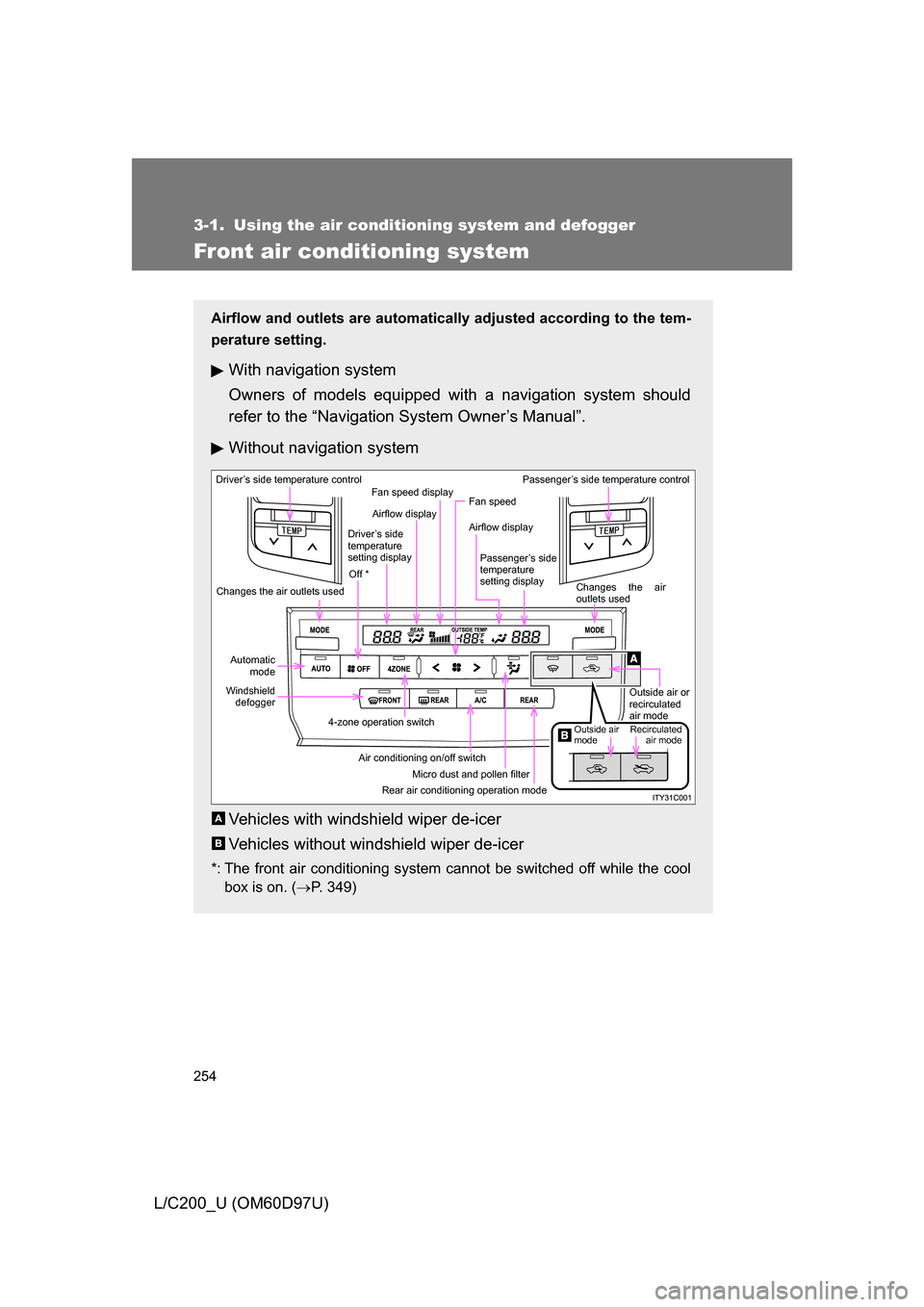
Airflow and outlets are automatically adjusted according to the tem-
perature setting.
With navigation system
Owners of models equipped with a navigation system should
refer to the “Navigation System Owner’s Manual”.
Without navig ation system
Vehicles with windshield wiper de-icer
Vehicles without windshield wiper de-icer
*: The front air conditioning system cannot be switched off while the cool box is on. ( P. 349)
Driver’s side temperature control
Changes the air outlets used Off *Airflow display
Fan speed display
Fan speed
Airflow display
Passenger’s side
temperature
setting display Passenger’s side temperature control
Changes the air
outlets usedOutside air or
recirculated
air mode
Outside air
mode Recirculated
air mode
Rear air conditioning operation mode Micro dust and pollen filter
Air conditioning on/off switch
4-zone operation switch
Windshield
defogger
Automatic
mode
Driver’s side
temperature
setting display
A
B
Page 255 of 556
255
3-1. Using the air conditioning system
and defogger
3
Interior features
L/C200_U (OM60D97U)
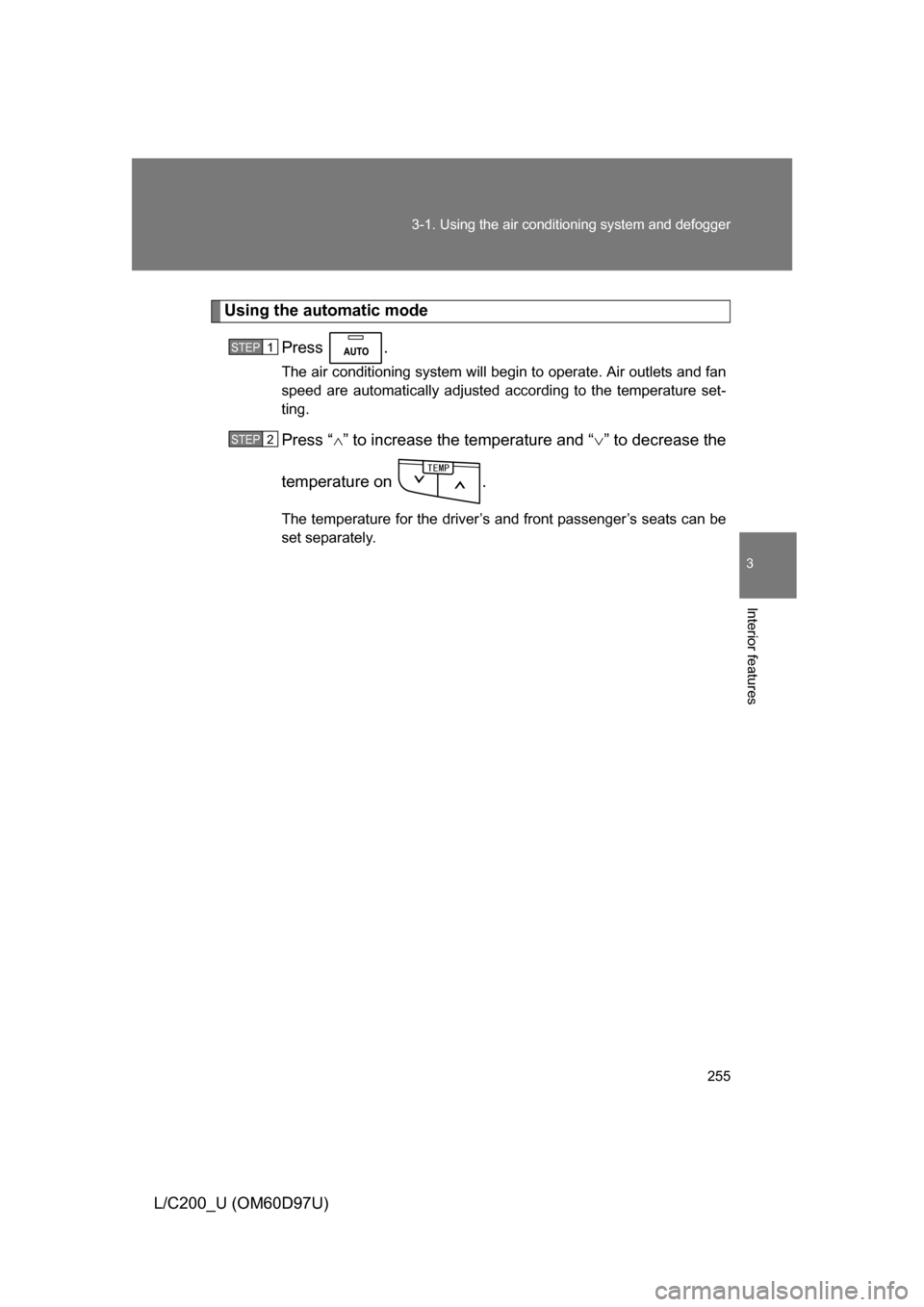
Using the automatic mode
Press .
The air conditioning system will begin to operate. Air outlets and fan
speed are automatically adjusted according to the temperature set-
ting.
Press “” to increase the temperature and “ ” to decrease the
temperature on .
The temperature for the driver’s and front passenger’s seats can be
set separately.
STEP1
STEP2
6'/2