Page 209 of 556
209
2-4. Using other
driving systems
2
When driving
L/C200_U (OM60D97U)
When the system is turned off
If the system is turned off when Crawl Control is operating, a buzzer
will sound for 3 seconds, the slip indicator turns off, and the Crawl
Control indicator flashes until the system has turned off completely.
When turning off Crawl Control while traveling, stop the vehicle
before the Crawl Control indicator turns off, or drive extremely care-
fully.
■ The Crawl Control can be operated when
● The engine is running.
● The shift lever is in any gear other than “P” or “N”.
● The four-wheel drive control switch is in “L4”.
● The parking brake is released.
● The driver’s door is closed.
● When the driving mode is not set to second start mode.
Page 214 of 556
214 2-4. Using other driving systems
L/C200_U (OM60D97U)
To disable Active TRAC and/or VSC systemIf the vehicle gets stuck in fresh snow or mud, Active TRAC and VSC
system may reduce power from the engine to the wheels. You may
need to turn the system off to enable you to rock the vehicle in order
to free it.
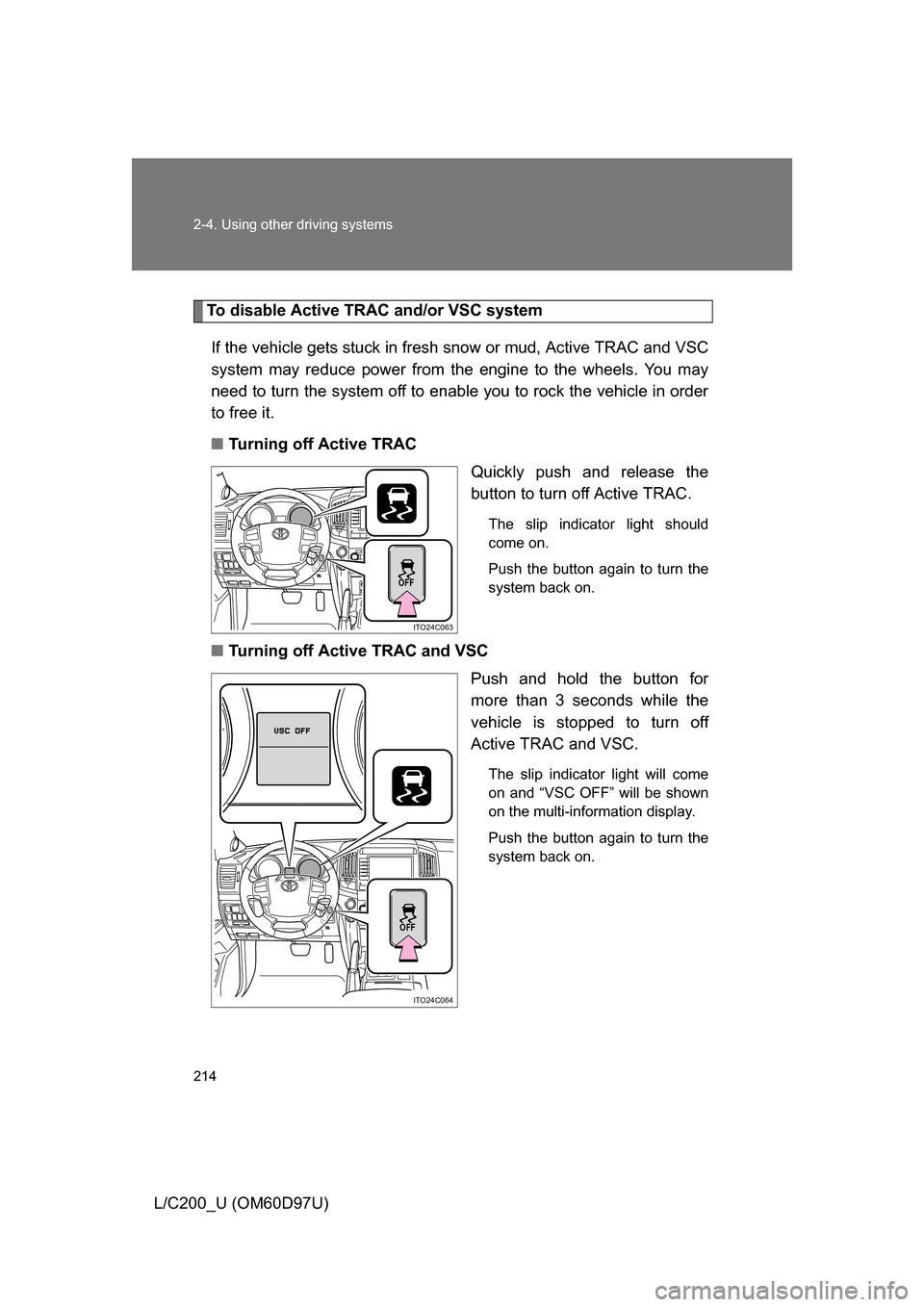
■ Turning off Active TRAC
Quickly push and release the
button to turn off Active TRAC.
The slip indicator light should
come on.
Push the button again to turn the
system back on.
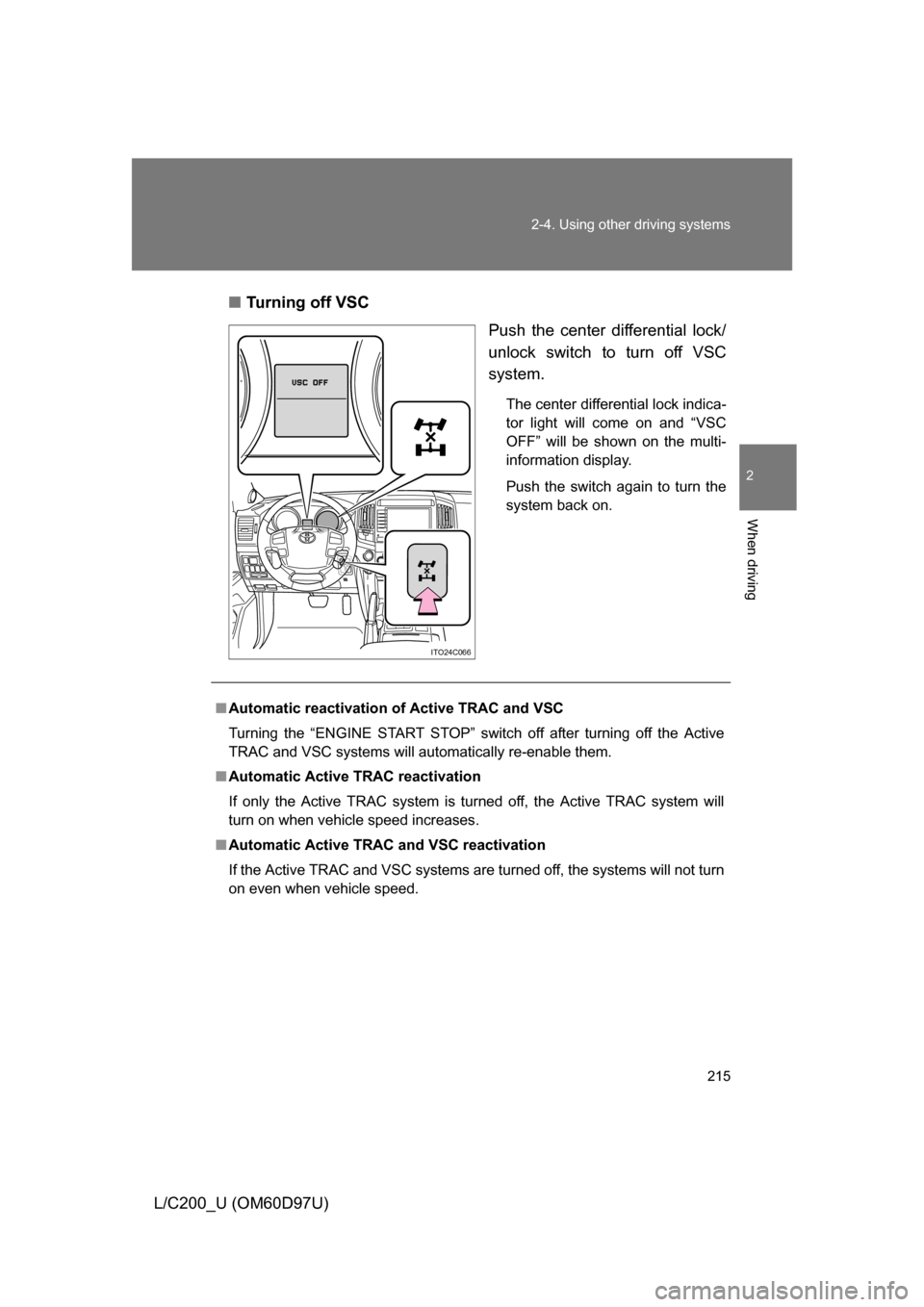
■Turning off Active TRAC and VSC
Push and hold the button for
more than 3 seconds while the
vehicle is stopped to turn off
Active TRAC and VSC.
The slip indicator light will come
on and “VSC OFF” will be shown
on the multi-information display.
Push the button again to turn the
system back on.
ITO24C063
OFF
ITO24C064
OFF
Page 215 of 556
215
2-4. Using other
driving systems
2
When driving
L/C200_U (OM60D97U)■
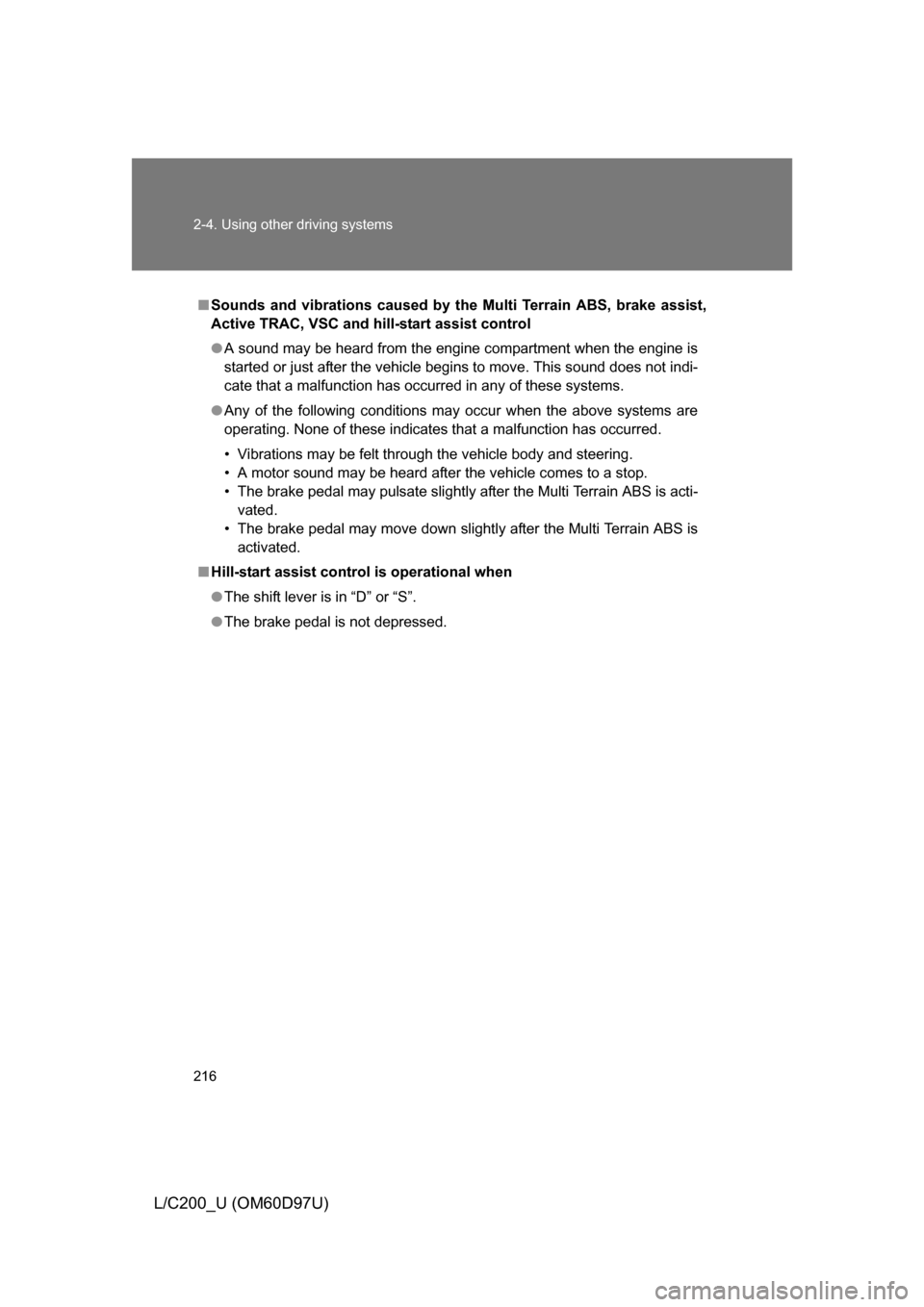
Turning off VSC
Push the center differential lock/
unlock switch to turn off VSC
system.
The center differential lock indica-
tor light will come on and “VSC
OFF” will be shown on the multi-
information display.
Push the switch again to turn the
system back on.
ITO24C066
■Automatic reactivation of Active TRAC and VSC
Turning the “ENGINE START STOP” switch off after turning off the Active
TRAC and VSC systems will automatically re-enable them.
■ Automatic Active TRAC reactivation
If only the Active TRAC system is turned off, the Active TRAC system will
turn on when vehicle speed increases.
■ Automatic Active TRAC and VSC reactivation
If the Active TRAC and VSC systems are turned off, the systems will not turn
on even when vehicle speed.
Page 216 of 556
216 2-4. Using other driving systems
L/C200_U (OM60D97U)
■Sounds and vibrations caused by the Multi Terrain ABS, brake assist,
Active TRAC, VSC and hill-start assist control
● A sound may be heard from the engine compartment when the engine is
started or just after the vehicle begins to move. This sound does not indi-
cate that a malfunction has occurred in any of these systems.
● Any of the following conditions may occur when the above systems are
operating. None of these indicates that a malfunction has occurred.
• Vibrations may be felt through the vehicle body and steering.
• A motor sound may be heard after the vehicle comes to a stop.
• The brake pedal may pulsate slightly after the Multi Terrain ABS is acti-
vated.
• The brake pedal may move down slightly after the Multi Terrain ABS is activated.
■ Hill-start assist control is operational when
● The shift lever is in “D” or “S”.
● The brake pedal is not depressed.
Page 224 of 556
224 2-5. Driving information
L/C200_U (OM60D97U)
NOTICE
■To prevent the water damage
Take all necessary safety measures to ensure that water damage to the
engine or other components does not occur.
● Water entering the engine air intake will cause severe engine damage.
● Water entering the automatic transmission will cause deterioration in shift
quality, locking up of your transmission accompanied by vibration, and ulti-
mately damage.
● Water can wash the grease from wheel bearings, causing rusting and pre-
mature failure, and may also enter the differentials, transmission and
transfer case, reducing the gear oil’s lubricating qualities.
■ When you drive through water
If driving through water, such as when crossing shallow streams, first check
the depth of the water and the bottom of the river bed for firmness. Drive
slowly and avoid deep water.
■ Inspection after off-road driving
● Sand and mud that has accumulate d in brake drums and around brake
discs may affect braking efficiency and may damage brake system compo-
nents.
● Always perform a maintenance inspection after each day of off-road driv-
ing that has taken you through rough terrain, sand, mud, or water. For
scheduled maintenance information, refer to the “Scheduled Maintenance
Guide” or “Owner’s Manual Supplement”.
Page 233 of 556
233
2-5. Driving information
2
When driving
L/C200_U (OM60D97U)
Winter driving tips
Carry out the necessary preparations and inspections before driving
the vehicle in winter. Always drive the vehicle in a manner appropri-
ate to the prevailing weather conditions.
■ Pre-winter preparations
●Use fluids that are appropriate to the prevailing outside tem-
peratures.
• Engine oil
• Engine coolant
• Washer fluid
● Have a service technician inspect the level and specific grav-
ity of battery electrolyte.
● Have the vehicle fitted with four snow tires or purchase a set
of tire chains for the rear tires.
Ensure that all tires are the same size and brand, and that chains
match the size of the tires.
Page 245 of 556
245
2-5. Driving information
2
When driving
L/C200_U (OM60D97U)
●
Note that when making a turn, th e trailer wheels will be closer than
the vehicle wheels to the inside of the turn. Compensate by making
a larger than normal turning radius.
● Crosswinds and rough roads will adversely affect handling of your
vehicle and trailer, causing sway . Periodically check the rear to
prepare for being passed by large trucks or buses, which may
cause your vehicle and trailer to sway. If swaying occurs, firmly grip
the steering wheel, reduce speed immediately but gradually, and
steer straight ahead. Never increase speed. If you make no
extreme correction with the stee ring or brakes, your vehicle and
trailer will stabilize.
● Take care when passing other vehicles. Passing requires consider-
able distance. After passing a vehicle, do not forget the length of
your trailer, and be sure you hav e plenty of room before changing
lanes.
● In order to maintain engine braking efficiency when driving on a
long steep downgrade, do not use overdrive. Transmission shift
range position must be in “4”, in “S” mode.
● Due to the added load of the trailer, your vehicle’s engine may
overheat on hot days (at temperatur es over 85°F [30°C] when driv-
ing up a long or steep grade. If the engine coolant temperature
gauge indicates overheating, immedi ately turn off the air condition-
ing (if in use), pull your vehicle off the road and stop in a safe spot.
( P. 501)
Page 246 of 556

246 2-5. Driving information
L/C200_U (OM60D97U)●
Always place wheel blocks under both the vehicle and the trailer
wheels when parking. Apply the parking brake firmly, and put the
transmission in “P”. Avoid parking on a slope, but if unavoidable,
do so only after performing the following:
Apply the brakes and keep them applied.
Have someone place wheel bloc ks under both the vehicle and
trailer wheels.
When the wheel blocks are in place, release the brakes slowly
until the blocks absorb the load.
Apply the parking brake firmly.
Shift into “P” and turn off the engine.
● When restarting after parking on a slope:
With the transmission in the “P ” position, start the engine. Be
sure to keep the brake pedal pressed.
Shift into “3”, “2”, “1”, or “R” position (if reversing).
Release the parking brake and brake pedal, and slowly pull or
back away from the wheel blocks. Stop and apply the brakes.
Have someone retrieve the blocks.
STEP1
STEP2
STEP3
STEP4
STEP5
STEP1
STEP2
STEP3
STEP4